
Xiaomi MiMo-V2.5 API Price Drop by 99%, Token Plan Quota Soars 51-Fold
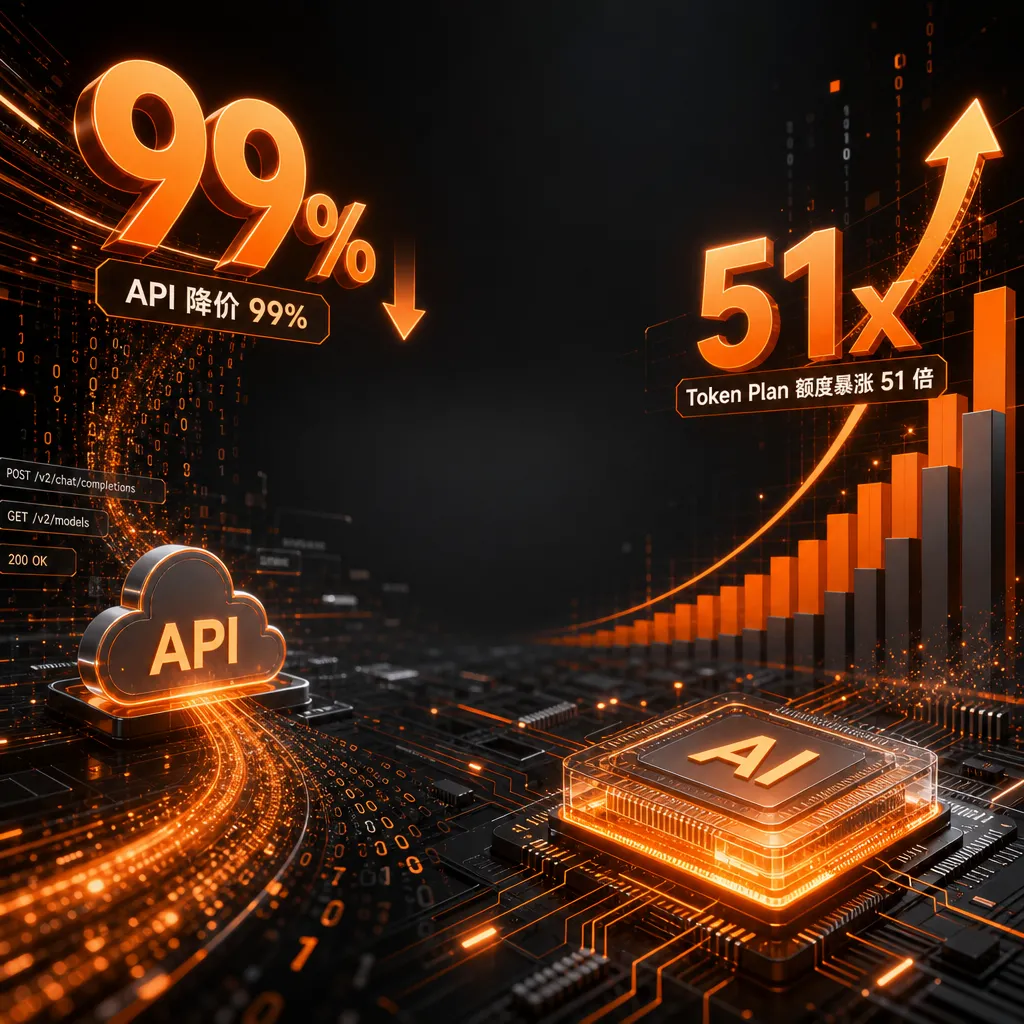
Xiaomi MiMo-V2.5 Series API permanently reduced in price today, with discounts of up to 99%. At the same time, the Token Plan package quota has skyrocketed from 1.6 billion to 82 billion Credits, increasing the actual usable amount by 5–8 times.
Xiaomi MiMo-V2.5 API Price Drop 99%, Token Plan Quota Surges 51x
In the early hours of May 27, Xiaomi MiMo officially announced a permanent adjustment to the entire model pricing system. The MiMo-V2.5 API series saw a maximum price drop of up to 99%, and the Token Plan package quota increased from the original 1.6 billion Credits to 82 billion Credits. All subscription users within the validity period had their quotas fully reset. This marks another aggressive move in China’s large model price war, following DeepSeek.
Pricing Logic: How the 99% is Calculated
The “maximum drop of 99%” cited officially mainly applies to cached input scenarios. The new pricing no longer distinguishes between 256k and 1M context window lengths and now uses a unified Credits consumption rule:
- MiMo-V2.5: Input 100 Credits/token, Output 200 Credits/token
- MiMo-V2.5-Pro: Input 300 Credits/token, Output 600 Credits/token
Compared to the previous complex pricing of 1 Token = 4 Credits with varying window lengths, the new rules are indeed simpler. But here’s the key: although the package quota numbers increased 51x (Max tier from 1.6 billion to 82 billion), the Credits consumed per call also rose proportionally. The official statement is that usable capacity increased 5–8x, not 51x.
Such “numeric inflation” is not uncommon in cloud service pricing — essentially recalibrating the billing unit to make users feel “their quota increased,” while the actual purchasing power increase is smaller. Nevertheless, even at 5–8x, heavy users still see a genuine cost reduction.
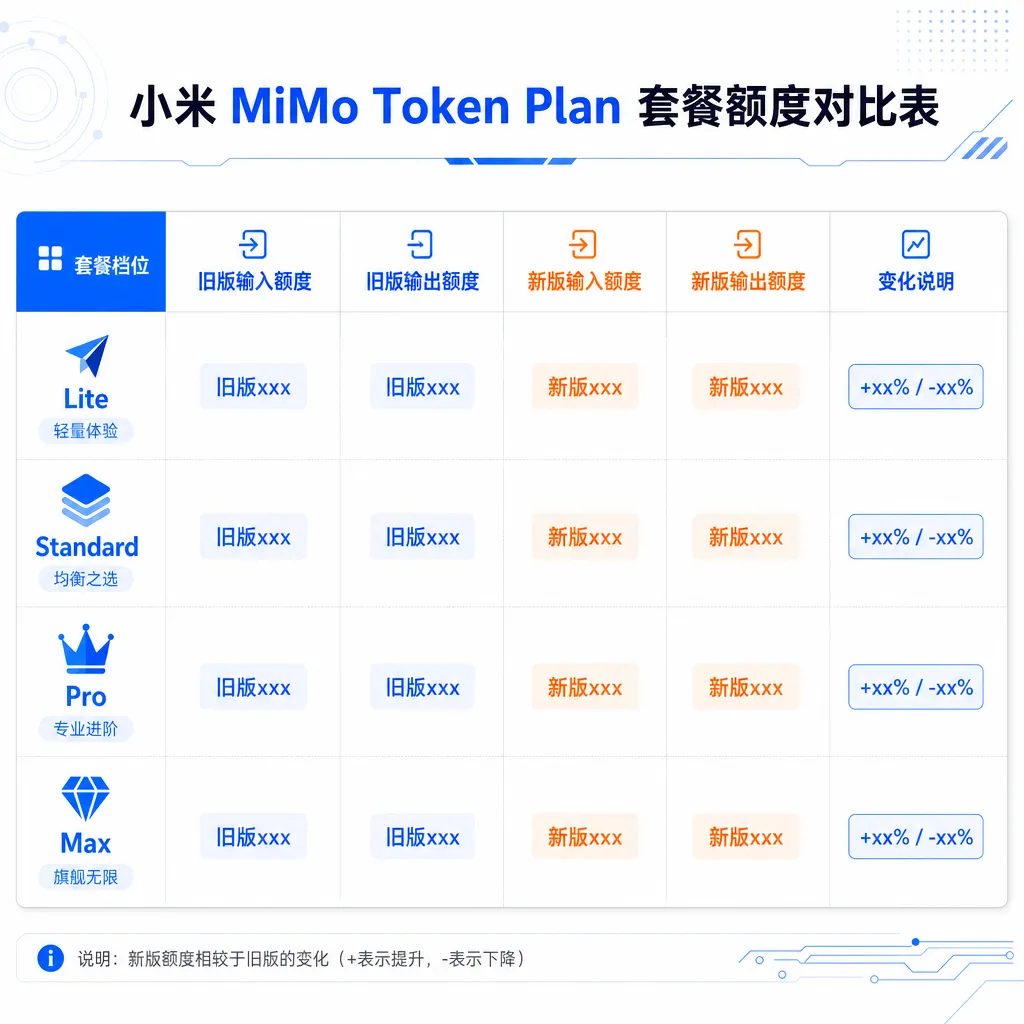
Token Plan Tiers Fully Upgraded
Specifically, the new Token Plan quota adjustments are:
| Tier | Old Quota | New Quota | Increase | |------|-----------|-----------|----------| | Lite | 60 million | 4.1 billion | 68x | | Standard | 200 million | 11 billion | 55x | | Pro | 700 million | 38 billion | 54x | | Max | 1.6 billion | 82 billion | 51x |
All active subscription users, regardless of current usage, had their quotas reset to the new standard at 00:00 on May 27. This means if you purchased Max tier last month and haven’t used it up, you now get reset to 82 billion Credits — essentially a huge free quota gift.
The official announcement also mentioned “surprise gifts” for expired Token Plan historical paying users, to be revealed in the next week. Such compensation to past users is relatively rare among domestic large model providers.
Nighttime 20% Off + Annual Subscription 12% Off — Who Is Xiaomi Learning From?
In addition to quota adjustments, Token Plan now adds two pricing strategies:
-
Nighttime Exclusive Discount: From 00:00–08:00 daily, all model Credits consumption rates are reduced by another 20%. This design clearly guides users to off-peak usage, reducing inference load during peak hours.
-
Annual Subscription Discount: Subscribe for a full year at once and enjoy 12% off, saving up to ¥948.96. In continuous monthly subscription mode, existing users get 30% off the second month, new users get 23% off.
The logic behind this combo is clear: use pricing to regulate user behavior while locking in long-term subscriptions. Nighttime discounts in cloud computing have long precedents (AWS, Alibaba Cloud have similar “off-peak discounts”), but they are still rare in large model API pricing.
Notably, Xiaomi has scrapped the previously criticized “1 Token = 4 Credits” pricing in favor of a direct token consumption multiplier — simpler and more developer-friendly.
The Hundred-Trillion Token Program Ends Early
Launched in late April, Xiaomi’s “Hundred-Trillion Token Creator Incentive Program” planned to distribute 100T Tokens over 30 days, but finished early by May 26 at 16:08. This pace shows two things: first, Xiaomi is willing to spend heavily on promotion; second, developer demand for free quotas far exceeded expectations.
The program was application-based, and approved users could get up to the Max tier Token Plan (valued at ¥659). While the event has ended, benefits for Apache Software Foundation members remain in effect long-term. This targeted support for the open-source community is a long-term ecosystem investment.
What’s the End Game of the Price War?
Viewed in a broader context, Xiaomi’s price cuts are part of Chinese large model providers collectively seeking cost efficiency. Earlier this year, DeepSeek lowered inference costs to unprecedented levels, forcing U.S. companies like OpenAI and Anthropic to follow suit. Yet, the logic differs between China and the U.S.:
- U.S. providers: Price cuts aim to defend market share while maintaining profit margins — hence OpenAI also pushes more expensive enterprise versions and premium plans.
- Chinese providers: Price cuts target developer ecosystem growth. Profit is not the top priority at this stage — scale first, then figure out monetization.
Xiaomi follows the latter approach. When MiMo-V2.5 series was open-sourced in late April, it used the permissive MIT license, allowing free commercial use and retraining without extra authorization. The “open-source + low-price API” strategy clearly aims to remove developer usage barriers and grow the ecosystem.
But how long can this “zero profit margin” race last? On Hacker News, developers questioned how companies constrained by chip supply could maintain inference capacity without top-tier H100 or Blackwell hardware. Xiaomi’s answer might be inference optimization tech like SGLang. The MiMo-V2.5 series already has Day-0 adaptation for SGLang and vLLM, and runs on domestic chips like Pingtouge Zhenwu 810E, AMD ROCm, and Sunway L600.
In other words, Xiaomi is using software optimization + domestic computing power to circumvent dependency on Nvidia’s high-end chips. Whether this path works directly determines the sustainability of this price war.
Token Efficiency: 42% Savings Compared to Kimi K2.6
Beyond price cuts, Xiaomi also highlighted token efficiency. Official data shows:
- MiMo-V2.5-Pro saves 42% tokens compared to Kimi K2.6 when achieving the same ClawEval score
- MiMo-V2.5 saves 50% tokens compared to Meta Muse Spark at the same score
Token efficiency is especially important in Agent scenarios, involving numerous tool calls, multi-turn dialogues, and long context processing — token consumption is the main cost driver. Reducing token usage while maintaining performance translates directly into real savings for developers.
When MiMo-V2.5 launched in April, Xiaomi showcased extreme cases:
- SysY Compiler Task: 4.3 hours, 672 tool calls — completing a compiler principles course project that Peking University undergraduates typically require weeks for
- Video Editor Development: 11.5 hours, 1,868 tool calls — delivering a full web app with 8,192 lines of code
- Analog Circuit EDA Design: 1-hour closed-loop iteration — completing an FVF-LDO design that experienced engineers need days for
These share the traits of high task complexity, frequent tool calls, and long context windows — making token efficiency a direct cost advantage.
What This Means for Developers
From a developer’s perspective, the impacts are:
- Greater Cost Predictability: With the complex multiplier dropped for a unified Credits consumption rule, costs are easier to estimate.
- More Value for Long-Running Tasks: The nighttime discount + annual subscription combo favors batch processing, data annotation, and model fine-tuning tasks.
- Lower Barrier for Agent Development: Higher token efficiency + API price cuts make previously cost-prohibitive Agent projects viable.
- Multi-modal Capability Now Accessible: MiMo-V2.5 supports native full modalities (image, audio, video), with API costs 50% lower than the previous generation — meaning multi-modal Agents are no longer exclusive to big companies.
However, note: Xiaomi’s Token Plan is subscription-based, not pay-as-you-go. If your usage fluctuates heavily, you might face “buy too much and waste” or “buy too little and run out” situations. Although four tiers are available, users between tiers may find it awkward.
How the Ecosystem Play Works
This price cut pairs with bigger ecosystem moves. The MiMo Orbit plan has two parts:
- Hundred-Trillion Token Creator Incentive Program: Though ended early, it clearly signals Xiaomi’s willingness to spend real money for developers.
- Agent Ecosystem Co-build Program: Offers free Token access to Agent framework teams, letting users integrate MiMo series models at no cost.
The second plan is more noteworthy. Agent frameworks are key to large model ecosystems — whoever becomes the default integration in major frameworks gains a spot in developer mindshare. Xiaomi has already adapted for SGLang and vLLM; next, securing LangChain, LlamaIndex, AutoGPT could establish the ecosystem’s moat.
Another point is chip vendor alignment. Pingtouge, AMD, Sunway, and Amazon Web Services all completed MiMo-V2.5-Pro adaptation immediately. The logic is: large model providers need diversified compute supply; chip vendors need flagship customers to prove inference capability. Both sides benefit, ultimately strengthening the domestic computing ecosystem.
Final Thoughts
On the surface, Xiaomi’s price cuts are another round of the price war — but looking deeper, they leverage cost advantages to push the industry to rethink commercialization paths for large models.
In the past year, the main theme in the large model industry was “capability competition” — whose model is stronger, whose benchmark scores are higher. By 2026, the game changes: with mainstream models reaching “good enough,” developers prioritize cost and ecosystem in selection.
Xiaomi’s approach: attract developers with open-source + low-price APIs, retain them with token efficiency optimization, and bind them with ecosystem plans. Whether this strategy works depends on two variables: 1) whether domestic computing can sustain large-scale inference cost pressure, 2) whether Xiaomi can build strong enough stickiness in the developer ecosystem.
At least for now, Xiaomi’s stance in this price war is serious. The price cuts are not promotional — they are a long-term strategy. Next, we’ll see how other providers respond.
References
- Xiaomi MiMo-V2.5 Series API Permanent Price Drop: 57%–99% Cut, Current Valid Token Plan Users’ Quotas Fully Reset - IT之家 - Official price cut announcement and Token Plan adjustment details
- How Do You Evaluate Xiaomi MiMo-V2.5 Series Model’s Big Price Cut on May 27? - Zhihu - Developer community discussion and evaluation of the price cut
- MiMo Max Quota Surges from 1.6B to 82B - Linux.do - Detailed data comparison of Token Plan quota adjustments


