
AI Coding Trains AI: Mindverse Open-Sources the First Zero-Human Code Training Framework

FaceWall Intelligence, in collaboration with Tsinghua University, has released ForgeTrain — the world’s first production-grade training framework written entirely by AI — and used it on Huawei Ascend to train the world’s best sub-2B-parameter model, MiniCPM5-1B, thereby completing the full “AI creates AI” closed loop.
AI Trains AI to Code: MindOS Open Sources the First Zero-Human-Code Training Framework
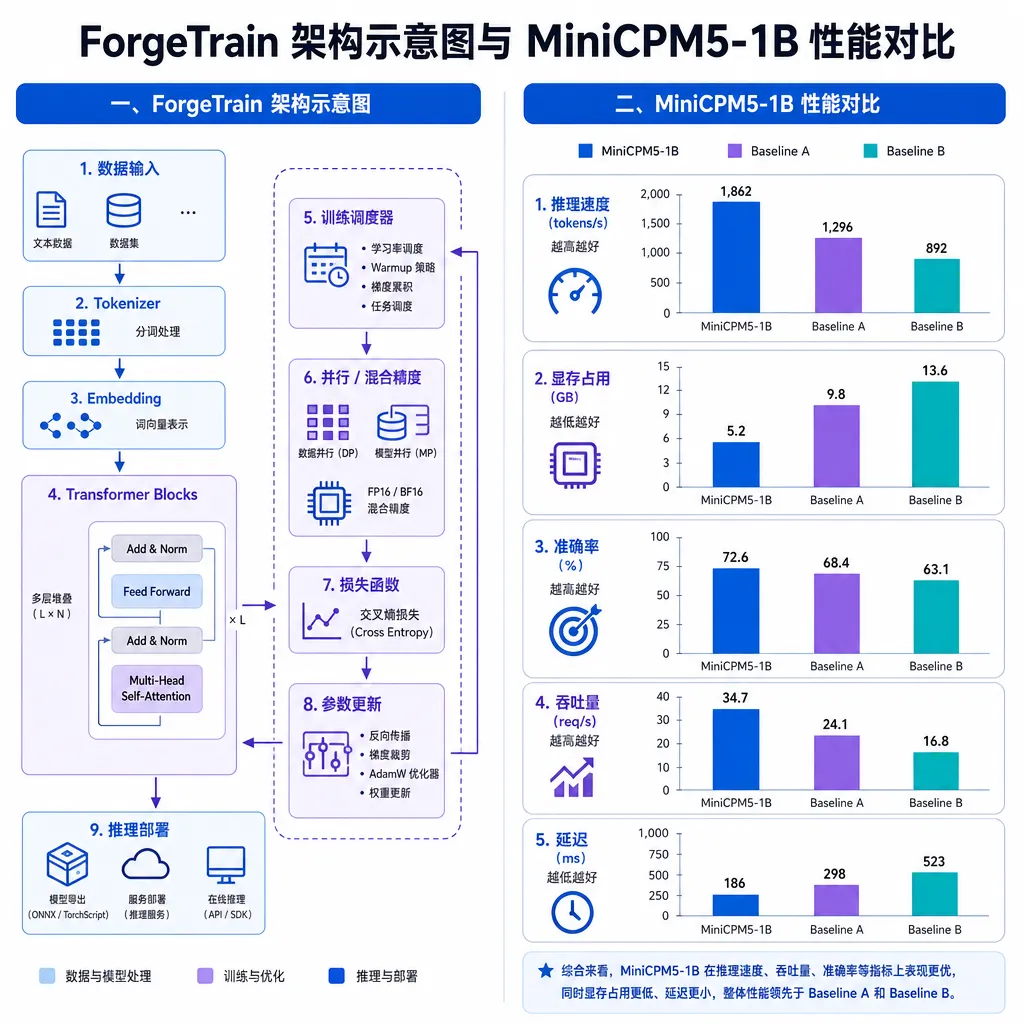
Today (May 27), MindOS, in collaboration with Tsinghua University and the OpenBMB open-source community, released ForgeTrain — the world's first production-grade large model training framework written entirely by AI, with zero human programmer involvement. What's more, they used this framework to successfully train a new generation edge-side model MiniCPM5-1B on Huawei Ascend chips, achieving first place globally in the AA-Index ranking for models under 2B parameters.
This marks the completion of a full closed loop: AI-written framework → running on domestic chips → training a leading AI model. The framework code and the complete toolchain used to create it, Agent Harness, have been open-sourced simultaneously.
AI Can Now Write Training Frameworks
A training framework is the foundational infrastructure for large model development — comparable to scaffolding for constructing a building. Traditionally, such frameworks were hand-written by human engineers, such as NVIDIA's Megatron or Microsoft's DeepSpeed. The unique aspect of ForgeTrain is that from the first line of code to the last function, everything was generated by AI with no human programmer involvement.
MindOS built a complete AI Agent toolchain called Agent Harness, which includes evaluation standards, testing protocols, and multi-agent orchestration schemes. According to these specifications, AI autonomously generates code, runs tests, fixes bugs, and optimizes performance — functioning like a "full-stack engineer."
This is not a toy-level experiment. ForgeTrain is a complete pre-training framework supporting production-critical features such as distributed training, mixed precision, and gradient accumulation. More importantly, its training speed is 10% faster than NVIDIA's Megatron. On Huawei Ascend chips, the advantage increases — achieving a further 10% speed boost.
MiniCPM5-1B: 1B Parameters Beating 2B Rivals
ForgeTrain is more than theory — MindOS used it to train MiniCPM5-1B, an edge-side text foundation model with only 1B parameters. On the internationally recognized AA-Index (Artificial Analysis Intelligence Index), it surpasses all models under 2B parameters, including Qwen3.5-2B released just three months ago.
Comparison: MiniCPM5-1B has half the parameters of Qwen3.5-2B, yet performs better. After INT4 quantization, its weights are only 0.5GB, enabling it to run directly on mobile phones and browsers. This is yet another validation of MindOS's "Density Law" — packing more knowledge into fewer parameters.
MindOS co-founder and Tsinghua University Computer Science Associate Professor Liu Zhi-Yuan previously proposed the "Density Law" for large models: model capability density can double every 100 days. In other words, every 100 days you can achieve the same capabilities of a previous model with half the parameters. MiniCPM5-1B's performance again confirms this rule.
From Bit-Level Alignment to Surpassing Performance
ForgeTrain’s open sourcing includes not just the framework code but the complete Agent Harness toolchain. Any team can reproduce the entire process — from bit-level alignment to outperforming human-written frameworks.
"Bit-level alignment" means that AI-generated code matches the numerical precision of a human-written reference implementation exactly, serving as a strict validation standard for correctness. Agent Harness provides full evaluation standards and testing protocols to ensure AI-generated code not only runs but meets production-grade accuracy, performance, and stability.
Moreover, ForgeTrain already outperforms human-written frameworks in certain scenarios. On Huawei Ascend chips, training with ForgeTrain is 10% faster than with Megatron — proof that AI can not only write correct code, but also find performance bottlenecks humans may overlook through extensive experimentation and optimization.
Domestic Chips + AI Framework + Leading Model
The most noteworthy aspect of this release is the full loop integration. ForgeTrain completed MiniCPM5-1B pre-training on Huawei Ascend chips with speeds 10% faster than NVIDIA's Megatron. This means domestic chips + AI-generated training framework + globally leading model — the entire chain is operational.
Previously, large model training heavily depended on NVIDIA GPUs and their software stack. ForgeTrain breaks this dependency. Not only can it efficiently run on Ascend chips, but AI-generated code greatly reduces the cost of adapting to new hardware. Theoretically, as long as the hardware provides basic operators, AI can automatically generate a compatible training framework.
For China’s AI ecosystem, this is significant: the three links — chips, framework, models — are now independently controllable, with performance matching or exceeding mainstream international solutions.
Edge-Side Models: "Small Winning Over Big"
From its inception, MindOS chose a different path — edge-side models. While other companies compete over parameter size in the "hundred-model battle," MindOS focuses on increasing model capability density so they can run on devices like smartphones and PCs.
MiniCPM5-1B is the latest achievement of this route. Its 1B parameter size allows smooth operation on almost any end device, including mid-to-low end smartphones. After INT4 quantization, weights are only 0.5GB — very lightweight for download and deployment. Yet it outperforms all models under 2B parameters, and in some tasks can challenge larger-scale models.
This "small winning over big" ability comes from three aspects:
-
Efficient Model Architecture: The MiniCPM series adopts MindOS's self-developed architecture capable of packing more knowledge into limited parameters. The latest MiniCPM 4.1 text foundation model introduced architectural innovations, increasing inference speed by five times compared to similar-size models.
-
Data Governance: Selecting truly high-information "textbooks" from PB-scale data instead of simply feeding the model more data.
-
Model Wind Tunnel: Conducting large numbers of small-scale experiments to derive training rules, then extrapolating them to models requiring full-scale training, avoiding blind trial-and-error.
Open Source Strategy and Ecosystem Building
Both ForgeTrain and MiniCPM5-1B are fully open source. Framework code, model weights, training datasets, and deployment plans are all public — rare for commercial companies, especially for core tech like training frameworks.
MindOS's open source strategy is based on two considerations:
- Building technical influence through open sourcing. MiniCPM series models have topped rankings on HuggingFace multiple times, and were even "copied" by a Stanford University team (later apologized and withdrawn). This influence attracts developers and partners.
- Accelerating the maturity of the edge-side AI ecosystem. Edge-side model deployment needs collaboration from chip makers, device manufacturers, and app developers. Open sourcing lowers entry barriers for more participants to build applications on MiniCPM.
MiniCPM series models are now deployed at scale in devices like cars and mobile phones. Liu Zhi-Yuan expects device numbers carrying these edge-side models to grow tenfold in the near future.
The Future of AI-Made AI
ForgeTrain's significance extends beyond being a training framework — it represents a new software development paradigm: let AI handle more programming tasks while humans focus on defining goals, designing specifications, and verifying results.
This paradigm is especially valuable in complex systems like large model training, which involve distributed computing, numerical optimization, and hardware adaptation — traditionally requiring experienced engineers months or years to develop. AI can generate an initial code version within days, then iterate rapidly through automated testing and optimization.
Furthermore, AI-generated code may explore optimization paths humans wouldn't try. ForgeTrain’s 10% speed advantage over Megatron on Ascend chips is partly due to AI discovering better operator combinations and scheduling strategies.
Of course, this doesn't mean human engineers are obsolete. Agent Harness design, evaluation standard setting, and training goal definition all require human expertise. AI is a tool to help humans achieve goals more efficiently, not to make decisions for them.
Technical Details and Open Source Resources
ForgeTrain’s core is an AI Agent orchestration system, breaking down training framework development into sub-tasks:
- Code Generation: Generate initial code based on functional requirements
- Unit Testing: Automatically generate and run test cases
- Performance Optimization: Use profiling to identify and improve bottlenecks
- Bit-Level Alignment: Compare numerical precision with reference implementation
- Integration Testing: Verify stability in real training tasks
Each sub-task is handled by specialized Agents, collaborating through message passing. The process is iterative: generate code → test → find issues → fix → retest, until all quality standards are met.
Agent Harness provides a complete toolchain including:
- Evaluation Standards: Define what qualifies as good code
- Testing Protocols: Verify correctness and performance
- Agent Orchestration Schemes: Coordinate multiple Agents in collaboration
Open source resources available on GitHub:
- ForgeTrain Framework Code: https://github.com/OpenBMB/ForgeTrain
- MiniCPM5-1B Model Weights and Dataset: distributed via HuggingFace and ModelScope
Industry Impact and Competitive Landscape
ForgeTrain’s release impacts the large model training sector in several ways:
- Lowering Barriers to Training Framework Development: Previously only big companies or top research institutions could develop production-grade training frameworks. Now any team can use Agent Harness to generate their own or customize ForgeTrain.
- Accelerating Hardware Adaptation: Building software ecosystems for new hardware (e.g., domestic AI chips) has been challenging. AI-generated adaptation code can greatly shorten the process.
- Promoting Edge-Side AI Deployment: MiniCPM5-1B shows small-parameter models can achieve high performance, encouraging more applications to migrate from cloud to device, reducing latency and cost.
In terms of competition, MindOS takes a differentiated route. While OpenAI, Anthropic, and Google compete in cloud-based large models, MindOS focuses on edge-side, avoiding direct confrontation. While other edge-side model companies still rely on manual optimization, MindOS already employs AI-generated training frameworks, establishing methodological leadership.
This lead is not just technical — MindOS is backed by Tsinghua University’s NLP Lab with over a decade of research. The team trained the world’s first Chinese open-source large model CPM in 2020, predecessor of China's foundational model WuDao. Such deep academic and engineering experience is hard to replicate quickly.
Future Direction: Autonomous Reinforcement Learning
In an interview, Liu Zhi-Yuan revealed that major milestones in AI are expected next year and the year after — the maturity of autonomous reinforcement learning.
Previously, models learned sequentially, predicting one token at a time from training data. Over the last year, learning paradigms expanded into exploratory reinforcement learning — models can generate their own learning data. For example, when solving a math problem, a model can explore multiple solution approaches, verify correctness with the standard answer, and learn from that.
This paradigm shift is crucial — high-level human intelligence is defined by autonomous learning, not rote memorization. Any excellent graduate can grow into an expert within six months on a job — autonomy is key.
Once autonomous reinforcement learning is achieved, models will continuously evolve within any given domain. Globally, most available compute power resides on user devices. If such models can run on the edge-side, they could become personal intelligent assistants for everyone.
ForgeTrain and MiniCPM5-1B are steps toward this vision. AI-generated training frameworks lower modeling barriers, while increasing capability density allows powerful AI to run locally. When these two lines converge, everyone could have a locally learning, evolving AI assistant.
This is not science fiction — it is happening now. In three years, MindOS has proven the feasibility of edge-side AI, and now has accelerated progress through AI-made AI. The question now is not if it can be done, but who can do it faster.
References
- AI Makes AI: MindOS Open Sources World's First Production-Grade AI-Written Training Framework ForgeTrain - IT Home Official Report
- MindOS Open Sources MiniCPM5-1B: Surpasses All Models Under 2B Parameters on AA-Index - Technical Details of MiniCPM5-1B
- ForgeTrain GitHub Repository - Open Source Code and Documentation
- Best Under 2B Globally! AI Trains AI, MindOS Mini Cannon Cuts Training Costs by 10% Compared to NVIDIA - Zhihu Technical Discussion


