
Codeg Multi-Agent Skill Practice: Let Codex Automatically Review Claude Code’s Work
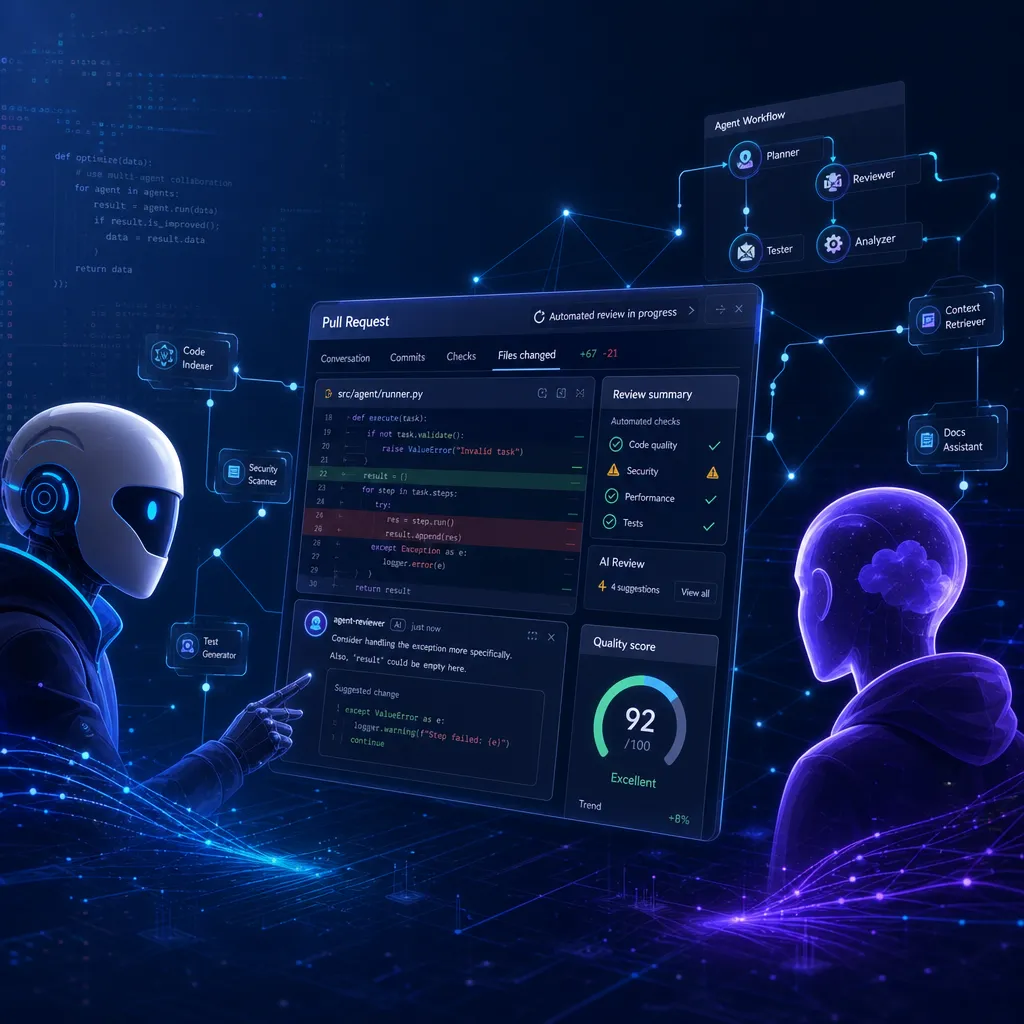
A developer shared a skill case of Codeg’s multi-agent collaboration on linux.do, enabling Codex to automatically review Claude Code’s output and iteratively fix it within the same session, effectively eliminating the manual back-and-forth switching that used to be required.
One Skill That Lets Two AI Coding Assistants Peer‑Review Each Other in the Same Session
Over the past few days a post on linux.do has been repeatedly discussed in developer circles: a user showed off a skill he wrote in Codeg—sub-agent-review-loop. With multi‑agent collaboration enabled, after Claude Code finishes writing the code it automatically calls Codex for a review; Codex finds problems and fixes them directly, then hands the result back to Claude Code for a second review by Codex. The loop continues until Codex decides it is production‑ready.
It might sound simple, but what really resonates with developers is the pain point it solves: previously, you had to shuttle diffs back and forth between two AI tools, copy prompts, paste comments—now the skill performs that entire process automatically.
This is worth talking about. It’s not a new model release or a conceptual multi‑agent framework, but a very concrete engineering case—multi‑agent collaboration moving from demo stage to “I use it every day to write real code.”
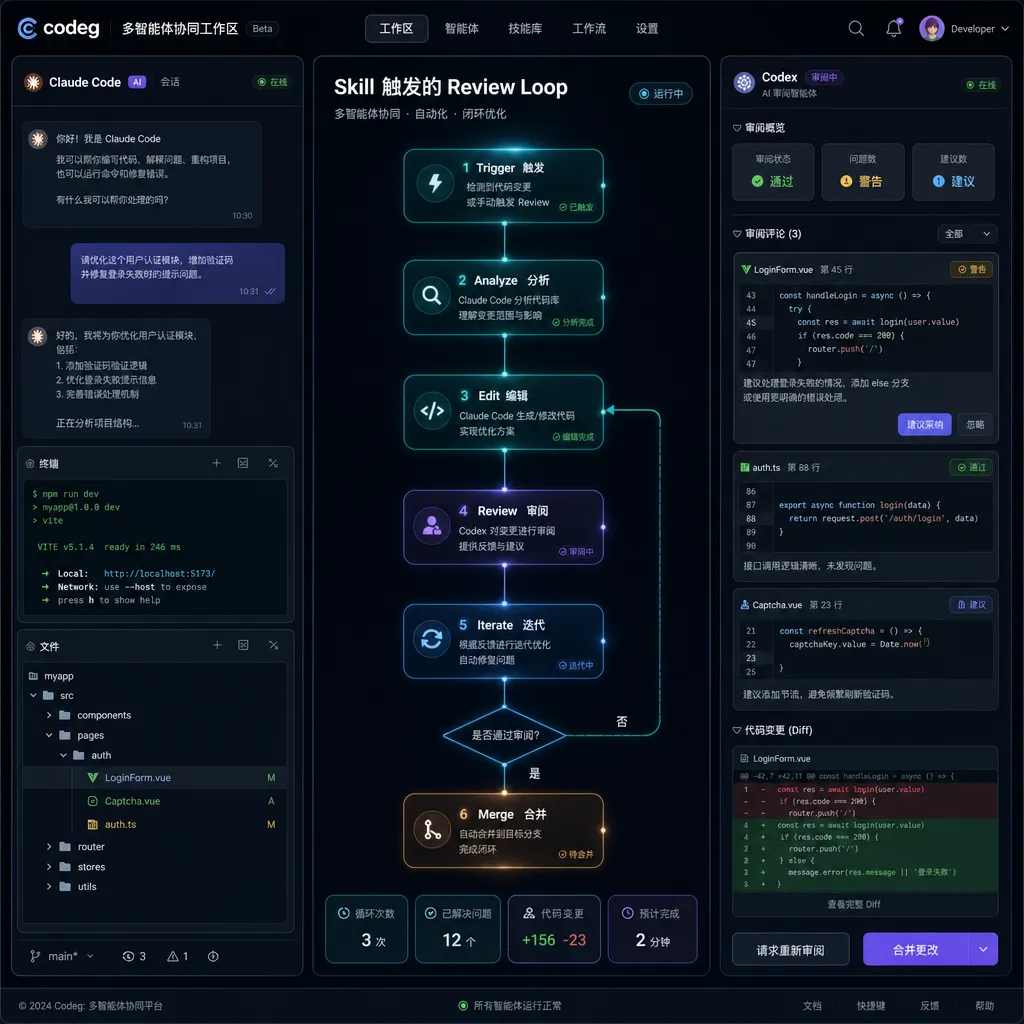
What the Skill Does: Making the Review Loop Deterministic
Here’s the skill content (excerpt from the original post):
---
name: sub-agent-review-loop
description: Use when any task could modify code, tests, config, schemas, migrations, deps, build/deploy scripts, artifacts, or behavior before completion
---

# Sub-Agent Review Loop

## Overview

Use Codex as an independent reviewer after work that can modify artifacts or behavior. Loop until the latest result is production-ready.

**Core principle:** Work is not complete until Codex approves the latest fixed version as production-ready.

## Required Loop

1. Finish the implementation and run the relevant local checks.
2. Call Codeg MCP `delegate_to_agent` with `agent_type: "codex"`, absolute `working_dir`, and a self-contained `task` containing the request, changed files or diff/SHAs, checks run, and constraints.
3. Require this quality bar: **production-ready**
A few key design points stand out.
Strict triggering conditions. The description lists a long set of triggers: if you touch code, tests, configs, schemas, migration scripts, dependencies, build/deploy scripts, artifacts, or behavior—any of them—run the review loop. It’s not a vague “when it seems necessary,” but a hard engineering rule: anything written to disk that might affect production must pass Codex’s review.
Codex is not an advisor—it’s the gatekeeper. The exit condition of the loop is blunt: “Work is not complete until Codex approves the latest fixed version as production‑ready.” Claude Code saying “I’m done” isn’t enough; Codex must sign off. Unlike self‑critique (a model checking itself), the reviewer here is a separate model with an independent context, immune to Claude Code’s reasoning bias.
Delegation payload is structured. When calling Codeg MCP’s delegate_to_agent, you must provide an absolute working_dir, a self‑contained task description, a list of changed files or diff/SHA, the local checks already run, and constraints. This means Codex receives full context—no guessing what Claude Code was doing.
The value of this design is that something that used to depend on human “glue”—two AIs reviewing each other—is now expressed declaratively in a few lines of a skill file.
Why Codex Reviews Claude Code
Among developers there’s a shared impression: the Claude series handles long‑context engineering tasks and complex refactors more smoothly, yet can be overly confident and skip edge cases; whereas Codex (GPT‑5‑based code reasoning) is more meticulous in spotting logic flaws and testing gaps. The two complement each other—one pushes forward, the other checks backward.
This skill simply productizes that intuition. The post also notes, “If you want to use a different sub‑agent for review, just replace Codex in the skill.” In other words, the architecture is open—the reviewer is configurable according to your understanding of model strengths.
That’s important. The concept of multi‑agent collaboration has been talked about for two years, but most practical setups either chain agents in a fixed pipeline (inflexible) or hide them behind a black‑box supervisor (uncontrollable). Codeg’s skill + MCP approach goes another way: the collaboration logic is described by the developer in a skill—who gets delegated when is configuration, not magic.
The Real Pain Point Solved: Human Fatigue as “Glue”
Anyone who has used Claude Code with Codex (or vice versa) knows the feeling:
You ask Claude Code to implement a feature; it finishes, but you’re uneasy, so you copy the diff to Codex CLI for review. Codex lists three suggestions; you copy them back to Claude Code for fixes; then regenerate the diff and review again… after a few rounds you grow anxious—the context breaks between two tools and you must constantly craft prompts, paste paths, and explain context.
This makes the human the message bus between AIs—a high‑latency, low‑bandwidth, error‑prone bus.
The sub-agent-review-loop skill replaces that bus with Codeg MCP. Claude Code directly delegates to Codex within its own session; Codex runs the review and returns the result; Claude Code then decides to fix or finish. The whole loop runs inside one conversation context—the developer only sees the final outcome.
The author described it as “efficiency maxed out”—not an exaggeration. Going from “I manually sync state between two terminals” to “I say one sentence and two agents talk and report back” is a qualitative leap.
What Codeg Is: Gathering Dispersed Coding Agents in One Workspace
A quick background on Codeg: launched in April 2024, it’s positioned as an enterprise‑grade multi‑agent coding workspace—aggregating session logs from local AI coding tools like Claude Code, Codex CLI, Gemini CLI, OpenCode, and Cline into one interface. It supports desktop app, standalone server, and Docker deployments.
Key features directly relevant to the skill case:
- Multi‑agent session aggregation: automatically ingests local chat logs from paths like
~/.claude/projectsand~/.cline/data/tasks, structuring them for search and skill access. - MCP and skill management: built‑in MCP server scanner and registry, with global and project‑level skill management. The review‑loop skill is added through this skill panel.
- Parallel Git worktrees: run multiple branches simultaneously; different agents deploy to separate worktrees, avoiding stash/checkout conflicts.
- Remote chat channels: bridges to Telegram, Lark, or iLink (WeChat) so you can monitor agent progress on your phone and approve sensitive operations directly in chat.
The architecture: Rust core (Tauri 2 / Axum) + React 19 / Next.js 16 frontend, data persisted via SeaORM to local SQLite—local‑first. For developers that’s friendly: all context stays on your machine, not secretly pushed to the cloud.
Why These Skill Cases Matter: A Reproducible Engineering Pattern
The review‑loop skill drew attention not merely for usefulness but for showcasing a widely replicable engineering pattern:
Any step that “someone should take a second look at” can be turned into a skill.
Extending that idea, developers could easily create more skills:
- db‑migration‑guard: when migration scripts change, automatically delegate to another agent to check backward compatibility, lock risks, and rollback paths.
- security‑review‑loop: triggered by edits to auth, authorization, or encryption code; reviewed by an agent fine‑tuned on OWASP guidelines.
- test‑coverage‑gate: after implementing a feature, have a reviewer agent check boundary‑case coverage and demand additions if missing.
- doc‑sync‑check: when APIs change, automatically verify related docs for updates and generate diffs if inconsistent.
Traditionally, such checks rely on coarse CI rules (noisy and error‑prone) or human reviewers (limited focus, fatigue). Skill + multi‑agent delegation provides a third option: embed semantic safeguards directly into the creation phase, executed in real time by an independent model.
Points to Keep in Mind
Of course, this setup has trade‑offs.
Token consumption rises sharply. One task used to take one run of Claude Code; now each iteration adds Codex review and re‑fix—three rounds can triple tokens. With pay‑per‑call APIs, the bill becomes noticeable.
Risk of non‑converging loops. The skill says “Loop until production‑ready,” but if the two agents differ on what that means, they may get stuck in endless revisions. In production, add a max_iterations safeguard (e.g., five rounds, then require human intervention).
Delegation payload quality defines the ceiling. If Claude Code’s task description sent to Codex misses key constraints, Codex’s review will misfire. The skill stresses “self‑contained task,” yet real performance depends on Claude Code’s grasp of context.
And note: multi‑model collaboration demands API access to all involved models—Claude, Codex, Gemini, etc. Aggregation platforms like OpenAI Hub, with a single key for all major models, OpenAI‑compatible format, and direct domestic connectivity, fit such scenarios well—you don’t need separate accounts or quotas for each model.
A Signal: AI Coding Enters the “Protocol Layer” Era
Looking ahead, this skill case points to something bigger: the competitive focus of AI coding tools is shifting from model capability to collaboration protocols.
In 2024 developers care which model writes code most accurately. In 2025 they’ll care which agent framework (Claude Code, Codex, Cursor) feels best to use. By 2026 many will realize single‑agent performance has plateaued—the productivity gap will come from how these agents collaborate: who does what, when to delegate, how context passes, how results are judged.
The MCP protocol supplies the infrastructure; Codeg provides the organizational interface; and skills offer declarative configuration syntax. Combined, they turn multi‑agent collaboration from an academic concept into everyday engineering practice.
The developer’s shared skill on linux.do might look like a small trick, but it demonstrates how development should work going forward. Replicating it is simple: install Codeg, connect Claude Code and Codex, paste the skill into the management panel. Worth ten minutes to try.
References
- Sharing a Codeg Multi‑Agent Collaboration Skill Case – linux.do: original poster shared the complete
sub-agent-review-loopskill and performance comparison. Primary source for this article.


