
**Qianwen 3.6-Plus Breaks Into Global Second Place — A Milestone Moment for Domestic Code Models**

Ali Qianwen 3.6-Plus ranked second overall on the globally recognized programming blind test leaderboard, Code Arena—trailing only Claude Opus 4.6—becoming the first Chinese model to break into the top two, marking a key breakthrough in domestic AI programming capabilities.
Qwen 3.6-Plus Ranks Second Globally on Code Arena: Not “Close”—It’s Really In There
On April 3, the global large model blind-testing platform LMArena released an updated ranking for its AI programming leaderboard Code Arena. Alibaba’s Qwen 3.6-Plus took second place globally, just behind Claude Opus 4.6 from Anthropic.
Trailing behind are the big names of OpenAI, Google, and xAI.
This marks the first time a Chinese large model has broken into the top two in a global programming blind test at this level. It’s not a “Chinese coding” leaderboard, not a home-grown evaluation — it’s the result of real blind testing and user voting from overseas.
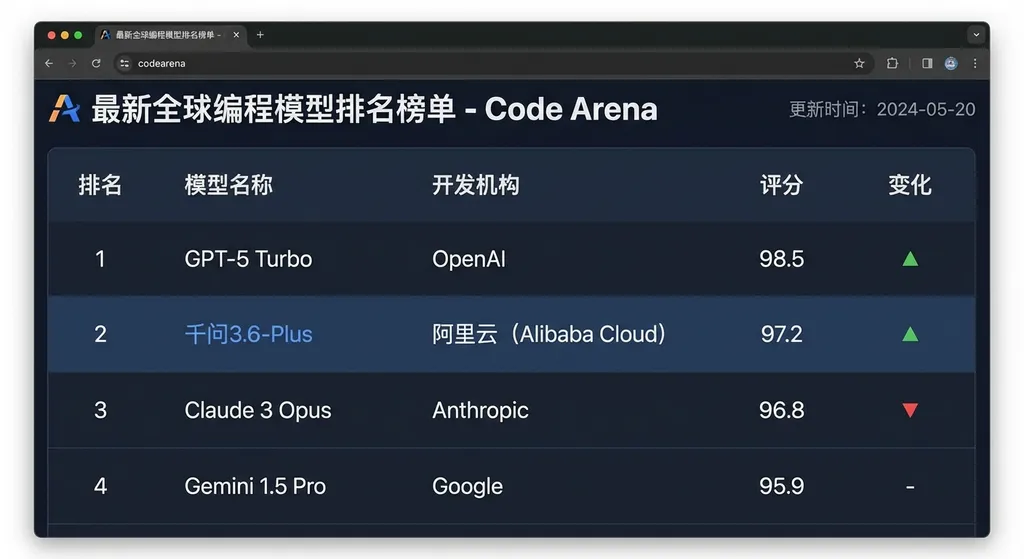
What Is Code Arena? Why Is This Ranking Worth Paying Attention To?
Let’s start with some background. Developers are probably familiar with Chatbot Arena (now called LMArena). It’s widely recognized as the hardest leaderboard in the AI domain to “game the system.” It doesn’t rely on automatic scores but on human blind tests. Two models compete anonymously — users don’t know which is which, and vote for the one they find better after using them. The ranking uses an ELO scoring system, just like chess.
Code Arena is its programming-specific branch, focusing solely on assessing how well models perform in real coding scenarios. “Real” here doesn’t mean solving algorithmic benchmarks like HumanEval but rather tasks closer to everyday development — writing business logic, debugging errors, refactoring code, handling complex front-end components.
Why is this leaderboard considered reliable? Three reasons:
- Blind testing eliminates brand bias. Users don’t know which model they’re using and judge purely based on code quality and interaction experience.
- Huge sample size. LMArena has accumulated over a million votes — far beyond the influence of a few dozen benchmarks.
- Impossible to optimize for. Unlike fixed benchmarks that can be “trained against,” blind test prompts come from real user queries with highly diverse distributions.
So when Qwen 3.6-Plus grabs second place on this board, it’s genuinely well-earned.
Specific Performance: The React Leaderboard Is the Real Battlefield
The overall second place is impressive enough, but the spotlight is really on the model’s React performance.
Code Arena includes multiple specialized tracks. Among them, the React leaderboard is considered the most cutting-edge and difficult one in AI coding. The reason is simple—React development is much more challenging than writing a sort function. It examines a model’s autonomous coding ability in complex web development scenarios:
- Are component designs reasonable and state management clear?
- Can it handle complex prop passing and lifecycle logic?
- Can it manage styling, interactions, and data flow together—not stop halfway?
- Can it make proper architectural decisions when requirements are ambiguous?
These combined abilities test a model’s software engineering understanding, not just its ability to “write code.”
Qwen 3.6-Plus also took second place in this React track — a result that would have been unthinkable for a Chinese model just a year ago.
From “Usable” to “Competitive”: Three Stages of China’s Programming Model Evolution
Looking at the timeline, the evolution of China’s coding models is crystal clear.
Stage 1: “Can Run.”
Around the first half of 2024, Chinese models still struggled with syntax errors, logical confusion, and poor context handling. Getting them to write a simple CRUD API was hard, let alone complex business logic. Developers generally felt Chinese models were okay for chatting but not for coding.
Stage 2: “Usable.”
From late 2024 to 2025, models like DeepSeek Coder and Qwen 2.5-Coder marked a qualitative leap. They could handle easy-to-medium coding tasks reliably and occasionally came up with surprisingly clever solutions. But compared to top-tier models like Claude or GPT-4, they still lagged behind in complex reasoning, long-context code understanding, and system architecture.
Stage 3: “Competitive.”
Qwen 3.6-Plus’s performance on Code Arena shows that Chinese models are no longer mere “followers.” They are now sitting at the same table with the world leaders, ready for a fair fight.
Honestly, this leap happened faster than anyone expected.
Technically Speaking: What Did Qwen 3.6 Get Right?
Alibaba hasn’t disclosed full technical details of Qwen 3.6, but public information and user feedback suggest several obvious improvements.
First, deeper code understanding. This generation handles large codebases far better. For example, given hundreds of lines of React code to refactor, it doesn’t just rewrite mechanically—it understands component dependencies and offers structural optimization suggestions. That shows substantial progress in semantic code comprehension rather than just pattern learning.
Second, precise instruction following. In coding scenarios, this is far more important than in chat. When told “only modify this function,” the model must obey. When told “use TypeScript, no ‘any’,” it can’t be lazy. Qwen 3.6-Plus is noticeably more consistent in this regard.
Third, multi-step reasoning ability. Complex coding tasks require the model to understand the requirement, decompose steps, implement progressively, and self-review. Any broken link along that chain leads to faulty output. Qwen 3.6-Plus’s improved reasoning manifests in more complete solutions with fewer places needing manual fixes.
How Far Behind Claude Opus 4.6 Is It?
Second place begs the question—how close is it to first? Let’s be honest.
Claude Opus 4.6 still holds a clear lead on Code Arena, especially in:
- Handling ultralong code. Claude’s ability to retain context in files with thousands of lines remains unmatched. Qwen 3.6-Plus is almost level for medium-sized tasks but still trails in hyperlong contexts.
- “Code taste.” Sounds vague, but every developer knows it—code that runs can come in elegant, maintainable form or clunky just-works form. Claude’s stylistic judgment—naming, architecture choices, code aesthetics—is still best-in-class. Qwen 3.6-Plus has improved greatly but isn’t quite there yet.
- Robustness in edge cases. When faced with obscure frameworks, rarely used APIs, or deliberately tricky requirements, Claude manages better. Qwen performs outstandingly on mainstream stacks but can stumble in long-tail scenarios.
Still, the fact that it’s being compared side by side with Claude Opus 4.6 says it all — half a year ago, this conversation wouldn’t even be happening.
What Does This Mean for Developers?
Practically speaking, if you use AI-assisted coding in your daily workflow, Qwen 3.6-Plus’s entry into the global top tier gives you another solid choice — especially in these cases:
- Better understanding of Chinese. Coding may be in English, but requirements, comments, and documentation are often in Chinese. Chinese models interpret such technical directives much more accurately — no need to translate your requirements first.
- Possibly lower cost. Pricing varies by platform, but Chinese models often offer more affordable API rates than equivalently capable foreign ones — crucial for teams with high call volumes.
- Lower latency. If your servers are in China, Qwen’s API naturally responds faster than overseas ones. In frequent interactive coding, a few hundred milliseconds makes a difference.
You can directly test Qwen 3.6-Plus’s coding skills through OpenAI Hub using OpenAI-compatible endpoints — no need to integrate Alibaba’s SDK. Example:
from openai import OpenAI

client = OpenAI(
    api_key="Your OpenAI Hub API Key",
    base_url="https://api.openai-hub.net/v1"
)

response = client.chat.completions.create(
    model="qwen-3.6-plus",
    messages=[
        {
            "role": "system",
            "content": "You are a senior full-stack engineer skilled in React and TypeScript."
        },
        {
            "role": "user",
            "content": "Help me build a Table component with virtual scrolling, column sorting, fixed columns, and custom cell rendering. Use TypeScript, no 'any'."
        }
    ],
    temperature=0.2,
    max_tokens=4096
)

print(response.choices[0].message.content)
// Node.js / TypeScript version
import OpenAI from 'openai';

const client = new OpenAI({
  apiKey: 'Your OpenAI Hub API Key',
  baseURL: 'https://api.openai-hub.net/v1',
});

const response = await client.chat.completions.create({
  model: 'qwen-3.6-plus',
  messages: [
    {
      role: 'system',
      content: 'You are a senior full-stack engineer skilled in React and TypeScript.',
    },
    {
      role: 'user',
      content:
        'Refactor this code, migrate state management from useState to Zustand, keep it type-safe.',
    },
  ],
  temperature: 0.2,
});

console.log(response.choices[0].message.content);
The interface is fully compatible with the OpenAI SDK — switching models only requires changing the model parameter. Claude, GPT, Gemini, DeepSeek—all can be invoked with the same code.
Bigger Picture: No.1 on OpenRouter and No.2 on Code Arena
It’s also worth noting that Qwen 3.6-Plus recently reached #1 in global API call volume on OpenRouter, the world’s largest AI model aggregation platform hosting Claude, GPT, Qwen, DeepSeek, GLM, and more.
Being ranked first in usage means one thing — developers are voting with their feet. It’s not an evaluator’s opinion; it’s paid API calls doing the talking.
Viewed together: Code Arena’s blind-test second shows top-tier capability; OpenRouter’s first shows real-world adoption. One proves it can fight, the other proves people use it. Both breakthroughs happening simultaneously is a first in Chinese model history.
This also reflects a trend: global developers are becoming more pragmatic about model choice. Brand prestige is fading; performance speaks louder. When Qwen delivers Claude-level results in blind tests at a more competitive price, developer decisions become straightforward.
A Reality Check: One Ranking Doesn’t Equal Full Supremacy
A few sober notes to close.
Code Arena’s rankings are dynamic. Models evolve constantly — today’s second may not stay second. OpenAI’s upcoming generation, Google’s Gemini series, and xAI’s Grok are all advancing rapidly. It’s an endless race.
And there’s always a gap between leaderboard performance and production reality. No matter how realistic Code Arena tries to be, it can’t fully replicate enterprise-level complexity: legacy maintenance, multi-developer style cohesion, CI/CD integration, etc.
Moreover, the competition among coding models now extends beyond the models themselves. IDE integration, agent capabilities, and ecosystem tooling matter increasingly. Products like Cursor, Windsurf, and GitHub Copilot owe much of their competitiveness to turning raw model power into smooth developer experiences. For Qwen to transform its Code Arena ranking into everyday productivity, it still needs deeper work on the tooling stack.
Even so, Qwen 3.6-Plus’s second place on Code Arena marks a milestone. It proves that Chinese models now possess world-class competitiveness in the toughest programming evaluations.
The next questions: How long can it hold the spot — and can it climb even higher?
References
- Another Key Step in Self-Reliance: China’s AI Coding Capability Makes Major Leap — Baijiahao coverage of Qwen 3.6-Plus becoming China’s strongest coding model on Code Arena
- Alibaba Qwen 3.6-Plus Tops Global Model API Call Rankings — Baijiahao report on Qwen 3.6-Plus’s OpenRouter usage lead
- Global Blind-Test Leaderboard: Alibaba Qwen 3.6 Becomes China’s Strongest Coding Model — Detailed Code Arena ranking and React category analysis
- Global Blind-Test Leaderboard: Alibaba Qwen 3.6 Becomes China’s Strongest Coding Model — Cailian Press coverage of April 3 leaderboard update
- Alibaba Qwen 3.6-Plus Leads Code Arena as China’s Strongest Programming Model — Eastmoney explanation of React track and technical insights
- Global Blind-Test Leaderboard: Alibaba Qwen 3.6 Becomes China’s Strongest Coding Model — Tonghuashun Finance analysis on ranking and industry impact


