
Microsoft MAI-Image-2.5 Surges to Third Place on Arena
Microsoft Research releases the MAI-Image-2.5 image generation model, rising to third place on the Arena leaderboard, just behind Google and OpenAI. The focus is on enhancing text rendering and commercial application capabilities, with MAI Playground set to launch within two weeks.
Microsoft MAI-Image-2.5 Climbs to Third Place on Arena: Dual Breakthroughs in Text Rendering and Commercialization
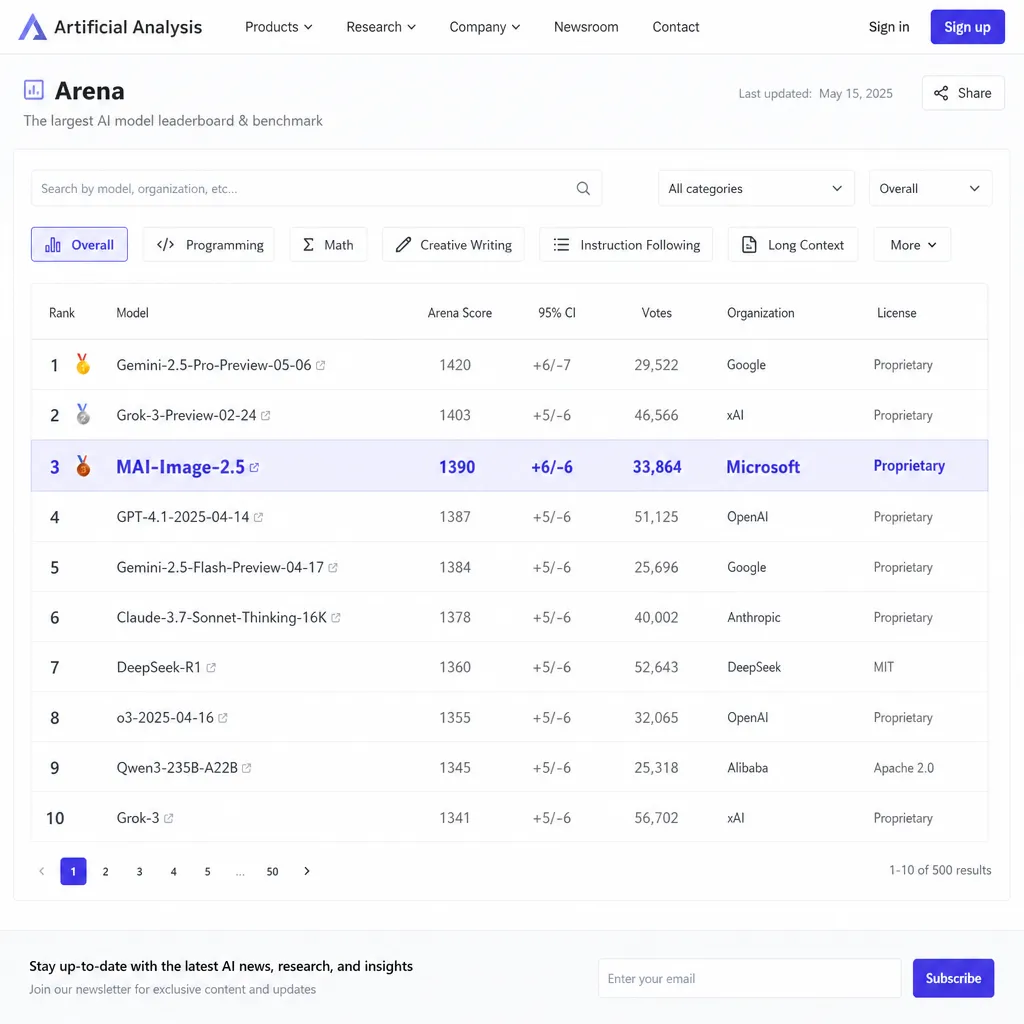
Yesterday (May 26), Microsoft Research released MAI-Image-2.5, the latest version of its self-developed image generation series. On the day of release, the model rose to third place on Arena’s text-to-image leaderboard, right behind Google Gemini 3.1 Flash and OpenAI GPT Image 1.5. This marks another strong push by Microsoft in the image generation field and shows that its proprietary model capabilities are approaching industry-leading levels.
From Reliance on OpenAI to Self-Developed Top-Tier Model
A year ago, Microsoft’s Bing Image Creator and Copilot depended almost entirely on OpenAI’s DALL-E 3 and GPT-4o for image generation. In May last year, Microsoft launched the first-generation MAI-Image, its first fully self-developed image generation model, which began operating alongside OpenAI models in its products.
Now, with the release of MAI-Image-2.5, Microsoft has not only moved past reliance on external models but also caught up technologically with key competitors. The Arena leaderboard is one of the most authoritative evaluation platforms for text-to-image models, using blind human scoring to present unbiased results. Its climb into the top three suggests the model’s image quality, instruction comprehension, and attention to detail have reached a commercial-grade level.
Core Upgrade: Text Rendering Is No Longer a Weak Point
Compared with the previous version, MAI-Image-2.5 shows a major improvement in text rendering, a long-standing challenge for image generation models. Most models struggle when asked to generate images containing text—fonts often distort, spellings are incorrect, or the specified text simply fails to appear accurately.
MAI-Image-2.5 introduces targeted optimization for this pain point. According to Microsoft, the model can now handle tasks that require precise text display, such as infographics, posters, product packaging, and labels. This means designers and marketers can directly use it to generate visual assets containing brand names, product descriptions, and price tags—without needing to manually add text later in Photoshop.
The commercial value of this capability is obvious. E-commerce product images, social media promotional posters, and event materials all rely heavily on images with text. If AI can generate ready-to-use, polished graphics rather than rough templates requiring manual editing, the entire content production workflow becomes far more efficient.
Refining for Business Scenarios: Not Just Beautiful, but Usable
In its blog post, Microsoft emphasized that MAI-Image-2.5 is “closer to commercially usable.” This wording is subtle—it’s “closer to” rather than “already.” It shows Microsoft’s clear positioning: the model is very capable, but not yet able to fully replace human designers.
In practical terms, MAI-Image-2.5 has undergone targeted optimization for several commercial use cases:
Brand Visuals and Product Display
When generating brand-related images, the model demonstrates more mature control over style consistency, color harmony, and compositional balance—crucial for maintaining brand identity. Businesses don’t want their AI-generated visuals to vary wildly in style or deviate from brand guidelines.
Stylized Illustrations
Compared with realistic imagery, illustrations call for stronger creativity and stylization. MAI-Image-2.5 performs more stably here, interpreting user style prompts—such as “flat design,” “cyberpunk,” or “watercolor illustration”—more accurately and producing more reliable results.
Commercial Materials
From PPT graphics to brochure illustrations and website banners, the images generated by MAI-Image-2.5 are noticeably more polished and complete. Microsoft notes that the model delivers “higher image completeness,” meaning results require minimal post-editing and are ready for direct use.
Visual Reasoning: Understanding Scenes Rather Than Just Assembling Elements
Microsoft specifically highlighted MAI-Image-2.5’s visual reasoning capabilities, a crucial but often overlooked metric.
Earlier generation models tended to just stack described objects together, without grasping spatial relationships, physical logic, or lighting consistency. Ask for "a person standing under a tree," and you might get a giant person next to a tiny tree, or mismatched shadows.
MAI-Image-2.5 shows significant improvement here. Microsoft reports that the model handles objects, scene structure, lighting, proportions, and spatial relationships more coherently. Even with a simple prompt, it can infer and fill in realistic details to create structurally logical images.
Example: If you input "a coffee cup on a wooden table next to an open book," the model must understand that:
- The cup should sit upright, not tipped over
- The book is open, so two pages should be visible
- The table has a wood texture
- Shadows for all objects must follow a consistent light source direction
- The sizes of the cup and book should be realistic
These details are rarely spelled out in prompts; the model must infer them automatically. Improved visual reasoning means users can describe scenes naturally instead of specifying every detail as if coding.
Rollout Plan: Available on Arena Now, Coming to MAI Playground Within Two Weeks
Users can already try MAI-Image-2.5 on the Arena platform. Arena provides anonymous model comparisons—users evaluate outputs without knowing which model produced them, then vote for the better one. This blind test ensures more objective results by removing brand bias.
Microsoft stated that MAI-Image-2.5 will be launched on MAI Playground and Foundry within the next two weeks. MAI Playground is Microsoft’s image generation portal, similar to OpenAI’s DALL-E web version. Foundry is Microsoft’s AI deployment platform for enterprises, enabling them to integrate MAI-Image-2.5 into their applications.
Notably, Microsoft has not announced when MAI-Image-2.5 will be available in Copilot or Bing Image Creator. Given the massive user bases of these services, Microsoft may first test stability in smaller platforms before gradually integrating it into mainstream products.
Competitive Landscape: Microsoft, Google, and OpenAI Form a Triumvirate
Arena’s rankings show a clear first tier of three players in image generation: Google, OpenAI, and Microsoft.
Google Gemini 3.1 Flash holds the top spot, representing Google’s concentrated multimodal capability. Gemini is inherently multimodal—image generation is just one component. Google’s advantage lies in data accumulation and infrastructure via services like YouTube, Google Photos, and Search, giving it unmatched scale.
OpenAI GPT Image 1.5 ranks second. OpenAI pioneered this field—its DALL-E series set the standard early on. GPT Image 1.5 integrates image generation directly into GPT, allowing users to create images seamlessly during conversation.
Microsoft MAI-Image-2.5, though in third place, is fully self-developed—a remarkable achievement. Microsoft’s strength lies in ecosystem integration: Copilot, Bing, Office 365, and Azure form a vast network that MAI-Image-2.5 can join seamlessly to reach hundreds of millions of users.
Others like Midjourney, Stable Diffusion, and Adobe Firefly remain strong in specific scenarios but lag in overall capability and commercialization. Midjourney excels at artistic stylization but struggles with text and business tasks. Stable Diffusion’s open-source nature offers flexibility but requires manual setup, raising technical barriers. Adobe Firefly focuses on creative workflows but lags in raw model performance.
Technical Route Speculation: Diffusion Model + Reinforcement Learning?
Microsoft has not disclosed MAI-Image-2.5’s architecture, but performance clues suggest reasonable hypotheses.
First, it likely uses a diffusion model architecture, the dominant framework in modern image generation—used by DALL-E 3, Stable Diffusion, and Midjourney. Diffusion models offer high-quality, controllable output but face slower inference and higher computational cost.
Second, improvements in text rendering likely come from two directions:
- Dedicated text rendering module: a sub-network added to handle textual fidelity—controlling placement, font, and scale precisely.
- Enhanced instruction comprehension: trained with reinforcement learning or human feedback (RLHF) to interpret user commands precisely (e.g., "write '50% OFF' in the top-left corner" implies location, content, and emphasis).
Third, stronger visual reasoning may stem from larger multimodal datasets and improved alignment. Data from GPT-4o and Copilot development—image-text pairs—likely trained MAI-Image-2.5 to better understand physical and spatial logic.
Commercial Outlook: Enterprise Market Is Key
Microsoft positions MAI-Image-2.5 as “closer to commercially usable,” signaling an enterprise-first focus rather than consumer-level use.
For businesses, the value of AI image generation lies not just in producing beautiful images but in streamlining workflows and boosting efficiency. Enhancements in text rendering, branding, and material creation are all geared toward enterprise applications.
Microsoft’s advantage comes from its mature enterprise service ecosystem. Through Azure and Foundry, businesses can deploy and integrate MAI-Image-2.5 rapidly. Through Copilot, employees can access image generation directly within their daily tools—no separate learning curve required.
In contrast, OpenAI and Google have weaker enterprise channels. OpenAI relies on ChatGPT and APIs without Office-scale reach. Google offers Workspace, but its enterprise footprint remains smaller than Microsoft’s.
If MAI-Image-2.5 secures a strong foothold in enterprise use, Microsoft’s position in AI will strengthen further. Image generation is just the entry—underneath lies the broader multimodal AI race.
Developer Perspective: When Will the API Open?
Currently, Microsoft has not revealed API access plans for MAI-Image-2.5. For developers, this is crucial—if the model is locked behind Copilot or Bing, application scope will be very limited.
Based on previous release patterns, Microsoft may first roll out enterprise APIs via Azure Foundry, followed by possible public API access. Enterprise APIs usually come with higher pricing but better reliability and support; public APIs are cheaper but may have call limits.
If the API eventually opens, it will compete directly with OpenAI’s DALL-E API and Google’s Imagen API. Microsoft’s advantages are price and ecosystem integration, while its weakness remains brand influence—OpenAI still dominates developer mindshare.
Future Outlook: Unified Multimodal Models Are the Endgame?
Industry trends show image generation evolving from standalone tools into unified multimodal AI systems.
Both OpenAI’s GPT-4o and Google’s Gemini can handle text, image, audio, and video simultaneously. Users can perform tasks like “analyze image → generate text → create new image” within one continuous conversation—no tool switching required.
MAI-Image-2.5 is still focused solely on image generation but will likely become part of a broader multimodal framework. Microsoft has already demonstrated early multimodal integration in Copilot, where users can analyze and generate images in a single interface. The release of MAI-Image-2.5 enhances Copilot’s image capabilities further.
In the long run, competition in image generation will shift from “whose images look better” to “who delivers a more complete multimodal solution.” Microsoft, Google, and OpenAI are all racing toward that future—and MAI-Image-2.5 is one important step for Microsoft along the way.
Summary
The release of MAI-Image-2.5 marks Microsoft’s self-developed image generation technology reaching the top tier of the industry. Moving from OpenAI dependence to a top-three position took only one year.
The model’s upgrades—in text rendering, business-use optimization, and visual reasoning—all center around the goal of commercial readiness. Microsoft’s strategy is clear: prioritize practical enterprise needs over artistic extremes—integrating AI into real workflows.
Within two weeks, MAI-Image-2.5 will be available on MAI Playground and Foundry, letting users directly experience its capabilities. If performance meets expectations, Microsoft’s competitiveness in the enterprise AI market will rise sharply.
For developers, key questions remain: When will the API open? How will pricing work? And can it integrate smoothly with existing Azure services? The answers will determine whether MAI-Image-2.5 becomes a widely adopted commercial-grade image generation solution.


