
Xiaomi MiMo plan quota skyrockets 80-fold — is an Agent model price war coming?
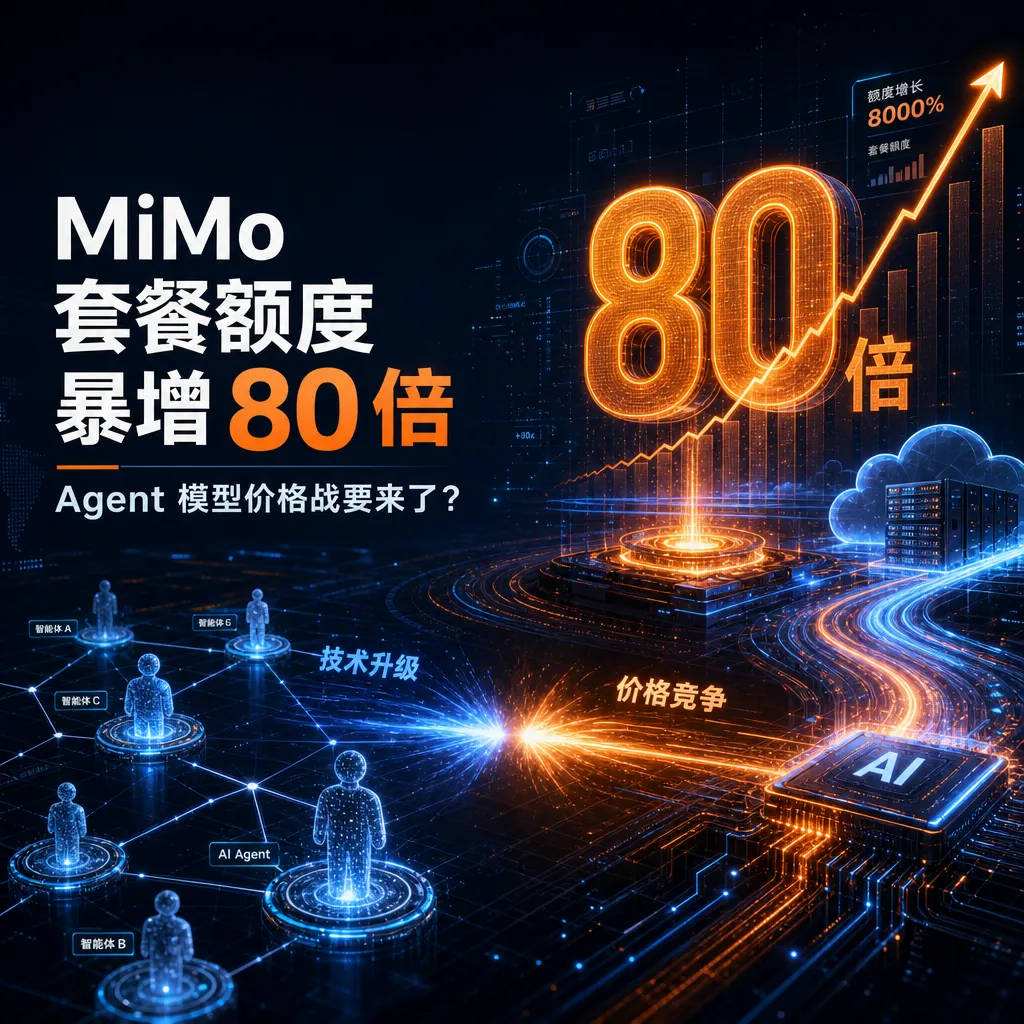
Xiaomi MiMo Token Plan updated again: Credits increased 60–80 times, equivalent to a 99% drop in API prices. Following the trillion-token free plan in April, Xiaomi made another major pricing adjustment in May, sparking industry concerns about a potential price war in Agent models.
Xiaomi MiMo Plan Credit Limits Surge 80× — Is an Agent Model Price War Coming?
On May 27, Xiaomi updated its MiMo Token Plan again. The Lite plan’s credit balance jumped directly from 60 million to 4.1 billion — nearly a 70× increase. For existing users, this effectively means an overnight 99% drop in API prices.
This is Xiaomi’s second major price strategy adjustment in two months. At the end of April, it launched a “Quadrillion Token Giveaway,” and now in May, another round of aggressive changes. Combined with Liang Sheng’s permanent price cuts for dsAgent, developers are starting to worry: will this domestic wave of price slashing drag foreign models into a global price war?
Credit Balances Surged, But the Algorithm Got More Complicated
The most obvious change in this update is the numbers: Lite plan rose from 60 million to 4.1 billion credits; Max plan from 2.6 billion to 16 billion. According to Xiaomi’s official conversion rule, MiMo-V2-Pro consumes 1 Token = 2 Credits, so theoretically, the Max plan’s 16 billion credits equal 8 billion Tokens.
But the real usable amount isn’t that simple. Xiaomi’s credit multiplier mechanism is quite complex: Pro model’s base ratio is 1 Token = 2 Credits, but when context length exceeds 256K, this doubles to 4 Credits. Since the Agent framework makes heavy use of cached Tokens, consumption actually accelerates. Developers have reported that the actual usable capacity of the entry-level plan may only be one-third of its nominal value.
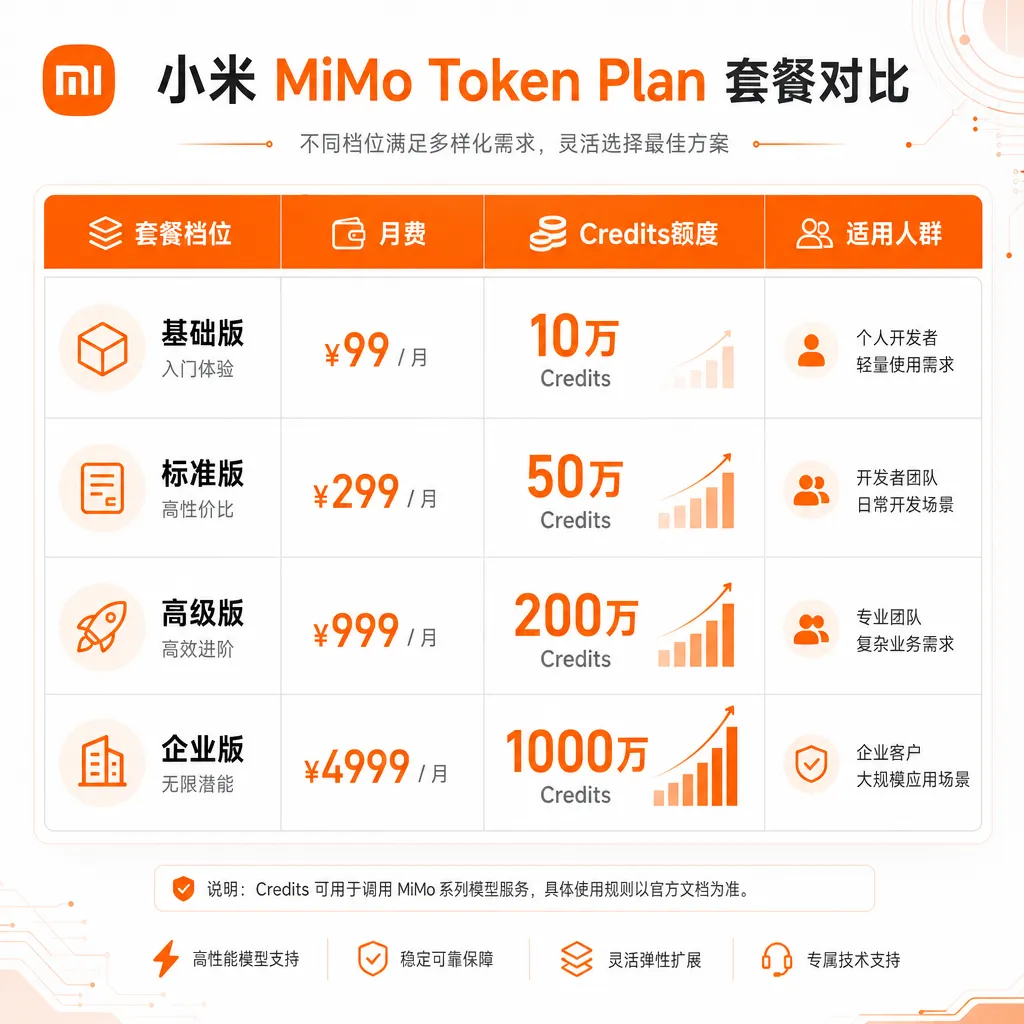
Xiaomi has never disclosed the full logic of its Credits conversion. Tencent Technology previously asked Xiaomi how Credits translate to actual usable Tokens under different models and context lengths, but at the time of publication, no response had been received. This opaque billing calculation makes some developers skeptical about the claimed “99% price drop.”
Luo Fuli’s Warning: Don’t Fall into Anthropic’s Trap
In a long post from April, Xiaomi’s large model head Luo Fuli directly pointed out Anthropic’s subscription dilemma.
Claude’s subscription plans ($20/month for Pro and $100–200/month for Max) were originally designed for individual users, but frameworks like OpenClaw invoke it differently: a single user query triggers multiple independent API calls, each with context windows exceeding 100K Tokens. Even with cache hits, this is highly wasteful. In extreme cases, a user paying $200 may consume thousands of dollars in computing resources.
Luo Fuli’s conclusion: A fixed monthly fee cannot cover real compute consumption in an Agent scenario. Anthropic eventually banned Pro and Max subscribers from using third-party Agent frameworks — essentially protecting Claude Code’s moat.
MiMo’s Token Plan takes a different approach. It supports third-party integration but charges by Token quota — pay for what you use. Luo explained, “Our goal is to deliver high-quality models and services sustainably, not to make you pay impulsively and then abandon them.”
She also acted as an industry pricing “whistleblower”: “I suggest LLM companies avoid blindly undercutting prices until they figure out how to price coding solutions without causing financial leakage. Selling Tokens at extremely low prices while opening up to third parties looks appealing but is a trap — the same one Anthropic just escaped.”
The post gained over 710K views and sparked heated discussion. Some developers agreed with her criticism of OpenClaw’s inefficient context management, while others noted that Xiaomi’s own Credit conversion scheme is equally opaque.
Conversion from Free to Paid Is the Real Test
Xiaomi’s performance data on OpenRouter tells the story clearly.
During its free period, MiMo-V2-Pro consumed over 4 trillion Tokens in a single week, ranking #1 daily, weekly, and monthly, with a market share exceeding 30% in programming usage. But after the free phase ended, weekly call volumes dropped sharply from their peak.
The OpenRouter pattern is simple: once performance reaches a threshold, whoever is cheaper—or free—can shoot to the top. Ranking shows model capability and usability, but usage volume heavily depends on being free.
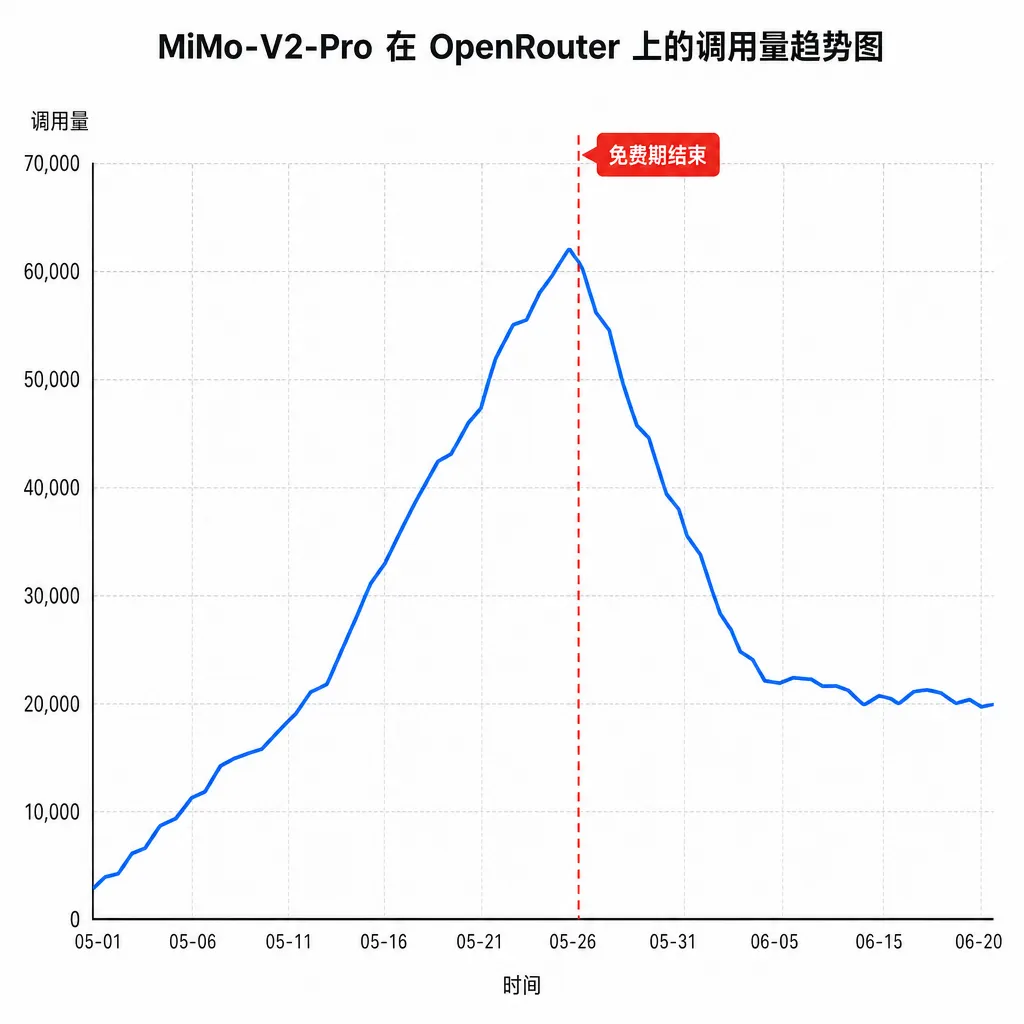
The conversion from free to paid users is a challenge all major model companies face. Xiaomi’s huge expansion of plan quotas is, in essence, using a “near-free” strategy to extend user retention time. But how many of those users will convert to long-term paying customers remains to be seen.
Developer feedback is mixed: some applaud Xiaomi’s generosity (“Lei Jun’s awesome, I’m standing up and cheering”), while others report issues such as MiMo-V2-Pro occasionally entering “infinite loops” during complex reasoning, or false positives in content moderation blocking normal API calls.
Xiaomi Is the Only Phone Maker Still Building a Foundational Model
Looking horizontally across the industry, Xiaomi’s choice is a lonely one.
Huawei’s Pangu model integrates with HarmonyOS for device-cloud collaboration; vivo’s Blue Heart model powers its OriginOS AI assistant; OPPO’s Andes model upgrades its Xiaobu assistant; Honor is following an AI ecosystem route around its devices. All these models are “AI serving phones” — none operate their own public API platforms or offer external model subscriptions. Likewise, major global manufacturers like Apple and Samsung do not offer foundational models directly to third parties.
vivo VP Zhou Wei’s remarks may reflect the industry consensus: phones may evolve into “intelligent agents,” but that doesn’t necessarily require self-built foundational models—integrating third-party large models can achieve similar results.
Xiaomi’s logic is different. Sources close to the company say Xiaomi now believes “large models are a core capability every future tech company must have. All of Xiaomi’s product features must be controlled, trained, and guided by a main model owned by Xiaomi itself — only then can it ensure ownership of user habits and input data.”
Massive user data from phones, cars, and IoT devices is its core asset. If the foundational model relies on a third party, both data sovereignty and product iteration speed fall under external control.
Organizationally, Xiaomi’s core LLM team sits under the Group Technology Committee, not the phone or auto divisions. VP Qu Heng oversees the line, but Luo Fuli enjoys substantial independence — she built her own team with a median age of 25, over 60% of whom are graduates from Tsinghua or Peking University.
R&D spending has ramped up rapidly. In 2025, Xiaomi’s total R&D expenditure reached 33.1 billion RMB, up 37.8% year-over-year, nearly matching its adjusted net profit of 39.2 billion. According to President Lu Weibing, AI investment accounts for about one-quarter of that sum.
When MiMo-V2-Pro launched, Lei Jun announced Xiaomi would invest over 16 billion RMB in AI R&D and capital expenditure in 2026, and at least 60 billion over the next three years. In terms of computing resources, Xiaomi employs a hybrid strategy combining self-built GPU clusters (tens of thousands of cards) with Kingsoft Cloud.
Will the Price War Actually Break Out?
Back to the initial question — will Xiaomi’s move trigger an Agent model price war?
Based on current signals, it’s quite possible.
When Liang Sheng permanently cut dsAgent prices, minimax’s stock fell significantly. But after Xiaomi followed with MiMo’s price overhaul, GLM and minimax stocks instead saw big gains. Some developers wondered: “MiMo’s positioning overlaps minimax’s — so why are their stocks still rising?”
One explanation could be: the market now sees price competition not necessarily as a bad thing. Lower prices can rapidly expand the user base; as long as conversion and retention follow, it can help leading players build stronger moats.
Still, Luo Fuli’s warning stands. Blindly following low-price strategies can lead to “coupon farming”–style cost inversions. Anthropic’s lesson is right there: the subscription model looked user-friendly, but once costs spiraled, it had to restrict usage to survive.
Xiaomi’s Token Plan attempts to balance “low cost” and “sustainability.” It bills by Token quota, supports third-party integration, and imposes no hourly limits — all pushing toward a “pay-as-you-use” direction. However, its opaque Credit multiplier and uncertain conversion rates remain two unsolved challenges.
Could Large Models Become Xiaomi’s Next Core Business Line?
Judging by public information, Xiaomi’s large model division is undergoing subtle but crucial structural shifts: it’s no longer merely a backend capability for phones and IoT — it’s gaining the foundation to become an independent business line.
The clearest signal is the product shift. Xiaomi has launched a developer API platform with tiered Token subscription plans. That step alone moves beyond the bounds of a traditional “tech middleware.”
Lei Jun publicly stated Xiaomi aims for a pivotal technical integration by 2026: in one product, to align its self-developed chip, operating system, and large AI model. Few companies cover all three layers today. Huawei achieved that with its Kirin chips, HarmonyOS, and Pangu model; Apple has long integrated chip and OS design, and is now strengthening on-device AI.
According to disclosures, Xiaomi has categorized AI-related business alongside smart EVs under its “Innovative Business” segment. In 2025, the segment earned 106.1 billion RMB in revenue — around 103.3 billion from vehicles, while AI income wasn’t separately disclosed. Product and structure are shifting toward independent operation, but public financial verification is pending.
When Xiaomi set its high-tier subscription pricing near Claude’s range and began challenging the industry’s subscription model, its aim may not have been simply “price competition.” By aligning with top-tier models, Xiaomi might instead be asserting its capability to “sit at the same table.”
From “Xiaomi won’t make a ChatGPT” (May 2023) to “MiMo plan quotas increase 80×” (May 2026), Xiaomi’s stance toward large models has changed faster than most expected. Whether this triggers a price war still depends on competitors’ reactions — but one thing is clear: the pricing logic for Agent models is being redefined.
References
- Is the Agent model price war starting? (Xiaomi MiMo Token Plan update) — Linux.do community discussion, developers’ first-hand feedback on Xiaomi MiMo plan updates
- MiMo plan credits reset for free, and subscription plans get boosted — User feedback on Lite plan upgrade from 60M to 4.1B Credits
- Tested MiMo — Developers’ real-world testing of MiMo model capabilities
- Impact of MiMo pricing on GLM and minimax? — Discussion on Xiaomi’s price cuts and effects on competitor stocks
- Xiaomi doesn’t want to “sell Tokens cheap” – 36Kr — In-depth coverage of Xiaomi’s Token Plan and Luo Fuli’s industry warning
- AI Morning Report 2026-04-23 – Zhihu — Official update on launch of MiMo-V2.5 and refreshed Token Plan
- Xiaomi launches Quadrillion Token initiative, free in 30 days – 36Kr — Details of Xiaomi’s April “Quadrillion Token Giveaway” plan


