
Robinhood Opens AI Agent Trading Accounts
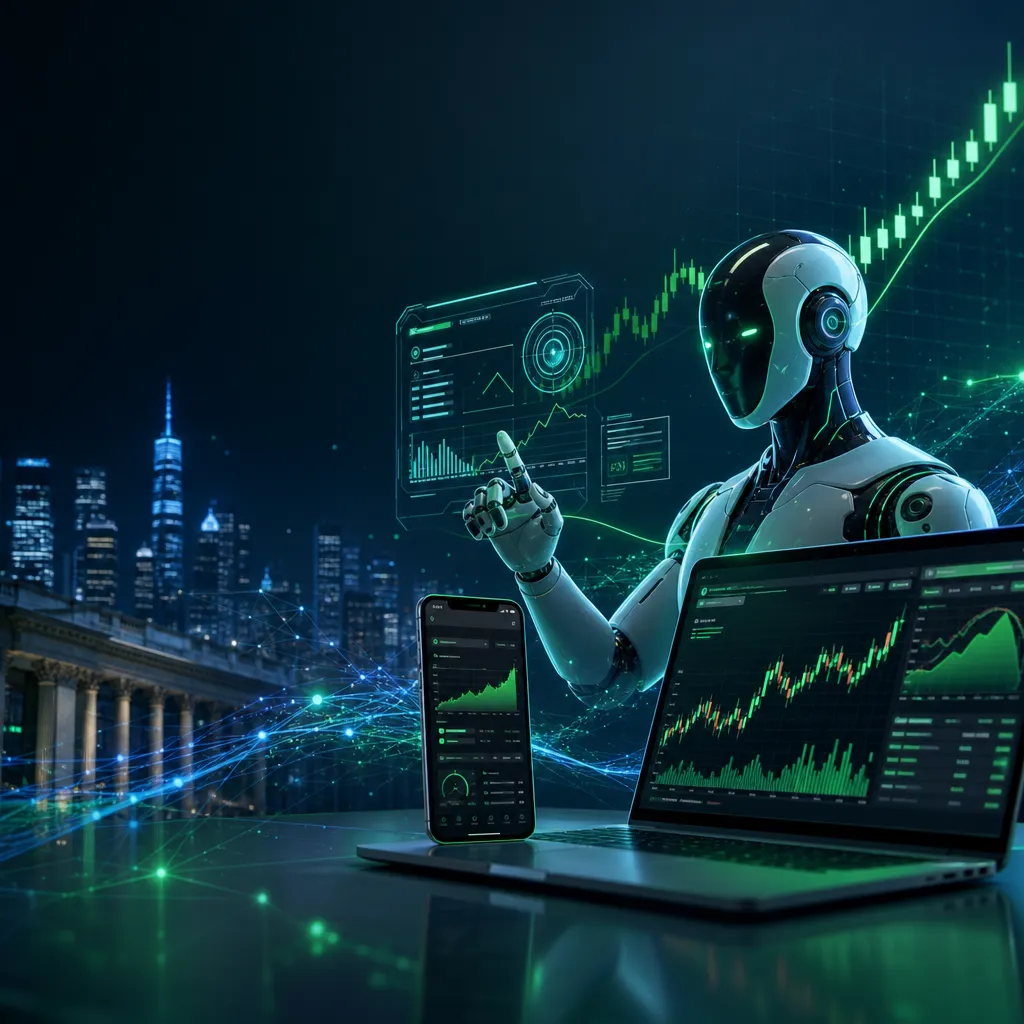
Robinhood launches independent AI Agent trading accounts, allowing users to pre-deposit funds and authorize the agent to autonomously trade stocks. This is the first real trading API opened to AI Agents by a major brokerage, marking the transition of financial automation from assisted decision-making to autonomous execution.
Robinhood Opens AI Agent Trading Accounts
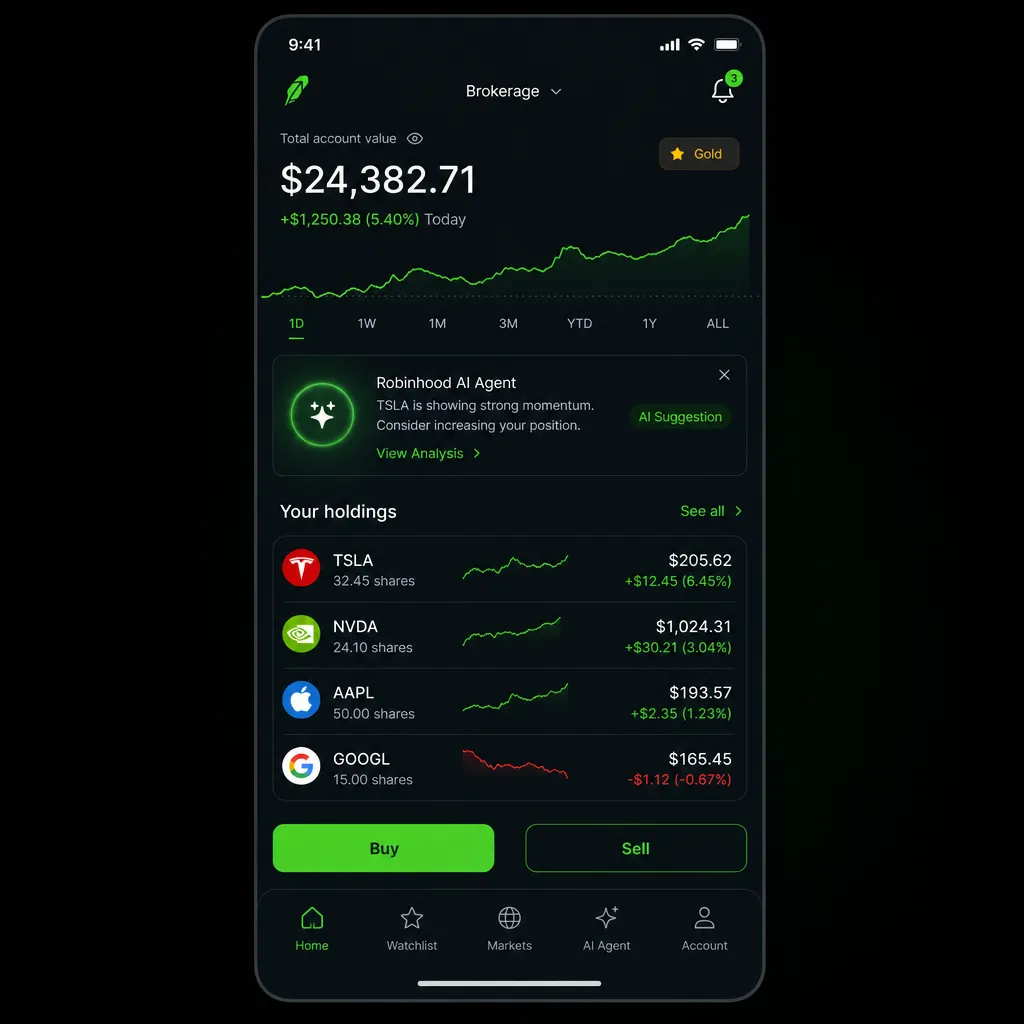
Robinhood announced today that it now supports users in creating independent AI Agent trading accounts. Users can deposit a predetermined amount and then authorize the AI agent to autonomously buy and sell stocks within that account. This marks the first time a mainstream brokerage has opened a real trading API to AI agents.
Unlike traditional quantitative trading interfaces or investment research assistants, Robinhood is granting full execution authority this time. The agent doesn’t just offer suggestions — it can directly place orders, close positions, and adjust portfolios. Once users set risk limits and funding caps, all remaining trading decisions are handed over to the agent.
Why Now
The financial industry has always had an ambivalent attitude toward AI. On the one hand, quantitative funds have long used algorithmic trading, and high-frequency trading is fully automated. On the other hand, consumer-oriented automation tools have remained at the “advice” stage — recommending stocks, generating reports, and answering questions, but never touching real money.
This caution is understandable. Regulation is strict, asset security is a sensitive issue, and AI’s unpredictability makes brokerages hesitant to grant control. But technological progress is shifting this balance.
Large models now have the reasoning power to understand complex financial logic. Breakthroughs by models like DeepSeek in cost and performance make real-time analysis of massive market data feasible. More importantly, the maturity of agent frameworks has given AI “tool-use” capabilities — not just text generation but also API calling, action execution, and exception handling.
Robinhood’s product design reflects this pragmatism. AI Agent accounts are independent and isolated from users’ main accounts. Users must actively deposit funds and set trading limits and stop-loss rules. The agent operates only within this sandbox, unable to access other assets. This design gives AI sufficient autonomy while keeping risk under control.
Key Technical Aspects
From a technical perspective, enabling an AI agent to safely execute financial trades requires solving several core problems.
The first is decision interpretability. Users need to understand why the AI makes a particular trade — what data it’s relying on and whether its logic chain is reasonable. Robinhood’s agent generates a decision report for each transaction, listing trigger conditions, reference indicators, and risk assessments. This promotes transparency and allows users to refine strategies and optimize agent behavior.
The second is risk control. AI can make errors due to data anomalies, hallucinations, or extreme market fluctuations. Robinhood has implemented multiple layers of protection: hard-coded trade caps, daily loss circuit breakers, and anomalous behavior detection. If an agent’s actions deviate from pre-set bounds, the system automatically halts trading and alerts the user.
The third is real-time capability. Financial markets change in milliseconds — even a few seconds’ delay can miss the best opportunity. Agents must quickly access data, reason, and execute trades. This requires high inference speed and API responsiveness. Robinhood uses a hybrid architecture: lightweight models process high-frequency data streams while large models handle complex decisions, coordinated via an event-driven system.
The fourth is regulatory compliance. The U.S. Securities and Exchange Commission (SEC) has strict rules for automated trading. Robinhood must ensure its agent complies with anti-money-laundering (AML) and know-your-customer (KYC) requirements. Each trade records a full audit log — decision basis, execution time, and market state — so regulators can reconstruct the agent’s activity if needed.
How It Differs from Existing Financial AI
Many financial AI products already exist, but most remain in an assistive role.
Research assistants such as Bloomberg GPT and FinGPT mainly analyze financial reports, produce research notes, and answer professional queries. Their output is text-based and does not involve trade execution.
Quantitative trading platforms like QuantConnect and Alpaca provide APIs for developers to code strategies, but those are deterministic algorithms, not large-model-driven agents.
Robo-advisors such as Betterment and Wealthfront automatically allocate assets based on user risk preferences, but their decision logic is pre-set and not dynamically adaptive to market conditions.
Robinhood’s AI Agent accounts combine all three: it interprets complex data like a research assistant, executes trades like a quant platform, and makes autonomous decisions like a robo-advisor. More importantly, it is designed for everyday users — no programming or financial expertise is required. Users simply describe their investment goals in natural language, and the agent plans strategies, trades, and adjusts positions accordingly.
Risks and Controversies
Of course, letting AI trade autonomously introduces new risks.
Model hallucination is a major hazard. Large models can make decisions based on mistaken data or faulty logic — misreading earnings reports, misunderstanding news events, or being overly optimistic or pessimistic about market trends. While Robinhood’s risk mechanisms help, this danger cannot be fully eliminated.
Market manipulation is another concern. If many users employ similar AI agents, they might make similar trades simultaneously, causing abnormal market swings. The “herd effect” already exists in traditional trading, but AI’s speed and scale could amplify it.
Accountability is also controversial. If an AI agent causes significant losses, who’s responsible — the user, the brokerage, or the model provider? Existing legal frameworks don’t provide clear answers. Robinhood’s user agreement states that users are responsible for their agent’s actions, but whether such disclaimers hold up legally remains uncertain.
Regulators are watching closely. The SEC has stated it will review AI-driven trading tools to ensure they don’t harm market fairness or investor interests. If Robinhood’s agent accounts create systemic issues, stricter rules may follow.
Industry Impact
Robinhood’s move will ripple through the financial industry.
For brokerages, it opens a new competitive frontier. Whoever delivers smarter, more reliable AI agents will attract more users. Traditional firms may hasten digital transformation, building their own agent products or partnering with AI companies rather than developing from scratch.
For retail investors, it lowers barriers to entry. No need for complex financial training, constant market monitoring, or manual order placement. AI agents can monitor markets 24/7 and adjust strategies automatically. But users may become overly reliant on AI and neglect risk management.
For quantitative funds, it could reshape market dynamics. If large numbers of retail investors start using AI agents, market liquidity and volatility will shift, requiring quant strategies to adapt.
For the AI industry, it is a major application milestone. Financial trading demands high standards — real-time performance, precision, interpretability, and safety. If AI agents prove effective here, they could pave the way for other high-risk sectors like healthcare and autonomous driving.
Other Players
Robinhood isn’t the only one exploring AI agent trading.
Polymarket already hosts autonomous agents trading in prediction markets. These agents analyze news, social media, and on-chain data to place bets. While the scale is smaller than stock markets, prediction markets offer a low-risk testing ground for agents.
Traditional banks are also moving in. Over 60 Chinese banks have integrated DeepSeek, mostly for investment research and client analytics rather than core trading. Few applications involve execution. Companies like Feihu Interactive are developing vertical agents for banks, covering marketing, risk control, and trading — aimed at institutional rather than retail clients.
Cryptocurrency exchanges are going further. With crypto markets operating 24/7, exhibiting high volatility and lighter regulation, AI agents have more freedom. Some exchanges now allow users to authorize agents to autonomously buy and sell crypto assets.
Future Outlook
Robinhood’s AI Agent account is just the beginning. In the coming years, we may see more financial services open to AI agents.
Personalized investment strategies will become standard. Each user’s agent will tailor strategies based on risk profile, financial situation, and goals. Agents may form collaborative networks, sharing market insights and trading signals.
Cross-asset trading will become possible. Agents won’t just trade stocks but also options, futures, forex, and crypto. They’ll autonomously rebalance asset allocations, enabling true all-weather investing.
Social investing will see new forms. Users can share their agent strategies; others can copy or enhance them. Strong agent strategies might even become digital assets — tradable, licensable, or subscribable.
Regulatory frameworks will mature. As AI agents proliferate in finance, regulators will craft clearer rules balancing innovation and risk. We may see dedicated agent licenses, audit standards, and liability systems.
All of this hinges on AI agents proving reliable. If early deployments suffer major failures, regulation may tighten and slow industry progress. Robinhood’s experiment is both an opportunity and a test.
The endgame for financial automation isn’t replacing humans but freeing them from repetitive tasks to focus on higher-level decisions. AI agents are tools, not substitutes — they can execute, monitor, and optimize, but investment goals, risk tolerance, and value judgments must remain human-defined.
Robinhood’s AI Agent account symbolizes finance’s shift from “AI assistance” to “AI execution.” It’s not the end — it’s the beginning. In the coming years, we’ll see more traditional financial services rebuilt around AI agents. The process will bring challenges and controversy, but the direction is clear.
References
- Robinhood now lets your AI agents trade stocks - TechCrunch – Official introduction to Robinhood’s AI Agent trading account features


