
Tencent releases 'Codename Craft': Create a playable game prototype with one sentence
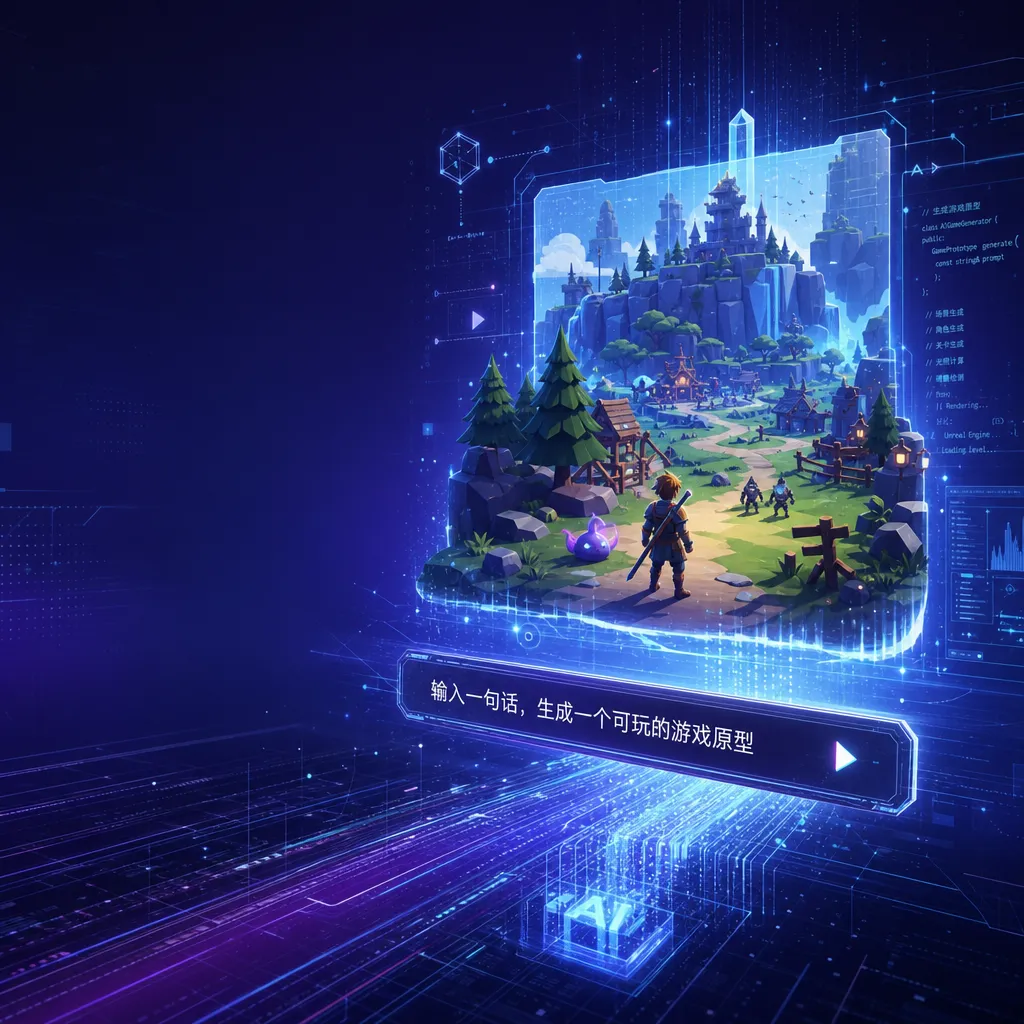
At the SPARK 2026 launch event, Tencent introduced the AIGC game creation platform **“Codename Craft”**, which focuses on generating 2D/3D game worlds through natural language. It comes with over ten thousand built-in preset art assets, and registration for the first test is now open.
At the SPARK 2026 Tencent Games Launch Event on May 27, Tencent unveiled something that’s hard for the gaming community to assess — the AI game creation platform “Code: Craft.” Operated by Tencent’s Game Ecosystem Development Department, the platform has simultaneously opened registration for its first round of testing today.
In one sentence: You chat a bit with an AI, and it spits out a playable game world.
Tencent is not the first company to attempt this, but its move marks the moment this idea enters the “mainstream big-studio participation” stage. Before this, companies such as Roblox, Rosebud AI, and Buildbox have been exploring this field for some time, while domestic players like NetEase and miHoYo have integrated plenty of AIGC modules into their internal toolchains. What makes Craft special is that it’s one of the few platforms that clearly positions “natural language → complete game prototype” as its main selling point, while treating an art asset library as a key advantage.
What It Can Actually Do
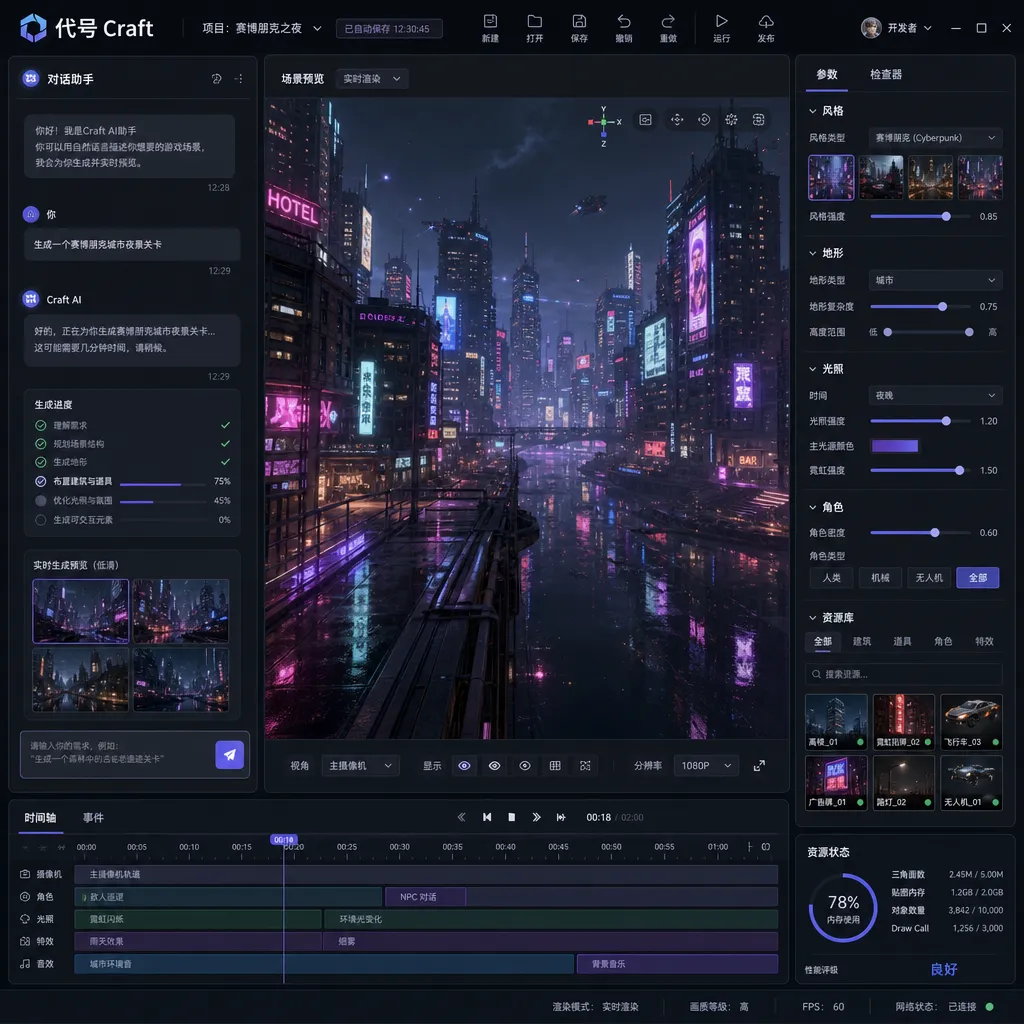
According to the official description, Craft’s workflow looks roughly like this:
- The user describes the game they want to make in natural language, e.g. “Design a space adventure RPG”
- The platform automatically generates game scenes, character models, and basic gameplay frameworks
- Supports prototype generation in both 2D and 3D genres
- Can output prototypes for mobile, PC, and console
- Exports in formats compatible with Unity and other mainstream engines
- Includes over 10,000 pre-made art assets, provided for free
The last two points are the ones really worth unpacking.
Unity export determines whether Craft is a “toy.” Whether it can cleanly export the generated project files into Unity — allowing programmers to continue coding and artists to refine — is the dividing line. If it’s locked in a closed-loop platform and can only produce a “playable demo for presentation,” its ceiling stops at the game jam level; but if it can integrate seamlessly into an industrial production pipeline, that’s the real story Tencent wants to tell — reducing art and prototyping costs for both internal studios and indie developers.
Over 10,000 pre-made art assets are Tencent’s differentiator. A long-standing issue with AIGC-generated assets is inconsistency in style, irregular specifications, messy topology, and broken UVs. The pre-made asset library effectively provides a “safety net” — AI assembling existing assets is far more reliable than generating meshes from scratch. This is the most pragmatic path for AI game generation right now: pure generation isn’t dependable, so go with generation + retrieval + assembly.
Why Tencent Is Doing This Now
The industrial context behind this move is actually more interesting than the product itself.
The art production bottleneck in game development has been a long-term headache. For a mid-sized mobile game, art outsourcing can easily account for over 40% of the budget — even higher for AAA projects. Over the past two years, AI has quietly penetrated front-line studios in 2D concept art, texture generation, and motion capture assistance. However, a full “prototyping acceleration” tool has been missing. The prototyping phase is one of the most expensive stages in game development — validating a gameplay idea can take several people one or two months to make a playable demo, and thousands of such projects end up being scrapped.
Craft is targeting exactly this pain point. Cutting the prototyping cycle from “two months” to “two days” could be transformative for Tencent’s internal incubation system and for indie developers’ trial-and-error costs.
On a broader scale, Tencent Games has clearly been accelerating its AI transformation over the past year. From using its Hunyuan large model in titles like DreamStar and Peacekeeper Elite, to experiments with intelligent NPCs, and now this platform tool — the path is clear: internal adoption first, then opening up to create an ecosystem. Craft follows the latter approach.
A Few Unanswered Questions
Since launch event details are limited, several key points remain unclear:
How good is the generation quality really? The official demo used a standard prompt like “space adventure RPG,” meaning the output likely relies heavily on pre-made assets. But if a user inputs something complex like “a cyberpunk version of Harvest Moon with Studio Ghibli-style visuals,” can Craft still deliver? That’s the real test of its capabilities.
To what extent is code generated? Generating scenes and characters is one thing; generating a “basic gameplay framework” is another. Gameplay logic involves state machines, event systems, and balance tuning — things even LLMs struggle with. The official term “basic gameplay framework” leaves room for interpretation — most likely, it means filling in parameters for templated gameplay rather than designing new mechanics from scratch.
Intellectual property rights. For games generated using the platform’s pre-made assets, how will commercial licensing work? That’s a universal issue for all AIGC platforms. A company as large as Tencent will probably adopt a tiered license model similar to Unity’s Asset Store, but we’ll need to see the first test’s terms.
Testing access. “Test registration open” usually means limited, invitation-only access. For platforms like this, Tencent typically prioritizes internal teams and partner studios — individual developers will likely have to wait in line.
Comparing with Competitors
Here’s a horizontal comparison of current competitive platforms:
| Platform | Core Capability | Asset Strategy | Output Format | |-----------|-----------------|----------------|----------------| | Roblox + AI | Closed-loop ecosystem | UGC marketplace | Roblox only | | Rosebud AI | Text-to-2D game | Pure generation | Web-playable | | Unity Muse | Assists Unity development | Pure generation | Unity project | | Code: Craft | Full prototype generation | Pre-made library + generation | Multi-engine export |
Roblox is strong on ecosystem but closed, Rosebud is flexible but weak in industrialization, and Unity Muse is more of a developer tool than a “creation platform.” Craft’s positioning seems like a “stitched hybrid of Roblox Studio and Unity Muse for Chinese developers” — an ambitious play.
Toolchain-Level Details Worth Watching
Based on the official information, Craft’s internal architecture likely looks like this:
User natural language input
    ↓
Intent parsing (gameplay type, style, platform)
    ↓
Scene generation ←→ Art asset library (>10,000 prefabs)
Character generation
Gameplay template matching
    ↓
Project file assembly
    ↓
Unity / Other engine export package
The intent-parsing layer is most likely powered by Tencent’s Hunyuan model. The art asset library represents a major monetization of Tencent’s years of asset accumulation — a moat no pure AI company can replicate. The gameplay template layer is where product skill matters most: done well, it’s “Lego building blocks;” done poorly, it’s just a “reskin tool.”
A Few Thoughts
Honestly, I’ve always been skeptical of “one sentence to make a game” products. We’ve seen plenty in the past two years — impressive demos at conferences, but when developers try them, most end up gathering dust. The hard part of game development has never been “making a runnable prototype,” but “iterating that prototype into a fun product,” and AI can only help so much in the second half.
However, Craft is different in two ways: first, Tencent’s involvement — its industrial capability and resource reserves are top-tier; second, its positioning as a “prototyping accelerator” rather than a “developer replacement” is far more pragmatic. If after the first test it proves that exported Unity projects can be picked up and further developed by programmers, its value becomes tangible.
As for slogans like “AI lets everyone make games,” take them with a grain of salt. The real barrier to game development has never been the tools — it’s ideas and refinement. Faster tools only make creative people more productive — and those without ideas hit the wall faster.
Test registration is now open, so interested developers can watch Tencent’s official channels for slots. Once a testable version is available, we’ll see how much substance this really has.
A Side Note
With AI toolchains evolving this fast, multi-model collaboration has become the norm — a single game prototype might use Hunyuan for dialogue, Claude for gameplay logic, GPT for storytelling, and Gemini for multilingual localization. Managing a bunch of API keys is increasingly painful. Platforms like OpenAI Hub — which aggregate access to mainstream models (GPT, Claude, Gemini, DeepSeek, etc.) under one key and support direct access in China using an OpenAI-compatible format — make this workflow smoother. Worth a mention.
References
- ITHome: Tencent announces AIGC creation platform “Code: Craft,” enabling natural language-generated game worlds – Onsite coverage from the SPARK 2026 launch, including core feature introductions
- ITHome Discovery Channel: Tencent launches AIGC creation platform “Code: Craft” – Additional details on pre-made art assets and platform adaptability


