
Snowflake bets $6 billion to bring enterprise Agent training onto AWS

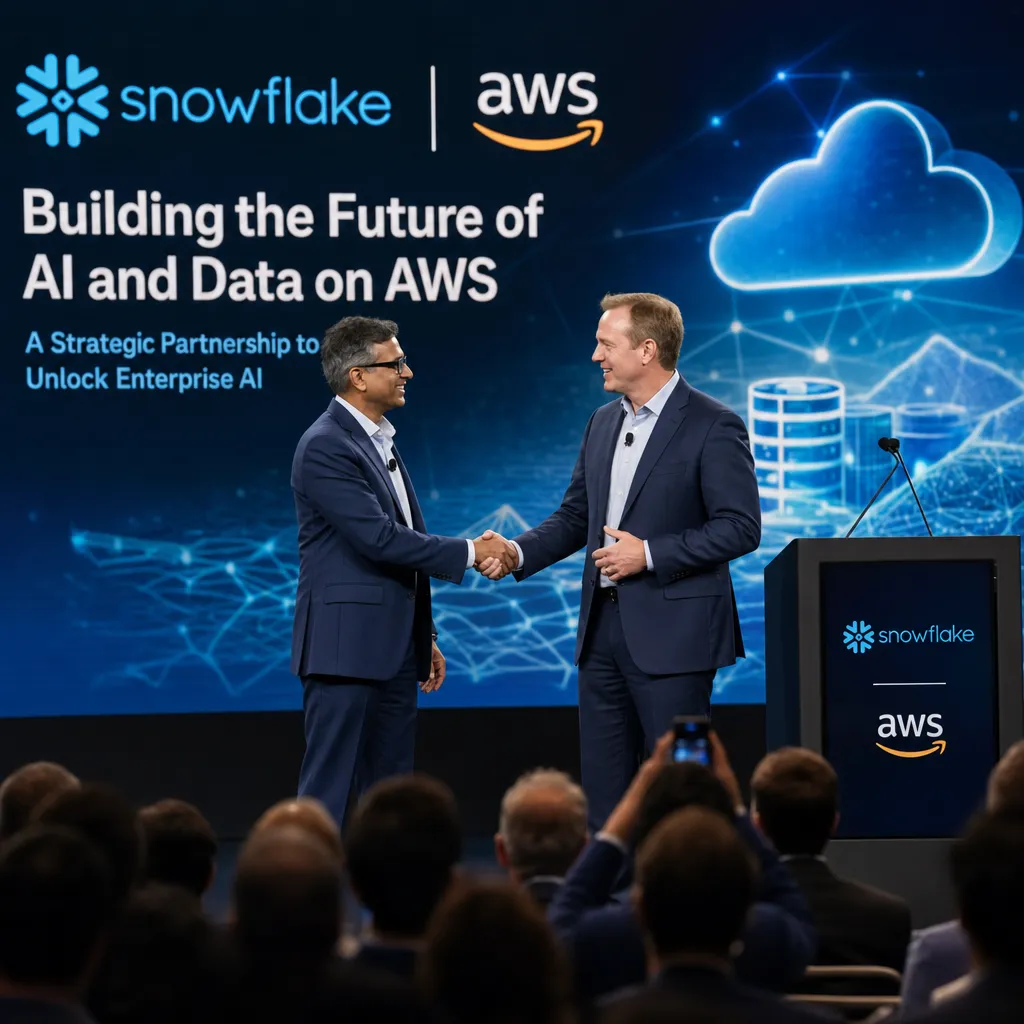
Snowflake has signed a five-year, $6 billion strategic cooperation agreement with AWS to fully adopt AWS’s self-developed AI chips for agent training and inference on its data cloud platform. This marks the largest single infrastructure investment in Snowflake’s history and represents another direct challenge from the Trainium camp to Nvidia.
Snowflake Bets Its Core Assets on AWS’s Proprietary Chips
On May 27, Snowflake announced the renewal of its Strategic Collaboration Agreement (SCA) with AWS, committing $6 billion over the next five years to AWS for procuring AI compute resources, expanding underlying infrastructure, and primarily supporting agent training and inference workloads on its data cloud. This is Snowflake’s largest infrastructure commitment since going public, with a single contract exceeding its total product revenue for fiscal year 2025.
Judging by the headline alone, it’s easy to mistake this for just another massive cloud deal. But upon closer inspection, three threads are tightening simultaneously: Snowflake’s agent roadmap requires cheaper compute, AWS’s proprietary chips need flagship customer endorsements, and Nvidia’s share in the enterprise data platform segment is slowly being eroded.
What Exactly Does the $6 Billion Buy?
According to key points disclosed by Snowflake and AWS, this $6 billion is not simply a “committed spend,” but covers three components:
- AI Accelerator Chip Procurement: Snowflake will extensively deploy AWS’s proprietary Trainium2 and next-generation Trainium3 chips for model training and fine-tuning tasks on its Cortex AI platform, while introducing the Inferentia series for inference workloads.
- Infrastructure Expansion: Dedicated capacity will be added in AWS us-east, us-west, and multiple regions across Europe and Asia-Pacific to accommodate enterprise-grade agent workloads.
- Joint Product Development: The two companies will integrate deeply in areas such as agent compute, vector search, and cross-account data sharing, with Snowflake’s Cortex Agents natively interfacing with Amazon Bedrock AgentCore.
TechCrunch described it plainly as a “big AI CPU chip purchase.” While technically inaccurate—Trainium is an AI accelerator, not a general-purpose CPU—the signal was correct: Snowflake avoided H100/H200 and didn’t wait for B200, instead placing its training-side bets on AWS’s own silicon.
Why Now, and Why Trainium?
Over the past two years, Snowflake’s stance on AI has shifted markedly—from initially emphasizing a “data stays in-cloud” closed strategy, to integrating Llama and Mistral in 2024, then signing a $200 million agreement with Anthropic to bring Claude into Cortex in late 2025, and most recently spotlighting Cortex Agents. The company’s role has evolved from “data warehouse” to “enterprise AI runtime.”
Agent workloads are nothing like traditional SQL queries. A complex agent call may involve:
- Multiple rounds of LLM inference (each round ranging from thousands to tens of thousands of tokens)
- Vector search + reranking
- Tool usage (database queries, APIs, code execution)
- Persistent storage for intermediate states
These workloads are long-tail, bursty, and severely token-bound. Using Nvidia H100s makes per-token costs hard to reduce; relying solely on resale of API services means Snowflake can’t capture margin. Trainium2’s appeal lies exactly here: AWS’s own figures show 30%-40% better price-performance compared to contemporary GPU instances, with more predictable cross-node communication latency in AWS’s network topology.
For Snowflake, betting on Trainium is a textbook “commitment-for-pricing” deal—$6 billion over five years is enough for AWS to grant steep discounts, while helping AWS maximize Trainium capacity utilization.
Nvidia Called Out Yet Again
In recent enterprise AI mega-deals, “bypassing Nvidia” is increasingly visible. Last year, Anthropic took billions in AWS investment and trained Claude on Trainium; earlier this year, Apple reportedly tested replacing some inference workloads internally with Trainium; now it’s Snowflake’s turn.
This doesn’t mean Nvidia’s dominance is threatened—on the main track of massive-scale training and cutting-edge model pretraining, Nvidia remains firmly in control. But the logic in the enterprise AI application layer is shifting:
- Customers buy results, not hardware. Snowflake’s clients don’t care whether the underlying hardware is Trainium or H100—they care about cost per thousand tokens and SLA compliance.
- Cloud providers have bundling advantages. AWS can package chips, networking, storage, and billing; Nvidia can only sell GPUs.
- Inference market is expanding. In the agent era, inference call volume will be orders of magnitude greater than pretraining; whoever nails inference price-performance wins scale profits.
Nvidia isn’t idle—at the most recent GTC, Jensen Huang repeatedly touted Blackwell’s inference strengths—but when enterprise customers sign contracts, pricing speaks for itself.
The Cortex Agents and Bedrock AgentCore Puzzle
The most noteworthy element in the agreement is actually product integration. Snowflake Cortex Agents were originally positioned as “run agents over your data”—developers could define agents that query, call tools, and persist memory based on their enterprise tables, views, and Iceberg tables. Its main advantage: data stays within Snowflake’s governance boundary.
But Cortex Agents lacked one piece: tool calls across enterprise boundaries and external service orchestration. That’s exactly what Amazon Bedrock AgentCore specializes in—it provides runtime, memory, identity, and gateway components designed for agent deployment in production.
After this collaboration, the two will natively interoperate. A concrete use case:
- A user defines a sales analysis agent in Snowflake, able to access CRM data, order tables, and product inventory.
- When the agent needs to send customer emails or call external SaaS services (e.g., Salesforce, Slack), it seamlessly switches to Bedrock AgentCore Gateway for authentication and invocation.
- The entire conversation history, tool call logs, and token usage are written back into Snowflake’s governance dashboard.
This “data governance + agent runtime” combo is highly impactful for enterprise IT—it solves the two biggest pain points for agents in the past year: how to prevent data leakage and how to audit when issues arise.
What This Means for Developers
If you’re building agent projects in an enterprise, this collaboration immediately brings several points to watch:
- Lower model costs on Cortex. With Trainium replacing GPUs, Snowflake can further reduce token-based pricing for Cortex; Anthropic’s Claude models on Cortex may also see price adjustments.
- Shorter agent deployment chain. Parts that previously needed manual stitching between Snowflake and Bedrock will be exposed via native connectors, drastically reducing IAM and network configuration work.
- More viable multi-model strategies. Snowflake Cortex already supports Claude, Llama, Mistral, and Snowflake’s own Arctic models; future integration with Nova and Titan on Bedrock effectively turns it into an enterprise-grade multi-model routing layer.
As a side note, for developers unwilling to be locked into a single cloud, there’s the route of using an OpenAI-compatible aggregation layer (e.g., OpenAI Hub services that call GPT, Claude, Gemini, DeepSeek via one key) for model abstraction, while keeping data and orchestration on their own infrastructure—common in domestic scenarios and relatively independent from cloud-native agent suites.
A Less Discussed Detail: Revenue Structure
Analysts see two angles in this $6 billion deal. First, AWS gains another anchor customer, strengthening Trainium’s narrative—Amazon’s stock rose 2.3% on announcement day. Second, for Snowflake: $6 billion is spending, but also supports “future revenue.”
In its latest earnings report, Snowflake’s product revenue grew 27% YoY, with AI-related contributions rising from single digits last year to around 18%. This agreement with AWS essentially locks in the compute foundation for AI business over the next five years—reassuring customers for long-term projects and giving Wall Street a clear “AI revenue realization” storyline.
The trade-off is clear: short-term margin pressure. Snowflake’s non-GAAP product gross margin had stayed above 75%, but AI workloads are inherently lower-margin; over the coming quarters, this figure will likely drop 3-5 percentage points. The CFO already set expectations in the earnings call: trading margin for growth is a necessary choice at this stage.
In Closing
If you line up the big enterprise AI collaborations of the past two years, a clear trend emerges: money is shifting from “selling models” to “selling the ability to run agents.” OpenAI uses Microsoft’s compute, Anthropic uses AWS’s, Snowflake bets on Trainium, Databricks is in deep talks with multiple chip vendors.
The last wave was about model parameters and benchmarks; this one is about: who can get enterprise agents actually running, cheaply, and in compliance. Snowflake’s $6 billion bet is grounded in that judgment.
Whether they win—let’s check back in five years.
References
- Reddit discussion on AWS Trainium2 vs Nvidia H100 price-performance — community firsthand feedback on Trainium inference performance
- Hugging Face AWS Neuron SDK repositories — official toolchain for deploying models on Trainium/Inferentia
- Stack Overflow discussion on Snowflake Cortex Agents integration — developer Q&A about integrating Cortex Agents with external services


