
Alibaba’s voice large model breaks into the global Top 5, ranking first in China for ASR, TTS, and Chat.
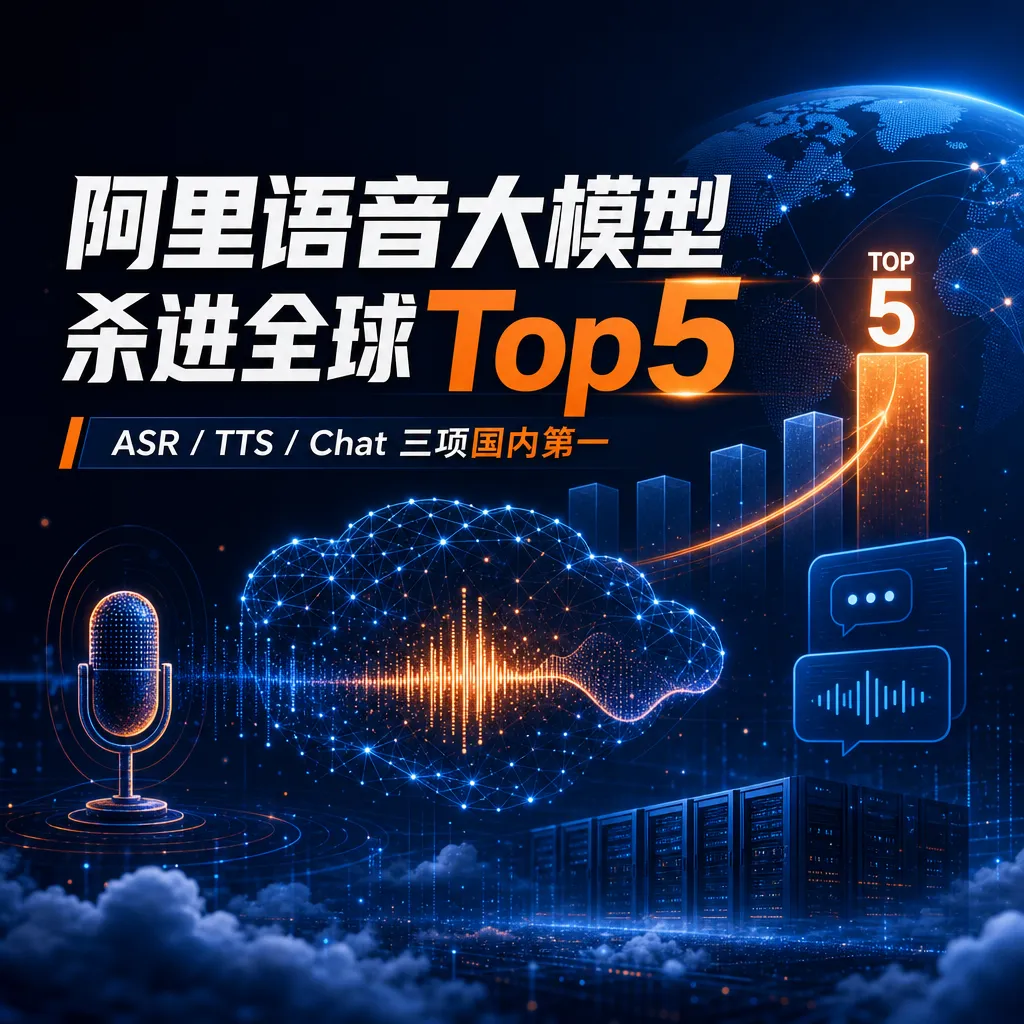
The latest rankings from the Artificial Analysis Speech Arena on May 28 show that Ali Fun-Realtime-TTS-Preview achieved an Elo rating of 1190, ranking fifth globally and first among domestic systems. It also took first place domestically in three subcategories: ASR, Chat, and TTS.
Alibaba’s Speech Large Model Breaks into Global Top Five on Speech Arena, Sweeps Three Domestic Tracks
On May 28, Artificial Analysis updated its Speech Arena leaderboard, where Alibaba’s speech large model Fun-Realtime-TTS-Preview achieved an Elo score of 1190 — ranking fifth globally and first among Chinese models. In the same leaderboard, across the three sub-tracks of ASR (speech-to-text), Chat (end-to-end voice conversation), and TTS (text-to-speech), Alibaba now holds the top domestic position in all three.
At first glance, the ranking may not seem earth-shattering — OpenAI, ElevenLabs, and MiniMax’s recently debuted top-ranked Speech-02-HD still lead the pack. But within the context of the domestic speech AI field, the significance shifts: over the past year, few domestic companies have reached the finals in all three subcapabilities simultaneously. Alibaba has now done all three with a single unified model, and without obvious specialization bias.
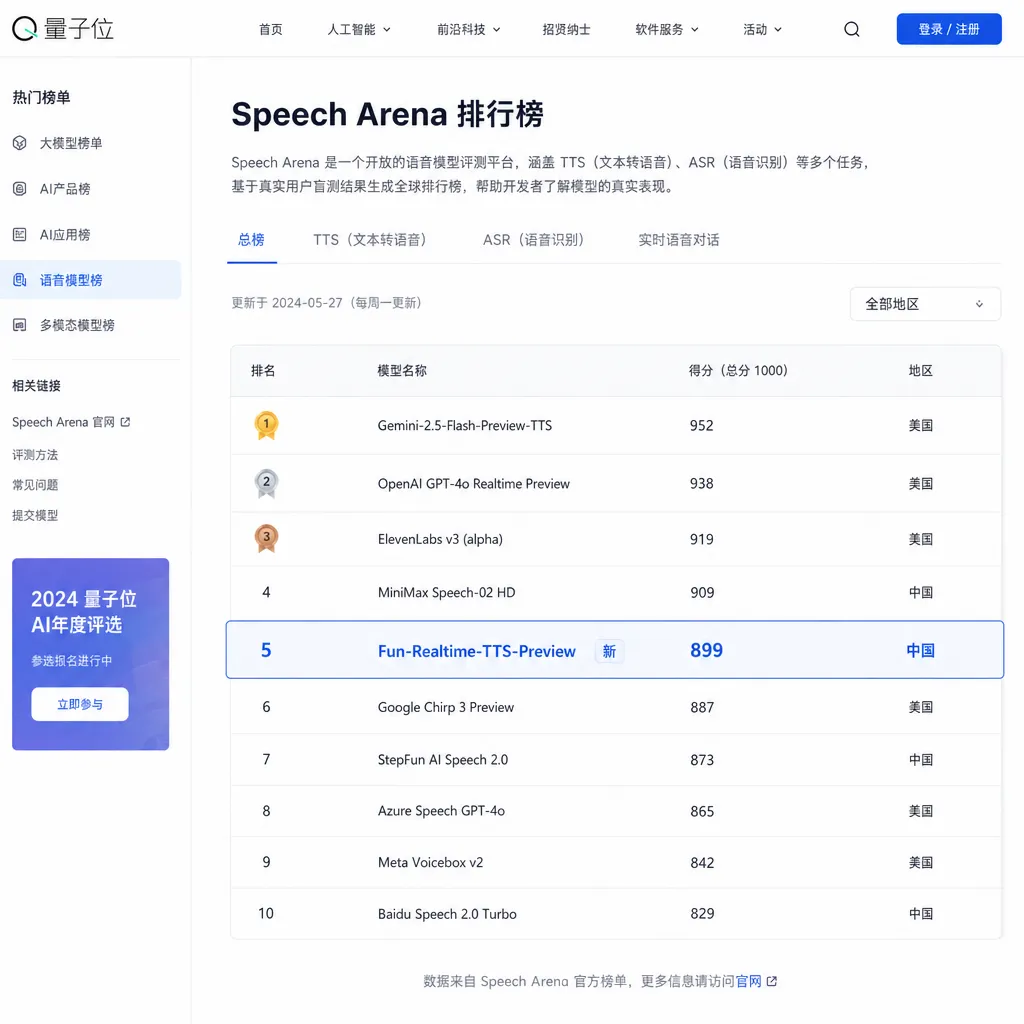
What does an Elo score of 1190 mean
Let’s first unpack how the leaderboard works so these numbers don’t feel abstract.
Artificial Analysis’s Speech Arena follows the same methodology as LMSYS Chatbot Arena — double-blind testing plus the Elo rating system. Users enter a text or upload an audio clip, the platform randomly calls two models, presents the results anonymously, and asks users to vote for the better one. Votes are aggregated and Elo scores are updated continuously.
This scoring system has several characteristics:
- It doesn’t rely on fixed test sets, making it hard to game through data memorization.
- Results reflect user preferences, capturing qualities like natural tone and emotional expression that metrics such as WER (word error rate) or MOS (mean opinion score) can’t easily quantify.
- Elo score differences correspond to win probability — a 1190 vs 1100 gap indicates that the first wins significantly more blind tests, beyond noise.
The top models usually hover around 1230, with small margins among the global top five. In other words, with 1190, Alibaba’s model is close to the first tier, though not quite at the ceiling yet.
What exactly is Fun-Realtime-TTS-Preview
Let’s unpack the name piece by piece.
Fun is a long-running family of speech projects under Alibaba DAMO Academy (now more commonly under the Tongyi Lab umbrella). Projects like FunASR, FunAudioLLM, and FunClip all originate from this line. FunASR’s GitHub repo has tens of thousands of stars — most developers working on speech in China have integrated its toolchain at some point. Fun-Realtime-TTS-Preview can be understood as the newest member, a preview version of an end-to-end large speech model.
Realtime is not decorative. In recent years, the main engineering bottleneck in speech large models has shifted from quality to latency — to make natural turn-taking, interruptions, and instant reactions possible, the first-packet delay must be under 300 ms, ideally around 200 ms. OpenAI demonstrated this “instant reply after interruption” capability last year with GPT-4o, addressing exactly that challenge. Fun-Realtime follows the same principle.
The TTS-Preview suffix can be misleading: it looks like a TTS-only model, but the leaderboard shows it ranks first domestically in ASR and Chat too. The most reasonable interpretation is that this is a unified end-to-end speech model — TTS is its main public entry point, but its underlying architecture supports listening, speaking, and chatting. This “one model for three tasks” design is closer to GPT-4o’s speech mode than to the traditional three-module chain of ASR + LLM + TTS.
Three-stage vs end-to-end — what’s the difference
This distinction is key to understanding today’s speech AI landscape.
A traditional voice assistant works like this:
Audio input → ASR model → Text → LLM → Text → TTS model → Audio output
Each module is separate, leading to cumulative latency, information loss, and error propagation. For example, if ASR mishears “That shop’s quite expensive” as a question, the downstream LLM might answer incorrectly. Or if the user laughs or sighs, that paralinguistic information disappears entirely once converted to text.
The end-to-end approach compresses this chain:
Audio input → Unified speech large model → Audio output
The model processes audio tokens directly, skipping text as the sole intermediate representation. Benefits include lower latency, preserved emotion and prosody, and expressive speech synthesis. The trade-offs: higher training cost, more complex data handling, and less fine-grained control than pure TTS (you can’t tweak pronunciation as easily as with SSML).
The fact that Alibaba topped the domestic Chat track is particularly notable — it showcases real-time, end-to-end voice conversation capability. Winning here suggests Fun-Realtime isn’t just a repackaged TTS model but a truly unified speech system.
The current landscape in China’s speech AI race
For comparison, here’s how major domestic players line up:
- MiniMax: Speech-02-HD reached the global #1 in the TTS subranking in early May, excelling in timbre fidelity and multilingual synthesis — a TTS-first route with less focus on end-to-end chat.
- ByteDance: The Doubao speech model excels in low-latency user-facing integration, but rarely appears on third-party leaderboards.
- iFLYTEK: Spark Speech leverages deep ASR experience; strong in traditional pipelines, catching up on end-to-end architectures.
- Alibaba Tongyi: Fun-Realtime-TTS-Preview pursues a unified architecture + real-time interaction approach.
- Tencent and Baidu: each has its own speech lines (Hunyuan and Wenxin respectively), though they currently have limited presence on global benchmarks like Speech Arena.
MiniMax leads in TTS, while Alibaba leads in overall capability. Their strategies differ: MiniMax optimizes one point, while Alibaba builds a comprehensive base. From an API/platform perspective, the latter suits developer infrastructure; the former suits content generation tools.
What this means for developers
If you develop voice-based applications, a few key takeaways stand out:
-
Domestic end-to-end speech models are becoming production-ready. Until now, teams seeking low-latency voice interaction largely relied on OpenAI’s Realtime API — but foreign hosting poses latency, compliance, and cost issues. A stable Alibaba API would be an attractive domestic alternative.
-
“Preview” means APIs and pricing are still evolving. It’s not time to switch production pipelines yet, but it’s ideal for running POCs or technical evaluations.
-
Three-stage architectures still have cost-performance advantages. Don’t scrap your existing pipeline just because end-to-end models look impressive on benchmarks. For less latency-sensitive workloads or those needing middle-layer filters like content control or logic injection, the modular chain remains more flexible.
-
Leaderboards are reference points, not ultimate truths. Speech Arena tests primarily for naturalness. Your deployment might care more about multi-turn consistency, long audio handling, or domain-specific accuracy. Always benchmark with real application data.
On a related note, OpenAI Hub is integrating speech APIs under a unified interface — its Realtime API and several mainstream TTS models already comply with the same format. If Alibaba releases a public API, it’s expected to follow suit. A unified key for both text and voice models would greatly simplify life for teams building voice agents.
A takeaway
Alibaba’s top-five result isn’t a sudden miracle — foundations like FunAudioLLM, CosyVoice, and SenseVoice laid the groundwork, making a unified end-to-end model inevitable. What’s interesting is timing: MiniMax claimed TTS global #1 in early May, and Alibaba responded by the end of May with a three-track domestic sweep. The pace of China’s speech AI race is clearly accelerating.
Two things to watch next: when Fun-Realtime moves from preview to official release and what its API pricing looks like; and whether ByteDance’s Doubao Speech will join public benchmarks to compete directly. Over the past year, speech models have been overshadowed by text LLMs, but with the maturity of end-to-end architectures and sub-300 ms latency breakthroughs, 2026 may be the year speech AI becomes true product infrastructure.
References
- MiniMax Speech Model Tops Global TTS Leaderboard – Zhihu: Background report on MiniMax Speech-02-HD’s rise to #1 in early May, useful for context when comparing Alibaba’s results.


