
Tencent WorkBuddy Goes Global: MCP Intelligent Agents Lead the Way

Tencent today released the international version of the desktop AI agent WorkBuddy, with native MCP protocol support for integration with overseas workflow tools such as GitHub, Jira, Notion, and Slack, becoming the first product in Tencent’s Agent Matrix aimed at the global market.
On May 28, Tencent pushed WorkBuddy to overseas markets. Following the domestic launch on March 9 and the dense mid-March release of the entire “Lobster Task Force” product lineup, this marks the first time a product from Tencent’s Agent line has ventured beyond China’s borders—and it sent out its most technically aggressive version: a desktop agent based on the MCP protocol.
The timing is delicate. Just two and a half months have passed since the domestic release, and a little over a year since Anthropic introduced the MCP protocol. Across the Agent ecosystem, the demand for “standardized tool invocation” is spreading from developer communities to enterprise IT procurement lists. This time, Tencent didn’t take the cautious path of focusing deeply on Chinese users first; instead, it directly chose to compete head-to-head with products like Claude Desktop, Cursor, and various overseas Agent IDEs—a rare move in Tencent’s history of global expansion.
Not Just a Simple Translation
Let’s clarify what the international version actually does. According to information disclosed today by 36Kr, WorkBuddy’s international version features three key changes:
- Localized adaptation: The UI, language, and work habits were completely redesigned for international users—it’s not just replacing Chinese menus with English.
- Skills package + expert/expert group mechanism: This product philosophy already existed in the domestic version—breaking complex Agent capabilities into composable “skill units,” and using an “expert group” to let multiple agents collaborate on tasks. The international version retains this architecture but has rebuilt the skill package content for overseas scenarios.
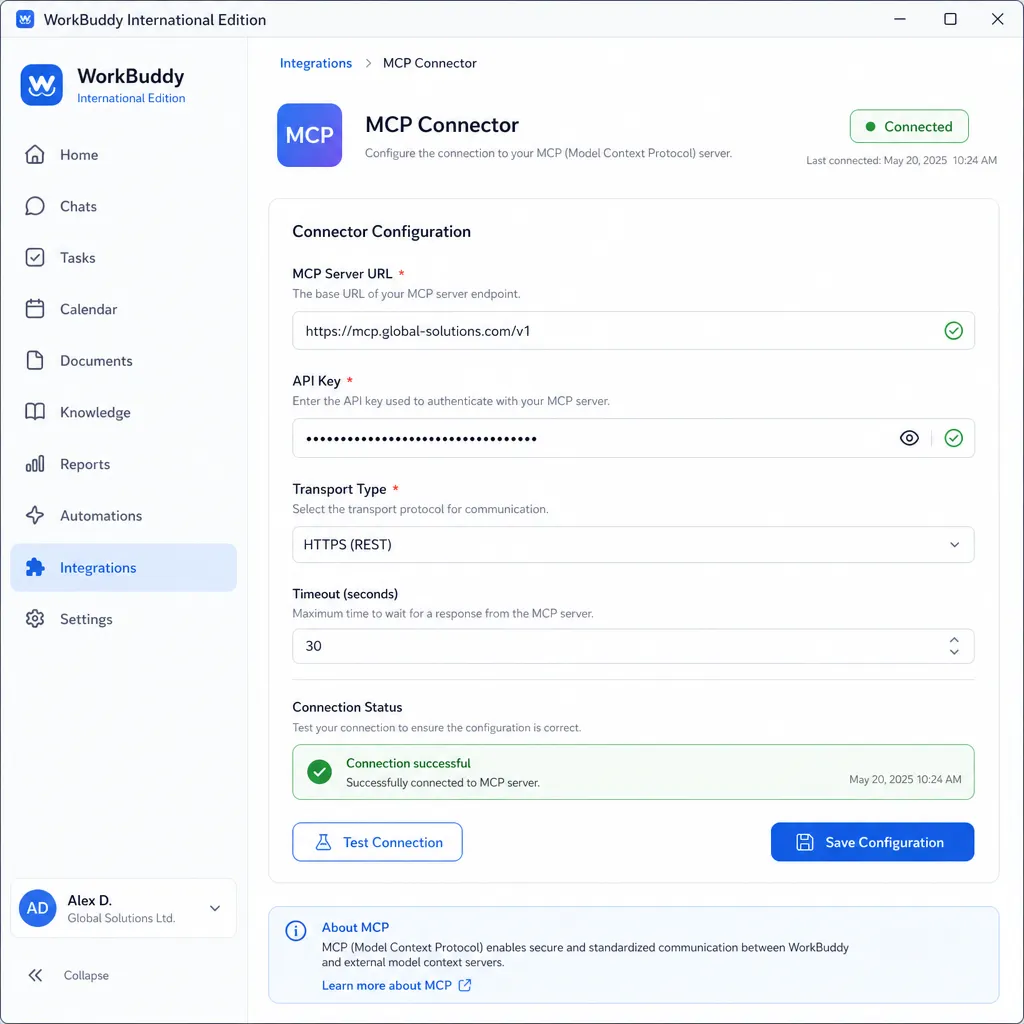
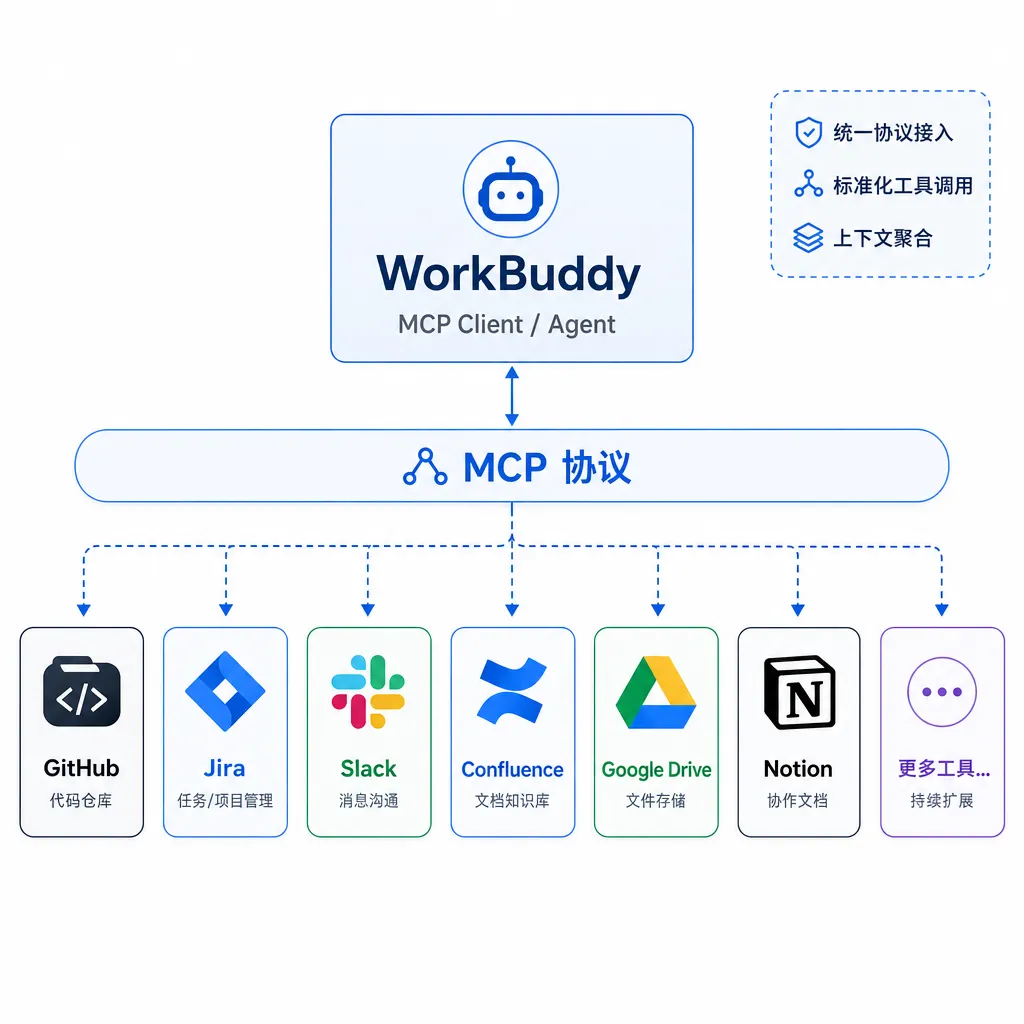
- MCP connector matrix: This is the most noteworthy feature in the release. The international version includes built‑in MCP connectors for GitHub, GitLab, Jira, Confluence, Google Drive, Gmail, Notion, and Slack.
Looking at this connector list, Tencent’s target users couldn’t be clearer: overseas development teams and knowledge workers. These eight tools essentially cover the entire daily workflow of a mid‑sized software company—code hosting (GitHub/GitLab), project management (Jira), documentation (Confluence/Notion), file storage (Google Drive), email (Gmail), and collaboration (Slack).
The domestic version’s connectors, by contrast, correspond to QQ, WeCom, Feishu, and DingTalk—targeting Chinese office scenarios. Comparing the lists shows that Tencent sees WorkBuddy as a “protocol‑layer product”: the same underlying Agent core and Skills framework, with connectors switched atop according to market. The decoupling is impressively clean.
Why MCP Is the Key to This Battle
To understand what differentiates the international version, we can’t ignore MCP (Model Context Protocol). Introduced by Anthropic in late 2024, MCP essentially defines a unified interface specification for how large models invoke external tools—it’s like USB‑C for the Agent world. Before MCP, every Agent vendor had its own tool‑calling protocol, and developers had to rewrite integration code for each new tool; with MCP, tool providers just need to write one MCP Server, and all MCP‑compatible Agents can use it.
By mid‑2026, the MCP ecosystem had grown substantially: major SaaS platforms like GitHub, Notion, Slack, and Stripe all released official MCP Servers, and over 2,000 third‑party servers exist in the open‑source community. Major overseas Agent products—Claude Desktop, Cursor, Zed, Windsurf—all natively support MCP.
But here’s an underrated fact: in the Asia‑Pacific region, WorkBuddy International is the first desktop agent to use MCP as its core connection layer and to be ready‑to‑use for both consumers and enterprises. Japanese Agent startups are still building proprietary protocols, Korean products remain at direct API stages, and Southeast Asia is dominated by Claude and ChatGPT. By choosing this timing, Tencent effectively laid down MCP “outlets” on Asian desktops right before the “USB‑C era” of Agents truly begins.
So what can connecting with MCP actually do? According to the official description, it enables “reading, writing, and operating external services without switching contexts.” Translated into developer‑friendly scenarios:
- Say in WorkBuddy: “Check my P0 bugs assigned in Jira this week, gather the corresponding GitHub PR links, and post them to the #dev channel on Slack.” — That’s a chain task calling three MCP Servers in one sentence.
- Say: “Sync this Confluence design doc to the product Wiki in Notion, formatted according to our team template.” — Cross‑platform document migration that once required manual copy‑paste or scripting.
- Say: “Scan all client emails from this week in Gmail, summarize feature requests into a Google Doc, and create corresponding Epics in Jira.” — A typical multi‑tool orchestration that used to demand Zapier or n8n workflows—now done with one sentence.
Aligned with the Domestic Version’s Product Logic
Looking back at the March 9 domestic release, we can see that the international version simply flips the same underlying product philosophy.
The domestic release focused on “zero deployment, zero configuration, ready in browser”—addressing the pain point that open‑source Agent frameworks like OpenClaw had too high a setup threshold; ordinary users struggled with Node.js environments and API permissions. Tencent’s solution was to wrap all that complexity into the client—download, install, and you’re ready.
The international version tackles a different pain point: the MCP ecosystem may be vibrant, but configuring an MCP Server is still a nightmare for non‑technical users—you must edit claude_desktop_config.json, know each server’s command‑line parameters, and manage OAuth authorization. Tencent turned this “configuration hell” into a GUI with instant use—essentially lowering the Agent usage threshold for both markets in its own way.
This product approach has precedent in Tencent’s history. Ma Huateng said at the company’s March staff meeting: Tencent isn’t always the originator of technology, but it’s often the first to make complex technology usable for everyone. QQ, WeChat, WeChat Pay, and Mini Programs all follow that path. With WorkBuddy’s international launch, that philosophy is now being applied to the Agent track overseas.
The Real Difficulty of Expanding Abroad
That said, let’s be realistic—WorkBuddy International faces much tougher conditions than its domestic counterpart.
First challenge: user habits. Overseas developers have been educated by products like Claude Desktop, Cursor, and Cline for over a year and already have fixed expectations of what an Agent should be. WorkBuddy’s “expert group” model lowers the threshold for Chinese users, but overseas developers are more accustomed to the DIY route: “I write my own system prompts, pick my own tools, build my own workflows.” This cultural difference isn’t something UI translation can fix.
Second challenge: model routing. The domestic version can seamlessly switch among Hunyuan, DeepSeek, GLM, Kimi, and MiniMax—ample local model supply. What model powers the international version? Official details are not yet public—but overseas users are hyper‑sensitive about model choice. Whether it’s Claude Sonnet 4.5 or GPT‑5.1, open‑source Llama or Tencent’s Hunyuan—it directly defines the product’s positioning. If Tencent hopes to open the enterprise market, it must either differentiate through Hunyuan self‑research or secure deep partnerships with model providers like Anthropic or OpenAI—neither path is easy.
Third challenge: compliance and data. Overseas enterprise markets impose rigorous requirements for data residency, SOC2, and GDPR. For a Chinese vendor making a desktop agent to win approval from Western IT procurement teams, the compliance process alone is lengthy. That explains why Tencent chose to start with developers—the compliance pressure for personal installations is far lighter than enterprise SaaS subscriptions.
What This Means for Developers
For overseas developers building Agent applications, WorkBuddy International changes at least three things:
- Another MCP‑compatible client choice. Beyond Claude Desktop, there’s now more than one desktop MCP container option.
- Skills packages could spark a new extension ecosystem. WorkBuddy’s Skills mechanism logically resembles Anthropic’s Skills SDK (introduced in 2025), but Tencent’s implementation leans more “plug‑and‑play.” If Tencent opens up Skills development documentation, it may create a new developer marketplace.
- The timing of Chinese vendors going global has shifted. Previously, domestic Agent products typically expanded “first to Southeast Asia, then to the West”; Tencent directly included GitHub, Slack, and Gmail in its initial connector list—signaling to peers: skip transitional markets, go straight to the main battleground.
In One Sentence
The domestic version of WorkBuddy solved “OpenClaw is good but too hard to install,” while the international version solves “MCP is great but too hard to configure”—the same product philosophy, applied to two markets.
Whether Tencent can truly win this fight depends on whether it continues to invest in the coming months—especially in model localization, enterprise compliance certification, and building a developer ecosystem around Skills. In the “Lobster Task Force” roadmap Ma Huateng shared on social media back in March, the last line said: “More products are on the way.” Today, that statement finally has an international version.
By the way, if you’re researching multi‑model Agent solutions, OpenAI Hub (openai-hub.com)—an AI API aggregation platform that supports unified calls to GPT, Claude, Gemini, DeepSeek, and other major models—makes it easier for domestic developers to test different models in Agent scenarios. One API key connects them all, compatible with OpenAI’s format, saving the hassle of applying for multiple overseas accounts.
References
- Tencent’s “Little Lobster” WorkBuddy Launch: Install and Use Instantly, Compatible with OpenClaw Skills – IT之家 – Detailed report on WorkBuddy’s domestic release on March 9
- Will the “Lobsters” Disrupt the Software World? – Deep Dive into OpenClaw – Zhihu – In‑depth analysis of OpenClaw’s technical architecture and ecosystem


