
Tencent Miora International Beta Invitation: Put your creative workflow into one intelligent agent

At Hong Kong Cloud Day on May 28, Tencent announced the launch of invitation testing for the international version of Miora (Miaojing), a full-scenario creative AI agent studio that integrates major visual models from home and abroad and covers all modalities of generation including images, videos, UI/UX, and 3D. This marks a key move in Tencent’s global AI strategy.
Tencent Miora International Beta: Putting the Entire Creative Workflow into One Intelligent Agent
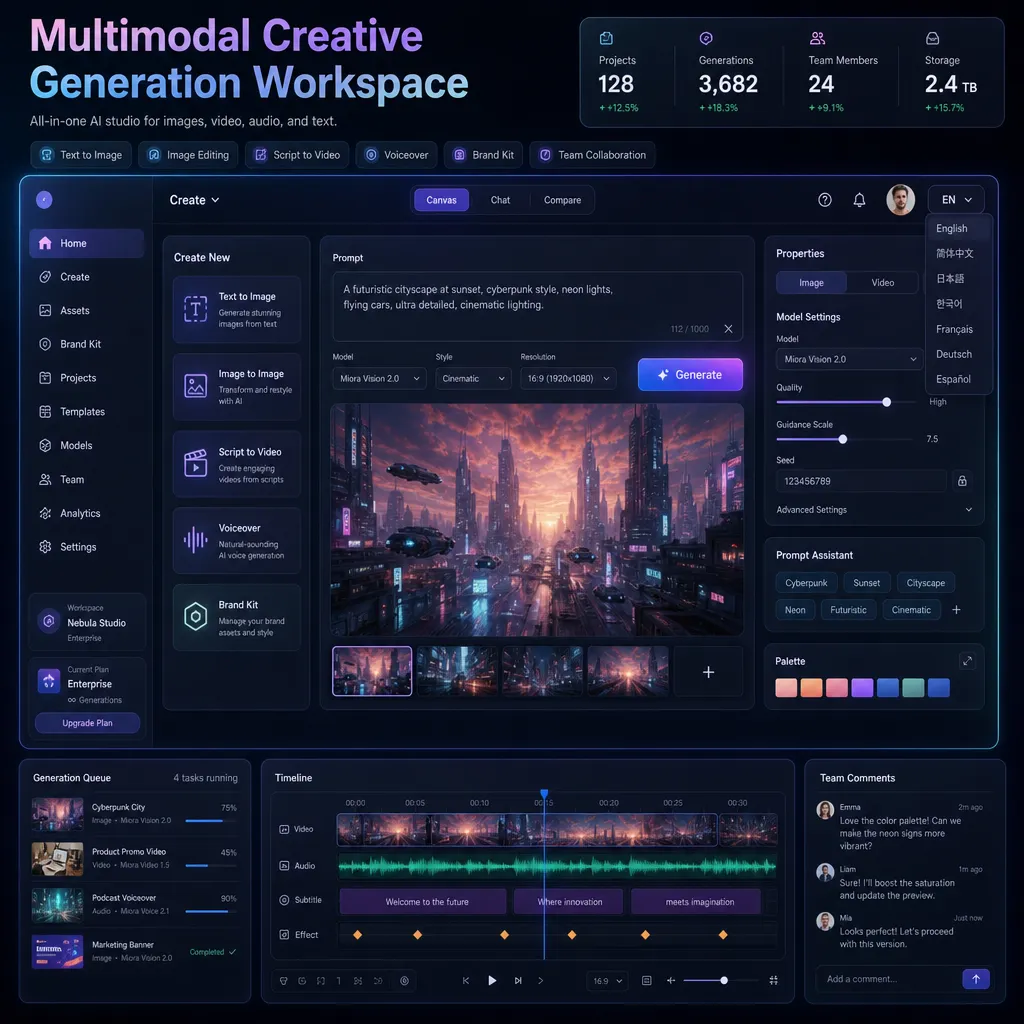
On May 28, Tencent unveiled a new card at Cloud Day Hong Kong—Tencent Design Miora (Miaojing) International Edition, which has started an invitation-only beta. It’s a full-scenario AI creative intelligence studio equipped with multiple mainstream visual models from home and abroad, covering image, video, UI/UX, and 3D multimodal generation. Access is currently limited to invite codes.
Choosing Hong Kong and Cloud Day as the time and place makes the intent clear: this is a new move on Tencent’s international AI chessboard. The target isn’t China’s crowded field of AI drawing apps, but rather overseas designers, creative professionals, and small to midsize studios.
Not Just Another Text-to-Image Tool
If you see Miora simply as the “Tencent version of Midjourney,” you’re underestimating it. From Tencent’s product positioning, Miora’s core concept is an “Intelligent Studio”—the keyword being studio, not “generator.”
Over the past two years, the AI visual track has gone through a rapid differentiation phase:
- Single-purpose tools: products like Midjourney, Keling, or Sora, which excel in perfecting one modality.
- Platform aggregators: connecting APIs from multiple models and letting users choose what to use.
- Workflow-based tools: following the ComfyUI route—linking generation, editing, and composition into programmable pipelines.
Miora clearly takes the third path, enhanced with agentic capability. Instead of asking you to “pick a model,” it lets an intelligent agent decide which model to use and how to sequence steps. Tencent Design’s logic here is to package the entire designer workflow—from receiving a brief, to generating mood boards, to image creation, to expanding visuals into videos and 3D assets—into a single conversational interface.
The challenge lies in being truly multimodal—images, videos, UI/UX, and 3D are each full tracks on their own. Miora aims to enable data flow among them: a character generated in an image can be directly turned into a 3D model; the visual style of a UI design can extend seamlessly into promo videos. This kind of cross-modal asset consistency is exactly what single-point tools struggle with.
Why "Mainstream Visual Models from Home and Abroad"
A detail in the official statement stands out: “equipped with multiple mainstream visual models from home and abroad.”
This isn’t Tencent suddenly being modest on its own Hunyuan turf. The logic is simple—
This is the international version. Overseas users won’t be convinced by “we use Hunyuan”; they’re used to tools like Flux, Stable Diffusion 3, and Veo. To open the global market, the model layer must be open, allowing users access to the SOTA tools they trust. Tencent’s winning edge isn’t in the models—it’s in orchestration, workflow, and product experience.
This move aligns perfectly with the “internationalization” strategy emphasized by Tang Daosheng at last September’s Tencent Global Digital Ecosystem Summit. At that time, Tencent Cloud International’s intelligent agent development platform ADP 3.0 and CodeBuddy had already gone global, with overseas client growth doubling. Miora extends that same line into C-end creative scenarios.
Who It's Competing With
Its direct competition includes “AI-powered creative giants” like Adobe Firefly, Canva Magic Studio, and Figma AI, as well as AI-native design platforms such as Krea, Leonardo, and Recraft.
Miora's differentiating edge lies in two areas:
-
Leading position in 3D generation. Tencent’s Hunyuan 3D series has surpassed 2.6 million downloads on Hugging Face, making it one of the most popular open-source 3D models globally. The Hunyuan 3D 3.0 and 3D Studio infrastructure gives Miora 3D capabilities that Adobe and Canva currently lack. This is one of the few areas where a Chinese tech company holds an asymmetric advantage over global giants.
-
UI/UX generation. This track currently lacks a true leader. Figma AI is still iterating slowly, Vercel v0 centers on frontend code generation, and Galileo has gone quiet post-acquisition. Miora elevating UI/UX as a first-class modality clearly targets this “vacant niche.”
Design Tools in the Intelligent Agent Paradigm
What’s more noteworthy is the product philosophy shift reflected behind Miora.
Traditional design tools follow the logic of “features–menus–buttons,” requiring users to learn the tool before using it. The first wave of AI transformation added a “magic button”—for example, Photoshop’s Generative Fill. But the essence remained tool-centric.
Design tools under an agent paradigm are a different story. The user tells the agent what they want, and the agent orchestrates models, arranges workflows, and outputs results. The designer’s role shifts from “operating tools” to “directing agents.” This is the real meaning behind the “studio” concept—Miora aims to become a designer’s virtual studio, not just another piece of software.
This approach aligns with Tencent’s other agent products launched this April at the Digital China Summit, such as WorkBuddy and QClaw. QClaw’s one-million-user milestone within 10 days already validated the explosive potential of “deployment-free, conversational agents” for consumer users. Miora follows the same trajectory, targeting creative scenarios and global markets.
How Usable Is It Right Now?
Currently, access is by invite-only; full capabilities have yet to be revealed. But reversing from Tencent’s known capabilities suggests a few likely components:
- Image generation layer: likely integrates Hunyuan Image 3.0 as well as top international open-source models like Flux and SD 3.5.
- Video generation layer: powered by Hunyuan Video models, potentially connected to the Veo or Kling international capabilities.
- 3D generation layer: centered on Hunyuan 3D 3.0, Tencent’s strongest domain.
- UI/UX layer: a new addition with unclear technical details, possibly combining large language models with visual model generation.
From a developer’s standpoint, the key concerns are API openness and workflow configurability. If Miora allows workflow exports like ComfyUI, or open model combinations like Replicate, it would strongly attract design engineers and independent creators. If it’s merely a closed SaaS, it will have to survive on the outer edge of Adobe and Canva’s moats.
Beta Rollout and Commercialization
Invite-only beta testing has become Tencent’s standard consumer-product rollout pattern—QClaw and WorkBuddy both started this way. The approach helps control scale, collect feedback, and stress-test monetization.
Pricing for the international version hasn’t been announced yet, but reference numbers from similar global tools include:
- Midjourney: $10/month basic
- Adobe Firefly: from $9.99/month
- Krea Pro: $35/month
- Leonardo: from $12/month
As a latecomer and multimodal suite, Miora’s pricing may be more aggressive than single-purpose tools. Tencent Cloud International already has mature overseas payment and distribution systems—a significant edge over startups.
A Few Takeaways
Miora’s success won’t depend on model performance—Tencent’s Hunyuan has already proven its foundation there. The real keys are threefold:
-
Cross-modal asset consistency. This is the ultimate pain point of every creative workflow—whoever solves it first wins the market.
-
Overseas creator community. Design tools risk being “one-time use” apps; they need ecosystems for sharing works, reusing templates, and trading skills. Tencent has SkillHub experience (with over 35,000 skills domestically). Replicating that for Miora will be critical.
-
Intelligence of agent orchestration. If Miora can interpret briefs like a seasoned designer—choosing routes, proposing optimization proactively—it becomes the pinnacle of workflow-based tools. If it’s merely a multi-model aggregator wrapped in chat UI, it will soon face homogenized competition.
The beta doesn’t yet answer these questions, but Tencent’s choice to debut Miora at Cloud Day Hong Kong clearly signals its intent to play the long game. The next milestones to watch will be the public beta and pricing reveal.
References
- Tencent Hunyuan Open-Source Models - Hugging Face – Homepage for Tencent’s Hunyuan open-source models, including weights and docs for 3D, image, and video models.


