
Alibaba Qoder Launches Cloud Agents: Reducing Enterprise Agent Deployment from One Month to One Day
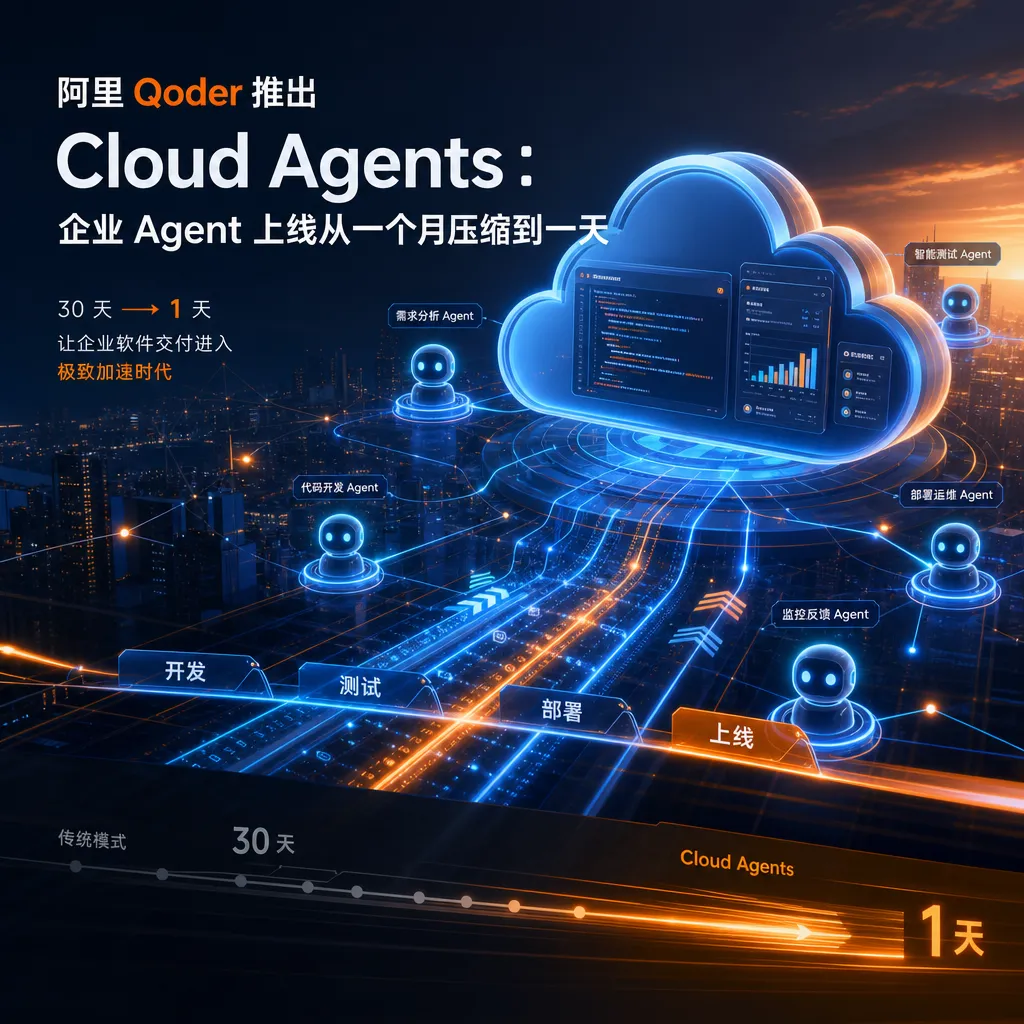
Ali Qoder today launched **Cloud Agents**, a fully managed AI Agent operating platform, which packages the Agent framework, model services, and runtime environment into a cloud service accessible via API. This shortens the enterprise Agent development cycle from one month to one day.
Alibaba Qoder Launches Cloud Agents: Reducing Enterprise Agent Deployment Time from One Month to One Day
On May 28, Alibaba Qoder launched Cloud Agents, a fully managed AI Agent runtime platform. Put simply, it packages together the Agent foundation, model services, and runtime environment, so enterprises no longer need to wrestle with inference engines, sandboxes, or long-running session management — they can simply call an API and get running. According to Qoder, the time from Agent development to deployment has been cut down from one month to a single day.
This move follows Alibaba’s Full-Stack AI launch event in Singapore on May 26, where Qwen Cloud, Qoder 1.0, and QoderWake digital employees were unveiled, along with the “agentification” of more than 60 cloud products. The roadmap is clear: transform the cloud from being “for humans” into being “for Agents.” Cloud Agents is the key piece that brings this strategy to enterprises.
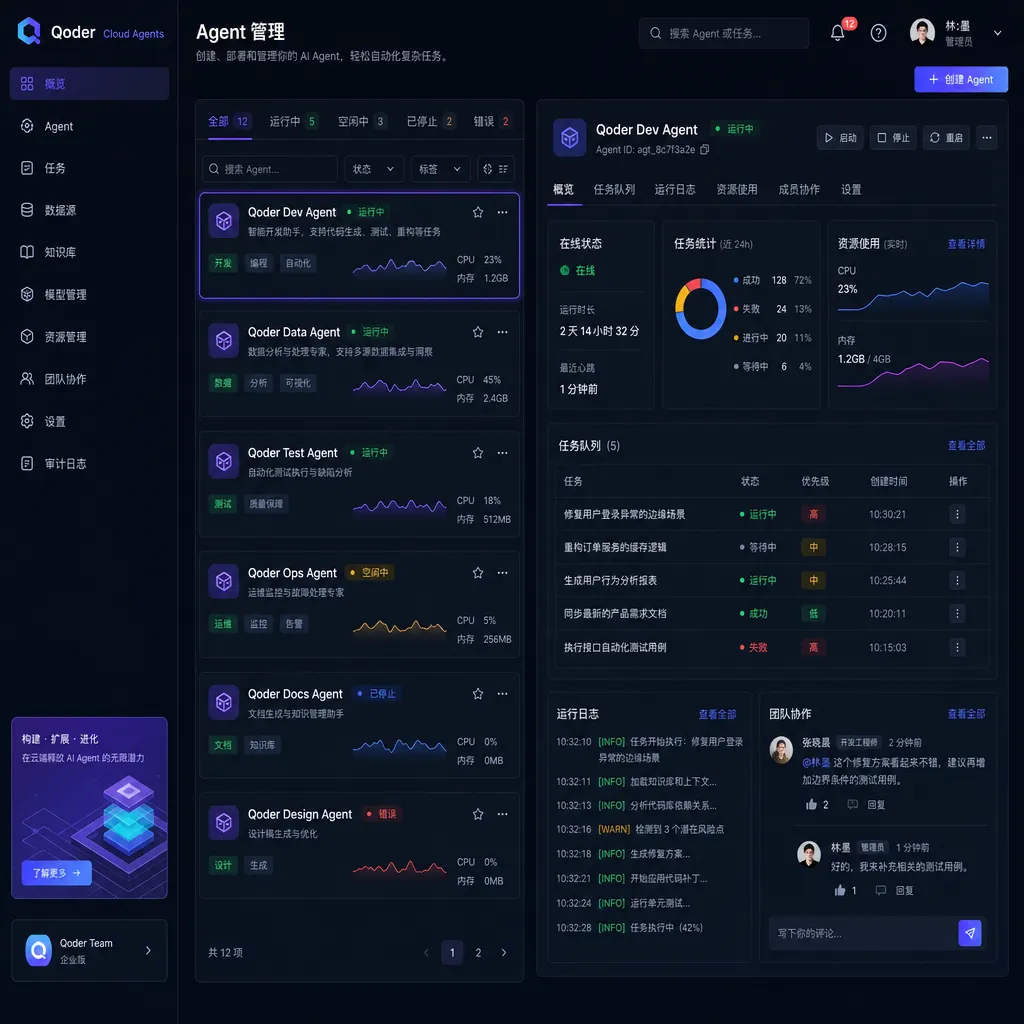
Where Enterprises Get Stuck with Agents
Over the past year, general-purpose Agent tools like Manus, Devin, and various “Computer Use” frameworks have indeed boosted efficiency for individual developers and white-collar workers. But they often fall short in enterprise settings. The reason is straightforward: general-purpose Agents solve “general tasks,” while enterprises need “domain-specific Agents” that integrate with real business flows such as customer service, risk control, operations, and compliance review — all of which require 24/7 uptime, fault recovery, and auditability.
Teams who’ve tried to operationalize Agents understand how much engineering is involved. To build a usable Agent, at minimum you need to handle:
- Inference execution engine – Stitching together tool calls from model outputs into a controllable execution loop, handling retries, timeouts, and exceptions.
- Sandbox environment – Isolating the Agent’s execution space so code runs, commands, and network access can’t impact the main system.
- Long-term sessions and memory – Business workflows often involve dozens or hundreds of tool calls; you must persist sessions, compress context, and resume workflows properly.
- Observability and auditability – Every inference step and tool call must be traceable and replayable for compliance and risk checks.
- Elastic scaling – Expanding capacity during daytime call-center peaks, and scaling down at night; managing that with K8s alone is another chunk of work.
Each of these tasks isn’t individually hard, but running them together stably is. For most teams, two or three engineers will spend a month assembling this foundation. Cloud Agents aims to offload all that infrastructure management.
What Exactly Is Cloud Agents Wrapping
According to the official description, Cloud Agents wraps the full Agent development and runtime process into a unified managed service, allowing enterprises to “invoke complete Agent capabilities just like using any cloud product.” That statement sounds abstract, but it really consists of three layers:
The first layer is the Agent engine itself.
The underlying engine is Qoder’s in-house Coding Agent Engine, which has been running for nine months across Qoder Desktop, Qoder CLI, and Qoder 1.0 with 5 million users worldwide. Its capabilities — understanding complex needs, invoking tools, executing long tasks, and fault recovery — were honed in the coding domain. Writing code demands sophisticated multi-step planning, debugging, and fault tolerance; an Agent that can handle code can easily adapt to support customer service, operations, and risk control scenarios.
The company claims that “without changing a single line of code, the same Agent can be directly applied to customer service, operations, risk management, or IT maintenance.” This may be an overstatement — you’ll still need some prompt engineering and tool configuration — but the core engine indeed doesn’t need rewrites.
The second layer is the runtime environment.
Each Agent instance gets an independent sandbox — a must-have in enterprise contexts to prevent data cross-contamination between tenants or business lines. Every tool call and inference step is delivered in real time via SSE (Server-Sent Events), allowing full traceability, replay, and auditability.
Choosing SSE is pragmatic. Compared to WebSocket, SSE’s unidirectional push is simpler, browser-native, and easier to reconnect. For streaming long-running Agent tasks, SSE is effectively the standard — both Anthropic’s Claude API and OpenAI’s Responses API use SSE streams.
Elastic scaling is another detail. Agent workloads differ from standard web services — a single task might run for minutes or hours, and concurrency models vary wildly. Automatic scaling optimized specifically for long Agent tasks means Cloud Agents schedules workloads differently, not just by layering basic HPA (Horizontal Pod Autoscaler).
The third layer is extensibility.
Cloud Agents natively supports Skills and the MCP (Model Context Protocol).
Skills are a Qwen Cloud and QoderWork concept, standardizing platform capabilities into Agent-readable commands. MCP, open-sourced by Anthropic last year, has become the de facto standard for connecting external tools to Agents.
The dual-protocol approach makes sense: MCP handles integration (“how to connect external tools”), while Skills handle usability (“how Agents learn to use them”). Enterprises can connect internal APIs, databases, or SaaS tools through MCP, then wrap them as Skills that define business semantics. The Agent can then call them directly.
What “One-Day Deployment” Really Means
The claim of “from one month to one day” needs unpacking. What’s compressed is not model tuning or business understanding but the engineering effort of building the infrastructure layer.
Typically, an enterprise building a production-grade Agent follows this timeline:
- Choose a model, integrate API, write the Agent loop (3–5 days)
- Set up sandbox, isolation, and permissions (5–7 days)
- Implement session management and long-task orchestration (3–5 days)
- Integrate monitoring, audit logs, and replay features (3–5 days)
- Perform deployment, load testing, capacity tuning, and release (5–7 days)
- Tune prompts and integrate tools (ongoing throughout)
The first five steps are all infrastructure-related — Cloud Agents manages them out of the box. What’s left is step 6: defining how the Agent interacts with the business and connecting internal systems via MCP. That can genuinely be done in a day.
However, there’s a common misconception: “one-day deployment” doesn’t mean “one-day business impact.” Prompt refinement, tool alignment, and edge-case handling can still take weeks. Cloud Agents solves the engineering reuse problem — not the business understanding problem.
Common Use Cases
The official examples span a broad range:
- Enhance existing software or apps with an intelligent assistant – The most direct use case; treat the Agent as a new interaction layer.
- Financial anomaly monitoring – Batch tasks that periodically scan data and auto-detect or handle anomalies.
- Contract compliance review – Long-document analysis and rule comparison, challenging for traditional NLP.
- Ops inspection – 24/7 monitoring tasks where the Agent decides whether deeper investigation is needed.
- Public sentiment and competitor tracking – Cross-platform crawling, summarizing, and analysis — the classic long-task Agent use case.
The common traits: clear task boundaries, dense tool usage, and long-run operation requirements. These scenarios play exactly to an Agent’s strengths over traditional automation scripts — scripts can’t “reason” and tend to fail on new cases; Agents can at least explore multiple paths.
Within the Qoder Ecosystem
So far, Qoder’s product lineup spans:
- Qoder Desktop / IDE – Developer workstation
- Qoder CLI – Command-line Agent
- Qoder JetBrains Plugin – IDE integration
- QoderWork – Desktop AI workspace for general users
- QoderWake – Digital employee (open beta)
- Cloud Agents – Newly released fully managed Agent platform
- Qoder Mobile
The logic behind this lineup is segmenting by user type and deployment model: developers use Desktop/CLI/JetBrains, business users use QoderWork, organizational deployment uses QoderWake, and system integration uses Cloud Agents. Combined with localized Chinese editions, the company now runs parallel domestic and international product lines.
In this matrix, Cloud Agents’ role is clear — it’s not a coding tool for developers, but foundational enterprise IT infrastructure that can be “bought and used.” The earlier products are tools; Cloud Agents is a platform.
How to View Cloud Agents
Objectively, Cloud Agents isn’t a brand-new concept. AWS Bedrock Agents, Azure AI Studio, and Google Vertex AI Agent Builder all offer similar products. Chinese providers like Volcano Engine, Tencent Cloud, and Baidu Intelligent Cloud do as well. Cloud Agents differentiates itself in two ways:
First, the Coding Agent Engine foundation.
This is a deliberate choice. Most Agent platforms use “general-purpose” Agent frameworks — broad but shallow. Qoder’s coding-centric foundation means it first solved one of the hardest scenarios. Coding requires extreme precision in planning, debugging, and error handling; if that engine works there, it can easily handle simpler business tasks like customer service or operations.
Second, deep integration with Alibaba Cloud’s full stack.
At the May 26 event, Alibaba Cloud “skillized,” “MCP-enabled,” and “CLI-enabled” over 60 cloud products. The value of that move now becomes evident with Cloud Agents — enterprise Agents operating on Alibaba Cloud (OSS, RDS, SLB, etc.) can call these services via Skills without custom SDK code. AWS and Azure both pursue similar integrations, but Alibaba’s rollout is particularly aggressive.
There are, of course, some concerns. One is pricing — fully managed services have different cost structures than self-hosting, and total cost-effectiveness will depend on pricing details. Another is data compliance — while Cloud Agents’ sandboxing and auditing are designed for governance, industries such as finance and government might hesitate to run Agents on the public cloud. Given that Qoder already offers localized Chinese editions, private deployment versions are likely coming.
As of now, Cloud Agents is available for trial on Qoder’s official website (qoder.com/cloud-agents). Over the past year, the Agent field has shifted from flashy demos to serious engineering and infrastructure competition. Cloud Agents represents a turning point — general-purpose Agents still have a “toy” element, but platforms like this that handle all the heavy lifting are what actually help enterprises save and earn money.
References
- Alibaba Qoder Launches Cloud Agents: Agent Deployment Takes Just One Day – IT Home — IT Home’s first report on Cloud Agents, including product capabilities and use cases


