
New on Hugging Face: MONET — 100 million high-quality image-text pairs now open source

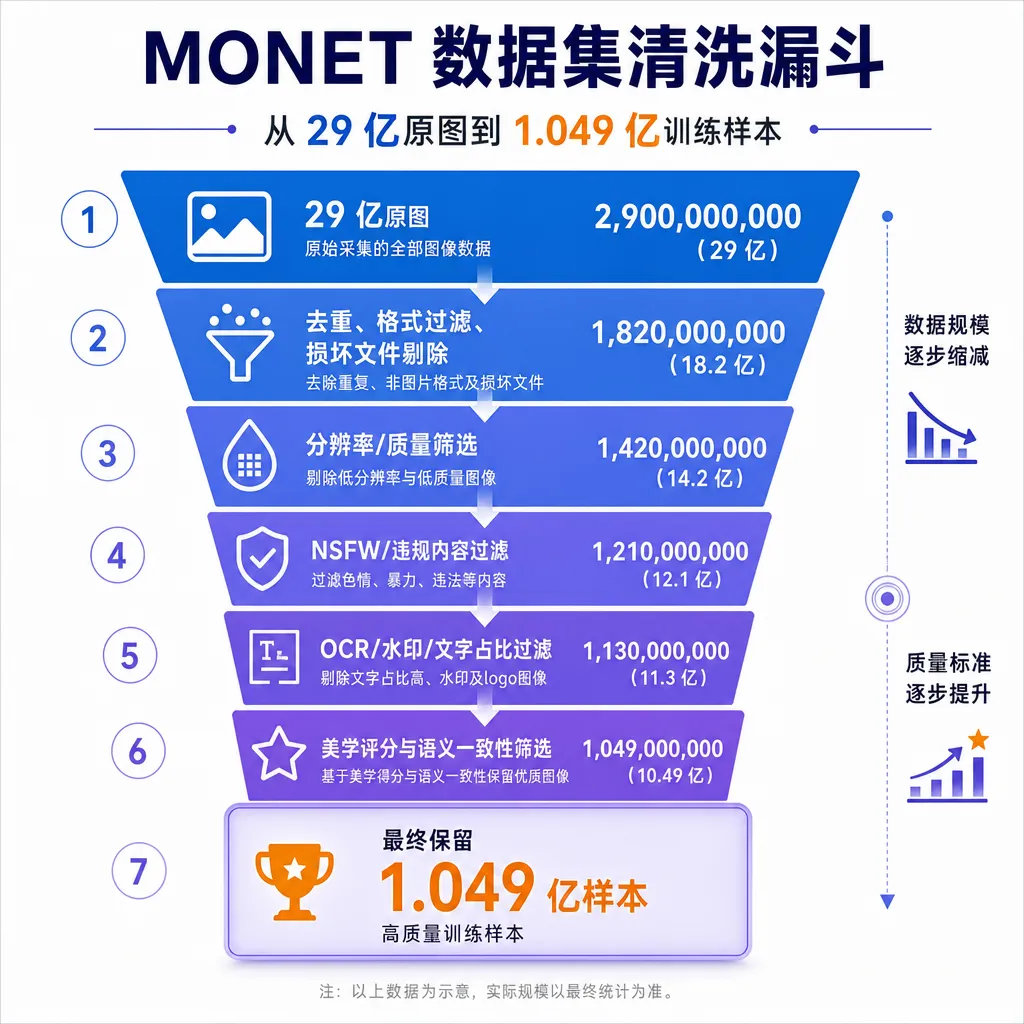
Jasper AI has open-sourced the MONET dataset on Hugging Face, refining 104.9 million high-quality image-text pairs from 2.9 billion images. Licensed under Apache 2.0, it comes with UMAP visualization, retrieval tools, and T2I training code.
A new dataset worth bookmarking for developers has been added to Hugging Face. The Jasper AI team recently open-sourced MONET — a high-quality text–image pair dataset distilled from 2.9 billion raw images into 104.9 million samples. It’s released under the Apache 2.0 license, commercially usable, and comes with an accompanying paper, visualization tools, retrieval interface, and T2I training code.
For teams training text-to-image (T2I) models, this is one of the rare large-scale open-source assets in recent months that is truly plug-and-play.
From 2.9 Billion to 100 Million: The Subtractive Logic of MONET
The key figure for MONET isn’t 100 million but the ratio of 2.9 billion to 100 million — meaning about 96.4% of the raw data was discarded.
This “subtraction” is more interesting than mere “addition.” Over the past few years, the dominant trend in open-source multimodal datasets has been scale building: LAION‑5B claims 5.8 billion pairs, MINT‑1T reaches 1 trillion tokens and 3.4 billion images, and OBELICS contains 353 million images. But anyone who has trained SD, SDXL, or any self‑built T2I model knows that the truly usable samples in those datasets are far fewer than the nominal counts — due to watermarks, low resolution, machine‑translated alt text, duplicated content, and low‑aesthetic samples. Every team ends up having to run its own cleaning pipeline.
What MONET does is standardize and front‑load that cleaning process. The team hasn’t disclosed the full filtering pipeline (that’s in the paper), but from the dataset card we know it includes at least resolution filtering, aesthetic scoring, caption rewriting/reordering, deduplication, and safety filtering. The remaining 104.9 million samples each have captions and metadata, ready to feed directly into diffusion‑training frameworks.
Three Supporting Tools: Turning the Dataset into an Usable Engineering Asset
Unlike open releases that simply dump a parquet file, MONET includes three complementary projects worth calling out:
- UMAP Visualization – Displays the semantic distribution of 100 million samples in two dimensions. This isn’t a toy demo; it’s genuinely helpful for selecting subsets to train stylistic models, judging distribution skew, and locating long‑tail classes.
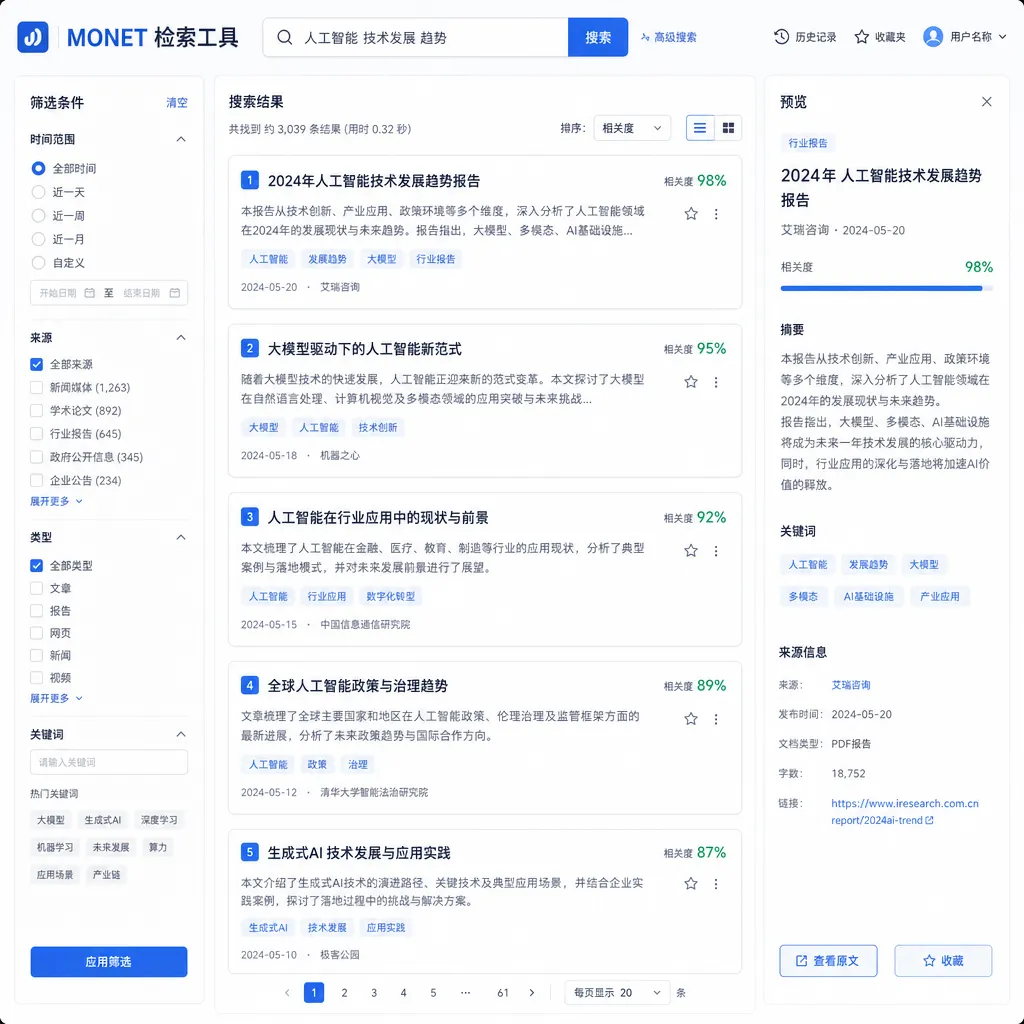
- Retrieval Tool – Supports bidirectional text–image search. You can enter a prompt to see which samples in MONET might negatively bias a model, or upload a reference image to find stylistically similar training samples — critical for fine‑tuning and subset selection.
- T2I Training Codebase – Complete code for training text‑to‑image models based on MONET, meaning small teams don’t have to build the dataloader, loss functions, and evaluation pipeline from scratch — they can fork and run directly.
Together, these make MONET not just a dataset but a minimal reproducible pipeline from data to model. For researchers and startups alike, this meaningfully lowers the entry barrier.
In Context: Where MONET Stands Among Peers
A comparison of today’s mainstream open‑source text–image datasets:
| Dataset | Scale | Source | License | Features | |----------|--------|---------|----------|-----------| | LAION‑5B | 5.8 B pairs | Common Crawl | CC‑BY 4.0 | Largest scale, but quality fluctuates and access has become difficult | | COYO‑700M | 747 M pairs | Common Crawl | CC‑BY 4.0 | Kakao Brain project, stricter filtering | | DataComp‑1B | 1.4 B pairs | Common Crawl | Various | Filtering driven by benchmarking | | OBELICS | 141 M docs / 353 M images | HTML | CC‑BY 4.0 | Interleaved text–image data, Hugging Face M4 team | | MINT‑1T | 1 trillion tokens / 3.4 B images | HTML/PDF/ArXiv | Partly open | Salesforce multimodal interleaved | | MONET | 104.9 M pairs | Refined from 2.9 B source pool | Apache 2.0 | High filtering ratio, full tooling provided |
In absolute scale, MONET isn’t the largest — in fact, it’s an order of magnitude smaller than LAION‑5B. Its distinct advantages lie in two areas:
- Apache 2.0 License – One of the most permissive open‑source licenses available, explicitly allowing commercial use. By contrast, CC‑BY datasets require attribution and some research‑only datasets forbid commercial use. For product teams, this difference is crucial.
- High filtering ratio and training efficiency – 100 million clean samples can outperform 500 million noisy ones — repeatedly confirmed by training experiences from SDXL, PixArt‑α, and others. PixArt‑α achieved comparable results to contemporaries using only ~10 million meticulously cleaned samples. At MONET’s scale, there’s ample data for training a medium‑sized T2I model.
A Less Obvious Point: Caption Quality
In recent years, the bottleneck of text–image datasets has shifted from the image side to the text side.
The reason is simple: high‑resolution images are easy to find; high‑quality descriptions are not. Web alt text is often SEO keyword spam or meaningless filenames like “IMG_2024.jpg.” When DALL·E 3 used GPT‑4 to rewrite captions, that step was widely recognized as key to its performance leap. Stable Diffusion 3 and FLUX later adopted similar methods.
The MONET card states that samples include captions and metadata but doesn’t specify whether captions are original or rewritten by a vision‑language model (VLM). Given the filtering ratio and the team’s background, it’s likely that captions were rewritten or at least quality‑scored by a VLM — otherwise a 96% rejection rate would be hard to explain. The forthcoming paper will clarify this.
If captions were indeed VLM‑enhanced, MONET’s effective training value would be far higher than its raw size suggests.
What It Means for Developers in China
Concrete use cases include:
- Training or fine‑tuning T2I models – MONET + its training code provides a complete starter kit. Teams with limited budgets can sample a subset (e.g., 10 million via UMAP clustering) to train a domain‑specific small model.
- Building retrieval‑augmented generation systems – 100 million text–image pairs with embeddings form a solid image‑retrieval corpus for RAG pipelines to assist image generation.
- VLM evaluation and fine‑tuning – High‑quality caption data also benefits vision‑language models like Qwen‑VL or LLaVA, not just T2I models.
- Academic baselines – The Apache 2.0 license plus full toolchain makes MONET a likely comparative baseline for future studies on data filtering, caption quality, and aesthetic scoring.
Note: downloading and storing 100 million images is non‑trivial. At an average of 100 KB per image, the full dataset is roughly 10 TB. Hugging Face’s datasets library supports streaming, but for actual training local or object‑storage hosting is recommended.
Some Reservations
A few watchpoints:
- Filtering bias – Any filtering introduces bias. Aesthetic‑score filtering nudges models toward “visually pleasing” imagery, which may degrade performance in documentary, medical, or industrial contexts. Whether MONET’s filtering accounts for diversity balance awaits details in the paper.
- Copyright risk – Since the 2.9 billion sources were likely web‑scraped, individual images may still have underlying copyright issues. Apache 2.0 covers the dataset as a whole, not each item’s rights. Teams planning commercial products should still conduct compliance checks.
- Lack of benchmarks – No published baseline models or metrics trained on MONET yet exist; “high quality” remains the team’s self‑description. Once the community reports actual FID/CLIP scores on MONET, its reputation will be firmly established.
In Closing
By 2026, open‑source multimodal datasets have moved from “who is bigger” to “who is cleaner and more usable.” MONET isn’t the largest, but it gets three things right: filtering rigor, permissive licensing, and a complete toolchain — a rare combination in today’s open‑source landscape.
For any team working on text‑to‑image generation, multimodal pre‑training, or visual retrieval, this dataset is well worth setting aside an afternoon to download and explore.
References
- Reddit original thread – Initial post by dh7net on r/MachineLearning with background and community discussion
- MONET dataset homepage – MONET’s page on Hugging Face with dataset card, downloads, and examples


