
Tencent Hunyuan releases Hy-Memory: equipping Agents with a second brain that never forgets

On May 28, Tencent Hunyuan launched **Hy-Memory**, a memory plugin designed specifically for long-term collaborative Agents like **Openclaw**, claiming a **70% reduction in memory volume**, **45% increase in information density**, and **35% cut in token consumption**. Together with the previously open-sourced **TencentDB Agent Memory**, Tencent is clearly stepping up its efforts in the field of long-term memory for Agents.
On May 28, Tencent Hunyuan unveiled Hy-Memory, positioned very directly: a memory plugin for long-term collaborative agents like Openclaw, officially described as a “second brain.”
You might not have felt much about this two months ago, but it’s quite interesting at this point in time—back in early April, Tencent Cloud’s database team had just open-sourced TencentDB Agent Memory, which gathered 4.1K stars in seven weeks and already integrates with Openclaw and Hermes quite smoothly. For one company to fire twice in the “Agent Memory” field within a single quarter shows Tencent’s internal judgment has shifted from “let’s try it” to “this must be done.”
First, why build this thing
Anyone who’s used Openclaw has probably experienced that overused official “three-week trajectory”:
The first week is the honeymoon phase. You dump all your project background, recent decisions, and future direction into it—it can search, write, plan, and it’s genuinely useful.
The second week starts to feel off. Every day you must spend a few minutes reminding it “what we’re working on.” You say “follow the previous plan,” it asks “which one”; you say “the option we ruled out,” it can’t recall why. It’s not complete amnesia—the text of recent rounds still exists—but its cross-day and cross-session understanding and judgment all drift away.
By the third week it’s downgraded. Users subconsciously narrow the depth of discussion, from “should I pursue this direction” to “find me some references, rephrase this paragraph.” The Openclaw kernel itself hasn’t degraded, but in the user’s perception, it’s been downgraded from a “thinking partner” to a “query tool.”
This trajectory isn’t unique to Openclaw—it’s the common Achilles heel of all long-term agents today: no matter how large an LLM’s context window is, it’s still limited. Simple sliding windows or RAG retrieval cannot handle “cross-session evolution of judgment.” Hy-Memory aims to eliminate that second and third week.
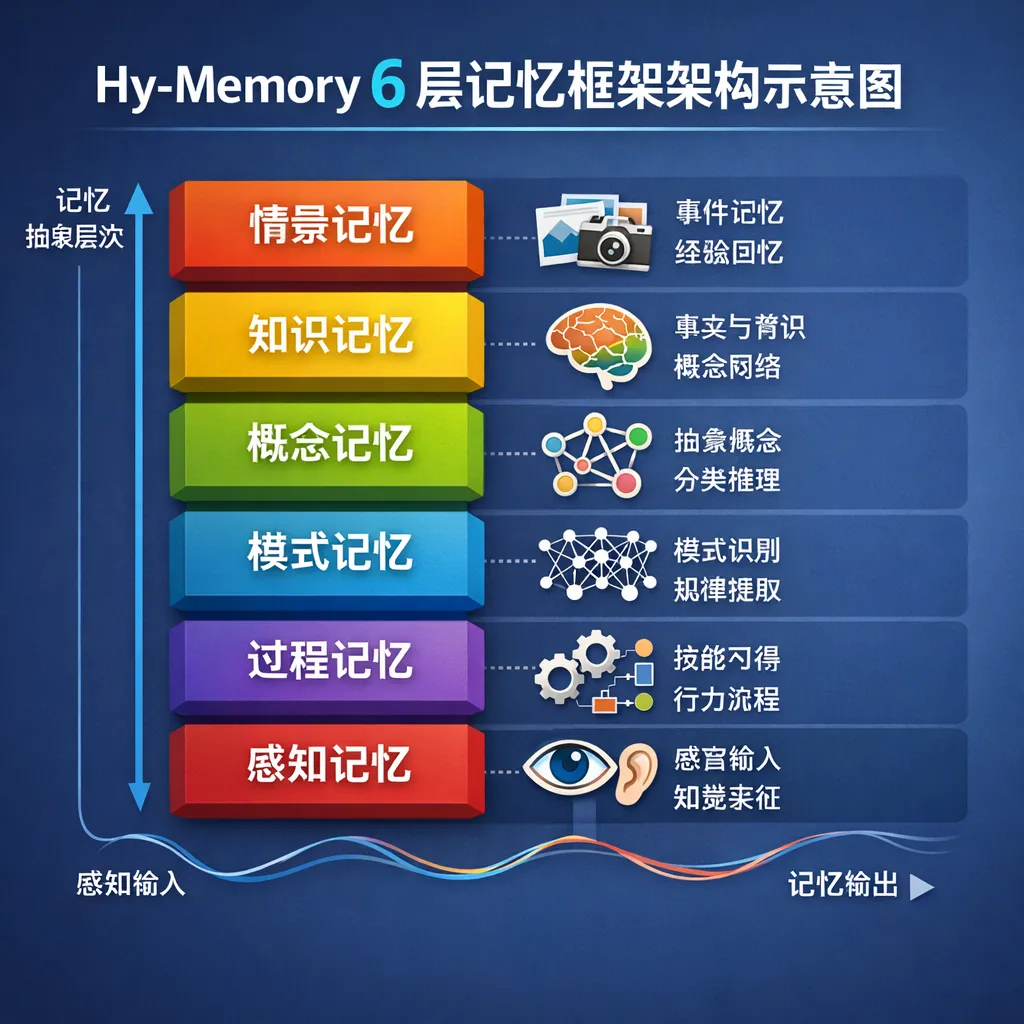
6-layer framework + System1/System2 + evolution chain — what problems are being solved
Officially, the technical foundation comes as a “three-piece set”: a 6-layer memory framework, a dual System1/System2 model, and an evolution chain. Sounds like buzzwords, but each layer actually corresponds to a specific engineering pain point.
The dual system borrows from Kahneman’s model. System1 corresponds to short-term, quick-reacting memory—handling facts and states from recent rounds; System2 corresponds to slow, deep-thinking long-term memory—retaining cross-session judgments, preferences, and user profiles. This design philosophy is consistent with the April TencentDB Agent Memory pyramid (L0 Conversation → L1 Atom → L2 Scenario → L3 Persona)—both move away from flattening conversation history into a vector database and instead store it hierarchically.
The 6-layer architecture aims to balance information density. The pain point of simple RAG is that top-k recall often returns many similar but low-value fragments; the agent sees ten almost identical sentences but still gives poor answers. With layers, recall can start from the high-density Persona layer, drilling down only when needed—meaning fewer tokens but more useful information.
The evolution chain is the most noteworthy design here. Most memory frameworks fail by storing each memory as an isolated point—you say “Use plan A” today, “Switch to plan B” tomorrow, then “Hybrid train A+B” the day after; the vector store ends up with three conflicting facts, leaving the model guessing which is latest when recalling.
Hy-Memory links them using “supersedes” pointers:
- A (initial plan)
- B (replaces A) → supersedes A
- C (replaces B) → supersedes B
- D (hybrid training, current head) → supersedes C
When the user asks “Which training method are we using now,” recall hits chain head D, and the entire A→B→C→D chain expands and returns. The agent knows not just the current conclusion, but how it evolved and what was ruled out along the way. This design directly addresses the real dilemma of “which option did we exclude” seen in that three-week trajectory.
How’s the data
From Tencent Hunyuan’s benchmark on authoritative public test sets:
- Number of memory entries reduced by 70%+
- Information density per memory increased by 45%+
- Token consumption for long-context sessions reduced by 35%
- Memory update speed improved by 20%
These figures are internally consistent—cutting memory count by 70% while increasing density by 45% means the total info volume actually rises while storage and retrieval costs drop. Comparing horizontally with April’s open-source TencentDB Agent Memory’s results (accuracy raised from 48% to 76% on PersonaMem, tokens reduced by 61% on WideSearch), Hy-Memory’s numbers aren’t wildly inflated—more like further engineering optimization along an existing path.
One point to note: the official release didn’t explicitly compare against Mem0, Letta (formerly MemGPT), or Zep, which are leading community frameworks. Without itemized benchmarking, claims of “surpassing mainstream memory frameworks” need third-party reproduction for confirmation.
What’s its relationship with the April open-source release
This was my biggest curiosity—Tencent Cloud Database Team open-sourced TencentDB Agent Memory in April, then Tencent Hunyuan released Hy-Memory in May. Both clearly address similar problems—so what’s the relationship?
From public info, they seem like “two product lines from different teams under the same company”:
- TencentDB Agent Memory — led by the Tencent Cloud Database Team; open source; emphasizes local deployment; uses SQLite + sqlite-vec backend and a 4-layer semantic pyramid; positioned as a developer-friendly engineering tool.
- Hy-Memory — led by Tencent Hunyuan; positioned as an official model-enhancement plugin for agents; based on a 6-layer framework + dual system + evolution chain; more model-driven in methodology.
This kind of “internal competition” isn’t rare in big tech, but it’s actually good for developers—you can choose by preference: if you want control, self-hosting, and visibility into every data layer, go with the open-source TencentDB; if you want Hunyuan’s deeper optimization and integration with Openclaw, go with Hy-Memory. Both paths validate each other’s thinking, meaning Tencent has doubled down on the “hierarchy + evolution” paradigm.
My take: the Agent Memory race is officially heating up
From late 2025 into 2026, the attention on Agent Memory is visibly rising. Mem0’s GitHub stars passed 20k, Letta gained many enterprise PoCs, Zep keeps advancing the graph-memory route, and OpenAI’s own Memory feature in ChatGPT is expanding—this space has evolved from last year’s “niche infrastructure” into middleware every long-term agent builder must face.
Tencent’s two successive releases make the direction crystal clear:
- No more blind faith in flat vector stores. Whether 4 layers or 6, hierarchical structure is the foundation. Simple flat RAG retrieval degrades too fast over long conversations—there’s no engineering fix.
- Memory must evolve, not just store. The “supersedes” chain admits the obvious truth that “users change their judgments.” Most existing frameworks pretend this doesn’t exist—today, that stance is untenable.
- Cost must be optimized. Cutting tokens by 35%, memory entries by 70%—Agent Memory isn’t a showcase project; it’s production middleware burning compute daily. Unit cost rules.
Are there caveats? Yes. First, which “authoritative public test sets” were used and how control groups were selected—the release doesn’t specify; second, Hy-Memory’s current integration is mainly focused on Openclaw, and timelines for supporting other frameworks like Hermes, AutoGen, or LangGraph remain unpublished; third, structured chains like “evolution” demand very stable upstream extraction—if the head node is misidentified, the entire chain gets polluted. Robustness needs time to prove itself.
Still, those are engineering issues, not strategic ones. The direction—hierarchy + evolution + dual system—is very likely to become the mainstream Agent Memory shape in the next year or two.
Practical advice for developers
If you’re currently building long-term agents or deep multi-turn collaboration products, put these tasks on your todo list:
- If your stack runs on Openclaw, test both Hy-Memory and TencentDB Agent Memory with your own benchmark—compare recall quality and token usage for your scenario.
- If you’re developing your own memory module, the idea of a “supersedes chain” for explicitly modeling conflict and evolution is worth borrowing, even if not implemented identically.
- Stop relying on simple “chat history + vector retrieval” to handle cross-session collaboration—fine for demos, but any user lasting over two weeks will see it crumble.
As for models themselves, every agent builder knows memory is just one piece of the puzzle—you still need stable reasoning beneath it. Cross-model testing is essential. Aggregator platforms like OpenAI Hub—which let you switch between GPT, Claude, Gemini, DeepSeek, etc. with one key, all OpenAI-format compatible—make domestic testing easier and save a ton of account and network hassle when running horizontal comparisons.
In conclusion
Agents will never possess human-like memory—they only simulate “I remember what we talked about” through increasingly sophisticated data structures. But if that simulation works well, the user experience becomes real. Whether Hy-Memory truly deserves the “second brain” label or not, together with its open-source sibling TencentDB Agent Memory, it clarifies one thing: long-term agents cannot be built by just extending context—they must handle memory engineering seriously.
That consensus now stands firm across the industry.
References
- ITHome: Tencent Hunyuan releases Hy-Memory—building an Agent “second brain” with strong memory — first domestic coverage, including the official description of the “three-week trajectory”
- linux.do Community Talk: Tencent Hunyuan releases Hy-Memory — includes diagrams of the supersedes evolution chain and benchmark screenshots


