
Step 3.7 Flash Release: Agent Scenario Speed Competition Levels Up Again

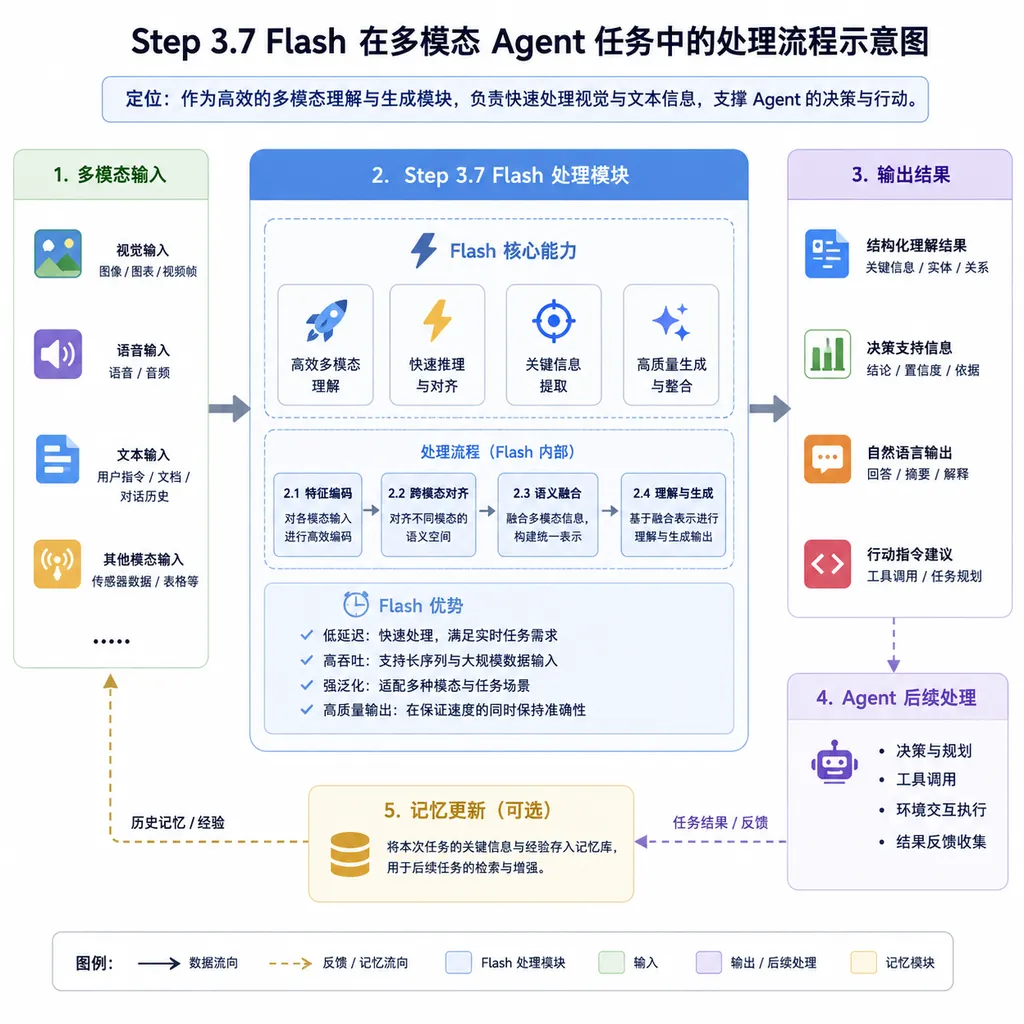
**StellarStep** officially launches today — **Step 3.7 Flash**, positioned as a production-grade flagship multimodal reasoning model for Agents, featuring three core strengths: high-speed inference, native multimodality, and tool invocation. Building upon the sparse MoE foundation of **Step 3.5 Flash**, it introduces systematic optimizations for visual search, tool orchestration, and the Agent ecosystem.
Today, StepFun launched Step 3.7 Flash on its open platform.
This time there was no press conference and no overwhelming publicity — just the documentation page going live and API channels opened. The whole rollout was swift and clean-cut, very much in line with their usual style: get the work done, then let the data speak.
The name already tells you that this is a mid-cycle upgrade from Step 3.5 Flash, not a major version leap — but with a clearer positioning: a high-efficiency Flash model for production-level Agents.
The official page condenses its selling points into four lines: native multimodal understanding and execution, enhanced connectivity and visual search, highly reliable tool calling and orchestration, and optimized compatibility with Agent ecosystems.
None of these are empty slogans — each one hits directly at the toughest pain points in real Agent applications.

From Step 3 to Step 3.7 Flash: StepFun’s path is getting narrower—and deeper
The timeline makes it clearer. Last July, StepFun open-sourced Step 3, a 321B total / 38B active MoE multimodal reasoning model. With MFA (Multi‑Matrix Factorization Attention) and AFD (Attention‑FFN Disaggregation), it dramatically reduced decoding costs and achieved solid throughput even on low-end GPUs at home and abroad.
That release set the company’s technical tone: less obsessed with parameter count, more focused on inference efficiency.
At the start of this year came Step 3.5 Flash. Total parameters shrank to 196B and active parameters to 11B, but thanks to sparse MoE + MTP‑3 (multi‑token parallel prediction), single‑GPU inference speed jumped to 100–300 token/s, peaking at 350 on encoding tasks. Released alongside Kimi K2.5 and Qwen3‑Max‑Thinking, it delivered performance close to theirs with only one‑fifth of the parameters — an impressive cost‑performance play.
Now with Step 3.7 Flash: while the name suggests a continuation of 3.5, its functional focus looks more like a reflection on half a year of real‑world Agent feedback.
After 3.5’s release, developer feedback from the Agent community largely clustered around three issues: occasional instability in tool use, poor robustness when handling webpage screenshots in multimodal browser tasks, and heavy context management overhead in long workflows. Step 3.7 answers precisely these three.
Four developer‑relevant changes
1. Visual search and networking upgrades as first‑class citizens
Previously, multimodal models generally “looked at a picture, understood it, answered a question.”
But in real Agent scenarios, models must open pages in a browser, read screenshots, locate buttons, and decide what to do next — a workflow requiring tight coupling of perception and action planning.
Step 3.7 Flash elevates “network and visual search enhancement” into an independent capability, implying end‑to‑end optimization of this workflow. Practically, the model can now handle webpage screenshots, chart OCR, and UI element localization without relying on external tools — it weaves visual perception and search reasoning directly into inference.
For teams building browser Agents or RPA automation, this targets a real pain point.
2. Improved reliability in tool calling
“High‑reliability tool invocation and orchestration” may sound like marketing, but it’s actually quite concrete in engineering.
The most painful part of Agent development isn’t that the model can’t call tools — it’s that it does so unreliably: wrong parameter formats, missing concurrency, or freezing where it shouldn’t.
One of 3.7 Flash’s main improvements is structural output stability during tool calls and planning accuracy for multi‑tool orchestration. Though official benchmarks aren’t yet posted, the open platform docs include new best‑practice examples for function‑calling retries, parallel calls, and nested calls — if a team really cares about tool usage, you can tell from their documentation structure.
3. Inference speed remains central to the story
The Flash line has always meant “fast.”
3.5 achieved 100–300 token/s; 3.7 builds on its sparse MoE + MTP design and further optimizes first‑token latency and throughput in long contexts.
For real‑time chat, voice Agents, and interactive coding assistants, this speed isn’t “nice to have” — it determines whether the product form factors are even viable.
Think of it this way: at 50 token/s, users are waiting; at 200 token/s, they are watching; at 300+ token/s, they’re using it.
That experiential gap matters more than a few extra benchmark points.
4. Full compatibility across Agent ecosystems
The last line — “Agent ecosystem compatibility optimization” — basically means smoother integration with LangChain, LlamaIndex, MCP, and other mainstream Agent frameworks. It’s not the sexiest update, but one developers genuinely appreciate: many teams don’t pick a model because it’s the strongest, but because it’s the easiest to swap in.
Who’s it compared to? Itself, Kimi, and GPT
The domestic “Flash” track is crowded.
Besides StepFun, Moonshot’s Kimi K2.5 and Alibaba’s Qwen3‑Max‑Thinking are pushing their own high‑speed variants. Overseas, Gemini 2.5 Flash, Claude Haiku 4.5, and GPT‑5 Mini are after the same slice of the market.
StepFun’s position here is subtle. It lacks Alibaba’s full‑stack ecosystem and Moonshot’s large consumer base, but it has an uncommon advantage: native multimodality from day one.
That means vision, language, and reasoning aren’t stitched together post‑training — they co‑evolved from the start.
In multimodal Agent scenarios where vision and language must interweave deeply, this architectural dividend becomes increasingly visible.
Comparing with its own Step 3.5 Flash, version 3.7 isn’t a generational leap in performance but an engineering refinement — steadier tool calls, better visual search, smoother integration into Agent frameworks.
This kind of “polishing upgrade” often matters more to front‑line developers than leaderboard scores.
Compared with Kimi K2.5, 3.7 Flash likely still uses only a fraction of its active parameters (K2.5 sits in the trillion‑scale), yet architecture gains narrow the performance gap to an acceptable range.
In other words: would you trade 5% of the cost for 90% of the performance?
That trade‑off is the underlying logic of the Flash series.
Deployment and usage
Step 3.7 Flash is currently available via StepFun’s Open Platform for API access, fully compatible with the OpenAI format. If you’ve used Step 3.5 Flash, the migration cost is nearly zero — just update the model field.
For Chinese developers wanting unified key management across vendors, OpenAI Hub has already integrated Step 3.7 Flash.
It can be used alongside GPT, Claude, Gemini, and DeepSeek through a single endpoint — ideal for multi‑model comparison or staged rollout testing.
As for open‑source release — StepFun’s previous Flash generations followed a “API‑first, open‑source‑later” cadence. Step 3 and Step 3.5 Flash eventually made their weights public on ModelScope and Hugging Face.
3.7 will likely follow suit, though no timeline has been announced yet.
One observation
To be blunt: the domestic Flash race has reached an awkward point.
Everyone’s leapfrogging benchmarks, yet the gaps are shrinking.
The real differentiators now lie in non‑quantifiable things — whether tool calls are stable, whether multimodal pipelines break on edge cases, whether long contexts suffer “amnesia,” whether latency remains smooth under concurrency.
Those can’t easily be measured, but they can be felt.
This Step 3.7 Flash update doesn’t tell a revolutionary story, but every change targets real developer pain points.
This “no hype, just work” rollout rhythm may be the most commendable attitude in today’s model industry.
There are too many model launch scripts out there; developers really just want one answer: Will it make my application crash less?
If StepFun can deliver a “yes” with 3.7 Flash, its footing in the Agent race will only grow steadier.
Don’t expect any parameter fireworks soon — but when it comes to making Agents actually run, the direction is right.
As for real‑world results, it’s prudent to wait another week or two for developer community testing.
After 3.5 Flash, reputation also rose only about a week post‑launch — likely the same story this time.
References
- linux.do community discussion: StepFun releases new model Step 3.7 Flash — real‑time launch discussion and hands‑on testing from the Chinese developer community, including first results for speed and tool invocation.


