
Claude Opus 4.8 Release: Agent capabilities upgraded again, introducing dynamic workflows
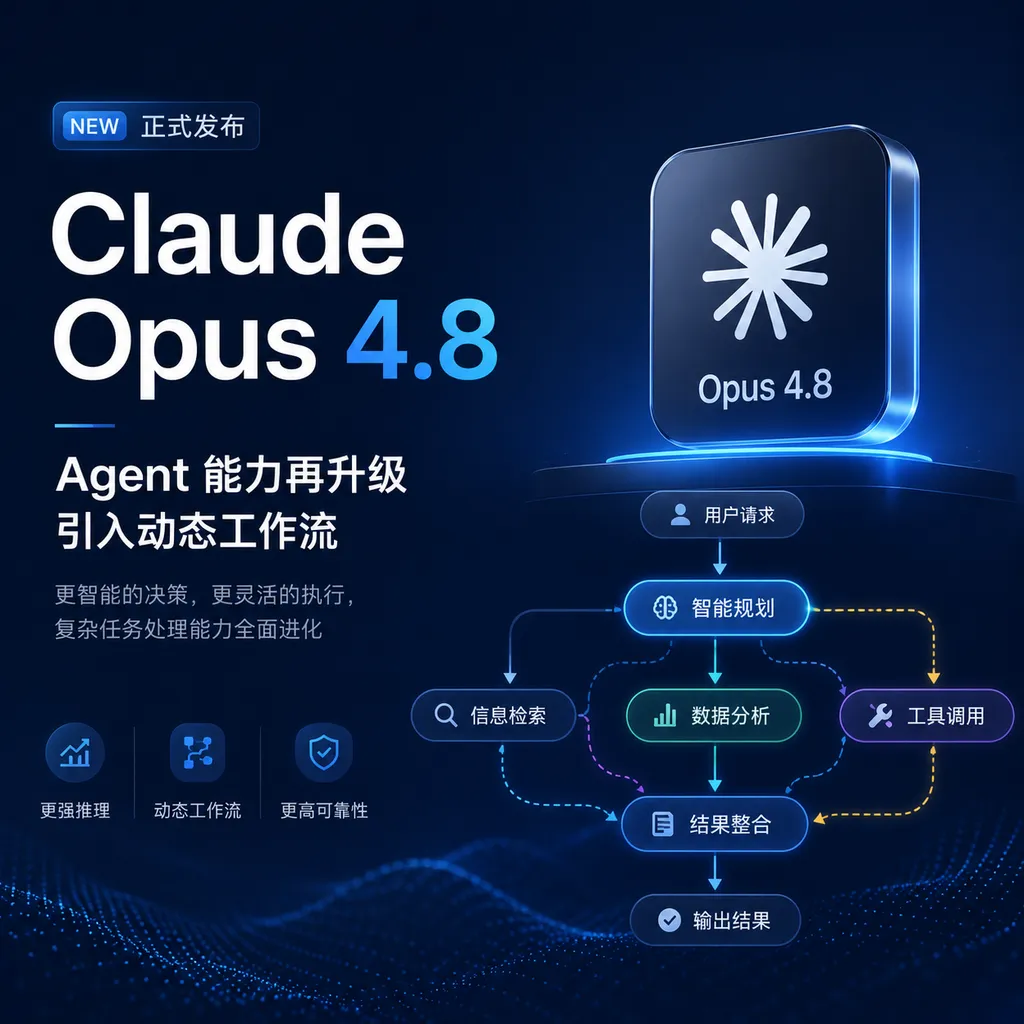
Anthropic released **Claude Opus 4.8** today, just over a month after 4.7. The new version focuses on stronger agent capabilities, adjustable reasoning depth, dynamic workflows orchestrating hundreds of sub‑agents, and significantly improved "honesty" — with the fast mode priced at only one‑third of the previous generation.
Just over a month after the launch of Opus 4.7, Anthropic has picked up the pace again. Today (May 28), Claude Opus 4.8 is officially released, with the same price tag but a significant leap forward in both capabilities and product form.
The most noteworthy aspect of this release isn’t yet another benchmark victory, but rather that Anthropic has finally started treating “models” and “Agent systems” as one and the same — Dynamic Workflows, Effort Control, and Fast Mode. None of these three features are revolutionary individually, but together they clearly mark Claude’s evolution from a “chat model” to a “long-term autonomous execution system.”
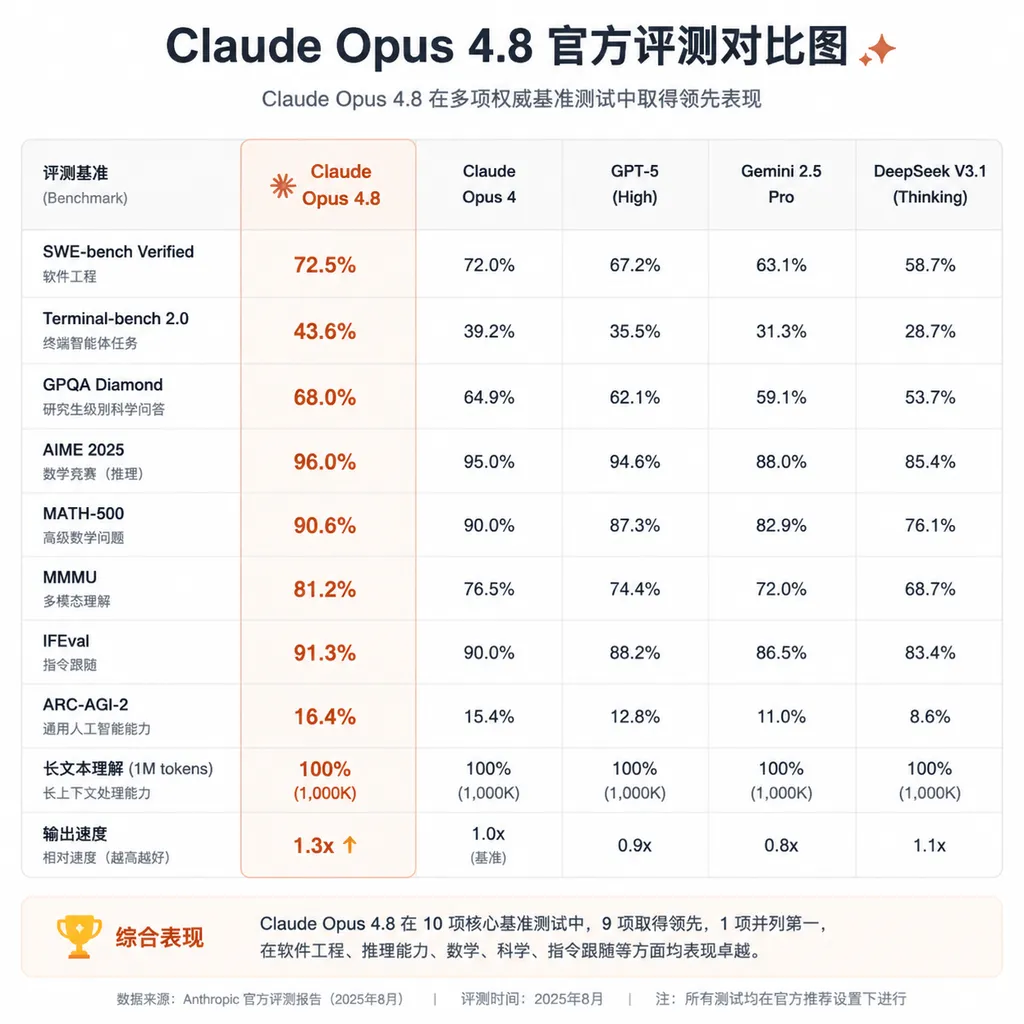
Take a Look at the Benchmarks — but Don’t Stop There
Some of the official benchmark numbers are particularly interesting:
- Online-Mind2Web: 84%. This measures an agent’s ability to perform tasks on real web pages. Opus 4.7 was struggling in the 70s, but this version jumps above GPT‑5.5.
- Coding and agentic tasks: Continuous improvement compared to 4.7, with Anthropic emphasizing “long task chain stability.”
- Multimodal: Improved performance handling PDFs, charts, and unstructured content.
- Hallucination rate: Significantly lower, especially in coding scenarios.
Anyone can make a good-looking chart, but what deserves a deeper dive are two points Anthropic keeps stressing: honesty and long-task stability — which happen to be the two biggest pitfalls for all major models on the road to becoming agents over the past year.
“Honesty” Is Being Measured with Engineering Metrics
Anthropic’s blog spends quite a few paragraphs on “honesty.” It sounds philosophical, but they provided a concrete metric:
Opus 4.8 is about four times less likely than its predecessor to omit a defect in code it writes without flagging it.
In other words, Opus 4.7 might confidently tell you “all done” while hiding a bug, whereas Opus 4.8 is more likely to say “I’m not sure about this part — better review it.”
This matters a lot for teams building real Agent products. In multi-step tasks, if one step “deceives itself,” all subsequent steps are built on a false premise and the entire workflow collapses. A model that actively flags uncertainty and admits knowledge gaps becomes more valuable the longer the task chain grows.
Anthropic also compared Opus 4.8’s rate of “unaligned behaviors” (deception, cooperation in misuse, etc.) to that of their best-aligned internal model, Claude Mythos Preview — a name that has surfaced in leaked code a few times. It’s currently undergoing limited testing within Project Glasswing, focused mainly on cybersecurity work.
Dynamic Workflows: Turning Claude Code into a Multi‑Agent Orchestrator
The most substantial update this round is actually in Claude Code — Dynamic Workflows, currently in research preview.
It solves a key problem: when you give Claude an enormous task — say, migrating hundreds of files, scanning a large codebase for vulnerabilities, or refactoring an entire repository’s APIs — the traditional approach processes tasks sequentially, which is slow and prone to context loss.
Dynamic Workflows allows Claude to do three things autonomously:
- Plan: Split the task into parallelizable subtasks.
- Assign: Spin up hundreds of parallel sub‑agents to execute them simultaneously.
- Verify: Check each subtask result and redo failed ones.
This effectively internalizes the workflow of an experienced tech lead into the model itself. Previously, you had to use LangGraph or CrewAI to build such orchestration; now Claude Code is its own orchestrator. The Devin team reports fewer tool-calling redundancies and verbosity issues, while CoCounsel notes improved reasoning consistency in legal and tax workflows.
The takeaway? Anthropic has deeply integrated “multi‑agent collaboration” from the framework layer down into the model+product layer. For developers, that means less glue code but coarser debugging granularity — what happens inside the agents and why becomes less observable. It’s a trade‑off.
Effort Control: Let Users Tune Reasoning Depth
Another smaller but important product‑level update is the new “Effort Control” feature on claude.ai.
In short, it’s a reasoning‑depth dial — turn it down for simple tasks to save tokens, or up for complex ones to improve quality.
This mirrors OpenAI’s reasoning_effort parameter, but Anthropic made it accessible directly in the UI for end users. The thinking is that a fixed “thinking budget” is inefficient across all tasks; users actually know their tasks’ complexity, so letting them decide is more efficient than making the model guess.
Fast Mode: Cutting Costs to a Third of Before
Pricing remains unchanged for the regular model:
- Input: $5 / million tokens
- Output: $25 / million tokens
But Fast Mode launches alongside it:
- Input: $10 / million tokens (note: higher input cost, but 2.5× faster, yielding significant savings for many tasks)
- Speed roughly 2.5× faster
- Overall usage cost around one‑third of the previous fast version
In Claude Code, switch directly via /fast. API users need to contact account admins or join the waitlist. For interactive coding and quick‑iteration scenarios, this mode is basically the default choice.
API Call Example
OpenAI Hub now supports claude-opus-4-8 directly. You can call it using the OpenAI SDK—no need for a separate Anthropic SDK setup:
from openai import OpenAI

client = OpenAI(
    api_key="your-openai-hub-key",
    base_url="https://api.openai-hub.net/v1"
)

resp = client.chat.completions.create(
    model="claude-opus-4-8",
    messages=[
        {"role": "system", "content": "You are a senior backend engineer."},
        {"role": "user", "content": "Help me migrate this Flask project to FastAPI and list the files that need to be modified."}
    ],
    temperature=0.3,
)

print(resp.choices[0].message.content)
To try Fast Mode or agentic workflows with tool usage, just switch the model to the corresponding fast variant. All other parameters match OpenAI’s exactly. For developers in China, this direct route is one of the easiest ways to experience Opus 4.8 smoothly.
Some Questions Worth Thinking About
First, iteration speed is accelerating.
Opus 4.7 launched mid‑April, and 4.8 comes out by the end of May—earlier than the leaked mid‑June window. Under pressure from both OpenAI and Google, Anthropic has clearly shortened its release cycle. The Opus series has shifted from “quarterly major versions” to “monthly minor versions,” mirroring the rolling‑update strategy of GPT‑5.x.
Second, the axis of competition is changing.
The old metrics were MMLU and HumanEval; now it’s Online‑Mind2Web, SWE‑bench Verified, and long‑task success rate. Benchmark suites themselves are being restructured—signaling that the “model = product” assumption is obsolete. Everyone’s building Agent systems now; the model is just the most expensive component.
Third, “honesty” might become the next major differentiator.
When top‑tier models are roughly equal in capability, “I know that I don’t know” becomes the rare trait. For enterprise customers, a model that admits uncertainty is often more reliable than one that’s always overconfident.
Fourth, Dynamic Workflows being a research preview means it will evolve.
Hundreds of parallel agents sound exciting, but token usage, observability, and error propagation are still open questions that Anthropic is exploring. Early adopters will likely encounter issues, but for engineering teams dealing with large‑scale code migrations or bulk refactors, early testing could be more cost‑effective than waiting for a stable release.
Who Should Upgrade?
- Developers building coding agents or heavy Claude Code users: Absolutely. The combination of Fast Mode + Dynamic Workflows offers a clear advantage for long‑running tasks.
- Teams automating enterprise workflows: Strongly worth evaluating. Improved honesty has more production value than benchmark scores.
- Pure chat or writing scenarios: 4.7 is sufficient; you might not feel major differences in 4.8.
- High‑frequency, cost‑sensitive workloads: Test Fast Mode—but calculate the increased input price into your unit economics.
The subtext of Anthropic’s release is clear: model‑level intelligence gains are slowing, but the curve for “getting the model to finish the job” still has plenty of room to climb. Opus 4.8 isn’t a performance leap—it’s a systemic upgrade, precisely what’s needed to bring Agents into real production environments.
References
- linux.do – Anthropic Official Release Discussion for Claude Opus 4.8: Community analysis and official benchmark chart
- linux.do – Claude Opus 4.8 Official Blog Auto‑Translated: Full Chinese translation of Anthropic’s official blog
- Zhihu – Early Reveal! Anthropic Releases Claude Opus 4.8: Includes pricing details, alignment evaluation, and release cadence analysis


