
Asana Acquires Stack AI: Collaboration Software Giant Completes the Agent Puzzle
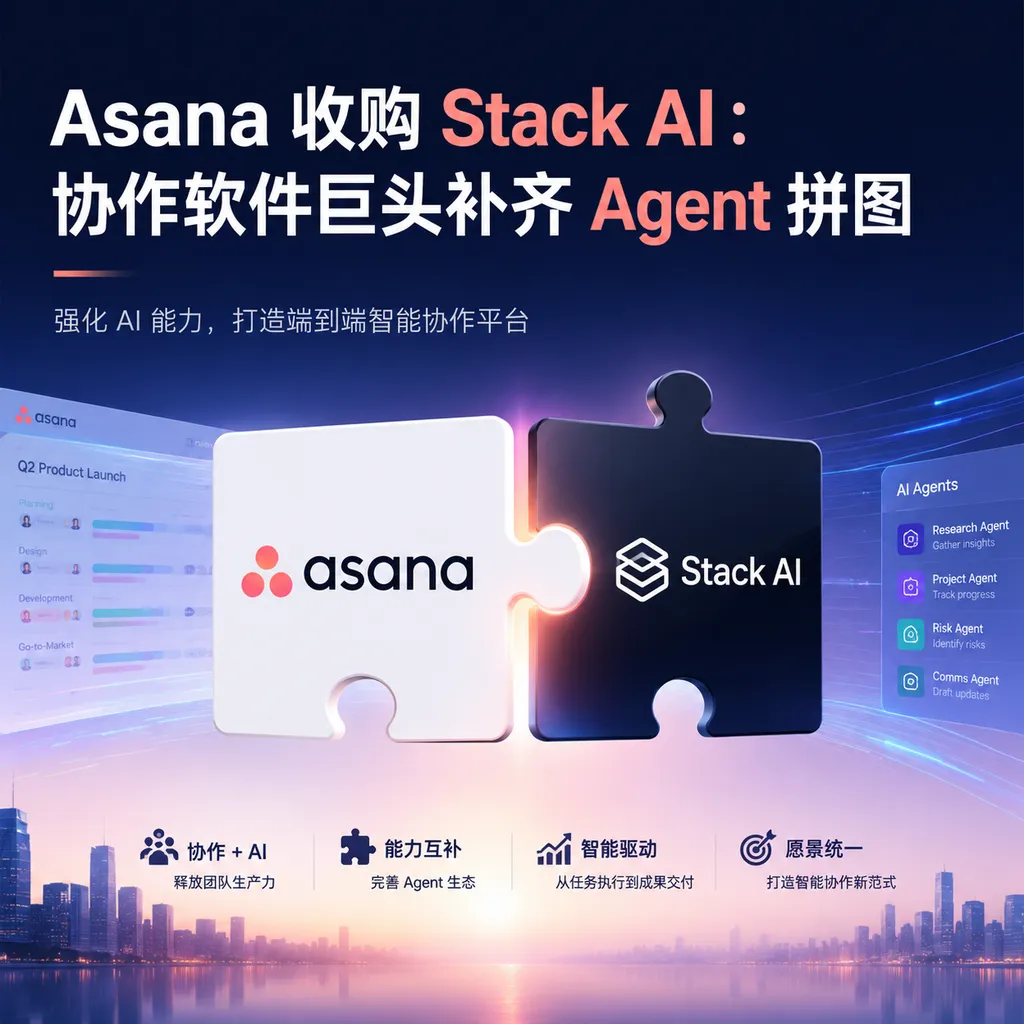
Asana today announced the acquisition of the no-code agent-building platform Stack AI, integrating its Agent Builder capabilities into Asana’s own AI workflow suite, officially joining the fierce competition in the enterprise agent arena alongside Salesforce and ServiceNow.
Today (May 28), Asana officially announced its acquisition of the no-code AI agent building platform Stack AI. The deal amount was not disclosed. The Stack AI team will be fully absorbed into Asana, and its Agent Builder product will be integrated into Asana’s existing AI workflow toolchain. This marks Asana’s most significant external expansion since the launch of AI Studio last year and signals that the SaaS company—originally known for task collaboration—has formally added an “enterprise-grade agent platform” to its product roadmap.
This move is neither too big nor too small, but in the context of the enterprise software merger pace over the past six months, it sends a clear signal: collaboration tool vendors are no longer satisfied with merely “adding an AI assistant” to their products—they now aim to directly control the agent-building pipeline.
Who Is the Acquired Stack AI
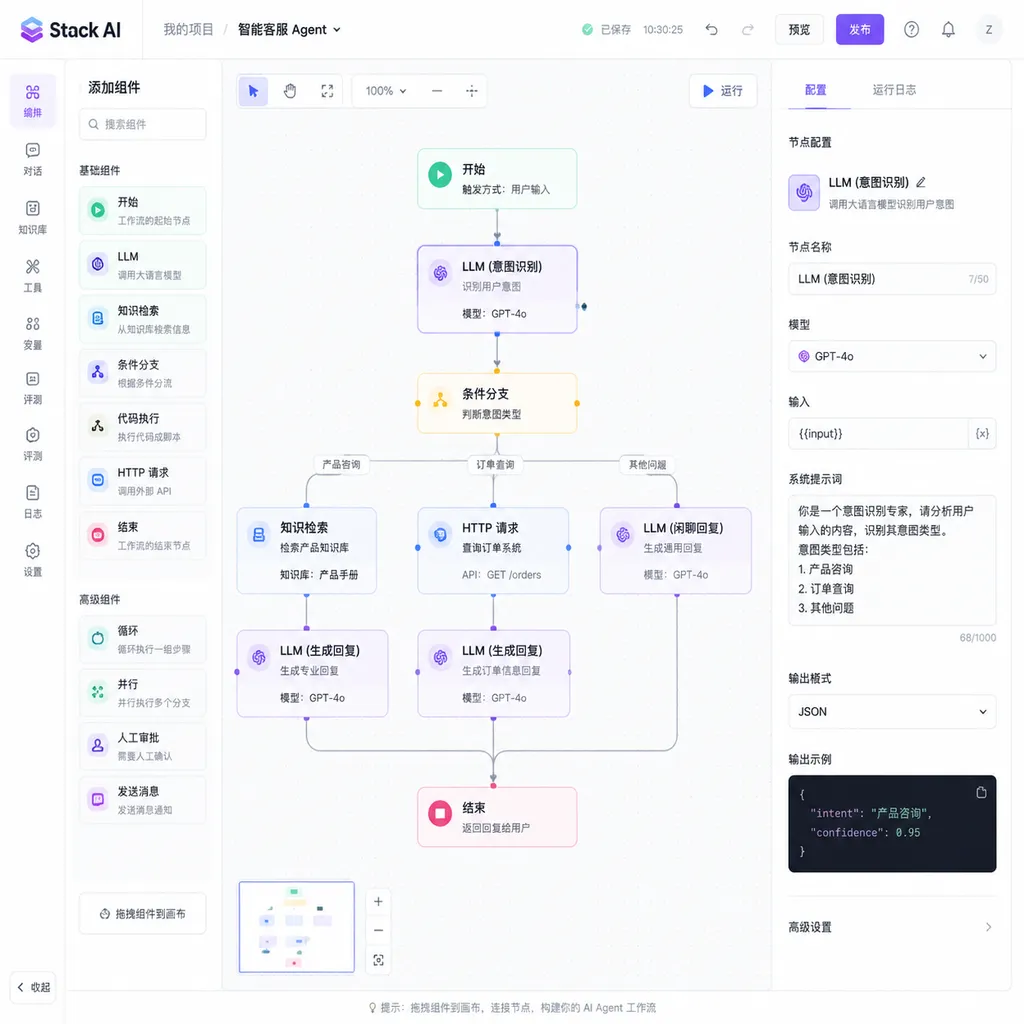
First, let’s clarify who Stack AI is. The company was founded by MIT alumni and is a YC-backed startup. Since 2023, it has gradually shifted its focus from “AI application building” to “enterprise-level agent construction,” with a clear positioning: enabling IT teams to turn internal enterprise processes into executable AI agents through a drag-and-drop interface.
Its client list says a lot—Allworth Financial, LifeMD, SmartAsset, Exeter, plus academic partner MIT. Its core industries are finance and healthcare—highly regulated, process-heavy sectors where IT departments have significant influence. Stack AI calls its approach ADLC (Agent Development Lifecycle), modeled after traditional software’s SDLC, emphasizing approvals, versioning, audit trails, and permission hierarchies as part of enterprise governance.
In terms of product form, Stack AI operates similarly to Dify, Coze, Lindy, and Beam.ai—visual orchestration + LLM invocation + tool integration + RAG. Its differentiation lies in two main areas:
- 100+ enterprise system integrations: Beyond SaaS tools like Slack and Notion, it can connect to legacy systems such as Salesforce, SAP, and Workday—allowing agents to genuinely “do work” in enterprise environments.
- Comprehensive security and compliance: Certified across SOC 2, HIPAA, and GDPR, with optional private deployment—these are hard prerequisites for enterprise clients to sign contracts.
Simply put, Stack AI’s survival and attractiveness to Asana among over 80 competing agent-building platforms come not from flashy technology but from combining “no-code” with “enterprise compliance.”
Why Asana Is Making a Move Now
To understand the acquisition, we need to look at Asana’s current situation.
Over the past two years, Asana’s main story has revolved around AI Studio—an AI workflow orchestration product for enterprise clients, billed by “AI credits.” It’s the company’s hoped-for secondary growth engine. According to earnings reports, AI Studio’s ARR growth is solid, yet Asana faces an awkward reality: its AI capabilities are essentially extensions of “task flows,” not true agents.
What does that mean? Asana’s AI Studio mostly runs LLMs atop existing project/task data structures—to summarize progress, generate status reports, or auto-fill fields. These features are useful but limited. What clients really want is: AI that can independently run processes across systems, invoke tools, and make decisions.
That’s precisely Stack AI’s strength. So the acquisition logic is clear:
- Add agent orchestration capability: Asana needs a tool that lets clients build complex agents from scratch—Stack AI fills that gap.
- Integrate legacy enterprise systems: Asana has been weak in deep ERP/CRM integration; Stack AI’s 100+ integrations are ready-made assets.
- Expand compliance-focused client base: Stack AI’s finance and healthcare clients nicely complement Asana’s tech- and mid-market-heavy portfolio.
- Acquire talent: Stack AI’s engineering team is small but has rare expertise in agent orchestration, tool invocation, and enterprise deployment.
The timing is also critical. Salesforce (Agentforce), ServiceNow (AI Agents), Microsoft (Copilot Studio), and Atlassian (Rovo)—all Asana competitors—are embedding agents into their collaboration or service platforms. If Asana were to build an agent builder from scratch, it would take at least 12–18 months—during which competitors could capture its clients. Buying is the only realistic option for this relatively small collaboration software company.
Key Issues Along the Integration Path
The acquisition announcement didn’t share many technical details, but based on CEO Dustin Moskovitz’s past statements and AI Studio’s current architecture, the integration will likely proceed along these lines:
1. Product Layer: Stack AI Becomes Asana Agent Builder
The standalone Stack AI product will probably continue operating for a while, but new versions will gradually be rebranded as “Asana Agent Builder,” deeply integrated with Asana’s workflow, task, and project data models. This means existing independent Stack AI clients may face a product migration—the stage where acquisitions most often lose customers.
2. Data Layer: Bidirectional Flow
Agents built in Stack AI will natively read and write Asana’s task/project data, while Asana’s automation rules can trigger Stack AI agents in return. Done well, this could create genuine synergy; done poorly, it risks feeling like two disconnected products calling each other’s APIs.
3. Business Layer: Unified Credit-Based Billing
Asana AI Studio’s current “AI credit” pricing model will likely extend to cover Agent Builder. For Asana, that’s good business—more agent activity means higher consumption and naturally higher per-customer revenue.
What This Means for the Industry
The most noteworthy aspect of this transaction, in my view, isn’t simply that Asana bought another AI company—it’s that it confirms the rapid consolidation of the “independent agent-building platform” space.
Looking back over the past 18 months:
- Salesforce acquired Airkit.ai
- ServiceNow acquired Element AI (earlier) and integrated Moveworks
- HubSpot developed its own Breeze Agents
- Atlassian launched Rovo
- And now Asana acquired Stack AI
Meanwhile, independent players like Coze, Dify, Beam.ai, and Lindy are all expanding and raising funding—agent-building platforms are splitting into two camps: either acquired and absorbed into major SaaS suites, or evolving into independent “agent operating systems,” like Sierra’s model. The middle ground is becoming increasingly untenable.
For developers, a few trends are worth noting:
- API compatibility among enterprise agent platforms will degrade: Each company wants to lock in its workflow data. Cross-platform agent standards—such as MCP or A2A protocols—are in development, but implementation is slower than the acquisition pace.
- No-code doesn’t mean no capability: Products like Stack AI have surprisingly high ceilings. Their LLM invocation and tool orchestration logic share roots with LangChain/LlamaIndex, just with a user interface wrapper. Developers working with enterprise clients will likely need to build secondary layers atop these platforms.
- Model choices will remain flexible: Stack AI already supports multiple model families (GPT, Claude, Gemini). After integration into Asana, it will likely continue this multi-model strategy—clients won’t tolerate vendor lock-in. That’s also why aggregation services like OpenAI Hub, which unify GPT, Claude, Gemini, DeepSeek, and other mainstream models under one API key, are becoming popular among enterprise agent developers—saving time and compliance overhead across multiple vendors.
A Few Unanswered Questions
The acquisition announcement remains brief, and several key points haven’t been clarified:
- The role and future of Stack AI’s founding team
- The fate of the independent product at stack-ai.com
- The integration timeline with Asana AI Studio
- Whether a developer-focused API/SDK will be offered
These details will likely surface during Asana’s next earnings call. But one thing seems certain—in Asana’s product launch event later this year, agents will take center stage. The well-worn collaboration software arena is being revalued through AI, and Stack AI is Asana’s bet on that future.
Whether it pays off depends on next year’s client retention data.
References
- Global Overview of 80+ AI Agent Building Platforms - Zhihu — a panorama of the Agent Builder sector where Stack AI operates, useful for comparison.


