
Apple iOS 27 distilled Gemini into the iPhone
The Information reported that Apple is using Gemini to distill on-device AI models, partially forwarding some Siri cloud requests to Google Cloud, while introducing NVIDIA confidential computing to safeguard privacy boundaries.
Apple Finally Shows Its Hand: The On‑Device AI in iOS 27 Is a Distilled Version of Gemini
The thing Cook least wanted to admit has been exposed by The Information.
On May 28, a deep‑dive report from The Information stripped bare Apple and Google’s collaboration on AI: the supposedly “self‑developed, privacy‑first, on‑device” AI model in iOS 27 is, in essence, a student distilled from Google’s Gemini as its teacher. What’s more surprising, part of Siri’s cloud requests are directly forwarded to a licensed version of Gemini on Google Cloud for processing.
It’s not entirely unexpected. When Apple and Google officially announced their partnership this January, many in the industry already guessed Gemini would be deeply integrated into the Apple Intelligence system. In March there was even talk that Apple was “disassembling Gemini.” But only now has the outside world seen how Apple actually “washed” Google’s model into its own.
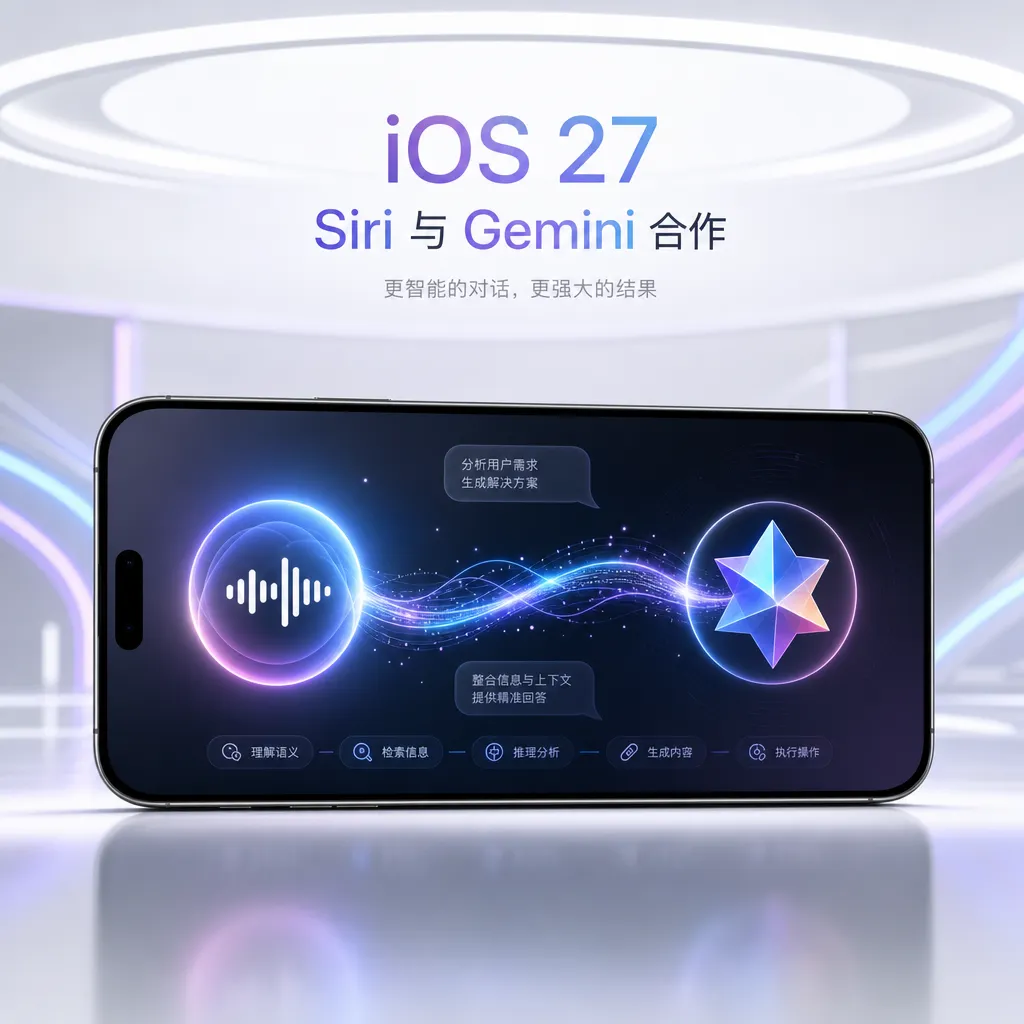
The On‑Device Play: Knowledge Distillation Compressing Trillions of Parameters to a Few B
Apple’s obsession with on‑device AI is written into its DNA. From the Neural Engine in A‑series chips to the ever‑present “Private Cloud Compute” segment at WWDC, Apple’s public narrative almost forbids the phrase “we upload user data to the cloud.”
But in reality, Apple has fallen behind in large‑model development. The grand promises of Apple Intelligence over the past two years have rarely been delivered—delayed personalized Siri, canceled features, and media jokes that it’s “worse than ChatGPT from three years ago.” If it insisted on going fully self‑developed, iOS 27 in 2026 would be a total let‑down.
So Apple chose a compromise: use the strongest existing model and distill a small one that can run on an iPhone.
Knowledge Distillation isn’t new. In short, a small “student” model repeatedly imitates the output distribution of a large “teacher” model until, for specific tasks, its performance approximates the teacher’s while having only a fraction—or even a few hundredths—of the parameters. DeepSeek and Qwen have used similar methods, and Google’s own Gemma series was distilled the same way.
Apple’s approach:
- Extensively calling Gemini APIs to build a massive set of “question–answer” pairs
- Training its own small model on this data (estimated 3B–7B parameters)
- Architecture pruning and quantization optimized for the iPhone’s Neural Engine
- Packing it into iOS 27 and marketing it as “running locally on‑device”
Strictly speaking, this on‑device model can indeed be called “Apple‑developed”—architecture, training workflow, and inference engine are all Apple’s. But the model’s “soul,” its understanding and generation preferences in natural language, clearly come from Gemini. It’s like a student copying the teacher’s lecture notes—technically their own notebook, but the knowledge still originated from the teacher.
Apple has also been seeking help to further compress models. Reports say it seriously considered acquiring Liquid AI, a Cambridge startup focused on lightweight on‑device AI solutions that matched Apple’s needs almost perfectly.
The Cloud Play: Siri Requests Sent Directly to Google Cloud
If the on‑device distillation can still be called “half self‑developed,” the cloud part goes even further.
The Information’s sources are blunt: the full Gemini model has trillions of parameters, and Apple’s Private Cloud Compute infrastructure—built on clusters of M‑series chips—cannot handle every user’s Siri requests. So in iOS 27’s Siri, certain complex requests will be routed to Google Cloud to call the licensed full Gemini model.
For Apple, that’s rather embarrassing. When Private Cloud Compute was unveiled, Apple framed it as a new paradigm for cloud privacy, implicitly contrasting it with “insecure” AI services from Google or Microsoft. Less than two years later, it’s forwarding requests to Google Cloud itself.
To preserve its privacy narrative, Apple has reportedly approved adopting NVIDIA’s Confidential Computing technology. The core idea: when GPUs handle data and models, the contents of VRAM remain encrypted, meaning even the cloud provider (here, Google) cannot directly read them. The trade‑off is slightly slower response times, but with significantly stronger protection for sensitive information.
Confidential Computing was laid out back in the NVIDIA H100 era—the H100 and later Blackwell chips include TEE (Trusted Execution Environment) support, enabling secure enclaves within the GPU. Apple’s choice here is essentially a PR‑friendly balance between “using someone else’s model” and “maintaining its privacy stance.”
So the eventual cloud‑AI architecture of iOS 27 may look like this:
User Siri request
   ↓
Apple on‑device lightweight model (distilled from Gemini)
   ├─ Process locally → return directly
   └─ Needs cloud → Private Cloud Compute (Apple M‑series)
                    ├─ Can handle → return
                    └─ Complex → Google Cloud (NVIDIA GPU + Confidential Computing)
                                    └─ Full Gemini → encrypted return
Three routing layers—the deeper it goes, the stronger the model, but the farther from “pure Apple.”
Why Gemini, Not GPT or Claude?
That’s worth unpacking.
Apple actually worked with OpenAI before—everyone saw how Siri connected to ChatGPT in iOS 18. But that was merely a “send query to ChatGPT” entry point; the model itself wasn’t part of Apple Intelligence’s core architecture. This collaboration with Google operates at a completely different level: Gemini is the teacher for Apple’s base models and the actual executor for Siri’s cloud processing.
The reasons for choosing Google are pragmatic:
1. Money. Apple and Google already have that $20‑plus billion annual deal for Safari’s default search engine. The AI partnership likely piggybacked on that business pipeline—an easy negotiation channel.
2. Cloud. Many of Apple’s services already run on Google Cloud (even iCloud used GCP early on). Forwarding Siri requests there faces the least friction.
3. Model Strength. The Gemini 2 series’ multimodal capability, long context window, and tool‑calling features are genuinely top‑tier. For Apple’s intended “personalized Siri + screen understanding + cross‑app operations,” Gemini fits better than the GPT line in multimodality.
4. Leverage. OpenAI is backed by Microsoft, and Apple can’t base its core AI stack on a rival’s ecosystem. Anthropic is too small and lacks the commercialization bandwidth to serve billions of iPhones simultaneously. After weighing options, Google is the only one offering the trio “elite model + elite cloud + existing business ties.”
What This Means for Developers
If you’re developing within the iOS ecosystem, iOS 27’s AI capabilities could bring several notable changes:
- On‑device model APIs will likely be redesigned. The Foundation Models framework shown at WWDC 2024 will probably be updated now that the underlying model has changed.
- Latency and power profiles will differ. The distilled model’s size and inference characteristics won’t match Apple’s earlier self‑developed versions, requiring fresh benchmarking.
- Cloud fallback will be standard. AI feature availability will depend on network connectivity; offline modes need dedicated logic.
- Privacy and compliance language must be revised. If your app uses Apple Intelligence to process sensitive data, understand that some requests may go to Google Cloud—your user agreements should reflect that.
For developers directly calling large‑model APIs, this event serves as a “demystification”: even Apple couldn’t build a fully usable on‑device LLM from scratch and had to distill Gemini instead. Smaller teams should stop fantasizing about “training our own” and focus engineering effort on product experience. Incidentally, the OpenAI‑compatible hubs now let you call Gemini 2, GPT, and Claude models through one unified interface with domestic connectivity—saving the hassle of multiple API keys and network work‑arounds. For teams doing multi‑model comparisons or distilling a vertical mini‑model, that’s an easier route.
Apple’s AI Story Enters Its Second Act
Apple’s compromise this time actually marks the end of an era.
For the past decade, Apple’s story has been about vertical integration—building chips, OS, apps, and services all in‑house, holding every layer. That strategy was unbeatable in the hardware age but hit a wall in the age of large models. Training a frontier model needs resources in compute, data, and talent that no M‑series cluster can supply. Even after two years of aggressive AI hiring, Apple Intelligence hasn’t broken into the first tier.
Admitting defeat and partnering with Google is already a massive concession for a company like Apple. The distillation + cloud‑forwarding scheme essentially acknowledges: Apple can’t be #1 at the model layer, but can still excel in user experience, device distribution, and its long‑standing privacy narrative.
iOS 27 is expected to debut officially at WWDC on June 9. How Apple packages its “Gemini Distillation + Google Cloud Routing + NVIDIA Confidential Computing” solution will be a must‑watch popcorn moment. It’s almost certain no keynote slide will name Gemini, yet everyone paying attention will recognize its shadow behind the scenes.
References
- ITHome: Apple iOS 27 Leak — Using Gemini to Train Local AI – Chinese summary of The Information report detailing on‑device distillation and cloud routing
- ITHome: Apple Reportedly Disassembles Google Gemini Model to Build Local AI for iPhone 17 and More – March coverage with the earliest mention of the distillation approach


