
Stability Audio 3.0 open-sources three models, extending single-track generation to 6 minutes.

Stability AI releases the Audio 3.0 family, featuring four models of different specifications. The largest version can generate a complete song up to 6 minutes and 20 seconds long. The three small and medium-sized models are fully open-sourced, while the large model remains under commercial licensing.
Stability AI Pushes Music Generation Length to 6 Minutes 20 Seconds
On May 20, Stability AI released four new audio models at once, packaged together as the Stability Audio 3.0 family. The biggest selling point is straightforward: the top-tier version can generate a complete 6-minute 20-second track in one go—more than doubling the length of 2024’s Stable Audio 2.0.
That’s a number worth pausing to think about. In the past year or two, the biggest bottleneck in AI music generation hasn’t been sound quality—Suno v4 and Udio already crossed the "listenable" threshold—but rather long-form structural consistency. Within three minutes, AI can muddle through; beyond four minutes, melodies drift, sections collapse, and choruses lose their way. By pushing controllable duration over six minutes, Stability has effectively brought AI-generated songs into the standard range of pop music.
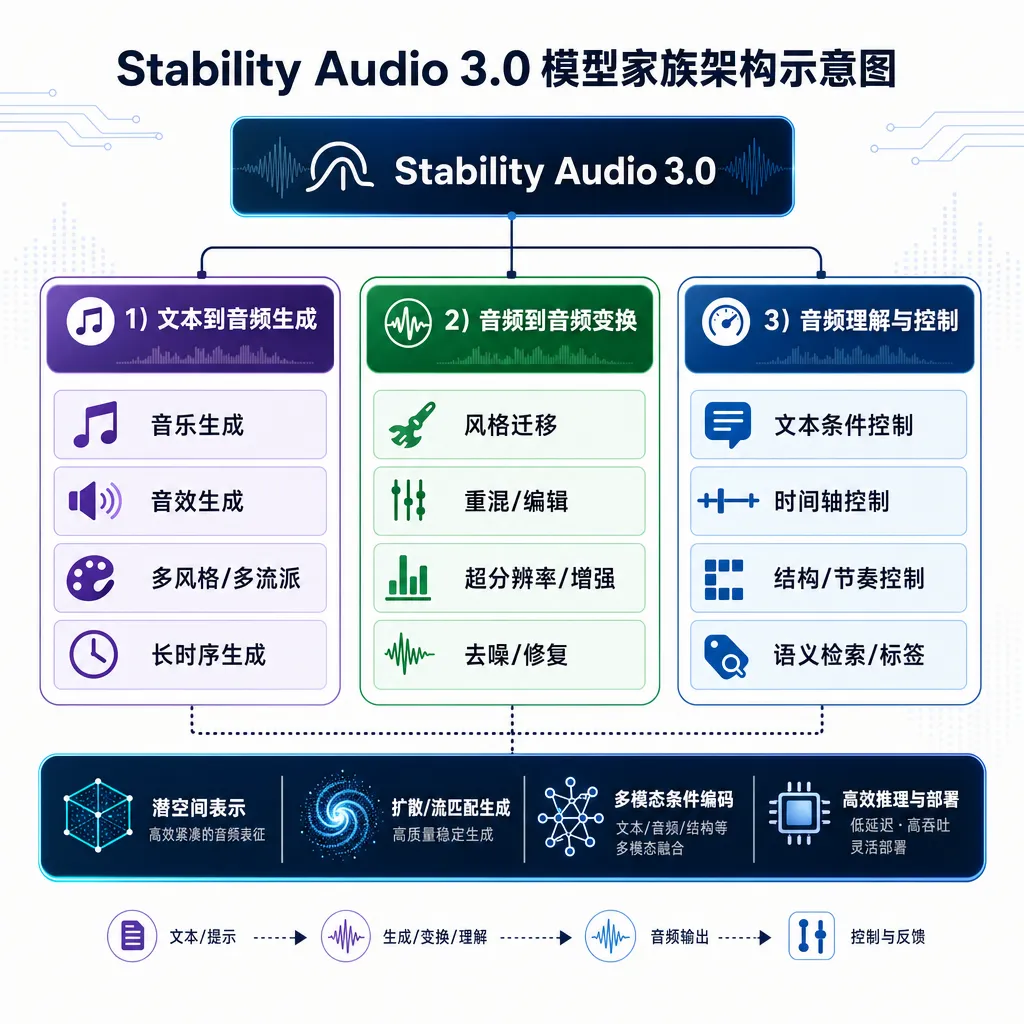
Four Models, Three Are Open Source
Stability’s product lineup this time is quite clear, divided into four tiers by parameter count and positioning:
| Model | Parameters | Purpose | Open Source | | --- | --- | --- | --- | | Small SFX | 459M | On-device sound effects generation | Open source | | Small | 459M | On-device music generation, up to 2 minutes | Open source | | Medium | 1.4B | Full tracks, up to 6m20s | Open source | | Large | 2.7B | Full tracks, up to 6m20s | Closed source, API/paid hosting only |
The two 459M-parameter Small models target on-device inference—they can run on an ordinary laptop CPU to generate sound effects or short music clips under two minutes. These are clearly aimed at game developers, indie creators, and podcasters: you don’t have to pay for server time or worry about data going to the cloud.
The Medium (1.4B) and Large (2.7B) versions are meant for full-scale compositions. Both support the 6m20s duration limit, differing in fine detail, timbral richness, and instruction-following accuracy. Stability is quite frank about why the Large model isn’t open source—it’s their only current monetization route. Companies with annual revenue over $1M USD (≈¥6.82M CNY) must obtain a commercial license to use it; smaller developers can pay-per-use via the API.
This “open-source small/medium, closed-source large” strategy reflects the trend among major open innovation companies. Mistral did the same early on: the community got runnable models, while enterprise clients paid for the strongest version. Compared to Meta’s Llama license—which is fully open but bans large enterprises from commercial use—Stability’s setup is actually more friendly to small teams: you don’t need to read the license three times just to be sure you can use it.
The Engineering Behind the Doubled Length
Extending from under 3 minutes in 2.0 to 6m20s in 3.0 sounds simple, but it’s not as easy as just lengthening the context window.
The core challenges of long-form music generation are threefold:
- Structural memory: The model must remember earlier themes and keys so the chorus returns correctly.
- Section planning: Songs longer than four minutes need intro–verse–chorus–bridge–outro structure, not just a continuous texture.
- Compute cost: After tokenization, audio sequences are far longer than text; six minutes of 44.1kHz stereo is an astronomical amount of raw data.
Stability hasn’t published a full technical report, but the model family design gives hints—2.7B parameters is not large for an audio diffusion model; rumor has it Suno and Udio use even bigger ones. Focusing on mid-sized models suggests they likely invested in architectural control mechanisms, explicitly encoding musical priors such as section planning and harmonic progressions instead of brute-forcing size.
The company says the Medium and Large models “demonstrate stronger structural control, with precise maintenance of musical form and melodic tone.” Translated: they solved long-range consistency problems, not just stretched the generation window.
Data Compliance: Licensing with Warner and Universal Paying Off
A critical but often overlooked aspect of this generation: it was trained entirely on legally licensed data.
Back in 2024, Stability AI had already signed data cooperation agreements with Warner Music and Universal Music—moves many dismissed as mere PR. In hindsight, they were highly strategic.
Compare this to Suno and Udio’s current situation: both are being sued by the RIAA and face potential statutory damages of up to $150,000 per song. Whether their weights can even remain usable is in question. Stability’s “licensed data + partial openness + commercial licensing threshold” model basically bets that mainstream commercial distribution of AI music (Spotify, Apple Music, film scoring) will require strict data compliance.
They also recently hired Ethan Kaplan, former Chief Digital Officer at Universal Audio and Fender, to lead their professional music products division. Combined with this model release, it’s clear Stability is building a professional-grade toolchain for musicians—not just another text-to-music toy.
How to Try It
Weights for all three open-source models are available for download. Developers can deploy them directly. The Small series has minimal hardware demands; the Medium model requires at least 16 GB of VRAM (FP16 inference); the Large model is API-only.
Here’s a typical prompt setup for running the Medium model locally:
from stable_audio_tools import get_pretrained_model
from stable_audio_tools.inference.generation import generate_diffusion_cond

model, model_config = get_pretrained_model("stabilityai/stable-audio-3-medium")

conditioning = [{
    "prompt": "upbeat synthwave track with driving bassline, 120 BPM, energetic chorus around 1:30",
    "seconds_start": 0,
    "seconds_total": 240
}]

output = generate_diffusion_cond(
    model,
    steps=100,
    cfg_scale=7,
    conditioning=conditioning,
    sample_size=model_config["sample_size"],
    sigma_min=0.3,
    sigma_max=500,
    sampler_type="dpmpp-3m-sde"
)
Notably, seconds_total in the prompt can now go up to 380 (i.e. 6m20s)—a new feature in 3.0. In 2.0, going beyond 190 seconds would usually break the model.
What It Means for Developers
Practically speaking, this release directly impacts several developer groups:
Game and App Developers: The Small SFX model is a perfect fit. For game background loops like “tense chase scene music” or “UI click sounds,” teams previously needed to buy sound libraries or contract freelancers. Now they can generate them on-device in real time. A 459M model is not unreasonable even for a client-side build.
Indie Musicians and Creators: The open-source Medium model + 6-minute capacity means you can now run a full song-generation pipeline on your workstation without paying for a Suno subscription. Quality may not match the Large model, but “good enough” has now expanded from 30-second snippets to full 6-minute tracks.
AI Music SaaS Teams: The Large model + commercial license route offers a new option. If you don’t want to train from scratch but need top-tier quality, use Stability’s API. If your business is still small, start with the Medium model and self-host—then scale up when ready.
Model Researchers: The three open models are good research material for analyzing scaling laws and structural consistency at different model sizes—openly comparable datasets in this field are still very rare.
Final Thoughts
The AI music space has been in an odd state—Suno and Udio nailed consumer-level experiences but are mired in lawsuits; Google’s Lyria hides behind YouTube; Meta’s MusicGen hasn’t updated in ages. With its combination of “licensed data + open-source strategy + duration breakthrough,” Stability has placed itself back on the playing field.
Six minutes twenty seconds isn’t the finish line—but it marks a turning point for AI-generated music, shifting from “short-form video BGM” to “album-ready songs.” Next up: natural-sounding vocals, multitrack editability, and DAW workflow integration—these are what professional musicians truly care about.
References
- ITHome – Stability AI Launches Audio Model Stability Audio 3.0: Original report with model specs, parameter counts, and licensing details
- Hugging Face – Stability AI Model Page: Stable Audio 3.0 open model weights and usage documentation


