
Alibaba Cloud has brought Bailian to the command line: connect to 150+ models with a single command.

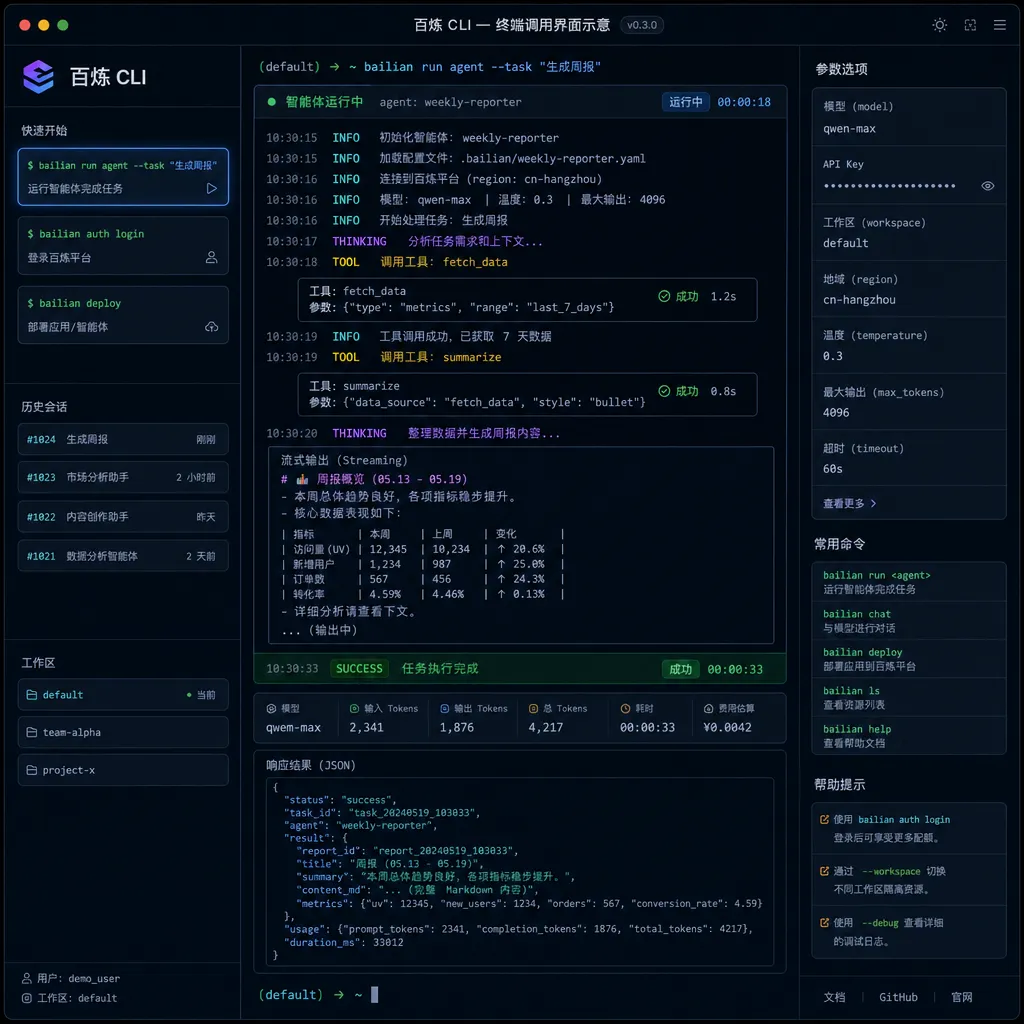
Alibaba Cloud today open-sourced Bailian CLI, enabling Agents to access over 150 models, more than a dozen applications, as well as full capabilities such as knowledge bases, memory, and online search — all with a single command. It is natively compatible with major Agent frameworks like Claude Code and Qoder.
Today (May 29), Alibaba Cloud packaged the core capabilities of Bailian into a command-line tool and released it on GitHub. With a single command, an Agent can access over 150 models, more than a dozen applications, plus a complete set of supporting facilities including knowledge base, memory, and online search.
Looking at this in the context of 2026, the timing actually fits well. Over the past six months, the de facto standard for Agents has shifted from “dialog box + plugins” to “terminal + CLI” — Claude Code, Cursor’s Agent mode, Qoder, and a slew of open-source Agent frameworks are all working around the command line. If model vendors still only provide HTTP APIs and SDKs, they risk being stuck in the middle: upstream Agent frameworks have to adapt to them, and downstream developers would have to manually translate model capabilities into tool calls. The purpose of Bailian CLI is to eliminate that translation layer.
The significance of going CLI: Not just another SDK
Let’s clear up a misunderstanding first. Bailian CLI is not just the original Python/Java SDK re-skinned into a command line. It is designed specifically for Agents — meaning its output is intended for another AI, not for humans.
These are two completely different design goals. A CLI for humans focuses on user-friendly interaction, colorful outputs, and progress bars; a CLI for Agents focuses on structured outputs, clear parameter semantics, parsable error codes, and the ability for an LLM to understand and correctly invoke it in one go. The official documentation states it supports “structured output for easy Agent tool invocation and automated orchestration,” which essentially means: every subcommand’s input/output is organized according to function calling specifications, allowing Agents like Claude Code to directly mount it as a toolset.
The list of natively supported frameworks — Claude Code, Qoder, OpenClaw, Hermes Agent — basically covers both mainstream coding Agents and general-purpose Agents. Claude Code is Anthropic’s own terminal Agent, Qoder is the IDE Agent Alibaba pushed recently, the latter two are representatives from the open-source community. This compatibility list means users don’t need to write their own MCP server or custom tool descriptions — once the CLI is installed, it can be used directly in these Agents.
Capability list: Packaging “Bailian” into a toolset
According to the official capability rundown, Bailian CLI now enables Agents to:
- Multi-modal model invocation: text, image, video, speech, visual understanding — covering 150+ models
- App & workflow invocation: directly call apps and workflows set up in Bailian’s console
- Knowledge base retrieval: RAG pipeline ready to use out of the box
- Memory management & user profiling: long-term memory, personalization
- Online search: allow Agents to fetch real-time information
- Local file upload & multi-modal file processing: feed local images, documents, audio, and video to the model
- Structured output: consumable by upstream Agent orchestration
The implicit message here is: Bailian has CLI-ized almost everything available on its platform. In the past, if you wanted an Agent to have the complete capability chain — “read a local image → use Qwen-VL to understand content → invoke an image editing model to create marketing visuals → check knowledge base for brand guidelines → write copy” — you’d have to hand-code several layers of glue code. Now, the Agent can invoke commands step-by-step, with the glue code improvised by the LLM at runtime.
The official use cases illustrate the point: letting an Agent search online for the latest information, reading local images and editing them into marketing material, and building enterprise-level assistants by combining knowledge base and memory. These three examples respectively cover the three most common pain points for Agents: “real-time capability, multi-modal processing, and contextual understanding.”
Why now?
This needs to be seen in a broader context.
Alibaba’s move isn’t isolated. Going back a few months, they launched Kilo CLI — a dedicated coding CLI for the Qwen3-Max and Qwen3-Coder series; before that, Qwen3.7-Max was released with a focus on the “Agent era,” emphasizing long-cycle autonomous execution and MCP integration. The pattern is clear: Alibaba is repositioning Bailian from a MaaS platform towards an “Agent runtime.”
Bailian CLI is the most critical puzzle piece along this path. Kilo CLI solves “using Qwen to write code inside an Agent,” covering coding scenarios; Bailian CLI solves “using Alibaba’s full suite of AI capabilities within an Agent,” covering general scenarios. They’re complementary — the former leans toward IDE-based code assistance, the latter toward general Agent workflows.
More practically, domestic large-model platforms have been competing fiercely at the “application layer” over the past year — building app marketplaces, workflow editors, memory bases, and knowledge bases. But to get developers to actually use these capabilities, the biggest barrier is “integration cost” — each capability has its own API, each API requires reading docs, writing clients, and tuning parameters. In the Agent era, this approach doesn’t work, because Agents don’t read documentation. So CLI-izing all capabilities, and optimizing output formats specifically for Agents, is essentially product adaptation for Agents.
Compared to MCP, how does it look?
The first reaction developers might have is: How does this relate to MCP (Model Context Protocol)? Do we have to choose one?
The positioning is different. MCP is a protocol, defining how Agents and tools communicate; Bailian CLI is a toolset — a concrete packaging of Alibaba Cloud’s capabilities. In theory, Bailian CLI could be wrapped into an MCP server, allowing any MCP-compatible Agent to call it.
But the CLI route has several practical advantages:
- Zero-configuration startup: MCP servers require spinning up processes, configuring schemas, and managing lifecycles; the CLI works immediately upon installation
- Better cross-Agent framework compatibility: not all Agents support MCP, but almost all support “shell command execution”
- Debug-friendly: humans can run a command directly in the terminal to instantly see what’s wrong, whereas MCP debugging has a much longer chain
So, it’s likely both approaches will run in parallel: CLI as the lowest-barrier entry point, MCP as the deeper integration option.
Some noteworthy details
A few points spotted while reading the documentation:
- GitHub repo is
modelstudioai/cli, not under thealibabamain organization — presumably operated independently under Bailian’s overseas brand ModelStudio. This naming also implies it’s not just for domestic developers; overseas sites (Singapore, Virginia) are supported as well. - Considering the Coding Plan, Bailian has already launched a subscription package similar to Claude Code’s Max Plan; after CLI-ization, the value of this subscription is amplified — one subscription, usable across all Agent frameworks.
- Qwen3.7-Max was just released, positioned as “for the Agent era.” Combined with model layer, CLI layer, and subscription layer, it’s clear Alibaba’s product rollout is planned in advance.
Advice for developers
If you’re building an Agent app based on Claude Code or Qoder, Bailian CLI is worth a half-hour try, especially for multi-modal scenarios (image editing, video generation, speech synthesis) — integrating these capabilities via API is tedious, CLI-ization makes it far easier.
If you’re building an internal enterprise assistant, combining “knowledge base + memory + online search” provides a fairly complete ready-made solution, at least during the PoC phase, without building the infrastructure yourself.
If you’re making a pure text dialogue application, then using an OpenAI-compatible interface is sufficient — CLI’s advantages won’t shine here. Incidentally, OpenAI Hub also supports direct invocation of Qwen series models with OpenAI-format compatibility and domestic connectivity, making it handy for comparison testing or multi-model routing.
This open-sourcing of Bailian CLI is a milestone event, but a few things need time to observe: the stability of Agent framework integration, especially the clarity of tool descriptions; the depth of structured output support for complex tasks; and whether the open-source community will follow up with more upstream wrappers.
The return of command-line tools is one of the most interesting product trends in recent years. Model vendors are finally realizing that making products for Agents and making products for humans are two different things — the former requires “clarity, callable, combinable,” the latter needs “good-looking, easy-to-use, easy-to-understand.” Bailian CLI is clearly aimed at the former.
Reference links
- modelstudioai/cli - GitHub repo: Bailian CLI open-source code and documentation
- Alibaba Cloud open-sources Bailian CLI, Agents can invoke the full suite of models and app capabilities - IT Home: Original news release from IT Home


