
OMO tears into Anthropic: its open-source orchestration framework has been “harvested at the pixel level”
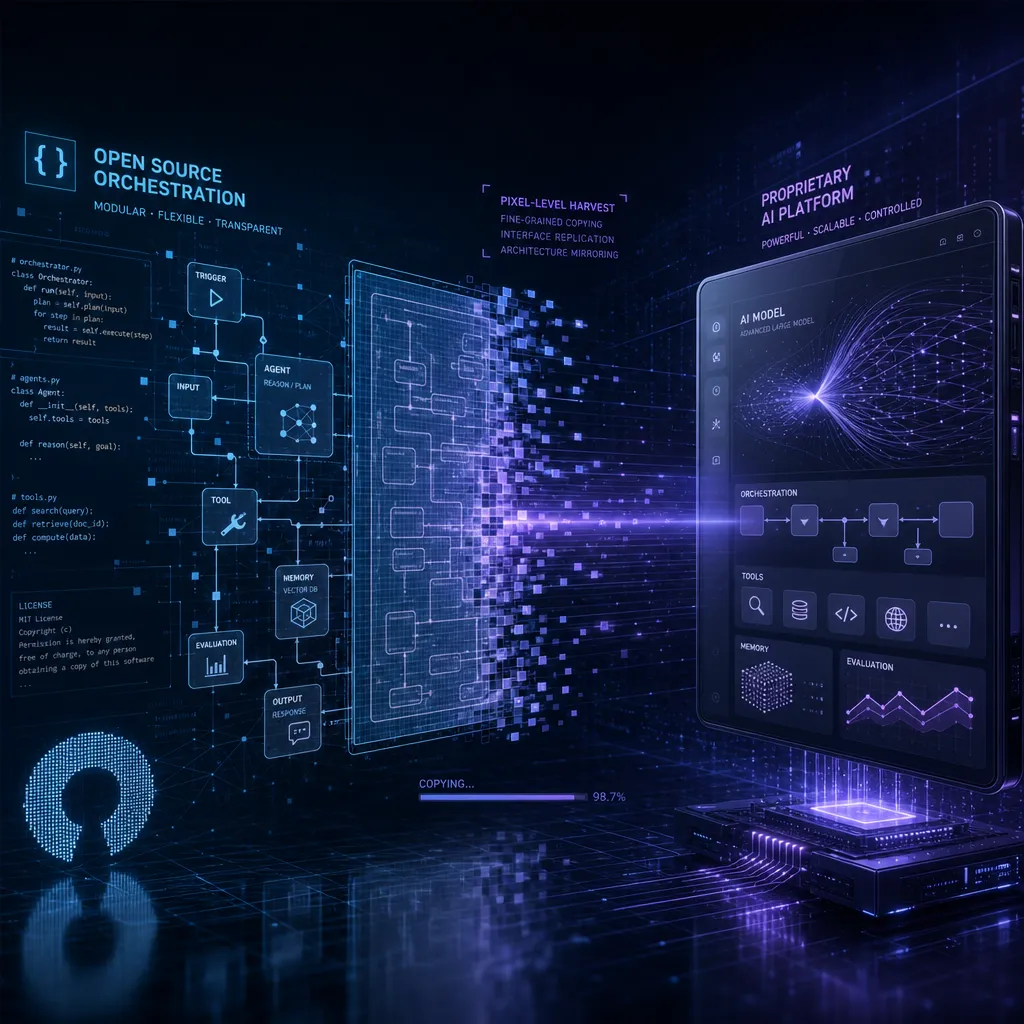
The open-source Agent framework OMO has publicly accused Anthropic of pixel-level plagiarism of its multi-model orchestration architecture in the dynamic workflow of Claude Code included with Opus 4.8. FactoryAI has also been called out for past issues. A growing rift is emerging over the relationship between open-source contributions and the ways large corporations absorb them.
I. Here’s What Happened
In the early hours of May 29, Anthropic had just released Claude Opus 4.8 and, in passing, upgraded Claude Code—introducing dynamic workflows and the so-called “ultracode” mode, focusing on multi-model collaboration and long-chain task orchestration. The buzz from the launch event hadn’t even faded before the open-source community exploded.
The team behind the open-source framework OMO fired off a dozen consecutive posts on X, directly accusing Anthropic: “This is pixel-level plagiarism.” They attached a side-by-side comparison of OMO’s architecture diagram (publicly shared in January this year) with the workflow diagram from Anthropic’s official blog. The similarities were striking—naming conventions, node topology, even token flow directions looked almost identical.
If you just glanced at one or two modules, it could be brushed off as “great minds think alike.” But OMO’s detailed comparison showed a near one-to-one mapping: from the three-layered architecture (planning, coordination, execution), to the feedback loops for dynamic model routing and merge review. The most intriguing similarity was in naming—OMO’s Greek mythology–inspired naming conventions also appeared in Anthropic’s internal codenames.
II. What Exactly Is OMO?
For developers unfamiliar with the background—here’s a quick intro.
OMO isn’t some tiny experiment built from scratch. It’s officially recognized as the #1 plugin of the open-source terminal Agent project OpenCode. OpenCode itself has already racked up 167,000 stars on GitHub, making it one of the hottest open-source Agent projects in the past six months. OMO, as the flagship component of its plugin ecosystem, earned another 60,000 stars on its own.
The people behind it have their own mythology, too. The main developer is a 23-year-old Korean hacker known only by the codename Q; operations and publicity are handled by the independent studio Sisyphus Labs. Over the past year, this duo turned OMO into the “next-generation Agent template” in the developer community.
OMO’s key selling point is a model-agnostic multi-agent dynamic orchestration architecture, with core modules including:
- Prometheus: The planner—decomposes high-level tasks into executable sub-task graphs
- Atlas: The coordinator—handles cross-agent merging, review, and conflict arbitration
- Sisyphus Junior: The executor—runs tool calls and code generation
- ultrawork: A dynamic workflow that links the above three layers, automatically adjusting recursion depth and parallel width based on task complexity
Additionally, a skill filtering mechanism ensures that tools invisible to specific sub-agents remain hidden—preventing the “to a hammer, everything looks like a nail” problem. The design cleanly separates “planning–coordination–execution,” allowing each stage to use a different model independently.
III. Why Anthropic’s Move Stung So Much
The OMO team wasn’t just angry about the “similarities” — it was the timeline of ‘block first, absorb later’ that really stung.
Let’s lay out the sequence:
- January 2026: Q officially releases the ultrawork workflow and the Atlas coordinator within OMO. The community begins large-scale testing.
- Soon after, OpenCode cofounder Dax Raad joked on a podcast that OMO was a “token burner” — since running multi-agent recursion caused massive Claude API usage, often millions of tokens per task.
- April: Anthropic steps in and unilaterally tightens policy, blocking third-party clients from using Claude subscription quotas. The official reason given was “abuse,” but the community saw through it — the real targets were high token-consuming open-source orchestration frameworks like OMO.
- May 29: With Opus 4.8’s release, Claude Code launches dynamic workflows and ultracode mode—effectively embedding mechanisms that OMO had already battle-tested in the open-source world into Anthropic’s closed-source, subscription-based ecosystem.
Just three months apart. Q’s tweet summarized it bluntly: “You used policy to push open-source implementations out of the ecosystem, then copied their architecture diagrams into your own product manual.”
It reminds many of how major cloud vendors treated open-source databases years ago—except this time, it’s happening in the nascent Agent orchestration space, and the pace has compressed to mere months.
IV. FactoryAI’s Old Grudge Resurfaces
There’s a second angle to this conflict. This time, OMO didn’t just take aim at Anthropic—they also called out FactoryAI by name.
In February, FactoryAI had made a splash with Missions, a product for “multi-day autonomous task flows,” touting long tasks, long context, and resumable execution. The OMO team had internally remarked on its architectural similarities back then; this time, they published a full mapping:
| OMO Module | FactoryAI Missions Equivalent | | --- | --- | | Planner Prometheus | Plan Approval Flow | | Coordinator Atlas | Orchestrator Droid | | Executor Sisyphus Junior | Worker Droid | | Skill Filtering Mechanism | Simplified tool scoping |
Essentially, the same logic wrapped in new names and “droid” branding.
FactoryAI has yet to respond. Anthropic has taken the same stance — neither confirming nor denying, simply refusing to engage. This “deaf and dumb” silence has only fueled speculation in the developer community — OMO-related posts have seen their retweet count multiply severalfold in the past 24 hours.
V. OMO’s Counterattack
Facing silence from the giants, the OMO team chose a two-pronged approach.
The first front is proving architectural originality. Sisyphus Labs publicly released GitHub commit histories, internal design document timestamps, and early Discord discussions—all forming a consistent timeline. Notably, the first appearance of the “Atlas” name in their repo pre-dates any known Anthropic internal documentation.
The second front hits Anthropic’s business model pain point. The OMO team kept emphasizing one thing:
OMO is completely model-agnostic—you don’t need an expensive Claude subscription. You can run ultrawork workflows with local models, cheap GPT, Gemini, or even Kimi.
Translated: Anthropic wants to lock developers into the Claude ecosystem via ultracode, while OMO offers the same architecture but lets you pick your own model. For budget-conscious teams, that’s a very tangible value proposition.
Q also revealed they’re working on a Codex-adapted version based on GPT-5.5, coming soon. Paired with his snarky remark about Opus 4.8 — “It’s basically just a decent GPT-5” — the message couldn’t be clearer.
For developers in China, the barrier to cross-model Agent orchestration isn’t actually high. Aggregators like OpenAI Hub already unify GPT, Claude, Gemini, DeepSeek, and Kimi under an OpenAI-compatible API. For a model-agnostic framework like OMO, switching providers usually means nothing more than changing the base_url. That’s why OMO can confidently claim, “We don’t need official quotas”—the alternative supply chain is already mature.
VI. Questions Worth Asking
Beyond the drama, there are deeper issues for developers to ponder.
1. Can Agent orchestration architectures really claim “originality”?
Honestly, the three-phase “plan–coordinate–execute” structure is not new. From AutoGPT to LangGraph to CrewAI, similar paradigms exist. No one can claim to have “invented” multi-agent. But OMO’s comparison focuses not on the broad structure but on specific coordination strategies, merge-review feedback loops, and triggers for dynamic routing — the engineering details that separate a functional framework from a non-functional one. If Anthropic merely “borrowed the concept,” that’s minor; if it mirrored these engineering decisions line-for-line, that’s a different story.
2. How passive are open-source contributors in reality?
OMO is under a permissive MIT-style license, meaning Anthropic technically hasn’t violated any terms. But the gap between legal and fair is the real crux here. The open-source world has long debated adding stricter attribution clauses for frameworks (like BSD-4’s advertising clause or CC BY-style attribution). This controversy will likely reignite that discussion.
3. Will “block first, absorb later” become standard procedure?
That April API policy, officially framed as anti-abuse, effectively cleared the field for Anthropic’s own version. If this tactic proves effective, other model providers might follow suit. For open-source Agent projects, that implies the more successful you are, the likelier you’ll suddenly lose API access one day. A worrying signal for the ecosystem.
VII. What to Watch Next
In the short term, a few key things are worth tracking:
- Whether Anthropic responds. The longer the silence, the more developers will question the originality of Claude Code’s new features.
- OMO’s Codex-adapted version progress. If it can achieve results equal to or better than Claude on GPT-5.5, it’s a direct strike against ultracode’s closed strategy.
- The stance of OpenCode’s parent project. With its 167,000 stars, its statement would carry weight. If Dax Raad’s “token burner” joke becomes an official statement, that changes everything.
- FactoryAI’s reaction. If OMO manages to generate enough public pressure, FactoryAI may be forced to respond.
In all likelihood, there won’t be a quick “justice served” ending — historically, open source rarely wins against big tech. But this episode has surfaced a question long brushed aside: once an open-source project validates a technical path, what can the original creators reclaim — beyond a thank-you note?
The answer, probably: nothing. But next time someone writes a license, they’ll remember this.
References
- Open-source masterpiece “officially harvested” by big tech? OMO plugin publicly slams Anthropic and FactoryAI for pixel-level plagiarism of its Agent orchestration architecture! - linux.do: Original source of the full timeline and architecture comparison images.


