
GPT-Image-2 Leak Test: Text Rendering Finally Works
After quiet testing in Chatbot Arena, OpenAI’s next-generation image generation model, **GPT-Image-2**, was leaked. It solves the most troublesome issue in AI image generation—text rendering—allowing for precise creation from poster designs to handwritten notes, and even producing convincing Chinese calligraphy.
GPT-Image-2 Leak Test: Text Rendering Finally Works
OpenAI has once again quietly tested a new model on Chatbot Arena. This time it’s the long-awaited image generation model GPT-Image-2, which has been in development for four months. It was tested under the codenames maskingtape-alpha, gaffertape-alpha, and packingtape-alpha, but sharp-eyed users caught it in action.
The test has since gone offline, but the leaked samples are exciting enough—the most troublesome problem in AI image generation, text rendering, finally seems to have been solved.
The Old Problem of Diffusion Models, Now Fixed
When diffusion models generate images, they are essentially performing probabilistic sampling. They’re excellent at handling continuous features such as global visual structure, lighting, and color distribution, but they’ve always struggled with symbolic systems—especially text, which requires precise structural accuracy.
The issue is obvious: ask DALL·E 3 or Midjourney to generate a coffee shop poster, and the shop name will likely be "COFFEF" or "CAFFE"—something that looks right but isn’t. Draw a street sign, and the letters twist as if drunk. This isn’t due to insufficient size or training time—it’s because the architecture lacks explicit modeling of symbolic structures.
GPT-Image-2’s breakthrough is its ability to generate clear, readable, grammatically correct text. Not just “text-like textures,” but actual usable text.
From the leaked samples, we see:
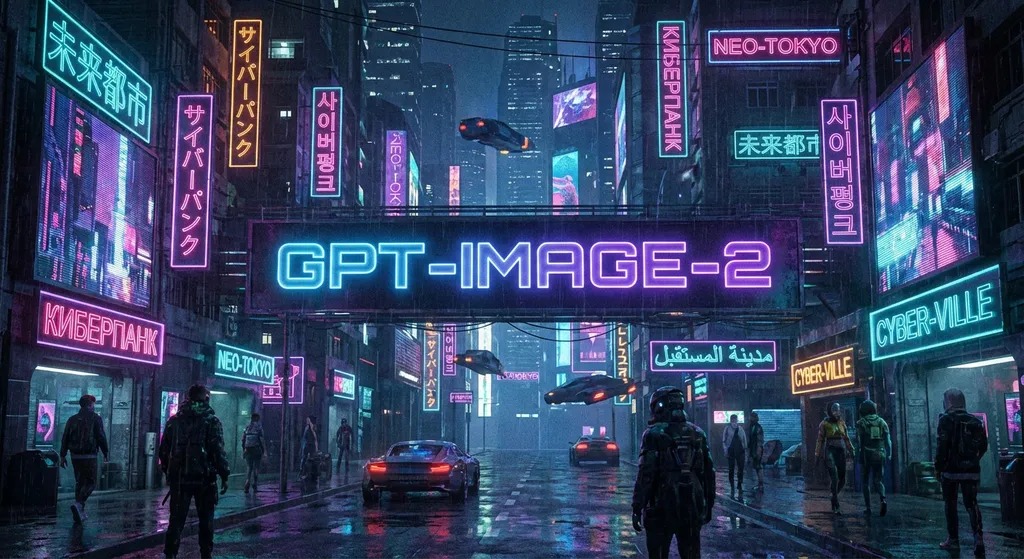
- Multilingual Billboards: Cyberpunk cityscapes with mixed English, Japanese, and Chinese neon signs; every character is clear, with stylistic variations.
- Webpage Screenshots: Generated browser interfaces where the address bar, buttons, and titles are all correct.
- Anatomical Labels: Medical illustrations with precisely spelled anatomical terms and neat layout.
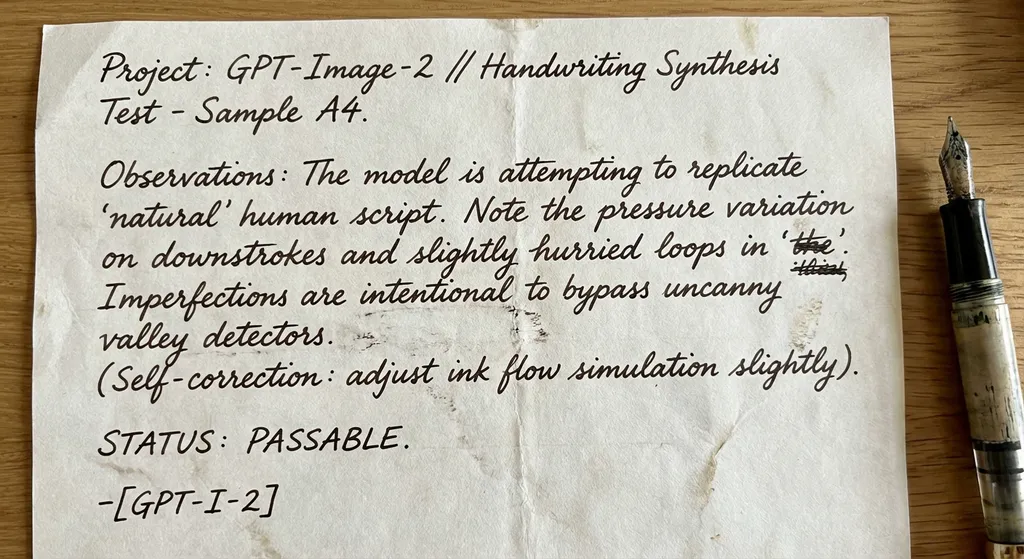
- Handwritten Notes: The most impressive—these don’t look like digital text pasted on paper, but real pen-on-paper writings, with varying stroke thickness, ink diffusion, and paper texture.
It Can Even Do Chinese Calligraphy—Almost
Some users tested GPT-Image-2 by asking it to produce a cursive (草书) version of Li Bai’s Quiet Night Thoughts. The result was good but not perfect: the strokes flowed naturally, and the work had a calligraphic rhythm, but on closer inspection it seemed closer to semi-cursive (行楷). The seal characters were abstract, and even included an extra line of poetry.
Still, that’s impressive progress. Chinese calligraphy isn’t just arranging character shapes—it involves stroke order, pressure variation, structural balance, and spatial layout. For an AI to grasp the “Eight Principles of the 永 character” and understand the interplay between strokes shows a deep comprehension of Chinese script morphology.
By contrast, Latin letters are relatively simple, as they’re just permutations of a limited alphabet. Chinese characters evolved from pictographs; each is a self-contained visual system. GPT-Image-2’s performance suggests OpenAI significantly refined both its training dataset and model architecture.
Realism in Portraits Steps Up a Level
Beyond text rendering, GPT-Image-2 has made evident progress in portrait generation. A simple test: have the model generate a selfie of Sam Altman.
Using GPT-Image-1.5 (the version currently integrated into ChatGPT), the portraits look roughly like him—facial structure fits, but skin texture and detail are coarse, like an upscaled low-resolution photo.
Switch to GPT-Image-2, and details like fine wrinkles, beard direction, skin pores, and hair highlights are perfectly captured. This isn’t simply higher resolution—it shows a deeper understanding of human facial structure, lighting, and material properties.
This improvement matters for realistic portrait generation tasks such as virtual fitting, game character design, or advertising assets. These once required real photography or 3D rendering—both costly. AI-generated results now approach commercial-grade quality.
The Color Problem’s Also Gone
The DALL·E line always had a minor flaw: images tended to be overly warm, as if under a yellow filter. That’s acceptable for some scenes but problematic for product or technical illustrations that require color accuracy.
GPT-Image-1 improved on this but didn’t fully fix it. GPT-Image-2 users report that colors now look right—cool tones where they should be cool, warm where they should be warm, with no pervasive tint bias.
This might seem trivial, but for professional users it’s vital. If designers must always color-correct AI outputs, it defeats much of the efficiency gain.
How Does It Compare to Nano Banana Pro?
Google’s Nano Banana Pro, released last year, was hailed as a new benchmark for image generation—especially in “world knowledge understanding.” It could generate complex, physically coherent scenes—like the inner structure of a machine—with logically correct connections between components.
From what’s leaked so far, GPT-Image-2 might match or even surpass Nano Banana Pro in that regard. It can produce not only photorealistic images but also ones that make sense physically.
For example, when generating a “19th-century steampunk train station,” GPT-Image-2 doesn’t just draw gears and steam pipes; it arranges them correctly—the gear interlocks, pipe routes, and steam flows make mechanical sense.
This “world knowledge understanding” means the model learned not only visual features but also physical, spatial, and functional relationships—crucial for creating technical documentation, educational materials, and engineering diagrams.
Possibly a Prelude to GPT-5o
Rumor has it GPT-Image-2 is based on a new pretrained foundation—perhaps even part of the legendary GPT-5o.
If true, the leap we’re seeing wouldn’t be mere fine-tuning but a full architectural upgrade. Moving from GPT-4o to GPT-5o may involve not linear growth in parameters, but fundamental changes in multimodal integration, training paradigms, and reasoning mechanisms.
The breakthrough in text rendering may indicate that OpenAI has found a more effective way to model discrete symbols alongside continuous signals. That would have implications beyond image generation—for video, 3D modeling, even code generation.
What It Means for Developers
If GPT-Image-2 is officially released, its most immediate impact will be automation of tasks that once required manual post-editing.
Poster and Marketing Materials: Previously, designers had to add or adjust text manually in Photoshop. Now, with text specified directly in the prompt, the model can generate finished posters in one step.
Technical Illustrations: When generating flow charts or schematics, the in-image labels will now be reliable—no more garbled or misspelled text.
Multilingual Localization: The same image can be generated in different languages without manual text replacement.
Prototypes and Mockups: Product managers can generate realistic UI screenshots complete with real labels, instead of filler text like “Lorem Ipsum.”
If OpenAI releases an API (very likely), developers can easily integrate GPT-Image-2 into their toolchains. For example:
import openai

# The OpenAI Hub supports GPT-Image-2 API calls
client = openai.OpenAI(
    api_key="your-openai-hub-key",
    base_url="https://api.openai-hub.net/v1"
)

response = client.images.generate(
    model="gpt-image-2",
    prompt="A vintage-style coffee shop poster with the shop name 'Morning Brew' and subtitle 'Fresh Coffee Daily', warm tone",
    size="1024x1024",
    quality="hd",
    n=1
)

image_url = response.data[0].url
print(f"Generated image: {image_url}")
This example shows how to call GPT-Image-2 via OpenAI Hub. Key parameters:
model: specifygpt-image-2prompt: describe the image in detail, including required textquality: set tohdfor higher quality output
The advantage of OpenAI Hub is that it uses the same API format, supports direct access from China, and allows one key to access multiple models. It’s easy to switch between GPT-Image-2, DALL·E 3, Midjourney, and Stable Diffusion for comparison.
Remaining Issues
Although GPT-Image-2 represents a qualitative breakthrough in text rendering, it’s not flawless:
Chinese Complex Scenarios Unstable: English text renders reliably, but Chinese—especially calligraphy, seal carving, or classical texts—still needs improvement.
Limitations on Long Texts: Most samples show short text (a few words or sentences). Full-page newspaper or book-cover text consistency remains unproven.
Stylized Text Control: It can produce handwriting, print, or neon styles, but may not yet replicate specific fonts precisely.
Speed and Cost: Enhanced text rendering likely makes the model more complex and slower. Generation time and API cost are still unknown.
A Turning Point
Since 2022’s explosion of DALL·E 2, Midjourney, and Stable Diffusion, AI image generation has lingered between “beautiful to look at” and “practically useful.”
Text rendering was the biggest roadblock. Designers often had to follow the “AI generate → export → Photoshop edit text → adjust again” workflow. As long as that loop exists, AI is just an assistant, not a productivity tool.
If GPT-Image-2 truly solves text rendering, AI image generation can finally evolve from “inspiration reference” to “final deliverable.” That could have a greater impact on the creative industry than we yet realize.
Of course, it’s early to draw conclusions. GPT-Image-2 is still in testing, and its final capability, pricing, and limits remain uncertain. But from what we’ve seen, OpenAI’s long-hidden upgrade is definitely worth watching.
References
- GPT-Image-2 Leak - Baijiahao - First exposure of GPT-Image-2 test codenames and rollout
- GPT-Image-2 Leak: OpenAI Image Generation Model Upgrade - Sohu Tech - In-depth analysis of color and realism improvements
- Overnight Shift: GPT-Image-2 Leak - Sina Finance - Comparison with Nano Banana Pro and competitive analysis
- Ultraman Group Photo That Fooled the Web - Baijiahao - Discussion of GPT-5o speculation and world knowledge capabilities
- GPT-Image-2 Leak - Tencent News - Technical details of text rendering and Chinese calligraphy tests


