
Bilibili’s AI summaries quietly switched to DeepSeek V4 Flash, as GPT Mini bows out.
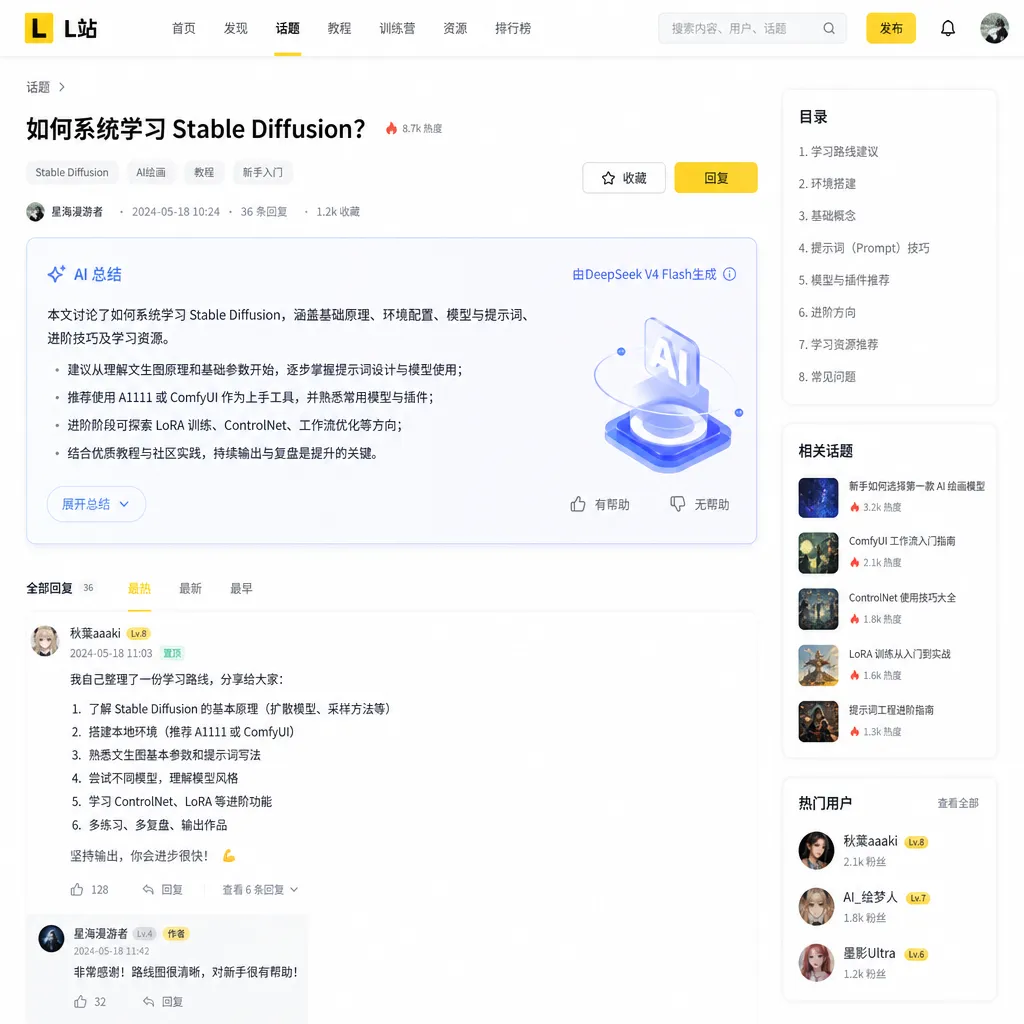
The topic AI summarization feature of the Linux.do forum has switched from GPT Mini to DeepSeek V4 Flash. The model’s mysterious prefix has sparked user speculation about a private deployment. Behind this switch is DeepSeek V4 Flash’s overall advantage in both cost and speed.
Waking Up to a Different Taste in L-Station’s AI Summaries
On May 29, veteran users of Linux.do (commonly known as L-Station) noticed a quiet change: for every trending topic, the AI-generated summary at the top of the page was no longer produced by GPT Mini—it had switched to DeepSeek V4 Flash.
User @SomeBro posted screenshots in “L-Station’s Topic AI Summary Model Has Switched to DS” showing that the model name had an unusual prefix before “V4 Flash.” It wasn’t the official naming convention nor any format used by common aggregators such as Volcano Engine or SiliconFlow. After some detective work, nine users reached a likely conclusion: the site admin (“the First Emperor”) had privately deployed or proxied the model himself.
To be honest, such a “small tweak” would go unnoticed on most forums. But L-Station’s user base consists largely of developers and heavy AI users. The AI topic summaries are the very first thing they see each day—summary quality directly determines whether they’ll open a thread spanning dozens of posts. So when the model changed, users immediately felt the difference.
Why DeepSeek V4 Flash?
Since the release of the DeepSeek V4 generation, the migration speed within China’s developer community has exceeded expectations. A few signals from the past month:
- Volcano Engine Ark integrated DeepSeek V4 Pro and V4 Flash into both its Coding Plan and Agent Plan, linking the two.
- NVIDIA’s official NIM inference optimization list now includes DeepSeek V4 (users on L-Station even discussed how to connect NVIDIA’s tuned V4 to Claude Code).
- Among the “top value-for-money” tiers of public or aggregator platforms, V4 Flash has become a default choice.
The “Flash” suffix defines its role: “good enough, cheap enough, and low enough in latency.” In OpenAI’s lineup, this corresponds to the GPT Mini / 4o-mini tier; in Gemini’s, it’s the Flash series; for Claude, it parallels Haiku.
For L-Station’s use case—“auto-summarize every new topic”—the profile suits Flash perfectly:
- High volume: Hundreds of new topics daily, each requiring ongoing summary updates as replies accumulate. Input tokens skyrocket.
- Latency sensitive: When a user opens a topic, the summary must already exist or appear within 2–3 seconds. Beyond 5 seconds, the experience collapses.
- Moderate quality requirements: The task isn’t coding or proofwriting—just compressing discussion across a dozen posts into a few sentences. The model must understand Chinese well, avoid hallucination, and maintain a consistent tone.
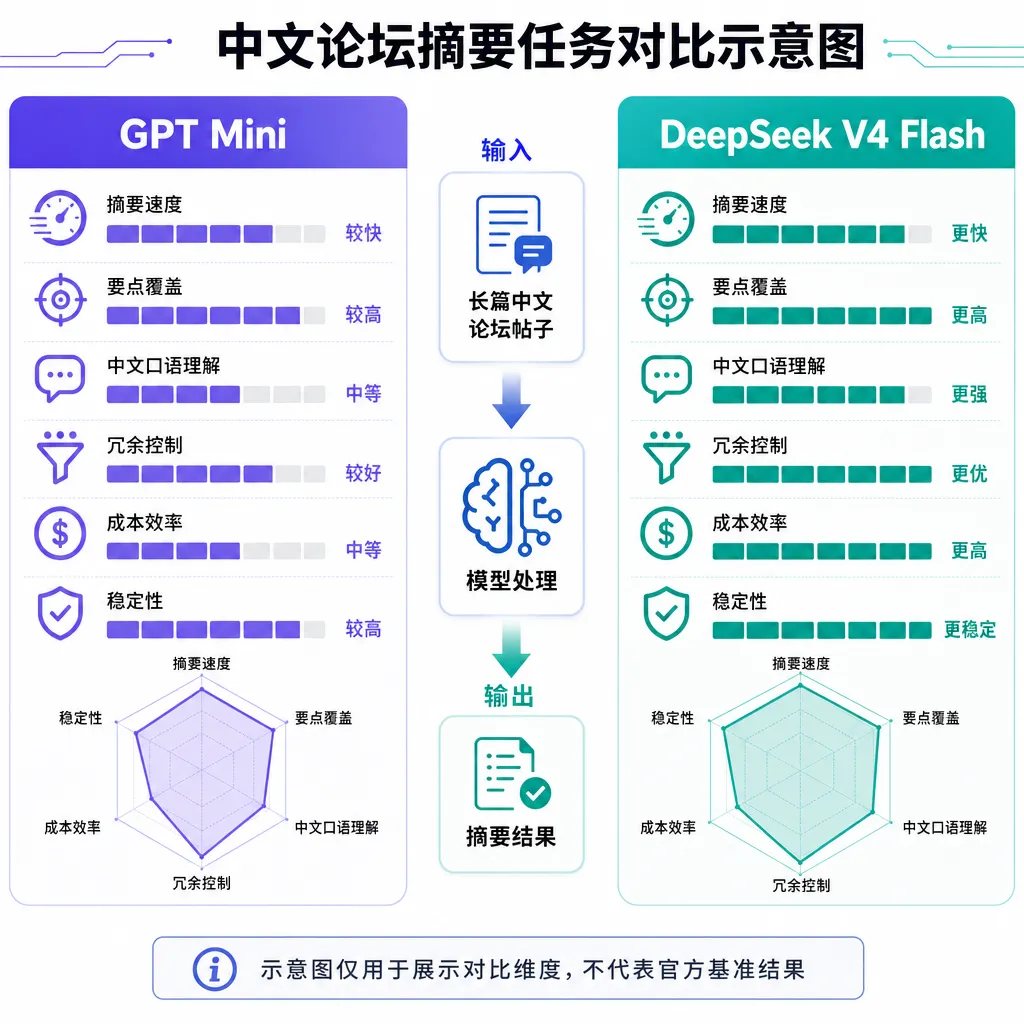
Point 3 is crucial. GPT Mini performs reliably in English summarization but often fails in Chinese forum contexts thick with slang (“the First Emperor,” “bro,” “car,” “melons,” “farming”). It trips in two ways: awkward “Chinglish” phrasing and total misreads of community jokes. The DeepSeek family’s advantage lies in its native exposure to Chinese community corpus, and V4 Flash pushes that advantage into an ultra-low-cost range.
The Mystery Prefix: Who’s Powering the Inference?
Back to the exciting part of that forum post—the strange prefix before the model name.
Normally, DeepSeek V4 Flash can come from:
- DeepSeek official API: clean names like
deepseek-v4-flash. - Volcano Ark: includes
ep-or endpoint IDs. - SiliconFlow / OpenRouter / other aggregators: includes channel prefixes like
siliconflow/,openrouter/. - Self-deployment (vLLM / SGLang / TensorRT-LLM): model names are completely user-defined.
The prefix shown on L-Station matched none of these conventions. Given the admin’s “do it myself” personality, the most plausible explanation is:
The First Emperor (the site admin) rented GPUs and deployed his own instance of DeepSeek V4 Flash specifically for L-Station’s topic summaries.
It makes perfect sense. Although DeepSeek V4 is a mixture-of-experts model, the Flash variant is far lighter on VRAM and runs well on multi-GPU consumer cards—even H20s or 910Bs. For a forum with hundreds of thousands of daily actives generating huge summarization loads, self-hosting costs less per margin than paying per token, especially for pure text tasks like “long input, short output.”
Why not use an open-source smaller model? It’s about balance. L-Station’s developer-heavy audience has low tolerance for poor summaries. Models like Qwen3-32B or GLM-4 still lag behind V4 Flash in Chinese summary accuracy—especially on long threads (hundreds of posts). V4 Flash sits at the sweet spot: affordable yet good enough.
From GPT Mini to DS V4 Flash: A Representative Migration
This “minor” update is worth highlighting because it’s emblematic.
Over the past year, “AI summaries” have become standard features across content platforms—Zhihu, Jike, Xiaohongshu, Discourse-based forums, even video intros on Bilibili—all powered by lightweight LLMs. Early on, nearly all relied on OpenAI’s Mini models, simply because they best balanced Chinese capability, cost, and stability.
But by 2026, the landscape has shifted entirely:
| Dimension | GPT Mini (2025) | DeepSeek V4 Flash (2026) | |------------|------------------|---------------------------| | Chinese summary quality | Average | Noticeably better; understands community context | | Token cost | Baseline | About 1/3–1/5 | | Mainland access | Requires proxy | Direct or self-hosted options | | Long-context stability | So-so | More stable | | Private deployment | Impossible | Fully open-source and deployable |
Individually, none of these factors would force a switch—but combined, migration becomes inevitable. Especially the “self-deployable” part, which for a community operator like L-Station means fully controllable costs—no more monthly-bill anxiety.
Users also noted a subtle change: with V4 Flash, summaries now “sound” more like the forum’s native tone. GPT Mini used to make rants read like news reports; V4 Flash captures the informal banter of L-Station users. That’s the side effect of native Chinese pretraining—it speaks the community’s language.
A Small Observation: The Aggregator Ecosystem Has Stratified
A broader takeaway: L-Station’s switch reflects a bigger trend—the segmentation of model access channels has matured.
Developers now typically use models in three tiers:
- Direct official API — for maximum stability and newest features, but expensive or geo-restricted.
- Aggregation platforms — one API key for all models; seamless switching, perfect for app developers. Platforms like OpenAI Hub unify DeepSeek, GPT, Claude, Gemini under one compatible endpoint, making debugging and migration trivial.
- Self-deployment — suited for entities like L-Station with steady traffic, GPU budget, and a single-purpose workload.
Most use cases fall in tier 2. Few developers will spin up GPUs for niche features, but managing a dozen vendor SDKs is equally unappealing. Hence aggregation APIs have boomed—they don’t solve model problems but model-selection mobility ones. L-Station’s switch was a one-time move; most products, however, need the flexibility to “use GPT today, V4 tomorrow, Gemini Flash next week.”
A Few Open Questions
Concerning this particular switch, some open curiosities remain:
- Why Flash instead of V4 Pro? Likely cost, though Pro handles very long threads (~200+ posts) better—perhaps the admin ran A/B tests.
- Was only the “topic summary” component changed? What about “message digest” or “search reranking”? No confirmation yet.
- Could it ever revert? Unlikely. A “70% cost cut with better output” migration never reverses.
Final Thoughts
Ultimately, the L-Station model swap is a small event but a vivid snapshot of 2026’s Chinese developer scene: in cost-sensitive Chinese-language scenarios, OpenAI’s small-model dominance is steadily being overtaken by DeepSeek-tier domestic models.
The shift isn’t driven by flashy press releases but by quiet, product-level decisions—“Let’s try swapping in V4 Flash”—that accumulate until one day, the whole pipeline has changed.
For application developers, one key takeaway remains: don’t lock yourself to any single model vendor. Today it’s GPT Mini, tomorrow V4 Flash, the day after maybe Gemini 3.5 Flash or Qwen3.7-Flash. Designing code that can switch backends in five minutes will only grow more crucial in 2026.
The First Emperor of L-Station made the right move.
References
- L-Station’s Topic AI Summary Model Has Switched to DS – linux.do: The original thread with first-hand discussion and screenshots of the model migration.


