
Mango TV has quietly started a large model API business: 9 domestic models available for free until the end of the month

Mango TV, a subsidiary of Hunan TV, quietly launched its AIGC open platform, integrating nine major domestic large models at once. It is compatible with the OpenAI format and offers limited free access until May 31. Why did a long-form video company suddenly step in to build a model API aggregator?
Mango TV Quietly Starts Big Model API Business: 9 Domestic Models Free to Use Until the End of the Month
In the past two days, someone on linux.do posted a message: Mango TV—the very one that airs Who's the Murderer and Sisters Who Make Waves from Hunan TV—has quietly launched an AIGC Open Platform, integrating nine domestic large language models, compatible with the OpenAI protocol, and offering free access until tomorrow, May 31.
The original post said, “Not posting the link to avoid being accused of drive-by marketing,” with an accompanying screenshot from Mango TV's aigc.mgtv.com backend. After checking the documentation, we confirmed the news is true: this isn’t some third-party proxy scraping for freebies—it’s an official developer platform under the Mango TV domain, with both text and image generation APIs live.
A long-form video company, whose core business revolves around content rights and subscription revenue, suddenly stepping into the API business, competing with cloud providers and model vendors—now that’s worth a closer look.
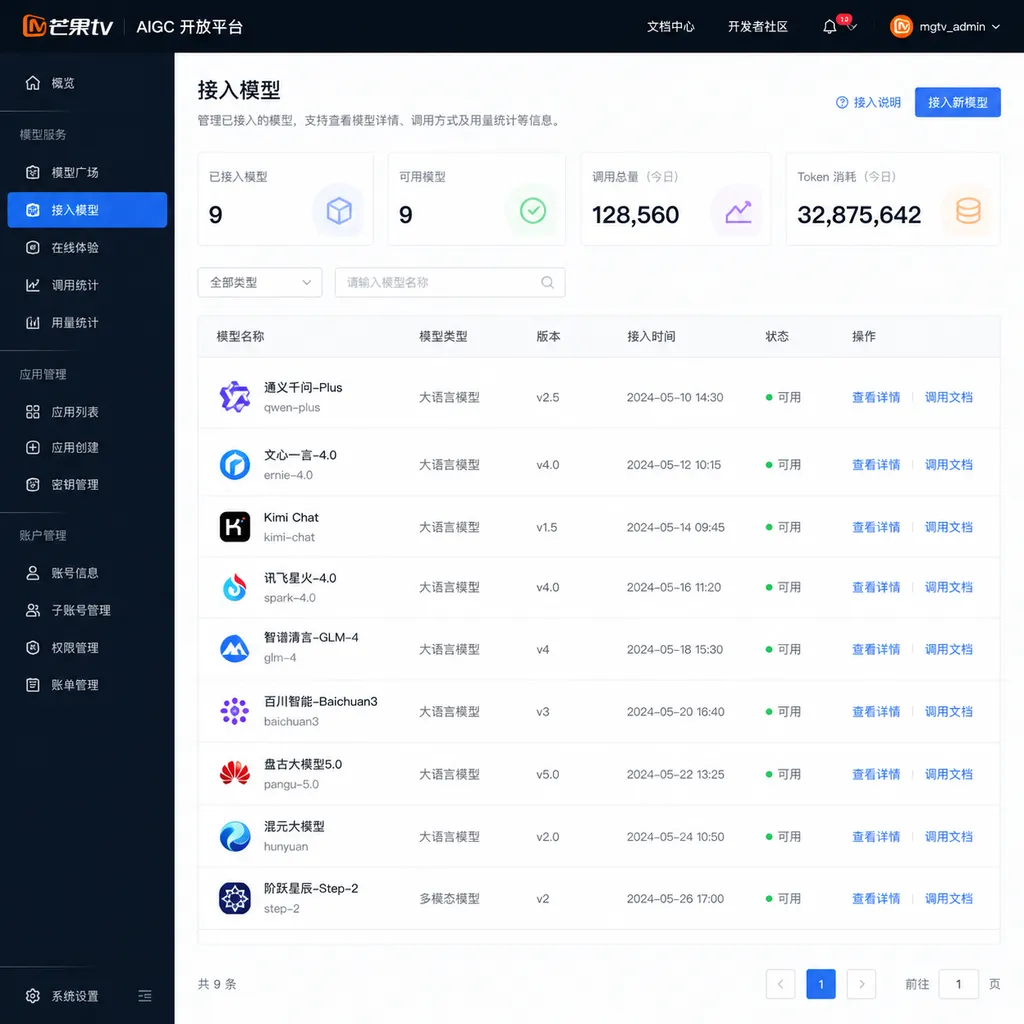
Nine Models Integrated at Once: Platform Levels Out the Differences
Let’s start with the technical side. Mango’s API product is essentially a model routing layer—you use one API key, and switch between different underlying models via the model field. According to developer feedback, the nine models integrated cover almost all top-tier domestic players—DeepSeek, Qwen, GLM, Kimi, Doubao, Hunyuan, plus a few niche ones.
Two main selling points are highlighted:
- OpenAI protocol compatibility. This means if your application is already written using the OpenAI Python or Node SDKs, you could in theory just change the
base_url, replace theapi_key, and update themodelname—with minimal changes. In the past two years, this has become the de facto industry standard—if you’re not compatible with OpenAI, you can forget about attracting existing developers. - Limited free access. All models are free to use until May 31. There’s no clear mention of QPS limits, but since this is a public beta, rate limiting almost certainly applies.
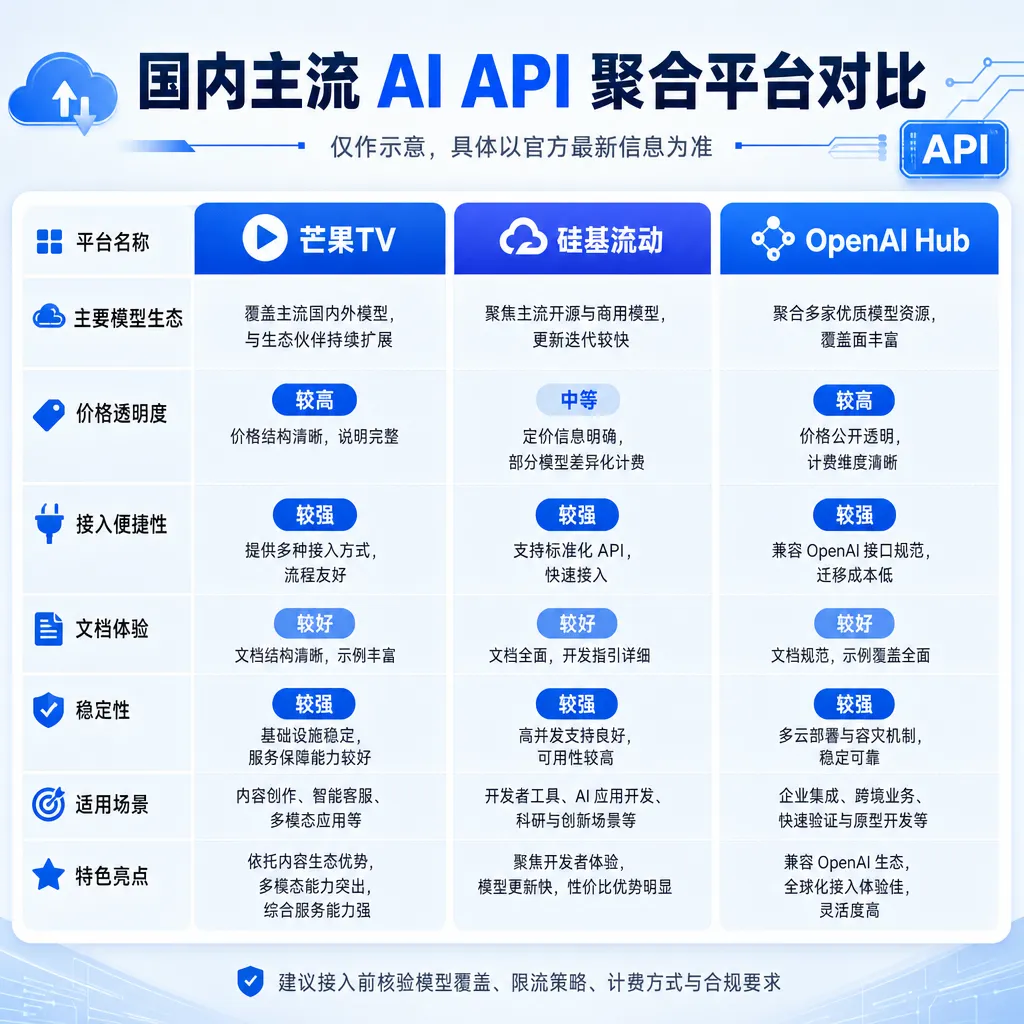
Model routing has turned into a red ocean since 2024. From global players like OpenRouter and Together AI to domestic ones like SiliconFlow and ppinfra, then OpenAI Hub, and now Mango TV entering as a content company—the field is already crowded. Aggregation platforms exist because they address two real developer pain points: unified billing and multi-model switching under one key. For any medium-sized AI app that uses DeepSeek for long context, Qwen for coding, and GLM for experiments, managing separate quotas, authentication, and billing for each model quickly becomes operationally unsustainable.
Why Is a Long-Form Video Company Doing Model APIs?
This is the truly intriguing part of the story.
Mango TV’s core business has never been B2B infrastructure. Its moat lies in copyrighted variety shows, self-produced dramas, and Hunan TV’s content supply chain. Building a model API means competing for market share with technically mature opponents like Alibaba Cloud, Volcano Engine, and Tencent Cloud—seemingly an odd fit.
But if you think about it, the logic works:
First, internal demand already exists. Long-form video platforms are natural heavy users of AIGC applications: script assistance, variety show planning, comment moderation, intelligent editing, poster generation, short video remixing, comment summarization, and customer support—each of these can use large models. Mango likely burns a nontrivial number of tokens every month; instead of paying cloud providers a protection fee, they can build an internal middleware layer—internally as a cost center, externally as a new business. This playbook is the same one AWS followed when it spun out of Amazon’s internal infrastructure.
Second, by 2026, domestic model pricing will be rock-bottom. At the beginning of the year, DeepSeek V3.2, Qwen3, GLM 4.5 and other leading models already cut their official API prices to very low levels. There’s little room left for profit, but high-volume distribution is still viable. Model providers are happy to expand usage through aggregators—direct-to-consumer API sales are a high-touch operation, while distribution via aggregators is far easier. Mango has traffic, brand awareness, and paying users, so joining the game isn’t unreasonable.
Third, AIGC content production itself is being reconstructed. Mango’s real aim may not be just selling API calls—it’s building a full-stack AI production toolchain for content creators—from script to storyboard to poster to editing. The API is just the gateway; behind it are workflows, SaaS tools, and creator communities. Both Alibaba Cloud and ByteDance are pursuing similar paths, but Mango’s proximity to “content” and “creators” gives it a unique edge.
The Logic Behind the Limited-Time Free Access
The phrase “free until May 31” deserves unpacking.
It’s a textbook cold-start acquisition move: offer free access during public beta, get developers to integrate and test, and let their data accumulate. Once the switching cost takes hold, starting paid access on June 1 dramatically lowers churn. Every cloud provider has used this playbook—it’s not innovative, but it works.
Developers should carefully consider:
- Unknown stability. Mango is a new player. Model routing sounds simple, but managing nine upstream models’ rate limits, error codes, streaming responses, and function calling nuances is no small feat. Some early developers already reported occasional 502 errors and throttling triggers.
- Unclear pricing. The current documentation doesn’t show post–May 31 billing rates. If Mango simply mirrors upstream model prices, it loses money; if it adds markup, it’ll compete against direct APIs and more mature aggregation services on cost-performance.
- Data compliance. As a licensed content platform, Mango may face stricter regulatory interpretations than pure tech firms. Before pushing enterprise prompts or data into their system, confirm data retention policies—especially for scenarios involving end-user data.
What This Means for Developers
From a developer’s perspective, this news sends three signals:
First: free benefits. If you need to run model comparison tests, batch data processing, or non-urgent but large offline workloads, the roughly one-week window until May 31 is an opportunity to experiment at minimal cost. OpenAI compatibility makes integration trivial—the code looks roughly like this:
from openai import OpenAI

client = OpenAI(
    api_key="Your API key from Mango AIGC platform",
    base_url="https://aigc.mgtv.com/v1"  # Check official documentation
)

resp = client.chat.completions.create(
    model="deepseek-v3",  # or qwen, glm, kimi, etc.
    messages=[{"role": "user", "content": "Explain what a Transformer is in one sentence"}]
)
print(resp.choices[0].message.content)
Note this is just a sample—the actual model names and endpoint paths should be verified in Mango’s documentation; supported parameters differ across models.
Second: market signal. When even a long-form video company thinks “model API aggregation” is a worthwhile venture, it means this business’s entry barrier and technical complexity have dropped to a certain threshold—large models as infrastructure are rapidly commoditizing. That’s bad news for independent model providers but great for app developers: the more standardized and cheaper the base layer becomes, the more room exists for innovation above it.
Third: the aggregator reshuffle isn’t over. Currently, over a dozen domestic platforms offer stable multi-model API aggregation. Mango joining only lengthens the lineup. Developers evaluate aggregators mainly on four dimensions: model coverage, pricing, stability, and add-on services (like caching, bulk calls, monitoring, and key management). Mango may enter via free access in the short term, but staying power will depend on differentiating itself in the latter three aspects. Platforms like OpenAI Hub, which support GPT, Claude, Gemini, DeepSeek, and others across both domestic and international markets, offer broader coverage—something developers will weigh carefully when choosing.
A Slightly Ironic Observation
When the model boom began in 2023, everyone bet that model companies themselves would become the “water, electricity, and gas” of the AI era. Two and a half years later, reality shows the model layer is rapidly commoditizing, its moat eroding. The real profit lies in the distribution layer—API aggregation, agent frameworks, vector databases, IDE plugins—the “middlemen.”
Mango TV entering the model API business shows how far the domestic ecosystem has evolved: even content companies realize that if you’re burning tokens anyway, you might as well sell them too. In another six months, expect more unorthodox entrants—e-commerce, social, travel platforms—each sitting on massive AIGC demand and developer bases. Spinning up an API aggregator won’t be surprising.
It’s a trend that’s friendly to developers but less so for pure model vendors. There’s one day left in the free window—grab the opportunity while it lasts.
References
- linux.do Forum Original Post: “Mango Secretly Launches a Big Model API” – First disclosure by developer community, including screenshots and usage feedback


