
GPT-5.5 Instant Upgraded Again: Fewer Lists, More Human Touch — o3 and GPT-4.5 Enter the Countdown to Retirement

On May 28, OpenAI rolled out the GPT-5.5 Instant update, featuring more natural response styles and clearer structure, while removing the Canvas feature and officially declaring the end of life for o3 and GPT-4.5 — they will be discontinued on June 27 and August 26, respectively.
GPT-5.5 Instant Upgraded Again: Fewer Lists, More Human Touch – o3 and GPT-4.5 Enter Retirement Countdown
On May 28, OpenAI released an update that wasn’t big in size but packed with information: the GPT-5.5 Instant model was upgraded on both ChatGPT and API endpoints, with response style adjusted to be more natural and readable. At the same time, OpenAI officially announced the gradual retirement of o3 and GPT-4.5, providing a clear decommission timeline.
This is the first official iteration since GPT-5.5 Instant debuted on May 5. Less than a month after its initial release, it’s receiving behavior-level fine-tuning — faster than any previous GPT generation.
So What’s Changed This Time?
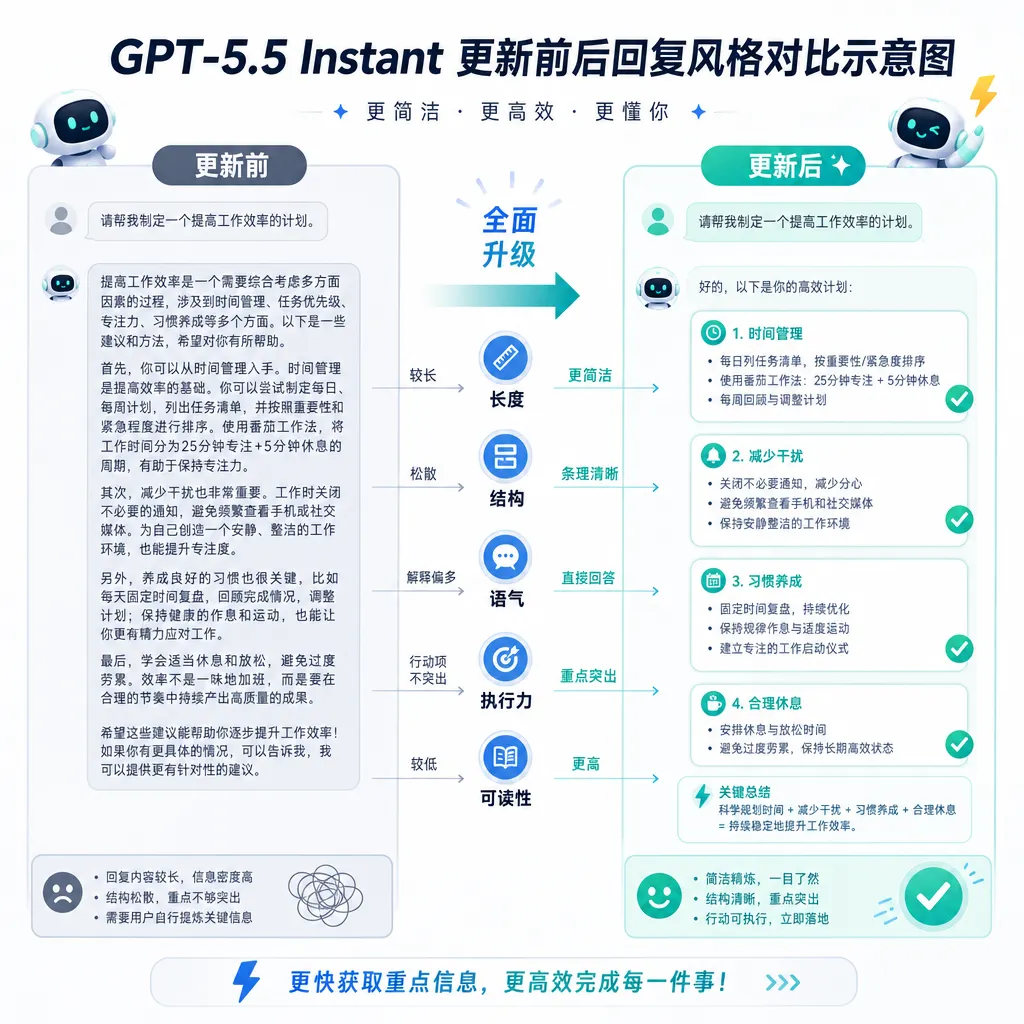
According to the official statement: More natural, more readable, fewer redundant lists.
Sounds like typical product manager phrasing, but anyone who’s used the GPT-5 series can probably relate — the 5-series had one persistent quirk: whatever you asked, it tended to throw a long bulleted list at you. Ask “what should I wear today,” and it might list 8 factors to consider + 3 outfit options + 2 cautions. Structured, yes, but it felt more like reading a PowerPoint deck than chatting with a human.
This upgrade mainly aims to suppress that “list addiction.” From OpenAI’s examples, the adjusted model tends to use coherent paragraphs when explaining math or answering open-ended questions, resorting to lists only when necessary. For code or genuinely enumerated content, code blocks and lists remain unchanged.
An important note: this update was also pushed to the API simultaneously. This matters more to developers than ChatGPT users — many applications built on GPT-5.5 Instant previously had to include system prompt workarounds like “Do not use excessive bullet points.” Those hacks can now be removed.
Recapping GPT-5.5 Instant’s launch highlights: in high-risk domains like medicine, law, and finance, its hallucination rate was 52.5% lower than the previous generation, with clear improvements in math, science, and visual reasoning. This update doesn’t touch the model’s core weights — it’s more like an RLHF-stage style recalibration. From an engineering viewpoint, this “first release capabilities, then tune style” two-phase rollout is becoming standard practice for OpenAI.
Canvas Was Axed — But Not Really Gone
One easily overlooked but significant change: GPT-5.5 Instant and GPT-5.5 Thinking no longer support Canvas.
Canvas was a collaborative writing and coding interface OpenAI introduced in late 2024 — separate window, real-time editing, version comparison, marketed as “co-write documents/code with AI.” It was widely seen as an answer to Anthropic’s Claude Artifacts.
OpenAI’s new approach: implement the same functionality directly in the chat stream through text and code blocks. Essentially, Markdown text and code blocks within replies now have editing capabilities — no need to switch to another panel.
An interesting decision. From a product logic perspective, Canvas split conversation and document into two layers — nice for long-form collaboration but disruptive to chat flow. Embedding features back into chat simplifies things for general users, though heavy collaborative users lose some power features. OpenAI clearly thinks the former group is larger.
Paid users can continue using Canvas until older models are fully retired — a buffer period. But the direction is clear: the Canvas product line won’t continue in the GPT-5.5 generation.
Retirement Timeline for o3 and GPT-4.5
The most concrete info in this announcement: for the first time, OpenAI gave definitive sunset dates for o3 and GPT-4.5:
- GPT-4.5: 30-day transition period, removed from ChatGPT on June 27, 2026
- OpenAI o3: 90-day transition period, removed from ChatGPT on August 26, 2026
Their retirement has long been in motion.
GPT-4.5 was the early-2025 model nicknamed “Orion,” focused on emotional intelligence and creative writing — but it was expensive and slow. After GPT-5‘s release, it faded quickly. Even OpenAI acknowledges its ChatGPT usage was “low.”
o3’s case is more complex. As the flagship of the o-series reasoning models, it performed impressively in scientific and math reasoning, but GPT-5.5 Thinking now fully covers and surpasses o3’s capabilities, leaving it as historical baggage.
A detail developers should note: the announcement only specifies removal from ChatGPT — there’s no equally clear schedule for the API. Based on precedent (e.g., GPT-4 lingering in the API long after its ChatGPT removal), API users likely have a longer migration window. Still, if your production setup still calls o3 or gpt-4.5, it’s time to start migration testing.
Migrating to GPT-5.5 Instant: A Minimal Code Example
For projects still using o3 or GPT-4.5, switching to GPT-5.5 Instant is practically zero-cost — the API interface is fully compatible; just change the model name.
If you're calling through an aggregator platform like OpenAI Hub (one key supporting GPT, Claude, Gemini, DeepSeek, etc., with domestic direct connectivity and OpenAI-format compatibility), the code looks roughly like this:
from openai import OpenAI

client = OpenAI(
    api_key="your-openai-hub-key",
    base_url="https://api.openai-hub.net/v1"
)

resp = client.chat.completions.create(
    model="gpt-5.5-instant",
    messages=[
        {"role": "system", "content": "You are a concise technical assistant. Respond in natural language and avoid unnecessary bullet points."},
        {"role": "user", "content": "Explain why layer normalization is needed in transformer training?"}
    ],
    temperature=0.7
)

print(resp.choices[0].message.content)
A few migration best practices:
- Remove old anti-list prompts. As noted earlier, the new version already minimizes list usage; overemphasizing it might make responses too loose.
- Lighten system prompt persona setups. GPT-5.5 Instant’s default tone is already more natural; descriptive “softening” phrases used for GPT-4.5 can be trimmed.
- If your app relied on o3’s long reasoning chain, migrate to
gpt-5.5-thinkinginstead ofgpt-5.5-instant. Instant targets low latency — complex reasoning tasks still belong to the Thinking variant.
Some Observations
First, “fewer lists” may sound like a small tweak, but it signals a trend: model developers are realizing that once capability ceilings level out, the next differentiator is user experience. Claude from Anthropic is often praised for “talking like a person”; OpenAI is clearly closing that gap with GPT-5.5 Instant.
Second, Canvas’s demise shows standalone UI concepts may lose to in-chat embedding. Artifacts thrive in Claude because they form part of a full long-form creation workflow; Canvas’s role in ChatGPT was always ambiguous — not essential, not irresistibly better. Cutting it is a rational move.
Third, o3’s discontinuation likely means the o-series product line won’t continue. Starting with GPT-5, OpenAI has reframed “reasoning mode” as a state within general models (Thinking), not a separate family. o1/o3 naming ends here.
Fourth, for developers, the most practical impact: if your app depends on stable output formatting (e.g., structured parsing, table generation), you’ll need to re-test templates with the updated GPT-5.5 Instant. “Fewer lists” benefits end users, but pipelines relying on consistent structure may need adjusted prompts or JSON mode.
Final Thoughts
This GPT-5.5 Instant update doesn’t introduce groundbreaking new abilities but exemplifies OpenAI’s current product rhythm — fast iteration, small steps, replacing dramatic major releases with continuous refinements. For developers, instead of waiting for GPT-6, the smarter move is to maximize what the current models can do.
OpenAI Hub now fully supports the upgraded GPT-5.5 Instant and GPT-5.5 Thinking. For those still running on o3 or GPT-4.5, the migration window is shrinking fast — especially GPT-4.5 users, whose deadline is June 27.
References
- ITHome: OpenAI upgrades GPT-5.5 Instant model — responses are more natural and readable — Source Chinese report with decommission schedule details
- Zhihu Column: GPT-5.5 Instant free for all — hundreds of millions of ChatGPT users see changes — Capabilities overview from its May 5 launch
- Reddit r/singularity: GPT-5 model discussion — Global developer community discussion on GPT-5.5 Instant upgrades


