
GPT-6 “Potato” is ready and will be served on April 14.

OpenAI’s codename “Spud” GPT-6 is reported to be released on April 14, boasting a 40% performance leap over GPT-5.4. It features a natively unified multimodal architecture and an expanded 2-million-token context window, while pricing remains nearly unchanged. To achieve this, OpenAI has scrapped Sora and All in AGI.
The Potato Is Cooked
A little over a week remains until April 14, and news about GPT‑6 can no longer be contained.
X platform tipster @iruletheworldmo (known inside the circle as “Strawberry Bro”) fired off multiple tweets claiming access to extensive insider information from OpenAI: GPT‑6, codenamed “Spud,” allegedly completed pre‑training as early as March 17. Post‑training and red‑team safety tests are said to have wrapped up, and the model is “ready for launch anytime,” with an internal release date of April 14.
The moment the leaks dropped, the community exploded—but some poured cold water on it. The tweet carries an X community note suggesting that the account “repeatedly fabricates wholly false AI leaks and insider news.” The top‑voted Reddit comment was blunt: “This guy has been making stuff up forever, still doing it now.”
However, this time feels a bit different.
OpenAI cofounder Greg Brockman recently confirmed several things on a podcast: a newly re‑trained model is coming that embodies two years of accumulated technology; progress toward AGI is 70–80% complete; and OpenAI is consolidating its main efforts around the GPT series. He used an intriguing phrasing—“Once you try it, you’ll realize how smart and obedient it is.”
These public statements align strikingly with Strawberry Bro’s leaks. Even if the leaker’s credibility is debatable, the puzzle pieces seem to be falling into place.
What Does 40% Mean
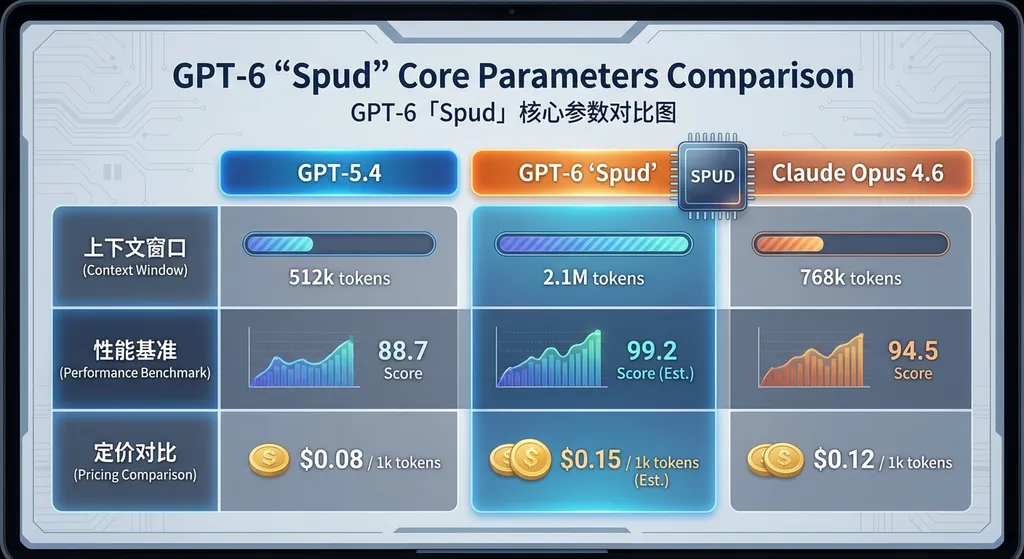
Let’s start with the attention‑grabber: Across three key dimensions—code generation, logical reasoning, and agent tasks—GPT‑6 is reportedly over 40% stronger than GPT‑5.4.
That 40% must be understood in context. From GPT‑4 to GPT‑4o and the GPT‑5 series, each generation improved roughly 10–20%, and the gap gets harder to widen—the whole large‑model field knows that. A 40% leap, if true, means OpenAI made fundamental architectural changes during pre‑training, not just minor post‑training tweaks.
In developer‑relevant terms:
-
Code capability: This has been OpenAI’s sore spot over the past year. Brockman admitted on a podcast that OpenAI had been “too focused on leaderboard rankings,” allowing Anthropic’s Claude Code to dominate, with developers voting with their feet. GPT‑6’s rise in coding capacity is less a technical leap than a strategic make‑up course. Since December 2025, OpenAI has been on “red alert” for programming. How much of this 40% was “forced out by Claude” is unclear—but surely not a small portion.
-
Reasoning ability: The leak claims that long‑context reasoning recall accuracy exceeds 98%, with hallucinations drastically reduced. If you often use large models for multi‑step reasoning—analyzing a long technical document or mapping major project dependencies—you know the pain of models “forgetting” or “making things up.” A 98% recall rate means consistency at scale is finally achievable.
-
Agent tasks: This is the one to watch most closely. Not just Q&A, but autonomous planning, step‑wise execution, and self‑correction. If that 40% boost falls partly here, every team building agent workflows on large models will feel the impact.
2 Million Tokens: From “Chunking” to “Whole Book Ingestion”
The context window doubles from GPT‑5.4’s 1 million tokens to 2 million.
Two million tokens equal roughly 1.5 million Chinese characters—about twice the length of Dream of the Red Chamber. In other words, you could feed two full novels at once with room to spare. In code terms, a mid‑to‑large project’s core repository could be input in its entirety.
This matters far beyond “handling longer text.”
Previously, with 1M‑token models, developers had to rely heavily on chunking, summarization, and retrieval‑augmented generation (RAG)—engineering hacks to compensate for model limits. A 2M‑token window won’t kill RAG, but it raises the threshold for tasks that can now be solved “without RAG.” Workflows that once needed finely tuned chunking strategies may now simply take raw input.
For enterprises, this means full‑library ingestion—contracts, codebases, data docs—in one go for holistic analysis. For developers, it simplifies app architecture: fewer RAG layers, fewer points of failure.
Of course, usable performance depends on inference speed and attention decay. A bigger window doesn’t always mean a better one. We’ll only know once real tests begin.
Native Multimodal: Not a Patchwork but True Unification
GPT‑6 employs a native multimodal unified architecture—one model handling text, audio, images, and video simultaneously.
Sounds mundane, but if you know how most current multimodal models work, you’ll see how major this step is.
Currently, nearly all “multimodal” models are actually text LLMs patched with modality encoders/decoders—a ViT for images, Whisper for audio, a separate stack for video—all aligned later in textual representation space. Functional, yes, but fragmented: the model doesn’t truly comprehend cross‑modal relationships; it just maps between feature spaces.
Native multimodal means joint training across all modalities from the start, within one architecture. The model’s understanding of images and text shares representations—no alignment layers needed. The result is qualitatively improved cross‑modal reasoning: e.g., feed a video plus a document and ask whether the operations match documented procedures. Patchwork models often fail that; unified ones won’t.
For developers, this also simplifies APIs—no more separate endpoints for each modality. One unified interface handles all input/output types.
Pricing: Mythos Intelligence at Sonnet Prices
Leaked pricing: $2.50 per million tokens input, $12.00 per million output.
Compared to GPT‑5.4, that’s nearly flat. Given a 40% performance boost and double the window, the pricing is extremely aggressive. In Strawberry Bro’s words: “Mythos‑level intelligence for a Sonnet‑level price.”
The logic is clear. OpenAI’s income now comes mainly from personal subscriptions, but enterprise demand shows strong willingness to pay. Keeping API prices low builds the developer ecosystem; enterprise deployments monetize—OpenAI’s been on that path for two years, GPT‑6 just continues it.
For API developers, that’s good news. If your project uses GPT‑5.4, migrating to GPT‑6 costs almost nothing while gaining real improvements. Through aggregation platforms like OpenAI Hub, switching could be as easy as changing the model name—fully compatible interface.
Assuming the API opens on release, calling will likely match current OpenAI formats:
from openai import OpenAI

client = OpenAI(
    api_key="your-api-key",
    base_url="https://api.openai-hub.net/v1"  # OpenAI Hub aggregation interface, connects directly from China
)

response = client.chat.completions.create(
    model="gpt-6",  # Actual model name upon release
    messages=[
        {"role": "system", "content": "You are a senior code reviewer."},
        {"role": "user", "content": "Please review the following repo architecture and identify potential performance bottlenecks and security risks."},
        # 2M-token window allows full codebase input
    ],
    max_tokens=8192,
)

print(response.choices[0].message.content)
// Node.js example
import OpenAI from 'openai';

const client = new OpenAI({
  apiKey: 'your-api-key',
  baseURL: 'https://api.openai-hub.net/v1',
});

const response = await client.chat.completions.create({
  model: 'gpt-6',
  messages: [
    { role: 'system', content: 'You are a full-stack engineer skilled in architecture and performance optimization.' },
    { role: 'user', content: 'Analyze this project’s entire code and propose refactoring suggestions.' },
  ],
});

console.log(response.choices[0].message.content);
Super App: ChatGPT + Codex + Atlas Combined
GPT‑6 isn’t only a stronger model—it’s the engine for OpenAI’s “Super App” strategy.
According to leaks and Brockman’s comments, GPT‑6 will power a desktop super app unifying ChatGPT (conversation), Codex (coding), and Atlas Browser (web navigation) into a single intelligent agent. No more switching products—one entry point for everything.
This concept isn’t new. Anthropic’s Claude already blends similar approaches—Claude Code interacts directly with the terminal and filesystem, Cowork executes autonomous browser tasks. OpenAI differs by aiming to integrate all these abilities inside one desktop app instead of scattering them across different products.
Its success depends on how strong GPT‑6’s agent abilities truly are. A model that plans, executes, and self‑corrects autonomously supports a very different product than one that just answers questions. If that claimed 40% boost indeed enhances the agent dimension, this Super App could succeed. If not, it’s just another demo.
All In on AGI: Cutting Everything Else for the Bet
To understand GPT‑6, look not just at the specs but the cost behind them.
To concentrate resources for GPT‑6, OpenAI reportedly made extreme moves:
- Sora cut: The once‑amazing video‑generation model will shut down on web and mobile April 26, with its API retiring in September. Rumored multi‑billion‑dollar Disney collaboration canceled as a result.
- Product division renamed “AGI Deployment”: More than rebranding—it means structurally focusing on one thing only: deploying AGI.
- Safety department moved under the Chief Risk Officer (CRO): Altman himself leaves safety oversight entirely to focus on data centers.
Insiders say Brockman believes AGI progress is 70–80% complete, and GPT‑6 represents the last 20%—“the final mile.” They’re cutting everything to bet on it.
Controversial, indeed. Dropping Sora means forfeiting a huge video‑generation market and implicitly admitting video and text lie on separate tech branches—OpenAI choosing text. Brockman’s words: “We’re convinced textual models can reach AGI.”
Whether right or wrong may take years to prove—but it explains why OpenAI is staking so much on GPT‑6 now.
Keep Your Cool: How Credible Is All This?
To be clear: as of publication, all detailed parameters, dates, and internal positioning for GPT‑6 come solely from @iruletheworldmo’s tweets. OpenAI has confirmed none.
His credibility is disputed. X community notes tag him for “repeatedly fabricating false leaks.” Reddit sentiment is similarly harsh. He does have prominent followers—Gavin Baker, Jim Fan—but follows don’t mean endorsement.
Still, several cross‑verifiable points exist:
- Brockman really said a new re‑trained model is coming.
- OpenAI truly is trimming non‑core businesses; Sora’s shutdown is official.
- OpenAI indeed feels heavy pressure from Anthropic in coding; Brockman admitted this.
- Product‑org changes have multiple independent confirmations.
So, a reasonable stance: GPT‑6 almost certainly exists, will likely launch soon, and will likely deliver major capability gains. But the specifics—40%, 2M tokens, April 14—should wait for official announcements.
What It Means for Developers
Regardless of exact specs, GPT‑6’s arrival will definitively reshape the developer ecosystem:
Short term: If you’re using GPT‑5.4’s API, prepare to test migration. If the 2M‑token window proves real, many RAG architectures can simplify drastically. Review which scenarios could switch from “retrieval‑enhanced” to “full‑input.”
Medium term: Native multimodal architecture will spark new product forms. Ideas once paused for lacking cross‑modal ability can now be revisited.
Long term: Should the Super App become reality, OpenAI shifts from model vendor to platform gateway. For all teams building atop OpenAI APIs, that’s both opportunity and threat—if your product overlaps its functions, time to define your differentiation.
And note: OpenAI’s aggressive pricing will squeeze competitors further. If GPT‑6 truly offers 40% better performance for nearly the same price, Anthropic and Google must either cut costs or accelerate iteration. For developers, that simply means stronger models for the same budget—no matter whose you use.
April 14—let’s see how OpenAI serves this potato.
References
- GPT‑6 Exposed – Netease: Detailed round‑up of Strawberry Bro’s leaks—performance, pricing, release date, etc.
- OpenAI’s New Model Isn’t GPT‑X! Re‑trained “Potato” Revealed – Baijiahao: Brockman podcast summary, including Sora strategy changes and new‑model positioning.
- OpenAI’s New Model Isn’t GPT‑X! Re‑trained “Potato” Revealed – Zhihu: Analysis of the Super App strategy and enterprise payment willingness.
- AGI Era Nearing: GPT‑6 Rumored for April 14 Release – Kuai Tech: Timeline and Sora shutdown details.
- Breaking! GPT‑6 Exposed – Sina Finance: Community discussion of leak credibility, including X community notes and Reddit reviews.
- GPT‑6 Rumored for April Launch – Baijiahao: Technical analysis of 2M‑token window and native multimodal architecture.


