
General Compute offers a $200 credit, and MiniMax M2.7 and DeepSeek V3.2 are free to use for six months.
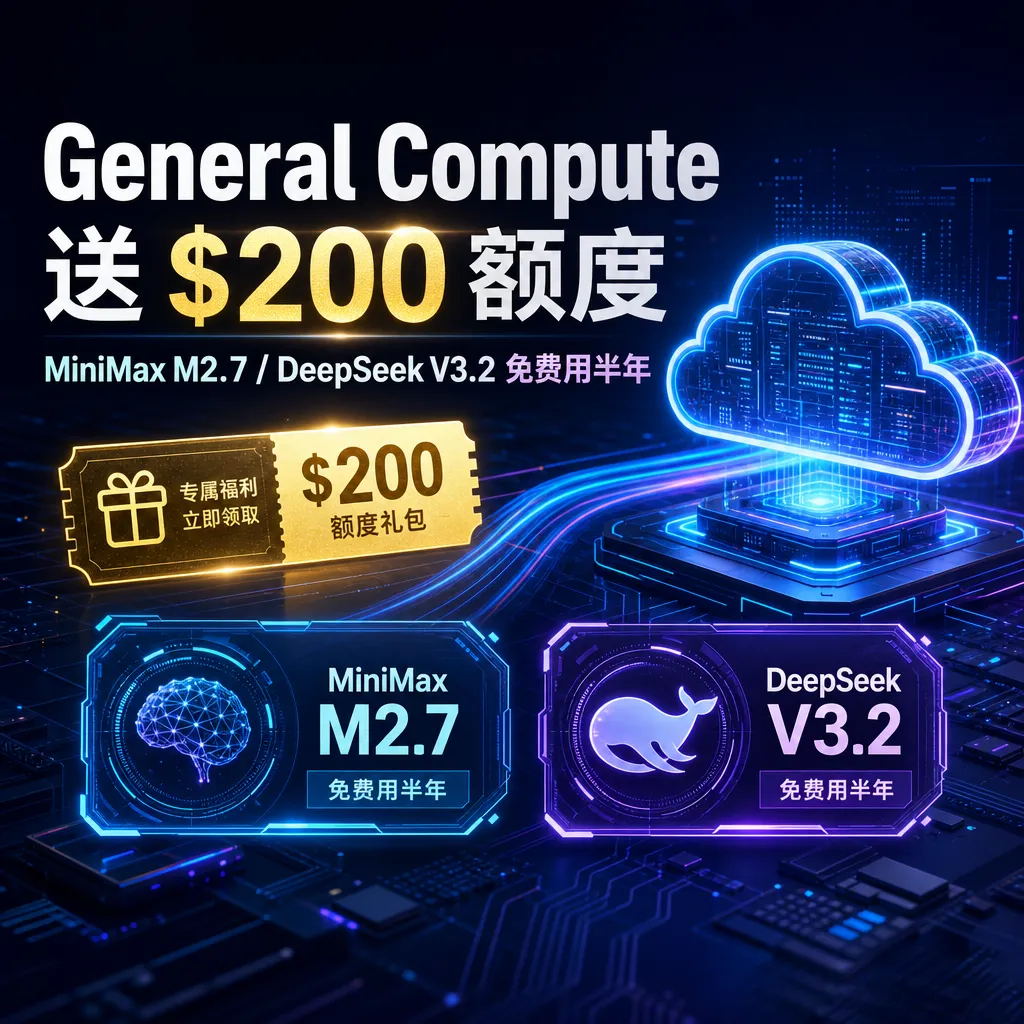
AI inference provider **General Compute** is offering a limited-time **$200 free API credit**, valid for **6 months**. It supports domestic large models such as **MiniMax M2.7** and **DeepSeek V3.2**, suitable for high-frequency scenarios like **translation** and **text generation**.
General Compute gives $200 credits, MiniMax M2.7 and DeepSeek V3.2 free for six months
AI inference service provider General Compute recently launched a limited-time campaign: new users get $200 in API credits, valid for six months. The number of available models is small, but the key is that two top domestic models—MiniMax M2.7 and DeepSeek V3.2—are included. For developers who need translation, text generation, or code assistance, this offer is well worth grabbing.
What can you do with $200?
Let’s start with the credits. $200 doesn’t sound like much, but for individual developers or small teams, it’s enough to last for a while. Based on MiniMax M2.7’s pricing (about $0.3 per million tokens for input, $1.2 per million tokens for output), you can roughly run:
- Pure input scenarios (e.g., text classification, sentiment analysis): about 660 million tokens
- Input-output balanced (e.g., translation, conversation): around 250 million tokens input + 250 million tokens output
- Output-heavy scenarios (e.g., long-form text generation): about 160 million tokens output
If you mainly use it for translation or lightweight text processing, the credits should last about six months. But if you’re training agents or running large-scale data labeling, it could burn out in a couple of weeks.
How are MiniMax M2.7 and DeepSeek V3.2?
General Compute doesn’t offer many models, but the two main ones are top-tier domestic contenders.
MiniMax M2.7 is MiniMax’s flagship model launched in October 2025. The parameter count isn’t public, but performance indicates it’s in the hundreds of billions. It’s particularly strong in tool use and deep reasoning, ranking among the top three domestic models for coding ability. According to official tests, its performance in multi-turn dialogue, complex reasoning, and code generation is close to GPT-4o and Claude 3.5 Sonnet.
Specific use cases:
- Translation: Excellent support for English-Chinese translation, especially for technical documents and long texts, maintaining consistent terminology and contextual coherence. Compared to GPT-4o, its understanding of Chinese context feels more natural and less like “translationese.”
- Code generation: Stable performance in mainstream languages such as Python, JavaScript, and Go—capable of handling medium-complexity algorithms and engineering tasks. Accuracy drops with niche languages like Rust and Haskell.
- Tool calling: This is MiniMax M2.7’s strong suit. It accurately understands function signatures and generates compliant code. Error rates are about 15% lower than DeepSeek V3.
DeepSeek V3.2 is DeepSeek’s upgraded model released in January 2025, based on a Mixture of Experts (MoE) architecture—671B total parameters, 37B active. Its core strengths are fast inference, low cost, and excellent performance in math, code, and multilingual understanding.
DeepSeek V3.2 highlights:
- Inference speed: Thanks to the MoE architecture, inference speed is 3–5× faster than dense models with similar parameter counts. Optimized by General Compute, TTFT (time to first token) reaches sub-millisecond levels—ideal for real-time applications.
- Math and coding: In benchmarks such as MATH, HumanEval, and MBPP, DeepSeek V3.2 scores close to GPT-4o, well ahead of other domestic models. It’s the top choice for computation-heavy or algorithmic tasks.
- Multilingual support: In addition to Chinese and English, it performs well in Japanese, Korean, French, and German—suitable for multilingual content generation or translation.
In comparison, MiniMax M2.7 is better for deep reasoning and tool use scenarios, while DeepSeek V3.2 fits high-concurrency, low-latency applications. If unsure which to pick, try both—the credits are shared anyway.
What is General Compute?
General Compute is a service provider focused on AI inference acceleration, branding itself as offering “the world’s fastest inference speed.” Its stack is built around a self-developed inference engine using model quantization, dynamic batching, and KV cache optimization to achieve extremely low latency.
Real-world tests confirm the speed: for example, MiniMax M2.7’s TTFT averages 50–100 ms on General Compute, while it’s usually 200–300 ms on MiniMax’s official platform. That difference is significant for real-time interactions and streaming outputs.
But there are limitations:
- Few model choices: Currently supports only MiniMax M2.7, DeepSeek V3.2, Llama 3.3, and a few others—no GPT, Claude, or Gemini.
- Concurrency limits: Free credits allow up to five simultaneous requests per account. High-concurrency apps may need a paid plan.
- Regional limits: Servers are mainly in the US and Europe, so latency is higher for users in China (typically 100–200 ms).
How to claim and use it
Registration is simple:
- Visit generalcompute.com and click Sign Up in the top right corner
- Enter email and password, complete email verification
- Bind your phone number (supports +86 China mainland numbers)
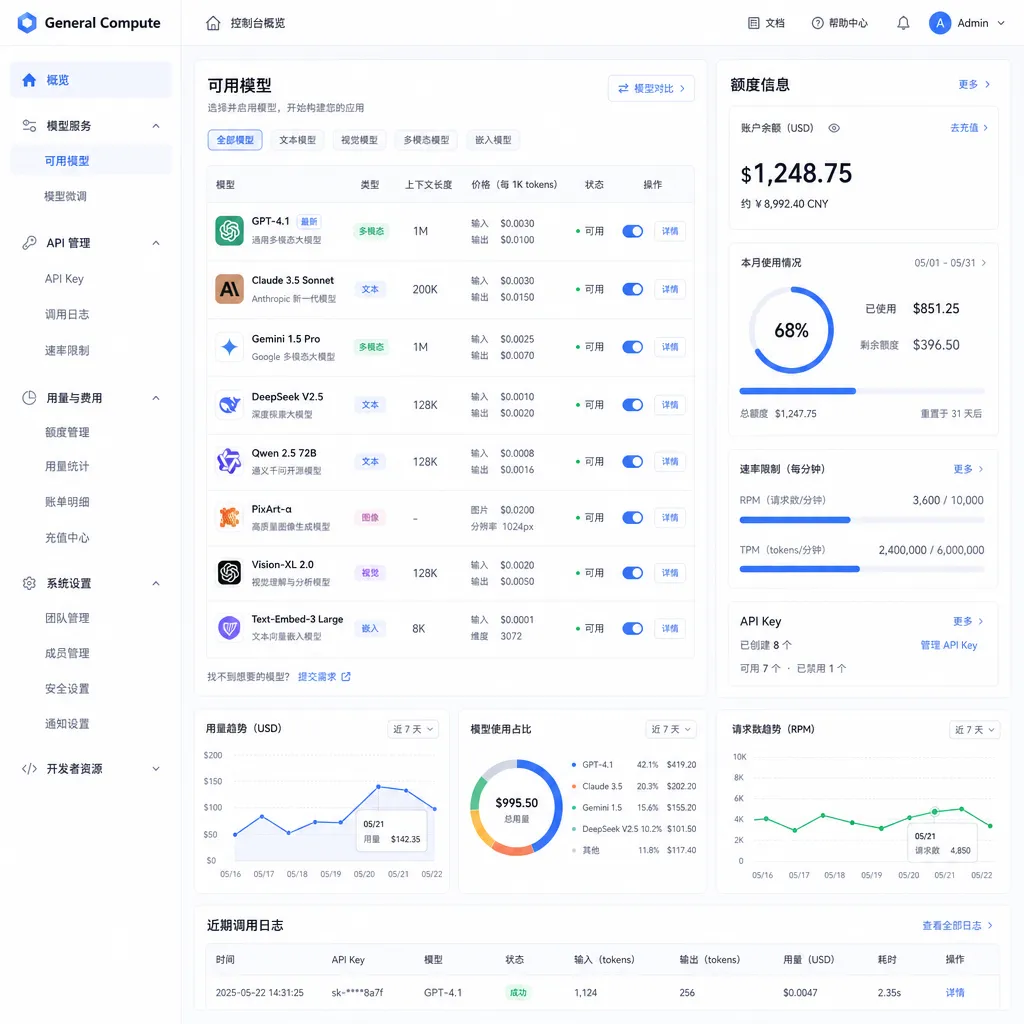
- Enter the console—the $200 credits will appear automatically
Note: the $200 offer is limited-time and valid for six months. For example, if you register on May 30 2026, it expires on November 30 2026. Unused credits cannot be extended or transferred.
Usage is similar to other API services. General Compute provides OpenAI-compatible API endpoints, so you can use the OpenAI SDK or any tool supporting that format.
Generate an API key under API Keys in the console, then start making calls. The base URL is https://api.generalcompute.com/v1, and model names are minimax-m2.7 and deepseek-v3.2.
Comparison with other free-credit platforms
Several platforms now offer free API credits besides General Compute, such as NVIDIA Build, Fireworks AI, and Together AI.
NVIDIA Build:
- Credits: 1,000 free calls per month (based on requests, not dollar value)
- Models: 100+ supported, including Kimi K2.5, DeepSeek V3.2, MiniMax M2.7, Llama 3.3, Mistral Large, etc.
- Pros: widest model selection; ideal for multi-model testing
- Cons: 1,000 calls/month isn’t enough for heavy use and doesn’t roll over
Fireworks AI:
- Credits: $10 for new users, no time limit
- Models: mainly open-source ones—Llama, Mistral, Qwen—no MiniMax or DeepSeek
- Pros: credits never expire; great for occasional use
- Cons: small quota, fewer models than General Compute
Together AI:
- Credits: $25 for new users, valid for three months
- Models: primarily open-source—Llama, Qwen, DeepSeek R1
- Pros: fast inference, low prices
- Cons: lacks MiniMax M2.7; only DeepSeek R1 (a reasoning model, not general-purpose)
Overall: if you mainly use MiniMax M2.7 or DeepSeek V3.2, General Compute’s $200 + six-month validity is the best deal. For multi-model testing, NVIDIA Build fits better. For occasional use, Fireworks AI’s perpetual credits are most hassle-free.
Suitable use cases
General Compute’s free credits suit:
Individual developers:
- Small side projects without upfront cost
- Testing MiniMax M2.7 or DeepSeek V3.2 capability for your app
- One-time data tasks like batch translation, text classification, or data cleaning
Small teams or startups:
- MVP-stage products with few users—free quota is enough
- Quick feasibility testing of AI features
- Limited budgets—maximize savings
Students and researchers:
- Course or thesis projects needing large-model APIs
- Experimental research comparing model performance
- Running baseline tests for papers without funding
Not recommended for:
- Production environments: concurrency and time limits make it unsuitable as a main service for deployed apps. Paid plans or self-hosted inference are better.
- High concurrency apps: simultaneous dozens of requests will hit free quota limits.
- Long-term projects: six months may be too short—plan migration in advance.
Some usage tips
If you decide to use the free credits, here are some suggestions:
1. Monitor credit usage
The console provides real-time stats. Check weekly to avoid unexpected outages.
If a specific endpoint consumes too many tokens, optimize prompts or parameters. For example, lowering max_tokens reduces output cost; using temperature=0 yields more deterministic responses and fewer retries.
2. Choose models wisely
Not all tasks need the strongest model. For simple text classification or keyword extraction, DeepSeek V3.2 suffices. For complex reasoning or tool calls, MiniMax M2.7’s higher accuracy can save retries—and money.
3. Prefer batch processing over single calls
When handling large datasets, use batch interfaces instead of loops. Batch processing reduces network overhead and boosts throughput. General Compute supports dynamic batching, automatically optimizing bulk inference.
4. Cache frequent queries
If your app handles recurring queries (e.g., common FAQs or standard translation templates), cache results locally. Return cached outputs instead of re-calling the API—this drastically cuts consumption.
5. Set timeouts and retry strategies
Although fast, occasional network fluctuations or server load spikes may occur. Set reasonable timeouts (e.g., 30 s) and retry policies (e.g., three attempts with 1 s intervals) to maintain reliability.
6. Plan migration early
Six months isn’t long. If your project continues beyond that, plan ahead:
- Upgrade to a paid General Compute plan
- Switch to official MiniMax or DeepSeek platforms (often with new-user promos)
- Move to aggregator services (OpenAI Hub, SiliconFlow, etc.)
- Self-host inference if you have the expertise and hardware
In conclusion
General Compute’s free-credit campaign is a great chance for developers to try MiniMax M2.7 and DeepSeek V3.2. The $200 and six-month validity are enough for small projects, experiments, or feature testing.
But note—the free plan is a starting point, not a permanent solution. If your project scales or user numbers grow, paid or self-hosted options become necessary. Free offerings often carry hidden costs—restrictions, stability issues, or sudden shutdowns.
Still, if it’s free to join, why not? You lose nothing by trying. If you need translation, text generation, or coding assistance, go ahead—sign up for a General Compute account and put those $200 credits to good use.
References
- Get $200 API Credits! Try MiniMax M2.7, 400 tokens per second!!! – shared by Linux.do community users
- Two platforms to grab free API call credits—just use them first – Zhihu column comparing free API services
- Outperforming DeepSeek-V3.2! New domestic large model open-sourced, free for a limited time – Zhihu article introducing MiniMax M2


