
OpenAI partners with Japan’s Data Section, marking the first Asia-Pacific milestone in its multi-cloud strategy.

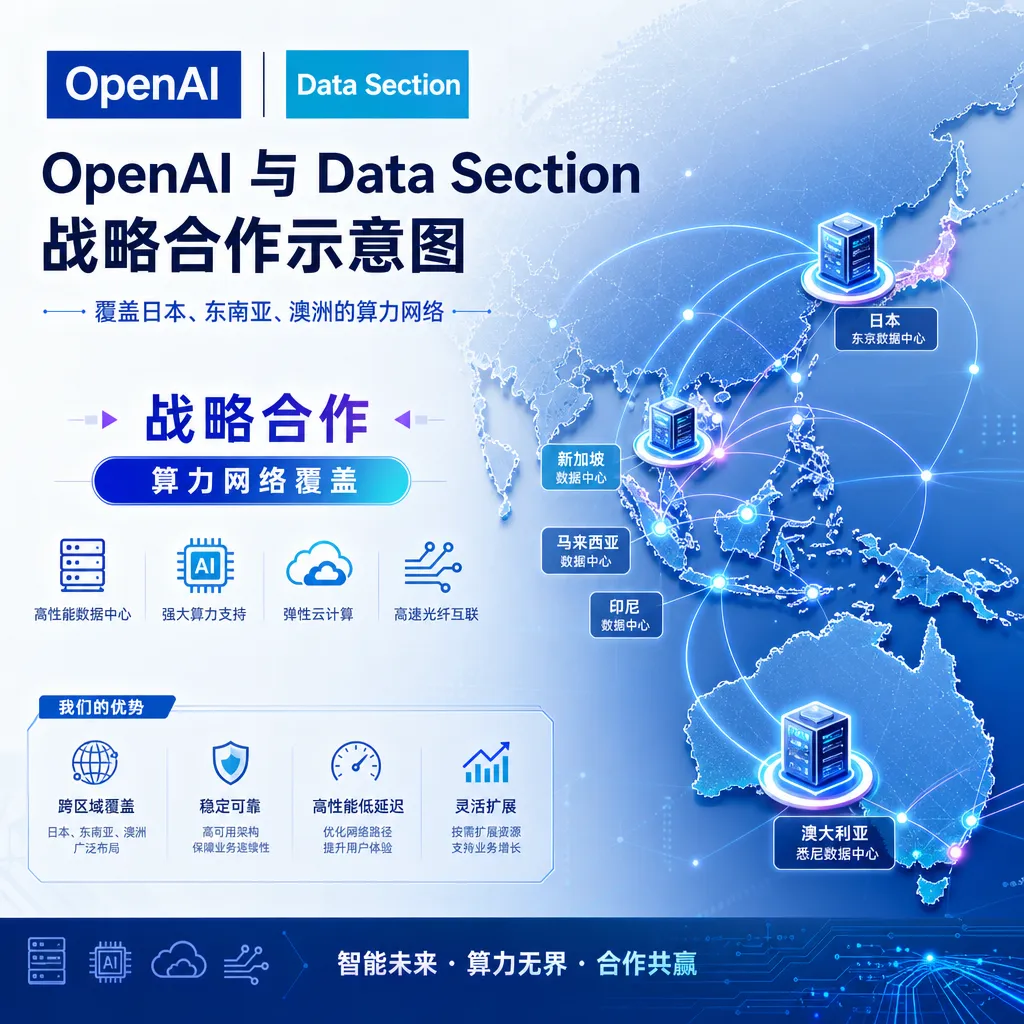
OpenAI has reached a strategic partnership with Tokyo-listed cloud service provider Data Section, through which model APIs will be deployed on GPU clusters in Japan, Thailand, Malaysia, and Australia. This marks the first time that OpenAI has entrusted its core inference business to an independent third-party cloud provider since lifting its exclusive partnership with Microsoft Azure.
OpenAI’s First Step Toward “De‑Microsoftization” Lands in Asia‑Pacific
On May 29, Japanese cloud services provider Data Section, listed on the Tokyo Stock Exchange, suddenly announced a strategic partnership with OpenAI. OpenAI will deploy its model inference services on Data Section’s GPU infrastructure, targeting the enterprise‑level API market in Asia‑Pacific.
At first glance, this looks like an ordinary compute‑power procurement deal. But given the larger context—OpenAI’s upcoming rush toward a NASDAQ IPO and the loosening of its exclusive compute contract with Microsoft—this is a landmark event: after publicly announcing its multicloud strategy, the first “new cloud” partner OpenAI selected wasn’t AWS, Oracle, or Google Cloud, but a listed Japanese company with relatively modest international visibility.
That choice alone is worth pondering.
Who Is Data Section—And Why Them?
Let’s lay out the basics. Data Section is a TSE‑listed cloud provider that bet early on GPU data centers, focusing on AI inference and high‑performance computing. Its compute nodes are distributed across Japan, Thailand, Malaysia, Australia, and the United States.
That network map is key. If you compare it with compliance maps for enterprise AI deployment in Asia‑Pacific, you’ll see that Japan, Southeast Asia, and Australia happen to cover the three territories OpenAI most wants to penetrate—but also finds hardest to enter directly:
- Japan: Financial, manufacturing, and governmental clients have extremely strict data‑localization requirements, making it very hard for foreign clouds to offer services directly
- Southeast Asia: Thailand and Malaysia are among the most active in legislating data sovereignty, with ever‑tighter cross‑border transfer limits
- Australia: The APRA (Australian Prudential Regulation Authority) has a dedicated review framework for financial institutions using offshore clouds
For OpenAI to handle these regions directly would take quarters just to clear compliance filings. Data Section, as a TSE‑listed company, already has a “Japanese pedigree” and deep regulatory familiarity—effectively a ready‑made compliance channel.
According to public information, their hosting platform is TAIZA, Data Section’s enterprise AI workflow platform. OpenAI’s models will be provided through this platform under a regulated framework. In other words, enterprise customers will still be using GPT‑series models, but with localized contracting, data flow, and compliance backing.
The Compute Stack: B300 and GB300
One technical detail stands out. According to disclosures, Data Section’s clusters are built on NVIDIA B300 and GB300 chips—the Blackwell Ultra generation designed for large‑scale inference loads and high concurrency.
This implies two things:
First, Data Section isn’t repurposing legacy H100/H200 clusters for OpenAI but using the latest inference‑optimized hardware. GB300’s NVLink domain and HBM3e capacity are particularly friendly to long‑context inference, one of OpenAI’s chief bottlenecks today.
Second, in generational terms, Data Section’s hardware in Asia‑Pacific isn’t lagging behind the hyperscale leaders. That’s one of the hard prerequisites for being chosen: if you’re substituting for Azure yet two generations behind in hardware, the job simply can’t be done.
OpenAI’s First Deal of “Multicloud Independence”
To grasp the significance of this partnership, consider OpenAI’s relationship with Microsoft.
For the past few years, OpenAI’s compute workloads almost entirely ran on Azure under an exclusivity clause. The boasting rights to “exclusive cloud partner of OpenAI” have been a core value driver for Azure AI’s valuation over the last two years.
But that exclusivity has been loosening this year. OpenAI publicly admitted it would pursue a multicloud approach, signing large deals with Oracle and CoreWeave. What makes Data Section special is that it’s the first publicly named non‑U.S. cloud provider to host OpenAI’s core model inference workloads under this new multicloud‑independence strategy.
This signals more than “no longer relying on Microsoft.” It signals “no longer keeping the compute lifeline on U.S. soil.” For a company preparing for an IPO and needing to demonstrate geopolitical‑risk resilience to investors, this is a necessary step.
Business Structure of the Partnership: More Than Renting Compute
According to multiple sources, the partnership goes beyond mere compute leasing and includes three layers:
- API Inference Hosting – Channeling OpenAI’s API traffic into Data Section’s compute pool for enterprise users in Asia‑Pacific
- Model Fine‑Tuning Services – Jointly developing fine‑tuned variants for Japanese, Southeast Asian languages, and vertical industries, starting with finance, manufacturing, and government
- Revenue Sharing – Splitting commercial revenue generated by the collaboration, rather than simple cost billing
The third point is especially interesting. OpenAI’s willingness to share revenue shows it treats Data Section as a channel partner, not merely an infrastructure supplier—a fundamentally different model from Azure’s “Microsoft invests first, then provides exclusive compute” arrangement.
In coming quarters, both sides are expected to announce industry‑specific fine‑tuning solutions for major Japanese enterprises and Southeast Asian markets and replicate the same blueprint for emerging regions.
Why Now
The timing is no coincidence. OpenAI’s NASDAQ IPO process has entered a critical window, and Wall Street’s scrutiny has shifted from “tech belief” to “business certainty.” Investors now care less about how much GPT‑X scores improved and more about:
- Whether revenue can escape over‑reliance on North American consumer subscriptions
- In how many regions enterprise business has operable, billable compliance channels
- Whether compute supply is locked to a single vendor
The Asia‑Pacific market is the most significant growth lever on OpenAI’s roadmap—and its weakest link so far. With Data Section, OpenAI effectively converts “Asia‑Pacific enterprise revenue” from a distant projection into a near‑term, quantifiable cash flow ahead of the IPO roadshow.
For Data Section, endorsement from the world’s top AI company is transformative. Previously, its market positioning in Asia‑Pacific as a “professional GPU cloud” placed it behind groups like SoftBank or NTT. Now, with OpenAI’s stamp, its investor narrative jumps an order of magnitude—from “local Japanese cloud” to “key variable in the global AI compute‑decentralization movement.”
What This Means for Developers
If you’re an enterprise AI developer in Asia‑Pacific, the impact unfolds on several levels:
Lower latency – Customers in Tokyo, Sydney, and Bangkok calling OpenAI models previously routed to U.S. or European nodes; now, inference can ideally occur locally. For latency‑sensitive RAG or Agent workflows, end‑to‑end delays could be halved.
Broader compliance scope – Under the oversight of Japan’s FSA, Australia’s APRA, or Singapore’s MAS, clients formerly had to rely on “data‑anonymization + overseas calls.” With the TAIZA‑hosted deployments, compliance thresholds are substantially eased—complete with localized contractual guarantees.
Price not necessarily lower – Don’t expect any discount. Data Section isn’t a low‑cost cloud, and the revenue‑sharing model means it must preserve margins. Pricing of Asia‑Pacific tokens will likely match or exceed official rates—justified by compliance and latency, not by cost efficiency.
In the Post‑Microsoft Era, Asia‑Pacific Is the Main Battlefield
Zooming out: Anthropic is deeply tied to AWS and Google Cloud; Mistral uses Microsoft Azure plus self‑built clusters; xAI runs its own supercomputer in Memphis. Each leading model developer now has its own answer to “where to host compute.”
OpenAI’s path—“multicloud independence + local compliance partners”—starting in Asia‑Pacific with a TSE‑listed company, is relatively aggressive. It’s betting on the explosion of the Asia‑Pacific enterprise market within three to five years, wagering that compliance barriers are harder to break than hardware ones, and that distributed compute can sustain its ever‑growing model scale.
The battle has just begun. After Data Section, OpenAI will likely replicate this “local listed company + GPU cluster + revenue sharing” model across Europe, the Middle East, and Latin America. Microsoft Azure will remain one of OpenAI’s largest compute sources—but the word “exclusive” can now be scratched from the story.
By the way, for developers who want direct access inside China to GPT, Claude, Gemini, and other major models, OpenAI Hub provides a unified OpenAI‑compatible API gateway—one key switching among models, sparing you the headaches of cross‑border networking and multi‑account management. Once Asia‑Pacific nodes mature, connection stability is expected to improve further.
References
- OpenAI and Japan’s Data Section Form Strategic Partnership to Target Asia‑Pacific Enterprise AI Market – IT Home: IT Home’s first Chinese‑language report on the partnership, with details on Data Section’s compute deployments and the TAIZA platform


