
Hohhot launches the nation’s first green computing full-stack AI platform, providing one-stop access to over ten mainstream models.
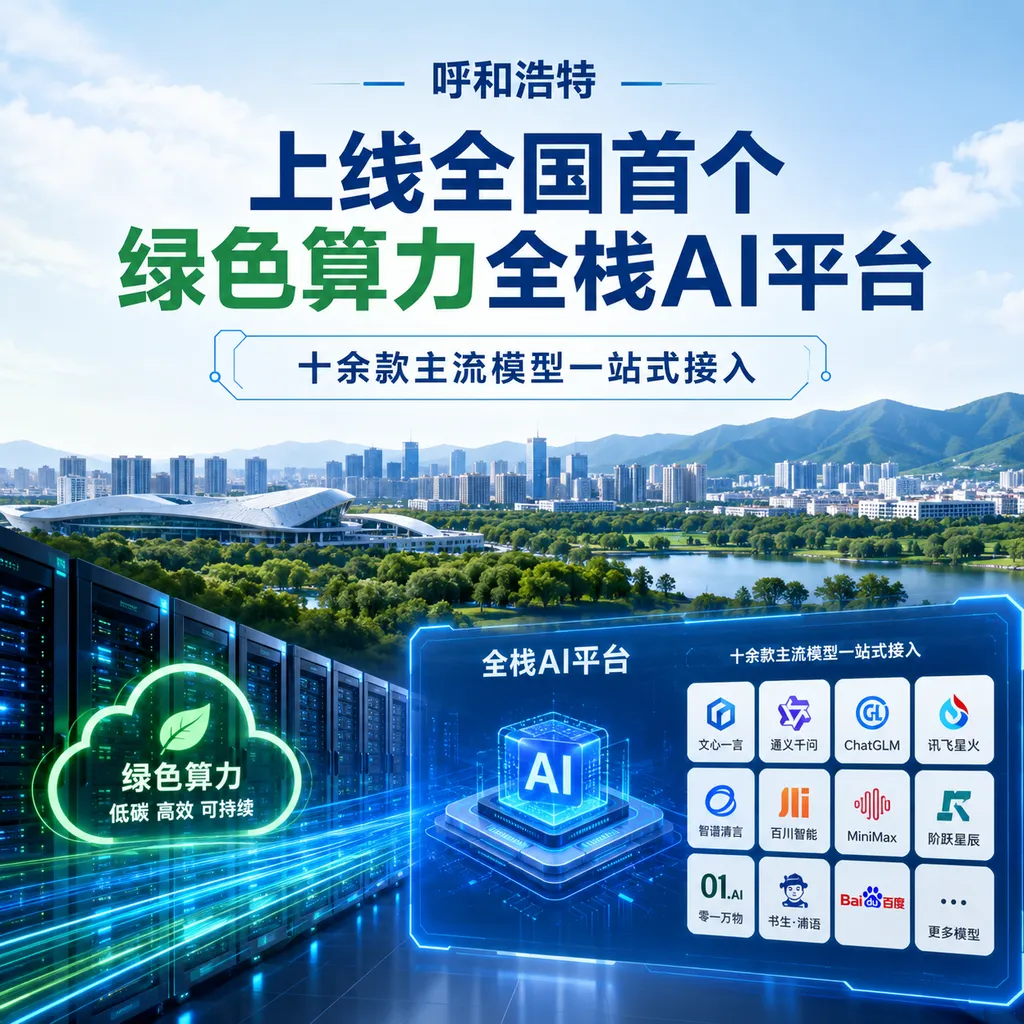
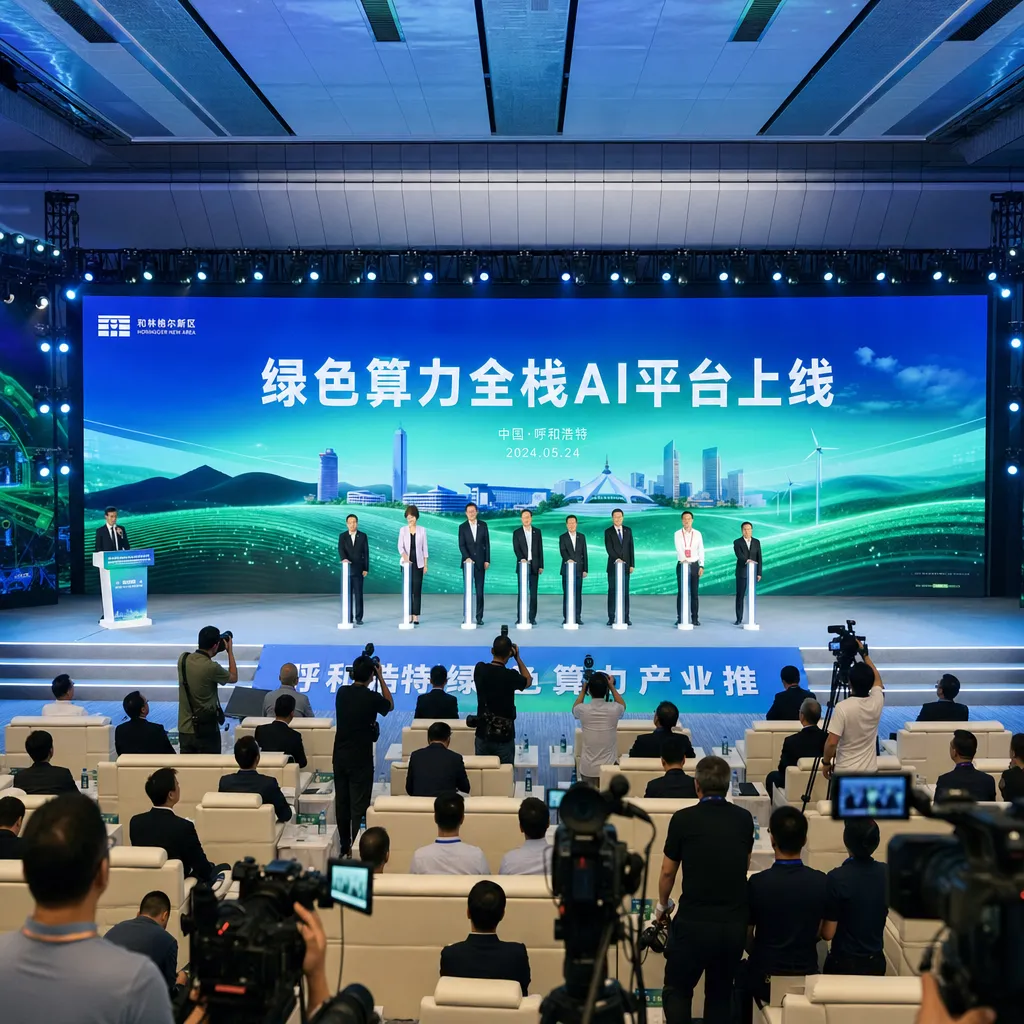
On May 30, China’s first full-stack green computing AI platform was officially launched in Hohhot. It integrates full-chain services including computing power scheduling, model invocation, and token settlement, with the first batch connecting to more than ten mainstream models, filling the gap in regional token trading services.
Hohhot Launches China's First Green Computing Full-Stack AI Platform, Integrating Over Ten Mainstream Models in One Place
On May 30, China’s first green computing full-stack AI platform—the Inner Mongolia Token Transaction Platform—officially went live in Hohhot. At first glance, it might look like yet another unveiling of a local computing center. But a closer look reveals that it differs from the typical “data center + policy slogan” model seen in recent years: it directly places Token trading on the table, shifting focus from the data-center business to the secondary market for AI services.
The platform was jointly built by the Inner Mongolia Big Data Industry Development Group, the Inner Mongolia Data Exchange Center, and Inner Mongolia Computing Network Technology. It's positioned as a core innovation outcome of "China Cloud Valley" and is located in the Hohhot area of the Inner Mongolia Pilot Free Trade Zone. On the same day, the Ministry of Industry and Information Technology (MIIT) released the Action Plan for Computing Power Interconnection—the coincidence of these events was no accident.
Selling Tokens Like Electricity: What’s New Here
In recent years, the typical domestic computing model has been “build data centers, deploy GPUs, sell rentals”—essentially an extension of IaaS. The platform launched in Hohhot, however, moves two steps up the chain:
- Base layer: Aggregates heterogeneous computing resources nationwide—including general, intelligent, and super computing—supporting domestic chips and mainstream architectures
- Middle layer: Integrates over ten mainstream models from the three major telecom operators and leading tech vendors
- Top layer: Enables direct Token trading and settlement
According to the official description, the platform establishes a full chain of “computing power output — model invocation — application implementation — token settlement.”
Translated into developer terms: you no longer need to separately negotiate computing contracts with telecom operators, sign APIs with model vendors, or build a billing system yourself. Everything—from ordering to calling to settlement—can be done on one platform.
The logic is similar to cloud vendors’ Model-as-a-Service offerings or model aggregation platforms like OpenRouter overseas: a unified entry point and billing system that integrates fragmented model supply. The difference here is that the initiative is driven by a mixed entity with local government backing, emphasizing “green computing” and “compliant Token trading.”
“Green” Is Not Just a Buzzword
It’s no surprise that the platform is located in Hohhot. Inner Mongolia’s low electricity prices, cool climate, and cheap land make it one of the most cost-effective regions in China for large-scale AI training and inference. Major computing centers of China Mobile, China Telecom, Alibaba, and ByteDance are all concentrating in the region. The term “China Cloud Valley” reflects the institutionalization of this locational advantage.
“Green computing” has two meanings:
- Physical layer: Powered by renewable sources such as wind and solar, with low PUE levels
- Settlement layer: Could be linked in the future to carbon disclosure and green power traceability, providing auditable “low-carbon AI invocation” certificates for government and enterprise customers
The second layer will be more relevant to developers. Once AI inference becomes part of ESG reporting, questions like “Which green power source was used?” and “What was the carbon footprint?” become compliance requirements, not marketing slogans. A platform integrating carbon data into settlement will be highly valuable to application vendors working with governments, finance, and state-owned enterprises.
Domestic Chip Compatibility—But Don’t Expect Too Many Details
The release repeatedly stresses “comprehensive adaptation to domestic chips and mainstream computing architectures.” Specific chips aren’t listed, but it’s reasonable to assume Huawei Ascend will be included, alongside Hygon, Cambricon, Muxi, and Iluvatar. Combined with existing NVIDIA resources, they form a heterogeneous resource pool.
The real challenge isn’t scheduling itself, but adapting models across different chips—hiding variations in quantization, precision, and performance from users. For example, a Qwen-72B model on an H100 GPU versus an Ascend 910B delivers differing throughput, latency, and cost. If the platform provides a unified API, users will wonder where their requests are actually executed, what SLA guarantees exist, etc.—these details remain undisclosed.
A likely approach would be:
- Standardized models (such as DeepSeek, Qwen, GLM families) adapted across multiple backends
- Routing strategies based on price, latency, or compliance preferences
- User access through an OpenAI-compatible protocol
This model has been validated both domestically and abroad—the challenge is engineering, not theory.
Which Are the “Ten-Plus” Mainstream Models?
While the press release doesn’t offer a complete list, the phrase “three telecom operators + top tech companies” sets boundaries:
| Provider | Possible Integrated Models | |---|---| | China Mobile | Jiutian series | | China Telecom | TeleChat series | | China Unicom | Yuanjing series | | Leading tech companies | Tongyi, Wenxin, Hunyuan, Doubao, DeepSeek, Zhipu GLM, etc. |
If this is roughly accurate, the “ten-plus models” represent China’s mainstream general-purpose LLMs. For B2B clients, accessing all major domestic models through a single contract is far more meaningful than any single model’s performance gain—since procurement, compliance reviews, and invoicing are the true bottlenecks in government and enterprise adoption.
“Token Vouchers” and “Computing Vouchers”: Subsidy for Ecosystem Growth
The release also mentions an easily overlooked detail: the platform will soon use “Token vouchers” and “computing vouchers” to attract model vendors, computing providers, and data service partners.
Anyone familiar with the internet playbook will recognize this—subsidize to gain GMV and ecosystem density. In the computing context, it means using fiscal or industrial funds to achieve a cold start: lure developers and vendors, build a few large-scale use cases, then form a positive cycle.
The success of this model depends on two things:
- Price: If post-subsidy cost per Token undercuts Alibaba Cloud's Bailian or Volcano Engine’s Ark, developers will naturally join
- Stability: Token services fail not from high cost but from instability—uncontrolled P99 latency renders price irrelevant
A Broader Perspective
On the same day—May 30—the MIIT issued the Action Plan for Computing Power Interconnection, aiming for:
- By 2026: Establish comprehensive standards, identifiers, and rule systems for interconnection
- By 2028: Achieve near-nationwide standardized interconnection, forming an “intelligent, aware, real-time, on-demand computing power internet”
Coupled with 12 existing technical guidance documents (on monitoring, computing-electricity synergy, and security), China is moving from slogans toward standardizing computing power as a nationally coordinated grid-like system.
The Hohhot platform is essentially a pilot for this framework. Upwardly, it connects to the national unified computing network; downwardly, it integrates heterogeneous computing and model supply into tradable Tokens. If it works, it becomes a replicable template for other provinces; if not, it will at least expose which pain points are real and which are not.
What This Means for Developers
In the short term, there will be little impact on individual developers—the first batch of users will inevitably be governments, state-owned enterprises, and research institutions, with enterprise-level pricing and integration processes.
In the medium term, two signals are worth watching:
- Price signal: If subsidies drive Token pricing for mainstream models to new lows, commercial cloud vendors may be forced to follow
- Compliance signal: If a single platform integrates green electricity certificates, data export compliance, and domestic chip invocation records, enterprises building compliant AI applications will re-evaluate their tech stacks
Model aggregation as a concept is proven—OpenRouter abroad and multiple domestic aggregators (including our own OpenAI Hub) all tackle the same issue through a unified “single key, multi-model” API layer. The difference is positioning: the green computing platform serves government and enterprise (G/B) clients with “national team + local government + green computing” branding. Both types of platforms will likely coexist rather than replace each other: developers and startups will still prefer flexible, low-latency mixed-model aggregators, while institutional clients will use compliant, green, domestically-prioritized official channels.
Outstanding Questions
The release leaves several developer-critical questions unanswered:
- Protocol layer: Is it fully OpenAI API-compatible? How are streaming, function calling, and multimodal support handled?
- SLA: In a heterogeneous computing pool, what are the latency and availability guarantees per request?
- Data compliance: What are the log retention and cross-domain data flow rules?
- Settlement granularity: Are Token prices based on each model’s native tokenizer or unified conversions? This directly affects cost accounting.
- Ecosystem openness: What are the access thresholds and revenue-sharing policies for third-party model vendors?
Answers will likely come only once the developer documentation is released.
In Closing
Back to the opening question—what’s new here? The novelty lies not in “yet another AI platform,” but in the first government-backed full-stack platform linking computing power, models, and Token settlement under a national-level action plan.
From hardware to API, from “power grid analogy” to actual Token invoicing—once this chain is complete, China’s AI infrastructure will have truly shifted from “selling GPU cards” to “selling services”.
Hohhot is only the starting point; what remains to be seen is how quickly this template will spread across key computing hubs like the Yangtze River Delta, Pearl River Delta, and Chengdu-Chongqing regions.
References
- ITHome: China’s First Green Computing Full-Stack AI Platform Goes Online in Hohhot, Compatible with Domestic Chips and Mainstream Architectures — Initial coverage with context on MIIT’s Computing Power Interconnection Action Plan


