
Zhiyuan GE 2.0 Tops WorldArena: 2B Parameters Beat NVIDIA

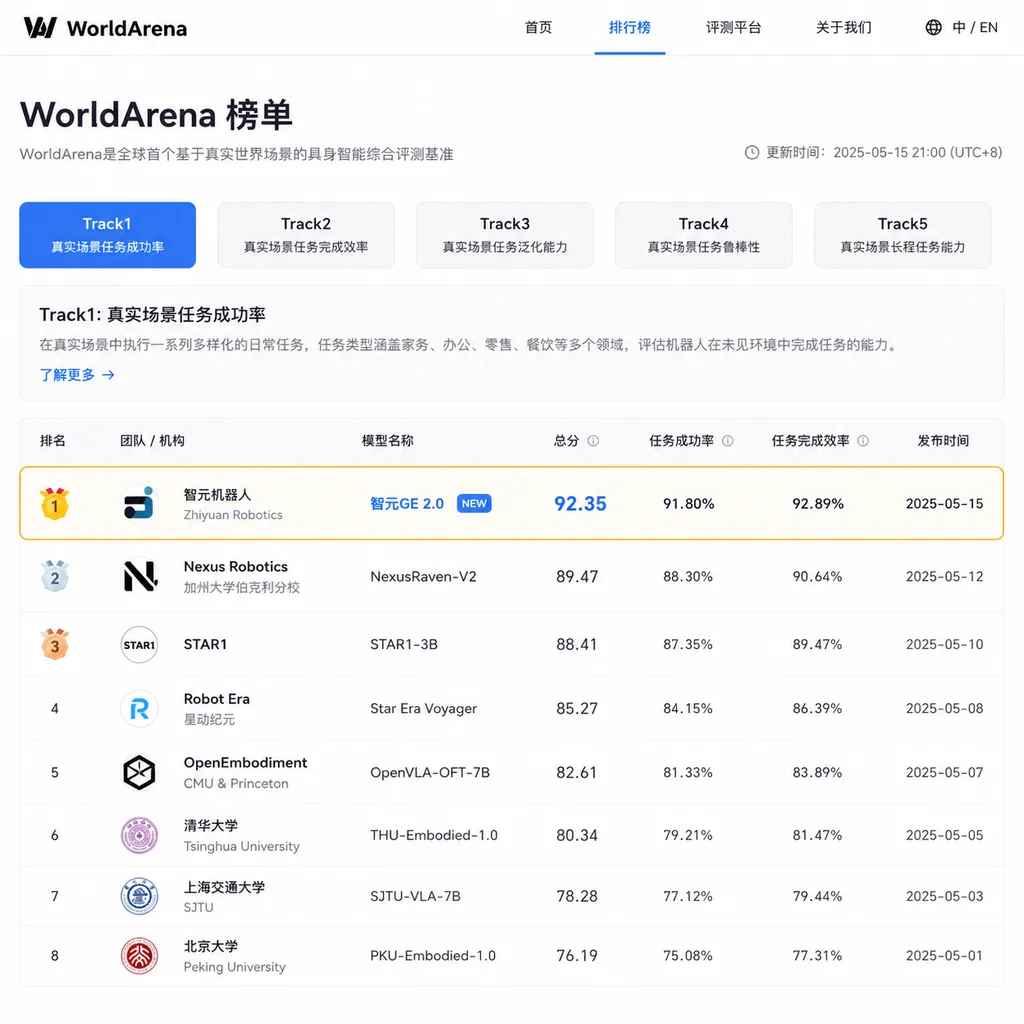
Genie Envisioner-Sim 2.0, a world model independently developed by Zhiyuan, won first place overall in the CVPR 2026 WorldArena Track 1 with 2 billion parameters, defeating teams such as NVIDIA’s DreamDojo and the Tsinghua-Stanford joint project Ctrl-World, demonstrating the feasibility of a lightweight approach in the embodied intelligence field.
2B-Parameter World Model Beats NVIDIA and Stanford
On May 29, the CVPR 2026 WorldArena world-model track finalized its overall standings: Zhiyuan’s self-developed Genie Envisioner-Sim 2.0 (hereafter GE 2.0) won first place in Track 1 – the World Model Perception and Action Response category. The competition featured heavyweight contenders, including NVIDIA’s latest DreamDojo, Tsinghua and Stanford’s Ctrl-World, plus flagship teams from Microsoft and others.
Even more impressive is the parameter count: GE 2.0 has only 2 billion (2B) parameters. In a field dominated by piling up parameters, compute, and data, this is a notably counterintuitive result.
How Tough the WorldArena Benchmark Really Is
Anyone working in embodied intelligence knows that WorldArena isn’t a leaderboard-friendly benchmark. It builds a 3D evaluation system of 16 core sub-metrics + 3 real-world application tasks, specifically assessing four things about embodied world models: perceptual accuracy, physical law understanding, spatial cognition, and action prediction & execution.
In plain terms, your model must not only “see” the visuals but also understand common physical rules like “a cup breaks when dropped,” “water flows downward,” or “a tower of blocks will collapse if stacked too high.” In an era when visual generation models are mocked for “ignoring physics,” this benchmark’s difficulty is a whole level above typical video-generation tests.
Zhiyuan did something rather interesting this time — they didn’t fine-tune for the competition. According to them, GE 2.0 competed as is, with only basic fine-tuning on the leaderboard data. If true, that makes this result even more valuable. In the AI community, “leaderboard optimization” isn’t exactly a secret practice — so winning without specific tuning suggests GE 2.0’s generalization capability is genuinely solid.
What’s New in GE 2.0
Compared with the previous version, GE 2.0 is no longer just a “video predictor.” It now forms a complete world simulator loop, consisting of five key modules:
- Long-horizon generation: can stably simulate 40–50 seconds of continuous video
- Multi-view generation: consistency across different camera angles of the same scene
- Embodied state modeling: simultaneous modeling of a robot’s own states
- Near real-time inference: response speed sufficient for closed-loop control
- Reward evaluation: built-in reward model that can assess rollout quality automatically
What’s the importance of this combo? Traditional world models have long struggled with being “vision-heavy, physics-light, hard to deploy.” The visuals look impressive but the physical logic is unreliable — so robotic control strategies can’t be based on them. GE 2.0 aims to fix that.
Long-Horizon: Stable Beyond 50 Seconds, While the Industry Baseline Crashes at 10
This metric from the GE 2.0 technical report is perhaps the hardest proof point.
In world-model-based video generation, the classic problem is the “curse of length”: as inference time increases, visual quality degrades sharply and physical consistency drifts. Standard industry baseline models start breaking down after 10 seconds — objects clipping through each other, physics anomalies, accumulated error explosions.
GE 2.0’s data show: even after generating continuously for 40–50 seconds, output quality remains higher than baseline models’ performance within their first 10 seconds. In other words, other models’ “peak” still underperforms GE 2.0’s “end-of-run.” That’s crucial for embodied policy training since most robot tasks — grasping, assembly, transport — require tens of seconds of continuous motion.
Closed-Loop Evaluation: From “Matching Success Rates” to Case-by-Case Alignment
The biggest skepticism toward world models used for strategy evaluation is: if something works in simulation, will it still work on the real robot?
Zhiyuan’s answer comes in two layers:
- Macro level: success rates in simulation strongly correlate with real-world outcomes.
- Micro level: case-by-case rollout comparisons, quantified using a confusion matrix.
The second point is an important innovation. Many teams only provide average success rates, but for evaluating robot strategies, what truly matters is ensuring that cases which fail in simulation also likely fail in real life, and those that succeed in simulation also succeed in practice. The confusion matrix makes this correlation directly visible — a commendably honest academic practice.
Data Feedback: World Model as Training “Sparring Partner”
Another highlight of GE 2.0 is its data feedback mechanism. The pipeline looks like this:
Policy Model → rollout in GE 2.0 → Reward Model filtering → high-quality data → feedback to Policy Model
This feedback loop isn’t new to reinforcement learning, but running it inside a world model means embodied AI may finally break free from massive physical data collection. Zhiyuan even built the world’s first 3000 m² robotic data capture facility, so they know exactly how expensive real-world data is.
Experiments show that this automatic filtering mechanism significantly boosts policy model performance across multiple tasks — signaling that simulation training can finally move beyond “manual data curation” into automated iterative refinement.
2B vs Hundreds of Billions: How a Lightweight Model Wins
Back to the original question — why can a 2B-parameter model outperform NVIDIA’s flagship?
My view is that this relates to the unique nature of embodied intelligence.
In language modeling, parameter count scales roughly with capability, so the more, the better. But for world models, the bottleneck isn’t “knowledge capacity” — it’s “physical consistency” and “real-time responsiveness.” A massive model that infers slowly and can’t sustain long-horizon stability may be smart but unusable for robotics — robot control requires millisecond-level reaction times, or the object will have already fallen before inference finishes.
Zhiyuan just demonstrated with hard evidence: for humanoid robots in real-time closed-loop settings, lightweight models can be more suitable — and not necessarily weaker than ultra-large ones. This philosophy mirrors the autonomous driving industry’s “edge-side small model with physical constraints” approach.

Zhiyuan’s Full-Stack Ecosystem
Looking at the bigger picture, GE 2.0’s win isn’t isolated. Back in April, Zhiyuan hosted its week-long “ALL IN AI WEEK”, releasing five major components:
- Open-source dataset
- Open-source simulation platform (Genie Sim)
- Foundation model (Genie Operator 1)
- World simulator (Genie Envisioner)
- Robot deployment application platform (Genie Studio)
This “data–simulation–model–application–ecosystem” chain contrasts sharply with the approach of companies focused mainly on robot hardware. Zhiyuan positions itself as an infrastructure provider for embodied intelligence — not selling robot bodies, but powering the entire physical AI industry from the ground up.
GE 2.0’s win in WorldArena represents an integrated achievement in the “simulation” and “model” components of this stack. From an industry standpoint, it provides more leverage than a single-point hardware breakthrough — because foundational models can scale across the entire ecosystem.
Project Links and Open Source
Zhiyuan also provided complete resource links:
- Project page: https://ge-sim-v2.github.io/
- Arxiv technical report: https://arxiv.org/abs/2605.27491
- GitHub repository: https://github.com/AgibotTech/GE-Sim-V2
For developers working in embodied AI, robot simulation training, or world modeling, these materials are worth studying — especially the implementations behind long-horizon stability and confusion-matrix-based validation.
Final Thoughts
The year 2026 is widely seen as the deployment milestone for embodied intelligence — when robots start moving from labs into real-world settings. Algorithms in this phase face very pragmatic demands: no matter how powerful a model is, if it can’t run on the robot, sustain multi-second action chains, or provide reliable simulation data, it’s worthless.
The most meaningful takeaway from GE 2.0’s success isn’t “a Chinese team beat NVIDIA,” but rather that the route of lightweight + full-featured + closed-loop usability has proven viable. In world-model development, we may be witnessing a paradigm shift — from “parameter scaling” to “physical credibility and real-world applicability.”
As for how the NVIDIA DreamDojo and Ctrl-World teams will respond, that’s worth continued observation. More details should emerge at CVPR.
References
- ITHome: “2B Parameters Achieve More with Less — Zhiyuan’s Self-Developed World Model GE 2.0 Tops WorldArena Leaderboard” – Core coverage of GE 2.0’s win
- GitHub: AgibotTech/GE-Sim-V2 – GE 2.0 official open-source repository


