
Copilot switches to token-based pricing, triggering a collective breakdown among developers

Starting June 1, GitHub Copilot will switch from a flat monthly fee to token-based billing. The Agent feature can consume up to 100,000 tokens in a single use, meaning heavy users may see their monthly costs skyrocket several times over, sparking widespread criticism in the developer community.
Copilot Switches to Token-Based Pricing, Developers in Uproar: The Free Lunch Is Over
On June 1 — just two days from now — GitHub Copilot will officially switch from a flat-rate model of "$10 per month, all you can use" to a token-based usage billing model. The news had been circulating among developers since early this month, but what really triggered the backlash were GitHub’s recent moves: suspending all Pro free trials, discontinuing annual subscriptions, and citing “abuse” as a reason for mass account suspensions. TechCrunch ran a blunt headline today: “Developers think this is a joke.”
The golden era when Microsoft subsidized Copilot with deep pockets — ends here.
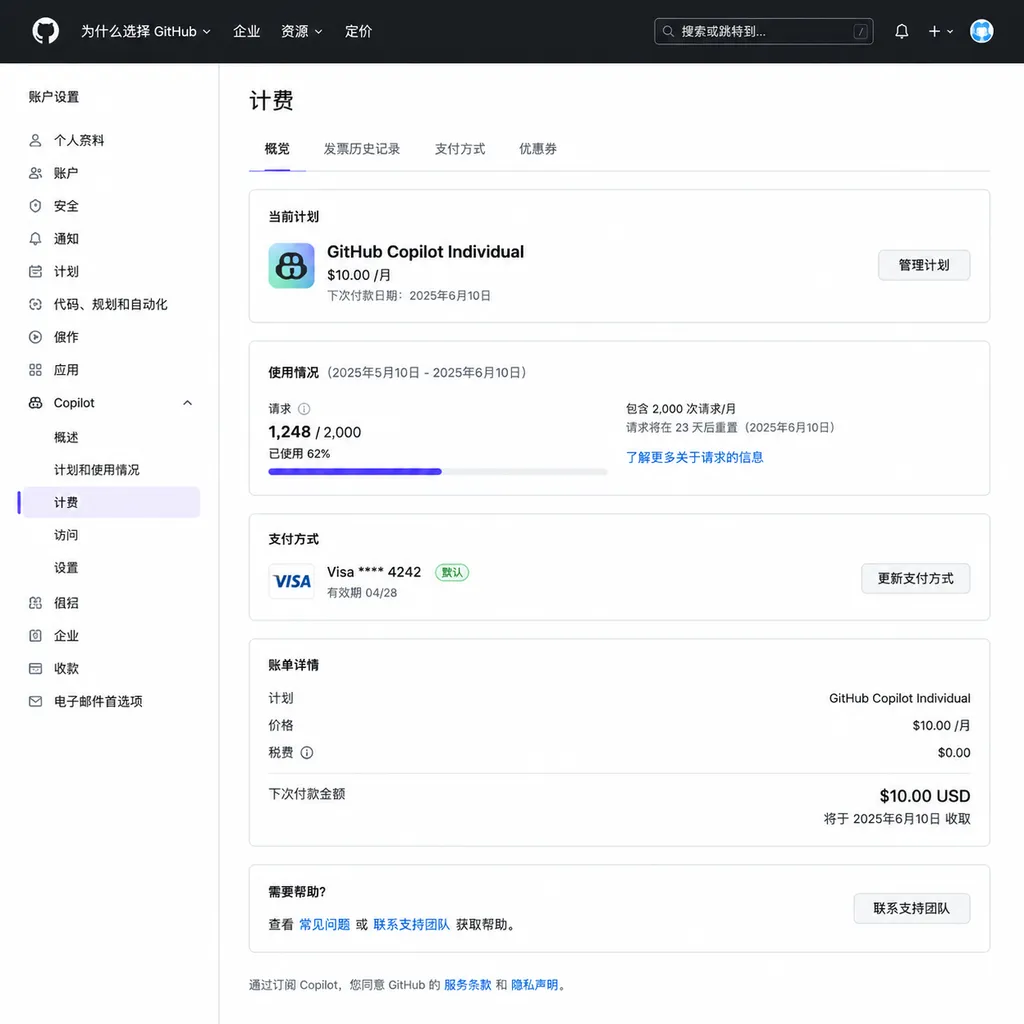
What Exactly Is Being Cut
Let’s clarify the rules first. The new billing system is called GitHub AI Credits, where 1 Credit = $0.01, roughly corresponding to 1,000 tokens (the exact rate varies by model; the official docs give detailed conversions). The subscription tiers appear unchanged:
- Pro: $10/month, includes a credit allowance
- Business: $19/user/month, usage-based with a configurable budget cap
- Enterprise: Custom
But the devil is in the details. GitHub has divided features into four categories, each consuming vastly different amounts of tokens:
| Feature | Consumes Credits | Magnitude | | --- | --- | --- | | Code Completion (Inline) | Free | Not counted | | Copilot Chat | Yes | 500–2000 tokens/call | | PR Summary | Yes | 1000–5000 tokens/call | | Copilot Agent | Yes | 10,000–100,000+ tokens/call |
See the problem? The real game-changer — the one that has transformed Copilot’s reputation over the past year, moving it from an “AI autocompletion tool” to an “AI engineer” — is precisely the Agent mode. That’s the workflow where you throw an issue at it and it reads the code, drafts a plan, runs tests, and opens a PR. A single run typically burns 50,000–200,000 tokens, which, under the new system, can easily cost over $1 per task.
For an active developer running 10 Agent tasks a day, a $200–$300 monthly bill would be perfectly normal. That’s a completely different species from the old $10 flat rate.
Why Change Now? The Answer Lies in the Financials
There’s no conspiracy here. Copilot’s old pricing was always a loss leader — an open secret in the industry. As early as late 2023, The Wall Street Journal reported that Copilot lost an average of $20 per user per month, and heavy users cost Microsoft up to $80 each month. Back then, Microsoft was in “market capture” mode, bolstered by Azure subsidies.
But since 2025, the situation has shifted:
- Base model costs have gone up, not down. Models like Claude and GPT — both Agent-friendly — have increased prices for each inference call. Anthropic raised prices in April; OpenAI’s reasoning model burns several thousand extra tokens per response thanks to built-in chain-of-thought reasoning.
- Agent mode has exploded per-user costs. Completions use hundreds of tokens, Agents use tens or hundreds of thousands — the math just doesn’t work.
- The era of venture capital subsidies is over. As one comment put it bluntly: “The time has come to settle the bill for the token free-for-all fueled by VC money.” Cursor, Windsurf, Replit, and Devin — all AI coding vendors — have taken similar pricing hits in the past six months. GitHub is simply the biggest domino.
So rather than blaming GitHub as “greedy,” it’s more accurate to say the entire industry is paying back its tab from the last two years.
Why Developers Are So Angry
Complaints on Reddit and Hacker News cluster around three main points.
First: Lack of transparency. Tokens may be familiar to API users, but for the average Copilot user who just clicks buttons inside an IDE, they’re a black box. When you ask Chat, “Why is this function throwing an error?”, the context behind the scenes may include 8,000 tokens (file contents + project structure + conversation history) plus a 1,500-token reply — roughly $0.10 gone in one message. For users used to fixed monthly plans, that’s a psychological shock.
Second: GitHub has removed the fallback model. There used to be a safety net that would downgrade you to a cheaper model when you exceeded your quota. That’s now gone — overages are billed directly as extra credits.
Third: Annual plans are permanently discontinued. Refunds for annual users were only available until May 20, effectively forcing everyone into monthly rolling usage-based billing. Some users dug up a GitHub tweet from just three months ago promoting “predictable pricing.” The irony stings.
Worse still, this week GitHub mass-suspended Copilot Pro trial accounts citing “abuse.” Officially, the claim is that some users were scripting fake trials, but many legitimate accounts were also affected — right as the pricing change hit. That felt like pouring gasoline on the fire.

Running the Numbers: How Much More Will You Pay?
Based on several circulating estimates online, let’s group users into three categories:
Light users (a few Chat requests per day, occasional PR summaries)
- Monthly use: ~50,000 tokens
- Old cost: $10
- New cost: $10–15
- Verdict: Minor impact
Moderate users (frequent Chat use, 1–2 Agent runs per week)
- Monthly use: ~800,000 tokens
- Old cost: $10
- New cost: $25–40
- Verdict: Moderate increase
Heavy users (Agent mode is the core workflow, 5–10 runs per day)
- Monthly use: 3M+ tokens
- Old cost: $10
- New cost: $150–500
- Verdict: Nightmare tier
Ironically, “heavy users” are exactly the group GitHub has spent the past year trying hardest to capture — Pro devs who treat Copilot as a junior teammate. The more they rely on Agent, the more absurd the new bill. No wonder they’re the loudest in protest.
Saving Tips and Possible Plan B
If you’re sticking with Copilot for now, here are a few practical cost-control tips:
- Use completion instead of Chat whenever possible. Inline code completion remains totally free — the only real buffer GitHub left.
- Batch Agent tasks. Instead of sending every little bug to the Agent, group related issues into one prompt to cut redundant context loads.
- Turn off automatic context indexing. Copilot tends to feed your entire workspace as context; manually targeting files can halve your token burn.
- Set a budget cap with Business plan. The $19/user/month tier allows strict monthly limits — safer than Pro’s “auto top-up on overages.”
But many users are now eyeing migration. The immediate winners of this shake-up are the alternatives:
- Cursor / Windsurf: Already usage-based but more transparent, with flexible model selection; you can attach your own API key.
- Cline / Continue / Aider (open-source agent tools): Bring your own API, cost fully controlled.
- Self-hosted + direct API connection: Hook your coding agent directly to Claude, GPT, DeepSeek, Qwen3-Coder, etc., bypassing the subscription layer.
That last option is what many teams are already moving toward. At its core, an AI coding tool is just a scheduler plus a bunch of prompts. The real cost comes from the model itself. Instead of paying GitHub’s markup, you can connect your own API key directly. Aggregator platforms like OpenAI Hub let you route a single key across Claude, GPT, Gemini, DeepSeek, Qwen, and more, OpenAI-compatible and accessible in China. Combine that with open plug-ins like Cline or Continue, and you’ve basically cloned the Copilot experience — with full cost transparency.
The Bigger Picture
Zooming out, Copilot’s pricing shift is just one symptom of how the AI coding business model is correcting itself. Over the past two years, everyone bet on the narrative of “AI engineers replacing human engineers,” slashing prices to minimize barriers and hook users early. Now midway through the story, reality hits: model marginal costs haven’t dropped, Agent mode devours compute, and loss-leading isn’t sustainable.
Claude Code raised prices in early May; Cursor halved its “fast request” quota in April; Replit Agent hiked prices three times in six months. GitHub isn’t an outlier — it’s following the tide.
Developers should be asking not “Should I still use Copilot?” but “Whose pricing does my AI workflow depend on?” The deeper you’re locked into one vendor’s ecosystem, the more painful the next price hike will be. Decoupling your tools from your model provider — and keeping alternatives ready — is the only real lesson from this wave of price corrections.
As TechCrunch aptly concluded: Microsoft isn’t killing Copilot — it’s just finally making it run at its true cost. This was always going to happen. Developers just weren’t ready for it.
References
- GitHub Copilot Pricing Overhaul: Token-Based Billing from June — A Zhihu column summarizing the new credit rules, discontinuation of annual plans, and refund window
- Reddit r/github Discussion: Copilot’s new token-based pricing — Live community feedback and complaints on the new model
- Stack Overflow Developer Survey Discussions — Technical analyses of Copilot usage patterns and token consumption


