
Xiaomi Reveals the Technical Secrets Behind MiMo-V2.5’s 99% Price Drop

After permanently reducing the price of the MiMo-V2.5 Pro API, Xiaomi for the first time fully disclosed five underlying inference system optimizations: KVCache Dual Pool, GCache, Affinity Scheduling, MTP Decoding Acceleration, and Multimodal Optimization. The company also claimed it can maintain a balanced budget even after the price cut.
On May 27, Xiaomi announced a permanent price cut for the MiMo‑V2.5 series APIs—with a maximum reduction of 99%. The general public reaction was: “Another marketing loss leader.” This wave of price wars among domestic large‑scale models has been going on since mid‑last year. Each time a price drop occurred, people ran the numbers and concluded that—based on mainstream inference costs—a cache‑hit price of ¥0.025 per million tokens couldn’t possibly be sustainable.
But this time, Xiaomi didn’t intend to leave things at the level of “speculation.” On May 30, the MiMo team published a long post on the official technical blog, detailing the reasoning‑system overhaul behind the price cut—and presented the direct conclusion: even after the price reduction, revenue and costs remain balanced. This is one of the few cases in the past year’s price war where a vendor disclosed both its cost structure and optimization path.
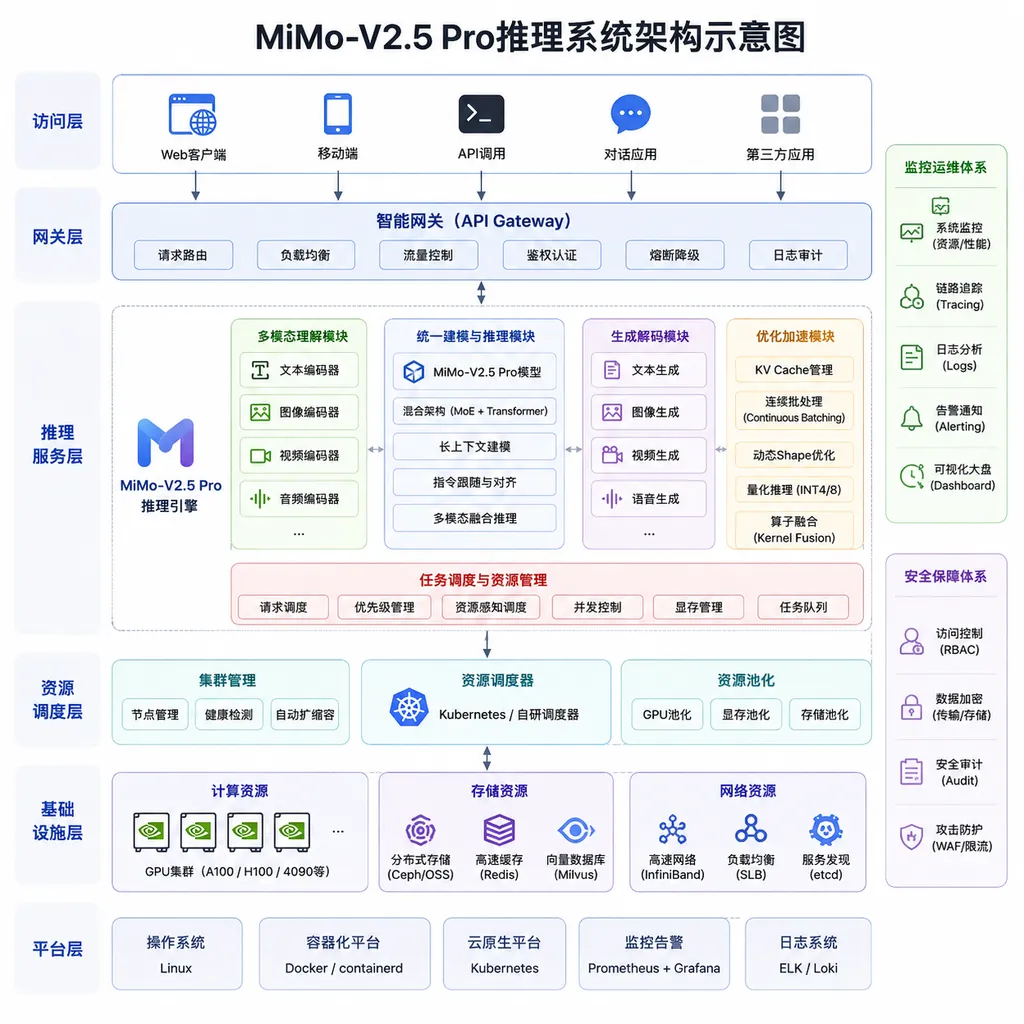
First, the price: how low did it actually go?
After the reduction, MiMo‑V2.5 Pro’s input‑cache‑hit price fell to ¥0.025 per million tokens. Together with adjustments to the Token Plan billing system, the usable quota in each package increased by 5–8 times. Added to the “100 Trillion‑Token Creator Incentive Program” launched on April 28 — with more than 540 thousand applicants and 100 trillion free tokens distributed (worth ¥65 million) — MiMo’s user‑acquisition cost has essentially hit bottom.
The question is: with prices cut this deep, the model is still the same trillion‑parameter MoE architecture MiMo‑V2.5 Pro that uses a Hybrid SWA design—no reduction in parameters, no capability downgrade. So what keeps it sustainable? The answer lies in five core optimizations Xiaomi disclosed.
Five core breakthroughs, broken down one by one
1. KVCache dual pool + SWA‑aware prefix tree
This is the most technically sophisticated part of the disclosure, and it’s a product of the Hybrid SWA architecture.
MiMo‑V2.5 Pro has 70 layers, of which 60 use local‑window attention (Sliding Window Attention, SWA) and 10 preserve global attention. Theoretically, SWA can greatly reduce KVCache storage and compute costs, but engineering‑wise there’s an unavoidable issue: SWA layers and global layers have completely different KVCache lifetimes and hit rules. The SWA window slides with tokens, naturally retiring old data, while global layers require complete retention. If both categories share one caching mechanism, you either waste VRAM or see the hit rate collapse.
Xiaomi’s approach was to go “dual‑pool”: the SWA layer and global layer KVCaches are physically managed separately, each with its own eviction policy and lookup path. On top of that, the prefix‑tree implementation must be SWA‑aware—traditional prefix trees assume cached data is continuous, but the SWA window means the valid range of cache differs by layer, so window information must be considered during prefix matching. Once deployed, cache hit rates for long‑prompt scenarios improved significantly—this is the key reason the ¥0.025 per million‑token input‑cache price is viable.
2. GCache distributed cache
Once single‑node KVCache optimization hits its limit, the next bottleneck is cross‑node scheduling. For the same user’s multi‑turn conversation or batch requests with similar prefixes, if the prompts land on different inference nodes, the prefix cache becomes useless.
GCache is the distributed caching system built by the MiMo team, elevating KVCache from a node‑local resource to a cluster‑wide “global resource.” The underlying storage is likely tiered—hot data in GPU VRAM, warm data in host RAM, and cold data in remotely RDMA‑accessible storage. This architecture is not unique domestically or abroad (e.g., Mooncake’s KVCache pooling idea), and though MiMo didn’t share many details, the mention of “distributed” implies GCache has passed PoC and is in production.
3. KVCache affinity scheduling
A distributed cache alone isn’t enough—the scheduling policy must align. If the scheduler allocates requests randomly, cache‑hit rates are diluted.
MiMo’s affinity‑based scheduling works like this: each inference request carries a “prefix fingerprint,” and the scheduler preferentially routes it to nodes that cache the same prefix. It sounds simple, but engineering‑wise must balance node load, cache‑hit rate, user fairness, and long‑tail latency. Affinity too strong creates hot‑spot overloads; too weak cancels the benefit. MiMo didn’t share algorithms, but results suggest they use a dynamic‑weight scheduling method that trades off hit rate and load in real time.
4. Decode‑stage MTP acceleration
MTP (Multi‑Token Prediction) was discussed in DeepSeek‑V3’s report—it enables the model to predict multiple tokens per forward pass in the decode stage, improving GPU utilization. MiMo applied MTP on the inference side in V2.5.
The decode stage is the most expensive part of large‑model inference. Unlike prefill, decode generates tokens one by one, so the GPU spends most of its time waiting on memory rather than computing—its arithmetic intensity is extremely low. MTP allows one forward pass to output several candidate tokens and uses speculative validation, effectively compressing N forward passes into 1. For trillion‑parameter MoE models, this yields major benefits—since the set of expert parameters activated per forward pass is fixed, producing extra tokens is almost “free.”
5. Multimodal inference optimization
Some versions of the MiMo‑V2.5 series support visual input. The main cost burden in multimodal inference isn’t text—it’s image encoding and the concatenation of visual and text tokens. A high‑resolution image can produce thousands of visual tokens; feeding them straight into the backbone would blow up the prefill stage.
The official disclosure was brief, but several directions can be inferred: batching and KVCache reuse in the vision encoder; dynamic compression of visual tokens (retaining detail in high‑information regions, downsampling low‑information areas); and unified management of multimodal prefix trees. Combined, these optimizations prevent multimodal capability from becoming a “cost shortfall” in the price war.
What makes this approach valuable
Taken together, MiMo’s optimization strategy is clearly full‑stack—from single‑node cache management (KVCache dual‑pool), to cluster‑level cache sharing (GCache), to scheduling (affinity scheduling), to model‑level acceleration (MTP), and to modality‑level optimization (multimodal inference). Every layer eliminates inefficiency without relying on a single “silver bullet.”
That’s why “99% price cut yet still profitable” sounds extreme but makes sense. The true expense of inference isn’t the computation itself, but the wasted portion when caches miss, schedulers misalign, and GPUs idle‑wait. By recovering that waste, per‑token costs can drop by more than an order of magnitude. This is what communities around vLLM, SGLang, TensorRT‑LLM, and others have been pursuing; MiMo has simply taken it to product‑level, large‑scale deployment.
The price war’s second‑half logic has changed
Looking back at the domestic LLM price war, last year’s logic was “buy market share with money.” This year it’s clearly different—vendors genuinely capable of lowering costs aren’t losing money; price competition becomes normal competition under reasonable margins. DeepSeek’s R1 shows this, and MiMo’s disclosure tells the same story.
For developers, that’s great news. “Low price + non‑degraded performance + no vaporware” offerings are growing; multi‑model orchestration and scenario‑based selection are now practical engineering options. On OpenAI Hub, for example, developers have recently been switching models and running A/B tests more frequently. The platform already integrates the MiMo‑V2.5 series—callable under the same API key alongside GPT, Claude, Gemini, and DeepSeek—saving developers the hassle of setting up a separate account just to test MiMo’s low‑cost capability.
A few unanswered details
Though the technical blog provided plenty, a few issues remain unaddressed:
- Does “break‑even” assume average requests or only include high‑P cache‑hit paths? If the latter, cost structures for long‑tail and first‑time requests aren’t fully disclosed.
- What are GCache’s exact consistency model and fault‑recovery mechanism? Edge cases are notoriously hard in distributed caches; this awaits follow‑up.
- What is MTP’s acceptance‑rate data? MTP’s real benefit depends entirely on the ratio of accepted speculative tokens—without numbers, comparison with DeepSeek or Qwen is impossible.
These gaps will likely be filled in future deep‑dives. But even now, the information disclosed is more substantial than most “price‑drop announcements” from domestic LLM vendors this past year—at least MiMo openly laid out its ledger for the industry to see. That, more than the price figure itself, is what deserves to be remembered.
References
- Zhihu Discussion: How to evaluate Xiaomi MiMo‑V2.5 model series’ big price cut on May 27 — community perspectives on the discount magnitude and Token Plan adjustments


