
Grok Imagine Video 1.5 quietly tops the image-to-video chart

xAI quietly released the Grok Imagine Video 1.5 Preview with 720p output, directly dethroning Seedance 2.0 on the Image-to-Video Arena and taking the top spot.
Grok Imagine Video 1.5 Preview quietly goes live, pushing Seedance 2.0 off the top of the image-to-video chart
xAI’s way of releasing new models this time is a bit out of character. No launch event, no ten warm-up posts from Elon Musk on X, not even a peep from the official blog — Grok Imagine Video 1.5 Preview just quietly went live on some late night at the end of May.
If not for the scoreboard updates, few people would have noticed. But the Image-to-Video Arena leaderboard has refreshed: this “Preview” 720p model has dethroned ByteDance’s Seedance 2.0, which had securely held first place last month, and jumped straight to the top.
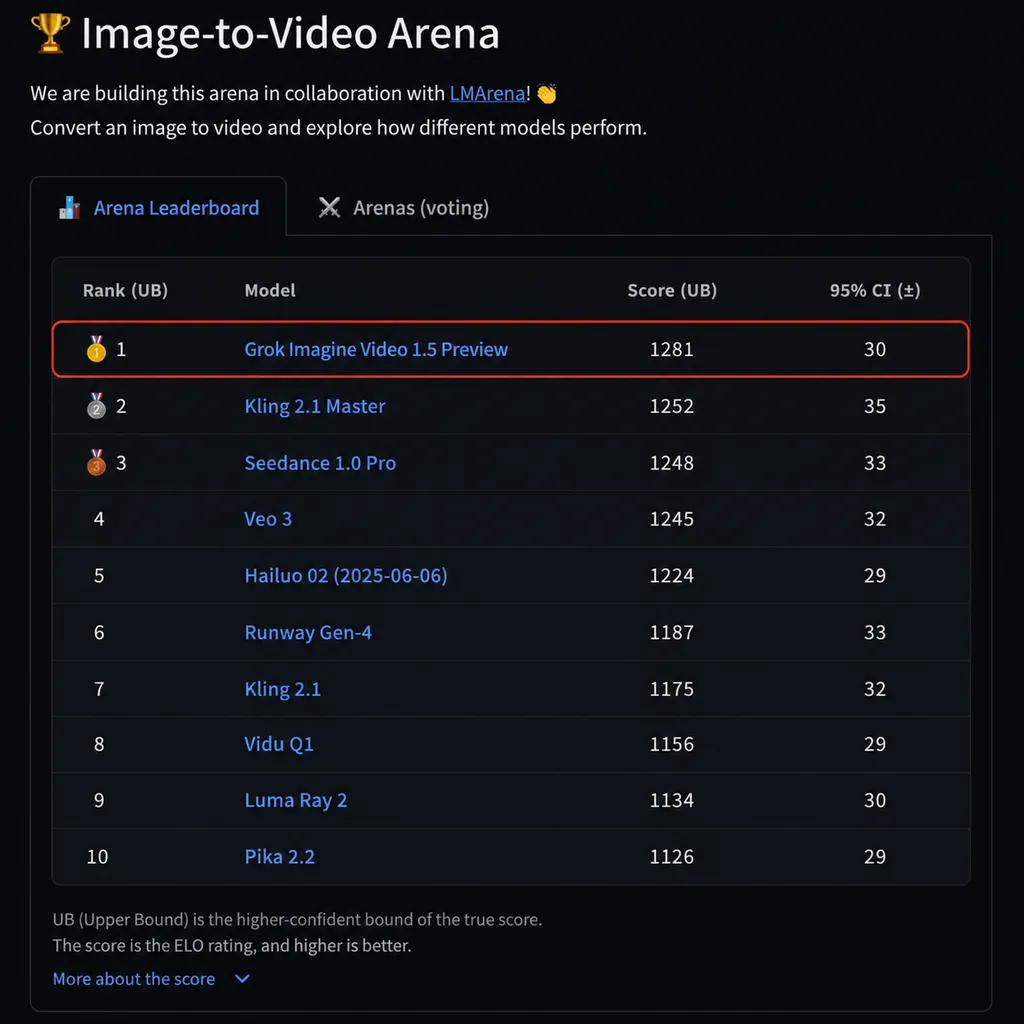
An underappreciated track, overturned by an understated update
Let’s first lay out the background. The Grok Imagine product line was originally xAI’s “image + short video” multimodal generator, designed for “speed” and “easy integration.” In the March 24 update, xAI added two functions to the Grok Imagine API: multi-image to video and video extension — the former aimed to solve subject consistency, and the latter to extend duration. At that time, the industry reaction was “interesting, but not impressive enough.”
Two months later, 1.5 Preview shot straight to first place.
Here’s a quick coordinate check for developers not familiar with the field:
- Seedance 2.0: ByteDance’s main image-to-video model, with top-tier motion smoothness and prompt adherence, long-time chart-topper.
- Veo 3 / Kling 2.5: Google’s and Kuaishou’s flagships, more cinematic in style.
- Sora 2 Turbo: OpenAI’s strength lies in text-to-video, not image-to-video.
- Runway Gen-4: Geared toward creative workflows, strong at camera control.
The image-to-video (i2v) track is more competitive than text-to-video. The reason is simple: most real-world production environments use i2v — first perfect the key frame with SD/Flux/Midjourney, then use a video model to animate it. This is currently the most controllable workflow. That’s why the Image-to-Video Arena ranking is closer to “real productivity” than pure text-to-video leaderboards.
For Grok Imagine 1.5 Preview to take first place here, it’s no small feat.
What exactly makes it strong?
xAI hasn’t released a technical paper yet, so we can only infer from community samples and blind tests. I reviewed the comparison samples posted in a linux.do thread and several blind tests from experienced i2v creators on X. A few traits stand out clearly:
First, larger motion without breaking. This is the toughest part for i2v models. Many models collapse when the subject makes large movements — jumping, turning, throwing. 1.5 Preview is noticeably more aggressive than its predecessor; fidelity in actions like turning and running approaches Seedance 2.0, but with freer camera motion.
Second, more reliable physical intuition. Fluids, fabrics, hair — typical failure zones for physics consistency — behave better than expected. In one test, “a person knocks over a stack of books,” most models make the books vanish or clip through; 1.5 Preview produces reasonably scattered trajectories.
Third, 720p is an interesting choice. While Seedance 2.0 and Veo 3 are chasing 1080p and even 4K, xAI only goes with 720p here, but without compromising frame rate or duration. My guess: in the trade-off, xAI prioritized “motion quality over resolution.” For short videos, social media, and ad creatives, this makes sense. You can upscale later — but if motion breaks, it’s broken.
Fourth, speed. Grok Imagine has always emphasized this. 1.5 Preview generates faster than Seedance 2.0 — community tests show roughly 20–30 seconds for a 5-second clip. For bulk generation, this number directly determines cost efficiency.
How to use the API
Good news — xAI has already integrated 1.5 Preview directly into the Grok Imagine API, so no waiting period. The model ID is grok-imagine-video-1.5-preview, and the call interface is consistent with the existing image-to-video endpoint.
If you’re using OpenAI Hub for aggregation, you can call it using the OpenAI-compatible SDK format, avoiding the need for separate xAI access (a key advantage for many teams in mainland China):
from openai import OpenAI

client = OpenAI(
    api_key="your-openai-hub-key",
    base_url="https://api.openai-hub.net/v1"
)

# image-to-video
response = client.videos.generate(
    model="grok-imagine-video-1.5-preview",
    image="https://your-cdn.com/first-frame.jpg",
    prompt="camera slowly pans right, the character turns around and smiles",
    duration=5,
    resolution="720p",
    fps=24
)

print(response.video_url)
For multi-image to video (specifying starting and ending frames, or multiple keyframes):
response = client.videos.generate(
    model="grok-imagine-video-1.5-preview",
    images=[
        {"url": "https://your-cdn.com/keyframe-1.jpg", "position": "start"},
        {"url": "https://your-cdn.com/keyframe-2.jpg", "position": "end"}
    ],
    prompt="smooth transition between the two scenes",
    duration=5
)
Video extension (continuing an existing clip) also carries over, handy for making longer videos:
response = client.videos.extend(
    model="grok-imagine-video-1.5-preview",
    source_video="https://your-cdn.com/seed-clip.mp4",
    prompt="the character continues walking forward, then stops at the door",
    duration=5
)
A few practical tips:
- Write motion, not appearance, in the prompt. The key frame already fixes appearance; use the prompt to describe “action + camera + pacing.” Writing “a beautiful girl with long hair” wastes tokens; “she lifts her head, looks at the camera, hair flows in the wind” is useful.
- Don’t use a low-res first frame. Even though output is 720p, using a 1080p or 2K first frame helps retain detail. The model extracts features internally, so more input information is better.
- Keep durations modest. For the preview phase, start with 5 seconds. For longer clips, use the extension feature. It’s more stable than running 10 seconds at once.
Why now? And why so quiet?
This part intrigues me.
xAI typically launches with fanfare — from Grok 3 to Grok 4 to the Aurora image model, Musk floods X with hype. This time, Imagine Video 1.5 is uncharacteristically silent: no tweets, no pinned posts. I see two possible reasons:
First, Preview means Preview. xAI likely knows this version still has issues in some corner cases — long takes, complex multi-person interactions, text rendering. Based on samples, it can still fail there. Quietly releasing it to gather data and feedback, then making noise later for the full version, is a safer play.
Second, the video generation track no longer needs hype. Sora, Veo, Kling, and Seedance have already educated the market. Developers now care less about “whether AI can generate videos” and more about “which one is cheaper, more reliable, and easier to integrate.” At that stage, a strong leaderboard performance naturally draws users — no launch event required.
Will it stay ahead of Seedance 2.0?
My take — yes in the short term, not necessarily in the long term.
Scores on blind-test leaderboards like Arena swing with each new release. Seedance 2.0 is almost certainly cooking up 2.5 or 3.0, and Google’s Veo also seems poised to move post-I/O. xAI’s edge here is more about timing — launching an upgrade quietly while others assumed the i2v race had stabilized.
One thing is clear: the image-to-video field has moved from “usable” to “hard to distinguish.” The gaps between models now hinge more on style preference, stability in specific scenarios, cost, and speed—not on “who can do it.” That’s good news for developers: more options, stronger bargaining power.
For teams working on video generation, my advice: don’t bet everything on one provider. Keep the ability to switch between Seedance, Grok Imagine, Veo, and Kling. Use A/B testing per scenario to pick the best performer. That’s why demand for aggregation APIs has surged — one key to call all models beats maintaining four or five separate SDKs and accounts.
Summary
- Grok Imagine Video 1.5 Preview has topped the Image-to-Video Arena, surpassing Seedance 2.0
- 720p, motion-first quality, and fast generation are its three key traits
- API is live, model ID
grok-imagine-video-1.5-preview, supporting image-to-video, multi-image video, and video extension - xAI’s unusually low-profile release suggests wider promotion only with the full version
- The i2v track has entered the “hard to differentiate” stage — multi-model use is the pragmatic approach
Let’s revisit this when the full release and tech report drop. For the Preview phase, getting real work done is what matters most.
References
- In an unnoticed corner, Grok Imagine Video 1.5 Preview was released - linux.do — the earliest community thread to spot the Arena leaderboard update and share sample comparisons


