
MiniMax M3 Launch: API and Token Plan Open Simultaneously
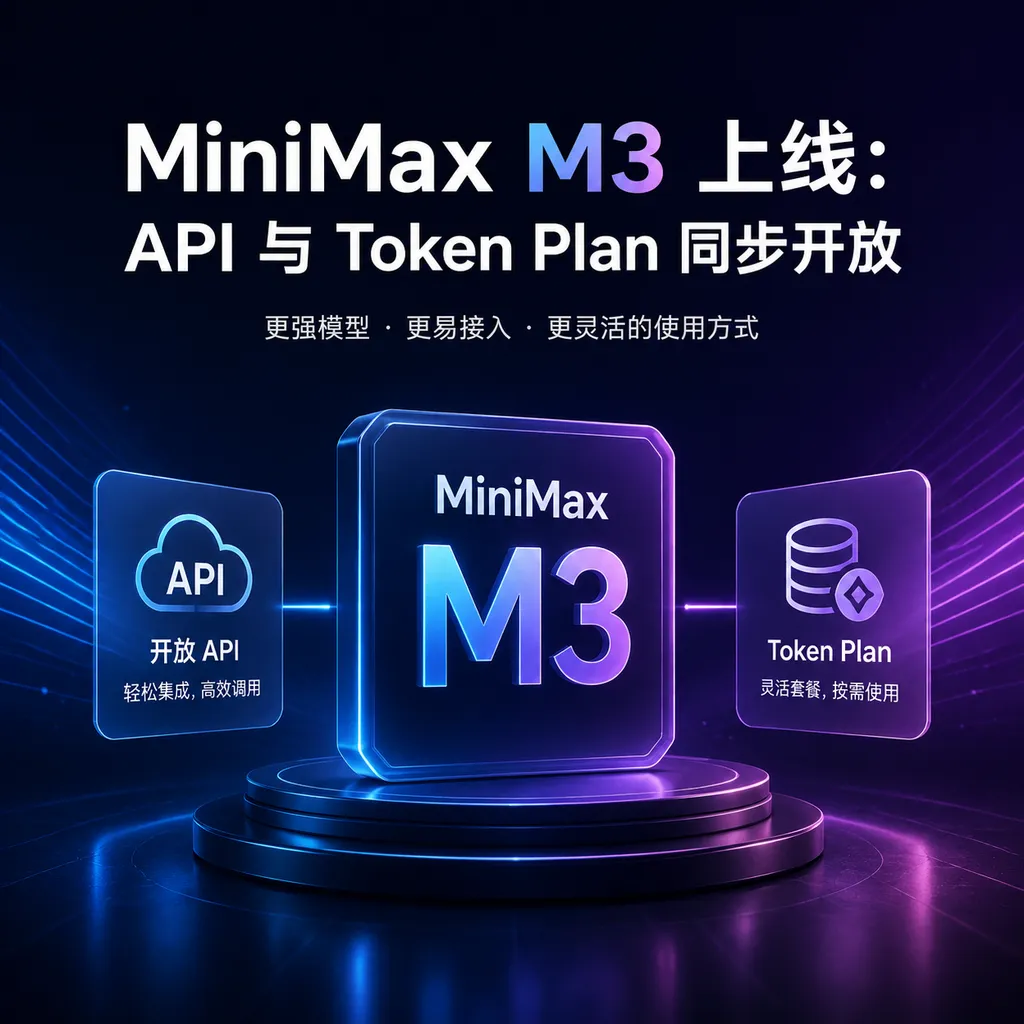
On June 1, the MiniMax internal testing group confirmed that the M3 model has been launched. The API and the full‑modality subscription Token Plan are now available, just over half a year since the release of the M2 series.
This morning, MiniMax announced in its internal beta group (Group 7.46): The M3 model is now live, with both the API and Token Plan channels open for use. No launch event, no teaser—the usual routine: let developers get their hands on it first.
This marks yet another flagship release following the dense M2-series iteration cycle in the second half of 2025—just over six months later. From M1’s open-source debut, which gained attention, to the M2 series completing the Coding Plan, and then the March upgrade turning the subscription into a fully modal Token Plan, MiniMax stands out as one of the few domestic AI model companies maintaining a “new generation every six months” pace. The arrival of M3 was largely expected, but rollout speed has still exceeded external expectations.
Clarifying What’s Confirmed
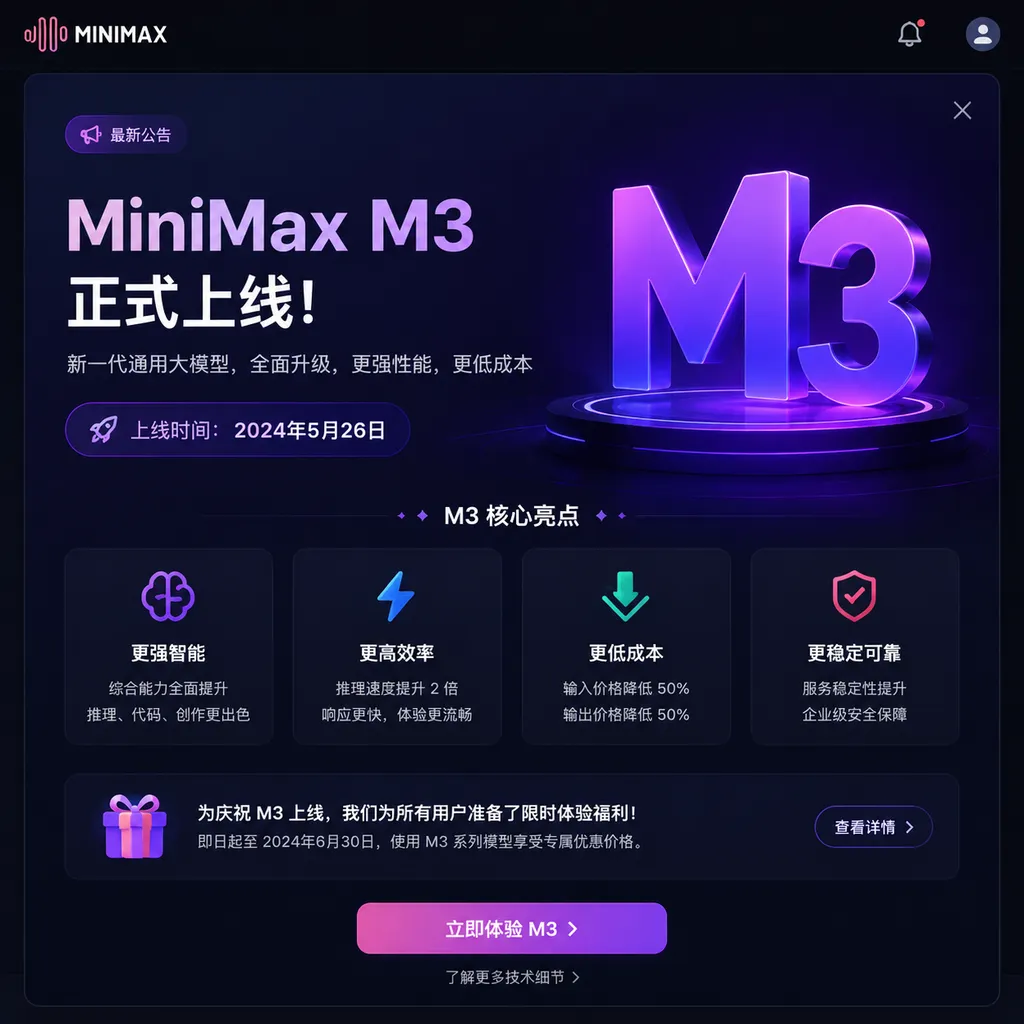
According to information shared in the beta group, this launch includes two pathways:
- API Channel: Developers can directly call M3 via the official MiniMax API. The model ID has been distributed in the beta channel, and official documentation will follow soon.
- Token Plan Channel: M3 is simultaneously integrated into the Token Plan subscription system. Existing subscription quotas automatically cover calls to M3.
A bit of context: on March 23, MiniMax upgraded its previous Coding Plan—originally focused only on programming scenarios—into the Token Plan, touted as “the world’s first unified subscription plan supporting full-modality generation.” Simply put, where one subscription previously bought access to code models only, the upgrade means a single plan now covers text, image, audio (Hailuo), video, and music generation. For Plus-tier and higher, the quota for the M2.7 coding model remains intact, with multimodal tokens thrown in for free.
Viewed through this new structure, M3’s significance is clearer: it’s not just another model but one directly plugged into an existing, fully operational subscription system with paying users. Developers don’t need to repurchase tokens—the subscription covers M3 automatically, making migration virtually seamless.
From M2 to M3: Key Inferences
While no official benchmarks or parameters have yet been released, M2’s evolution offers some clues.
M2.1 currently serves as the Token Plan’s default base model for general dialogue and tool use, while M2.7 is designated for coding, having taken on most Agent-type tasks during the Coding Plan era. The fact that M3 is launching via both API and subscription strongly suggests it’s a unified successor to M2.1’s general-purpose position, not a specialized sub-model targeting a single domain.
This “converged” approach is relatively rare among domestic vendors. The more common path is to maintain separate product lines—one for chat, one for code, one for reasoning—each evolving independently. If MiniMax really positions M3 as a unified base model, the logic likely is: once multimodal parity across the stack is achieved, maintaining several separate text models no longer offers sufficient ROI. It’s better to consolidate into one main line and use multimodality as the differentiator.
This reasoning also applies to OpenAI and Anthropic—OpenAI simplified its model lineup significantly after GPT-5, and Anthropic’s Claude 4.5 series has undergone similar consolidation. MiniMax is pursuing the same direction, only faster.
Why the Token Plan Matters
Viewed alone, the launch of M3 is a routine weekly industry event. But in the context of the Token Plan, MiniMax’s move is far more significant than just releasing another model.
Developers are familiar with the pain points of traditional API billing: each model has its own pricing—text by the thousand tokens, images by the piece, audio by the second, video by duration—creating an accounting nightmare. MiniMax’s Token Plan collapses this structure into a unified token allotment pool—whether you’re using M3 for coding, Hailuo for video generation, or TTS for voice, all usage draws from the same shared quota.
Subscription Plan Illustration (Based on Public Information):
Plus and above → M2.7 coding quota + multimodal quota (free bonus)
After M3 launch → M3 general-purpose capability joins the same token pool
This packaging approach is especially friendly for small and mid-size teams. A startup developing AI tools previously had to subscribe separately to OpenAI, ElevenLabs, and Runway—each with its own SDKs and rate limits. Now, in theory, a single subscription could power the entire demo stack. Of course, this depends on MiniMax’s multimodal performance holding up—and indeed, its Hailuo video and audio models have been gaining strong reputation over the past year, giving credibility to this strategy.
What It Means for Developers
In the short term, there are a few things you can do right away:
- Existing Token Plan Subscribers: Switch your model ID to M3 and run a round of regression tests to see if your workflows improve. Subscription quota stays the same; migration costs boil down to changing one string.
- Direct API Users: Wait for the formal documentation and pricing. M2’s API wasn’t the cheapest among domestic offerings but was strong in multimodal support; M3 will likely keep this positioning.
- Teams Still Observing: Add M3 to your next evaluation round. Since MiniMax hasn’t published benchmarks yet, the only reliable way to gauge performance is to test it yourself.
In the longer term, if the M3 + Token Plan combination proves successful, it could set a new model for commercialization among domestic LLM vendors—competing not by token pricing but through subscription bundles covering full-modality needs. OpenAI already does this with its ChatGPT subscription + API dual track, but such an approach remains rare in China’s API market.
How to Access
On launch day, OpenAI Hub added M3 to its aggregated API list, compatible with the OpenAI format and directly accessible domestically. For developers already using OpenAI Hub to call multiple models with one API key, adding M3 requires no change to authentication logic—just swap the model field. In such cases, multi-model A/B testing is practically cost-free.
Questions Still Pending
The information density of M3’s launch is not high; several key details remain unclear:
- Full benchmarks: M3’s performance on mainstream leaderboards such as MMLU, GPQA, SWE-bench, and AIME has not been disclosed, making comparison with GPT-5, Claude 4.5, DeepSeek V4, and Qwen3 Max difficult.
- Context window: M2.1 started at 128K. Whether M3 extends to 256K or beyond will directly affect its usability for long-chain Agent tasks.
- Multimodal alignment: Since the Token Plan emphasizes full-modality integration, whether M3 is natively multimodal or still runs via a “text core + Hailuo video + TTS” composite pipeline is an important question.
Given MiniMax’s usual timeline, the full technical report and pricing details will likely follow within a week or two. Until then, hands-on testing is advised—MiniMax’s models typically prove themselves more effectively in real-world runs than through paper numbers.
References
- LINUX DO community post: MINIMAX M3 now available — First internal beta source confirming that M3 is live, with both Token Plan and API channels open.


