
NVIDIA Releases 32-Billion-Parameter VLA: Autonomous Driving Now Has an Open-Source Teacher Model

At the Taipei GTC, NVIDIA unveiled the Alpamayo 2 Super — a 32‑billion‑parameter open‑source vision‑language‑action model, tripling the previous generation’s 10 billion. It’s aimed at Level 4 Robotaxi applications. The accompanying AlpaGym closed‑loop reinforcement learning and OmniDreams world model were launched simultaneously.
NVIDIA unveils 32-billion-parameter VLA: autonomous driving finally gets a proper open-source teacher model
On June 1st, at the Taipei GTC, Jensen Huang boosted the parameter scale of NVIDIA’s Alpamayo series in one go—from 10 billion to 32 billion. The new model is called Alpamayo 2 Super, positioned as an open-source, reasoning-based vision-language-action (VLA) foundation model, with a very straightforward target customer base—those working on L4 Robotaxi systems.
If half a year ago Alpamayo 1 was merely NVIDIA’s first try at open-source VLA—a sampler to prove to the industry that "cars can think like ChatGPT"—then Alpamayo 2 Super clearly stakes out its spot as a teacher model: you distill it, it’s open-source; you don’t have to start from scratch—NVIDIA gives you the full set: data, simulation, closed-loop training.
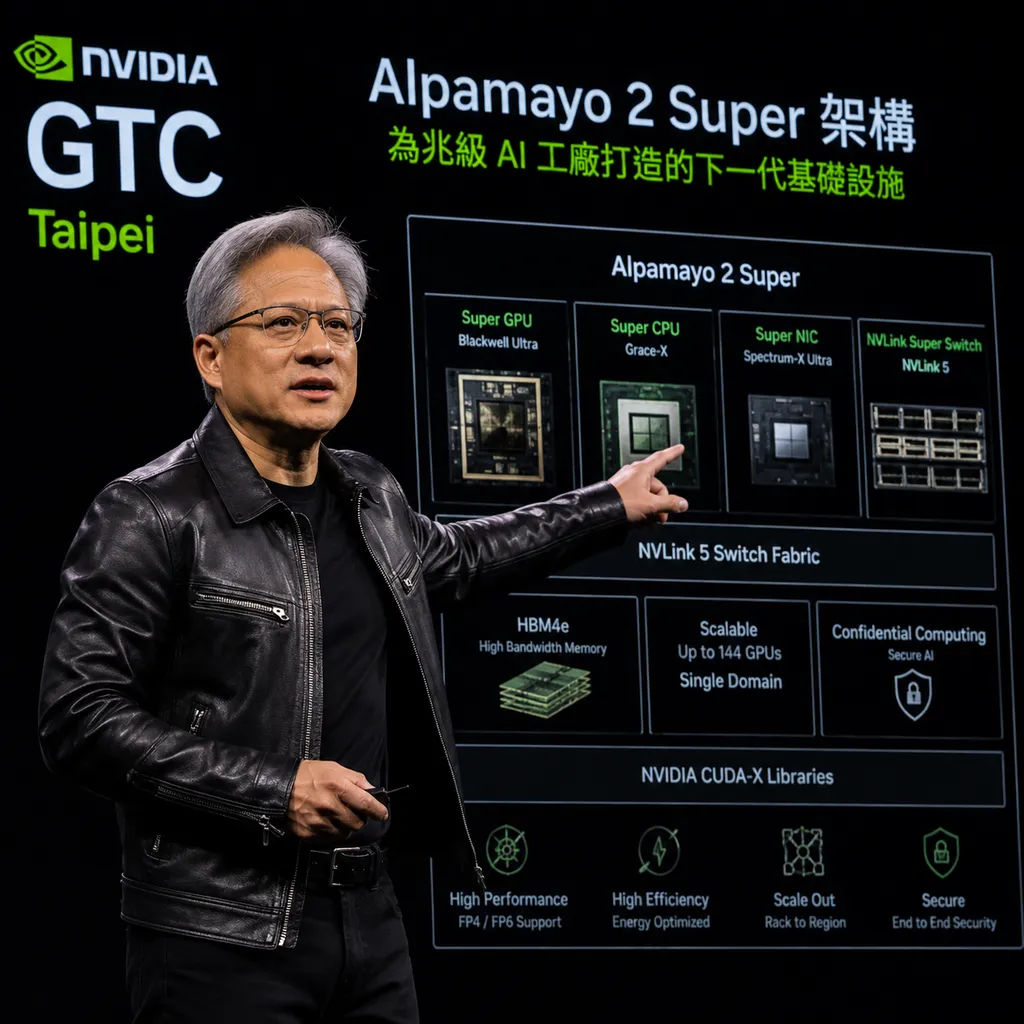
Not just tripling parameters
When looking at models, the public tends to focus on the parameter count. Alpamayo 2 Super jumped from 10B to 32B—3.2x on paper. But what truly matters isn’t the number, but that it operates on a completely different level from its predecessor.
The first-generation Alpamayo 1 was essentially a trajectory generation model—feed it a video, and it outputs how to steer and accelerate in the next second. Alpamayo 2 Super takes on much more. It’s designed to handle reasoning, planning, and execution across the entire autonomous driving stack—and every part must be explainable. That point is critical for automotive-grade compliance: if regulators ask why the car changed lanes, the model must produce a causal chain, not just output a set of black-box coordinates.
Key features include:
- Trained on NVIDIA Cosmos, comprehensively enhancing logical reasoning, 3D spatial awareness, and trajectory prediction for long-tail scenarios;
- Full surround perception: upgraded from forward-facing cameras to 360-degree panoramic vision, covering front, side, and rear—essential for lane changes, merges, and complex intersections;
- Meta-action outputs: beyond trajectory and causal chain outputs, it can also anticipate high-level driving intents like "yield," "change lane," or "stop," serving as anchors for downstream planning modules;
- Inference-based auto-labeling + 2D object localization: compressing labeling cycles that used to take months down to days—hugely impacting data team cost structure;
- Optimized causal chain and trajectory outputs: reinforced for rare, long-tail scenarios that imitation learning struggles with.
In short, Alpamayo 2 Super isn’t meant to be deployed in-vehicle directly—it’s too large. Its role is as a teacher model, distilled into smaller models for deployment on the DRIVE Hyperion platform’s DRIVE AGX Thor automotive chips.
NVIDIA’s teacher-model strategy is crystal clear
NVIDIA’s playbook for VLA mirrors what Llama did for large language models—build the strongest open-source foundation model so the ecosystem can train, distill, and customize from it.
The product lineup speaks for itself:
Alpamayo 1 Nano   (10B)  — Early pilot
Alpamayo 1.5 Nano (10B)  — Iterative version
Alpamayo 2 Super  (32B)  — Teacher model, the main highlight this time
The Nano series focuses on real-time, in-vehicle deployment; the Super model “knows the most,” then transfers that knowledge to Nano variants. Each car manufacturer no longer needs to train a foundational VLA model from scratch—something only NVIDIA and a handful of major players could afford in terms of cost and data.
The subtext is clear: NVIDIA doesn’t just want to sell chips—it wants to define the “operating system layer” of autonomous driving. The model is open-source, but training uses Cosmos, simulation uses Omniverse, closed-loop training runs on AlpaGym, and deployment happens on DRIVE Thor—you basically can’t circumvent NVIDIA’s stack.
The matching trio of releases is the real moat
The model may be the headline, but what really underpins Alpamayo 2 Super’s capabilities are the three infrastructures released alongside it. These are often glossed over but are the true treasures for developers.
AlpaGym: closed-loop reinforcement learning platform
Most autonomous driving training is still "open-loop"—feeding recorded driving data into a model to predict the next action, comparing results with ground truth, and calculating loss. The issue: real-world vehicles operate in closed loops—each brake or steering move alters the subsequent environment state.
AlpaGym moves training into that closed loop: the model continuously runs a “decision–perception” cycle within AlpaSim, where every vehicle action dynamically changes the simulation environment. The system, built atop AlpaSim microservices and Omniverse NuRec, boosts reinforcement learning throughput dramatically.
Transitioning from open-loop to closed-loop training is the biggest hurdle in autonomous driving—AlpaGym turns that hurdle into an open-source framework.
OmniDreams: world model for long-tail scenarios
What’s hardest about L4 autonomy? Not the 99% of common cases—but the 1% of rare events: a truck dropping cargo, oddly placed construction cones, heavy rain and glare at night. Such data are nearly impossible to capture in real driving.
OmniDreams is a generative world model designed to simulate large volumes of long-tail driving scenarios. Used with NuRec: NuRec reconstructs environments traversed by real fleets; OmniDreams generates endless variants within those reconstructed worlds. One real-world driving snippet can spawn hundreds or thousands of “what-if” training samples.
Omniverse NuRec: neural reconstruction
NuRec works like an engineering version of NeRF—it uses real fleet data to build 3D scene reconstructions and generates synthetic training data in quantity. NVIDIA also exposes this as modular agent skills via the NVIDIA Agent Toolkit for developers to call.

An overlooked detail: causal-chain auto-labeling is open-source
NVIDIA quietly dropped another item on GitHub—an automated causal-chain labeling workflow.
This tool can automatically generate labeled driving data with reasoning and causal links directly from raw dashcam videos, fully eliminating human annotation. For embodied reasoning models, this is core training material. Traditionally, humans had to label causal chains like: "Why did the model slow down? Because a pedestrian 30 meters ahead was about to cross." Costly and slow. Automating this process means that the data flywheel for reasoning-based VLAs can finally spin.
This open-sourcing step might actually have more impact than the model itself.
Domestic integration progress
At the launch event, NVIDIA specifically named BYD, Geely, Zeekr, Xiaomi, and Pony.ai as Chinese automakers and autonomous driving companies already using or developing with the NVIDIA Hyperion platform.
That list is telling. It means that even though domestic players are pursuing in-house chip and model development, the main L4 Robotaxi contenders are still opting for NVIDIA’s full-stack. The reason is simple: building a VLA foundation model from scratch has massive data, compute, and talent barriers, whereas the open-source Alpamayo route has effectively cut the entry cost down to “fine-tuning level.”
Release schedule and availability
According to NVIDIA’s official timeline:
- Inference code: coming to GitHub this summer
- Model weights: to be released simultaneously on Hugging Face
- Causal-chain auto-labeling tool: already open-sourced on GitHub
- Fine-tuning scripts: included with the open platform for easy adaptation to proprietary datasets
Since its debut, the Alpamayo series has accumulated nearly 400,000 downloads and just won Computex Taipei’s Best Choice Award (in-vehicle technology and smart cockpit category). Judging by community enthusiasm, the series is already exerting tangible influence in the autonomous driving sector.
Final thoughts
The term “VLA” has been used broadly over the last couple of years—from robotics to autonomous driving. Technically, the Alpamayo 2 Super doesn’t introduce flashy new architectures, but it does piece together what a proper "reasoning VLA" should look like: multi-modal perception + meta-action output + causal-chain explainability + closed-loop reinforcement learning, backed by an end-to-end tooling suite—from data collection to in-car deployment.
For automakers, it’s a hard package to refuse: even if you don’t embrace NVIDIA’s entire paradigm, if you’re building L4 systems, you’ll almost certainly rely on some part of this pipeline.
For developers, the tangible value is clear: an open-source 32-billion-parameter teacher model for VLA, plus labeling tools and a closed-loop RL framework, drastically lowers the barrier to end-to-end autonomous driving research. Even if you just want to experiment with it for video understanding or scene generation, those weights are worth running.
Whether the "ChatGPT moment" for physical AI has truly arrived is still unclear—but at least in autonomous driving, NVIDIA has single-handedly filled the open-source VLA toolbox. What happens next depends on how the automakers choose to engage.
References
- ITHome: NVIDIA launches Alpamayo 2 Super open-source reasoning model to empower L4 autonomous driving R&D — main source from the press event, includes full feature list
- Hugging Face: NVIDIA Alpamayo series model hub — platform for published model weights
- GitHub: NVIDIA open-source autonomous driving toolchain — repositories for inference code and causal-chain auto-labeling workflow


