
OpenAI Strikes Back with Robots: From World Models to Real Agents

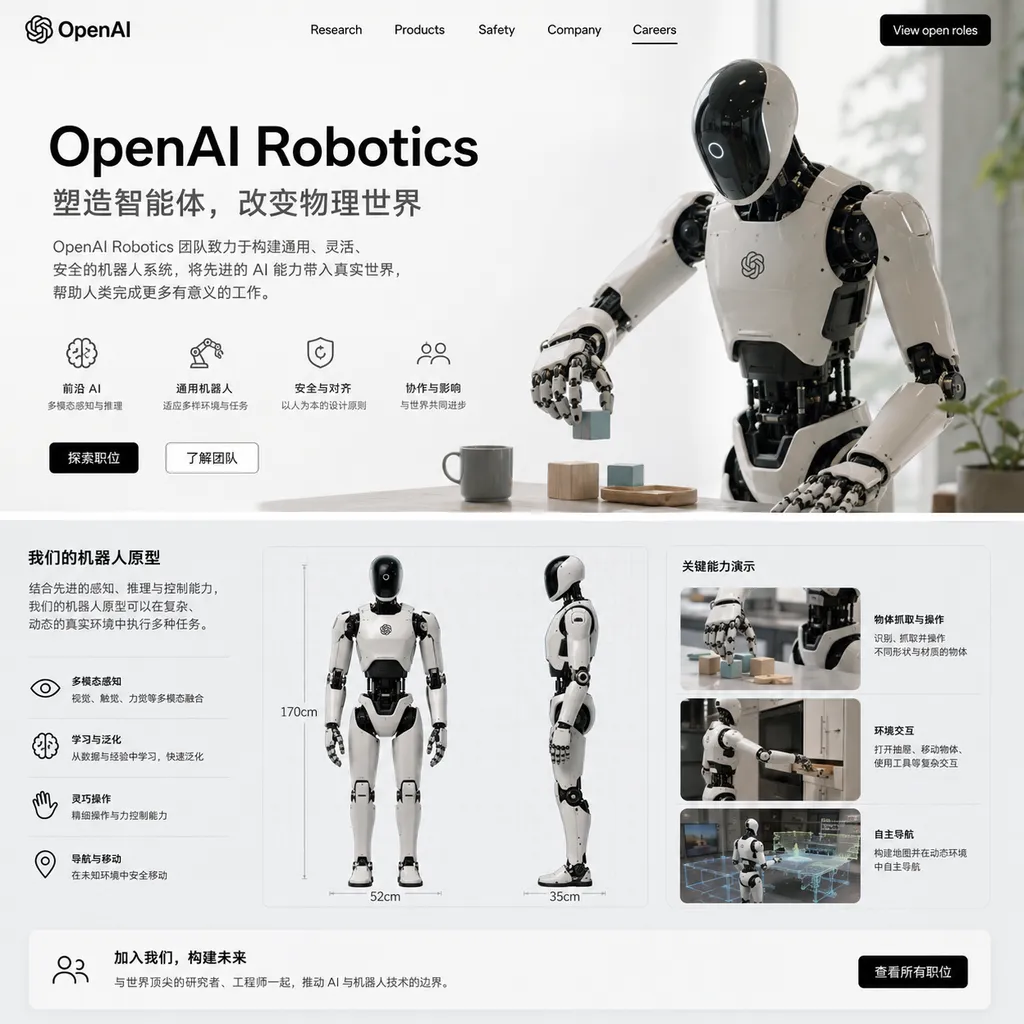
OpenAI officially announced the establishment of its Robotics team, led by former DALL·E head Aditya Ramesh, restarting its long-dormant robotics efforts. This time, instead of focusing solely on hardware, the team is using world models as the “brain,” aiming to create embodied agents for the real world.
OpenAI Is Getting Back Into Robotics
On June 1, Sam Altman posted a hiring announcement for OpenAI Robotics on X, formally declaring that the company—slowed by ChatGPT for the past four years—was re-entering the robotics race. The recruitment scope was wide: full-stack hardware, systems, operations, and machine learning engineers. The message was clear—this was not just a new research group but a full push to co-develop hardware and models.
A few hours later, co-founder Greg Brockman added on X that “OpenAI Robotics is moving very fast.” This kind of coordinated announcement between the CEO and co-founder has historically only marked major points like GPT-4 and Sora.
One notable detail is the project’s origin. Altman revealed that OpenAI’s internal “World Simulator” research project had evolved rapidly over the past year, and has now been restructured into OpenAI Robotics, led by Aditya Ramesh—the creator behind the DALL·E series. His transition from image generation to world modeling and now robotics leadership shows OpenAI’s own interpretation of embodied intelligence: starting from content generation models and extending that generative ability into prediction and manipulation of the physical world.
Why Now, and Why This Strategy
The timing is deliberate. The last time OpenAI seriously worked on robotics was from 2018 to 2021 with the Dactyl robotic hand project, which was eventually scrapped due to “too little data, too expensive hardware, and too weak models.” The approach back then relied on reinforcement learning and simulation-to-reality transfer, meaning even a single hand turning a Rubik’s Cube required millions of simulation runs.
By 2026, the situation will be completely different:
- The large-model paradigm is proven. The success of GPT demonstrates that data scale × compute scale = capability growth works. The remaining challenge is how to bring that into the physical world.
- World models have become a consensus direction. From Sora to Genie, from Fei-Fei Li’s Marble to Meta’s JEPA, the industry increasingly believes that letting AI truly enter the physical world requires understanding it, not just describing it.
- Humanoid robotics funding has exploded. Figure AI, 1X, Unitree, Tesla’s Optimus—all show hardware is no longer the bottleneck; what’s missing is a truly capable “brain.”
- Internet text data is drying up. Multiple research institutions estimate that by 2026–2028, high-quality public text corpora will be largely exhausted. The next big data dividend lies in sensor data from the real world.
Combine these factors, and the logic closes neatly: OpenAI cannot wait. It must secure its position before the world model race is fully claimed.
Short-Term: Assistive Robots; Long-Term: A Robot for Everyone
Altman’s statement makes the strategy clear:
In the short term, OpenAI will focus on developing robots that assist skilled workers in building future infrastructure; in the long run, everyone can have a personal robot that fulfills various needs.
Two keywords here deserve unpacking—“assistive” and “infrastructure.”
“Assistive” implies OpenAI does not intend to immediately target consumers, nor the household scenario—which is a prudent choice. Domestic environments are incredibly complex and have high safety demands. In spaces with seniors or children, any grasping mistake could make headlines. Business-to-business verticals are currently the only viable commercial path; Chinese manufacturers share the same view—validate in settings such as retail, production lines, and offices first, and defer home applications.
“Infrastructure” narrows the scope further—it likely refers to data centers, energy sites, and semiconductor plants, i.e. the “capacity AI itself depends on.” The underlying logic: OpenAI is the largest buyer of AI infrastructure. Massive projects like Stargate need construction, wiring, and maintenance—if robots could join that loop, OpenAI would essentially build tools to accelerate its own expansion.
The Real Technological Core: Dual-Layer Architecture of World Model + VLA
This time, OpenAI repeatedly emphasized: deep integration and co-design of robotics hardware and machine learning research. That’s not a formality—it’s a statement of approach.
To understand OpenAI Robotics’ playbook, look to the current mainstream industry consensus: the “World Model + VLA” dual-layer architecture.
- World Model (the brain): Handles understanding and prediction. When given a task, it mentally simulates possible scenarios and plans optimal routes. This layer learns physical laws and causal logic, not just input-to-motion mapping.
- VLA (Vision-Language-Action, the cerebellum): Handles concrete execution. Once assigned subtasks, it outputs movement parameters to control joints, grasping, and navigating.
- Closed-loop feedback: When results differ from predictions, the world model replans, and the cycle iterates.
This architecture is distinct from prior years’ VLA-only approaches because it gives the model explicit understanding of the physical world, rather than end-to-end visual-to-motor mapping. Pure VLA systems suffer from poor generalization, low interpretability, and massive training data demands. Introducing a world model as the upper planner adds “imagination” to embodied intelligence.
By converting the Sora team’s World Simulator project directly into the Robotics division, OpenAI’s move makes perfect sense—Sora has already shown that video-generation models can capture a degree of “physical intuition.” The next step is to connect that intuition to robotic arms and legs.
Where Will the Data Come From: The Unspoken Part
If the world model is the “brain,” then data is its nourishment. This is the question everyone’s watching but OpenAI hasn’t openly discussed.
Wang Xiaogang of SenseTime’s robot program recently made a notable observation: the industry is shifting from machine-centered data collection to human-centered ambient data collection. Global robotic training data, totaling around 100,000 hours in past years, could jump to tens of millions of hours within the next two—an increase of over 100×.
Data sources fall into three categories:
- Internet images + text: massive but indirect—essentially “book learning”
- Simulation-generated data: scalable but with a sim-to-real gap
- Real-world wearable data collection: gather data from cleaners, factory workers, etc., during their actual work—closest to real-world distribution
Within OpenAI’s game plan, the first two are strengths (thanks to Sora’s video priors and large-scale simulation), but the third is a weakness—it has no factories, no workers, no end-user hardware installations. That explains why hardware and operations roles were equally stressed in the recruiting post. Without deployed hardware, there’s no real-world data stream; without real-world data, the world model floats in empty space.
This effectively acknowledges that a pure software company cannot build true embodied intelligence. Brockman’s comment about "hardware–software co-design" implies they’ll build at least reference-level robotic bodies themselves.
Comparing Tesla, Figure, and DeepMind: What Advantage Does OpenAI Hold?
Looking across the competition:
- Tesla Optimus: has manufacturing lines, real-world data loop, and can reuse the FSD vision stack. Strongest in hardware scaling but relatively closed model layer, and iteration speed bound by factory rhythm.
- Figure AI: previously partnered with OpenAI before parting ways; now developing its own Helix model. Elegant hardware design but uncertain mass production.
- Google DeepMind: outstanding at models (RT-2, Gemini Robotics), but long reliant on external hardware partners—lacking a closed data loop.
- 1X Technologies: closely tied to OpenAI (early investment), focuses on household robots, lighter-weight hardware.
OpenAI’s differentiated edge? The strongest generative-model foundation (Sora’s world simulation), the most powerful compute orchestration (Stargate), and the largest application entry point (ChatGPT’s user base). Its downside: starting almost from zero in hardware and manufacturing know-how.
Thus, a plausible next step: OpenAI may begin with reference hardware + partner manufacturing, focusing its core on the “brain” layer while outsourcing the body. 1X remains one of the most likely collaborators.
What It Means for Developers
In the short term, OpenAI Robotics won’t instantly offer developer APIs. This will mirror GPT-3’s early trajectory: first closed-door research, then early partners, then open interfaces.
But several things will happen soon:
- The robotics talent market will get shaken. OpenAI’s compensation packages previously drew core researchers from competitors; this time, it’s robotics’ turn.
- World modeling will become the next standard capability. Future GPT versions, likely post–GPT-5, will have stronger physical reasoning abilities, exposed first via APIs to developers working on simulation, planning, or embodied agents.
- Next-generation Sora will take on more robotics roles. Video-generation models are themselves forms of world models; the next Sora will likely evolve into an interactive world simulator, letting developers pretrain robotic strategies within it.
For application developers, the realistic path remains calling the smartest “brains” and connecting them to your own hardware or agent frameworks. This mirrors today’s mainstream approach in China—using mature communication stacks like ROS 2 or WebRTC to link cloud-based large models to robot bodies, turning actions like grasping, moving, and recognition into callable agent tools.
If you’re building multi-model Agent systems, an aggregator like OpenAI Hub can simplify the process—one key lets you call GPT, Claude, Gemini, DeepSeek, etc., all via unified OpenAI-style APIs and domestic direct connections, so you can experiment with “brain selection” without swapping SDKs repeatedly.
One Verdict
OpenAI’s move into robotics isn’t just a business expansion—it’s a restatement of its path to AGI.
Over the past two years, Altman has repeatedly said “AGI is just a few years away.” But scaling language models has visibly slowed—each post-GPT-4 iteration yields smaller marginal gains. If AGI’s definition includes acting in the physical world, OpenAI must venture into robotics; otherwise, it will only ever build “AGI that outputs text,” not “AGI that changes the world.”
This step was inevitable—it’s just that Altman chose a moment when all the cards are on the table.
Hardware’s no longer the bottleneck, the world-model paradigm is clear, capital’s eager to invest, and competitors aren’t yet firmly positioned. OpenAI won’t let that window belong to others.
As for success? It depends on whether Ramesh can produce the first demo that makes people say “Whoa.” Sora’s demo was just a short video, but it defined an entire track. Now it’s time for the robotics version of the “Sora moment.”
References
- OpenAI Announces Recruitment and Entry Into Robotics, Short-Term Focus on Assistive Robots – IT Home: Original report on OpenAI Robotics hiring and Altman’s remarks


