
Coze 3.0 Launch: Coze Shifts from a Bot Factory to a Multi-Agent Collaboration Platform
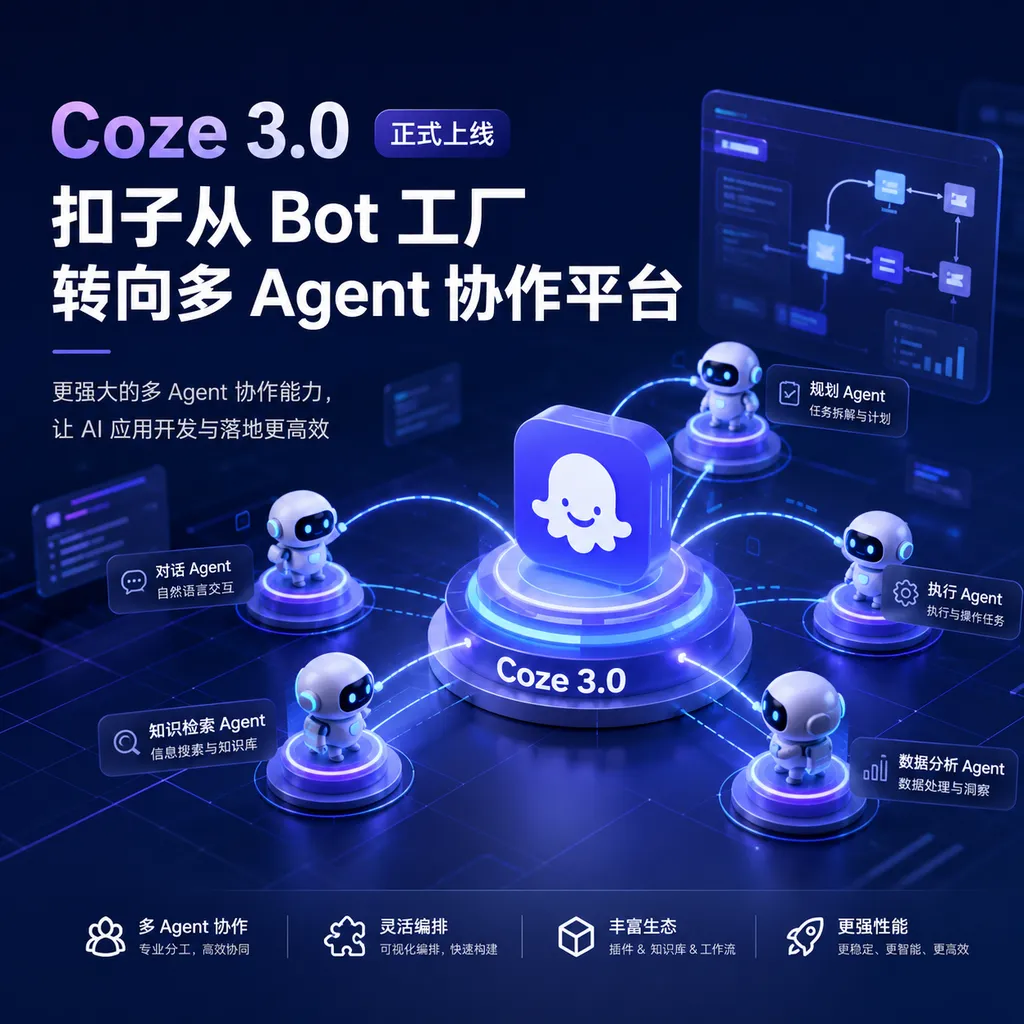
ByteDance Coze 3.0 officially launched today, featuring multi-user and multi-Agent collaboration, built-in industry skill packs, and one-click integration with coding Agents such as Claude Code and Codex CLI. This marks Koutzi’s transition from a standalone bot factory to an Agent ecosystem platform.
On June 1, ByteDance’s AI Agent platform Coze officially released version 3.0. Unlike previous incremental updates that usually “added a few new models and optimized a few nodes,” this time the company introduced multiple major capabilities all at once—multi-user and multi-Agent collaboration, industry skill packs, one-click loading, and cross-device synchronization—along with direct one-click integration of several highly popular coding Agents in the developer community: Claude Code, Codex CLI, and Openclaw.
It’s clear what story Coze wants to tell this time: transforming itself from a “Bot factory” into an “Agent collaboration platform.” That’s also the exact position platforms like Dify, n8n, AgentScope, and JoyAgent have been racing for over the past six months.
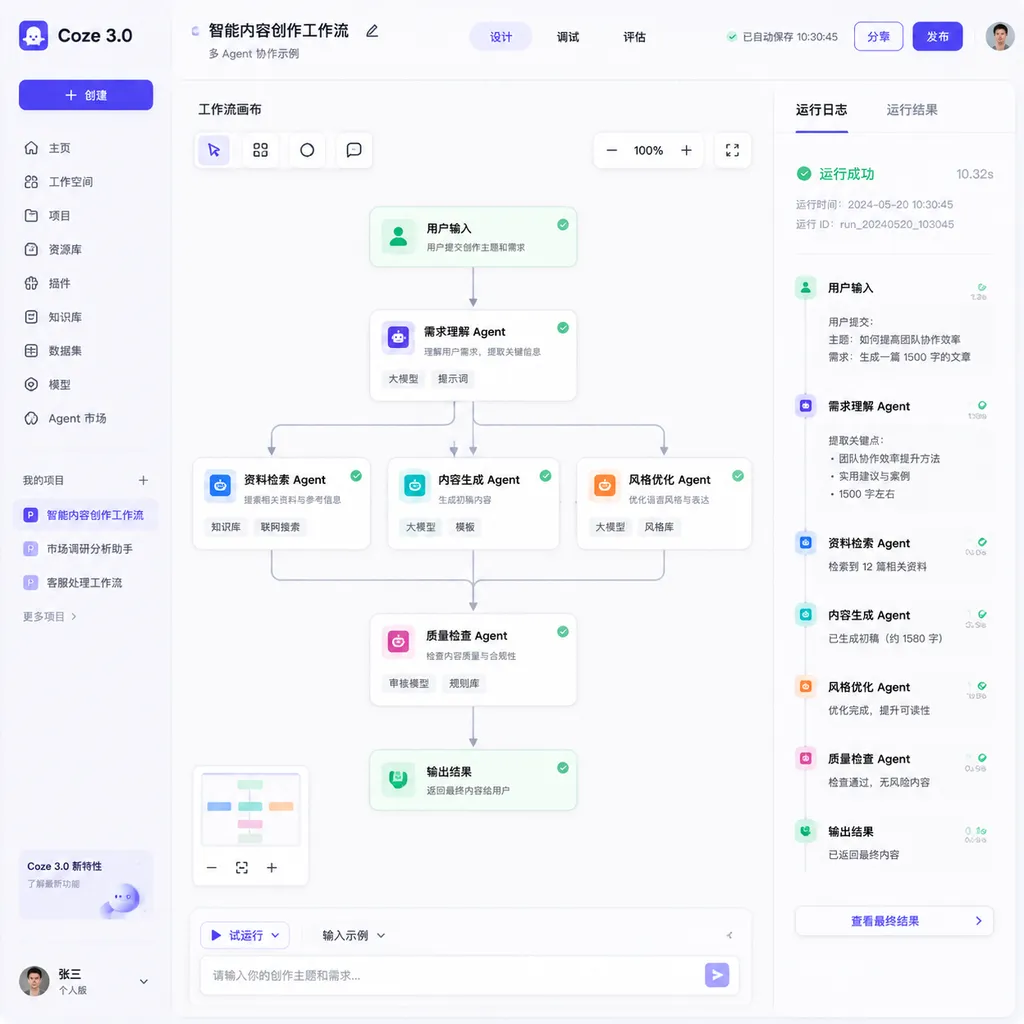
From Single Bot to Multi-Agent Collaboration: Coze Fills in the Missing Piece
In 2024, Coze’s philosophy resembled that of a typical low-code Bot platform—one user, one Bot, one workflow, with complex usage scenarios solved by stacking workflow nodes. This approach worked for simple Q&A, customer service, and content generation tasks, but once the workflow spanned a long chain—“information retrieval → data analysis → document generation → multi-person review”—a single Bot quickly ran out of steam: context explosion, deeply nested tool calls, and disorganized state management.
That’s why, since the second half of last year, nearly all leading Agent frameworks have made “multi-Agent orchestration” their core differentiator. In October, Microsoft merged AutoGen and Semantic Kernel into the Microsoft Agent Framework, introducing five orchestration modes: sequential, concurrent, group chat, handoff, and “magnetic” orchestration. Alibaba’s AgentScope 1.0 focused on a systematic implementation of the ReAct paradigm, while Ant Group’s agentUniverse emphasized modularized collaboration modes derived from financial-business use cases.
Coze 3.0’s “multi-user, multi-Agent collaboration” fills that gap and adds a rarely emphasized dimension—multiple people. In other words, collaboration isn’t just Agent-to-Agent but also includes human participants as first-class citizens in the orchestration chain. This resembles Eigen’s Human-in-the-loop concept, but Coze’s integration with the Feishu ecosystem makes implementation much more straightforward: one Agent runs data analysis, another writes the report, and a product manager reviews and provides feedback in real time through Feishu—a workflow that was previously either impossible or extremely cumbersome to build in Coze via manual workflow nodes.
Industry Skill Packs: From General-Purpose Agents to “Plug-and-Play Domain Experts”
Another major 3.0 feature is prebuilt skill packs for five industries: finance, media, healthcare, law, and research. It’s not a massive change but hardly trivial either.
It’s not huge because “industry templates” have long existed in platforms like Dify and n8n, with hundreds of community-contributed examples. But it’s significant because this time ByteDance officially launched these packs, meaning that commonly used tools, data sources, prompt engineering techniques, and compliance constraints in these verticals are now bundled in a single, one-click-loadable unit. For enterprise users, that’s the difference between going live in three days versus three months of tuning.
The industry choices are also interesting:
- Finance: high compliance demands, sensitive data, and complex workflows. Ant’s agentUniverse follows this path, while ByteDance’s SaaS-based approach will appeal to small and mid-sized financial institutions.
- Media: Coze’s traditional stronghold, backed by the Douyin, Toutiao, and CapCut content ecosystem, making these skill packs the most natural fit.
- Healthcare / Legal / Research: typical “high knowledge density + strong RAG demand” domains. The skill packs here derive value not from orchestration itself but from well-structured built-in knowledge bases, retrieval strategies, and domain-specific prompting.
Notably, Coze hasn’t adopted the “fully open-source + localized deployment” approach like Youtu-Agent. Instead, it sticks to a dual-track model: SaaS-first complemented by the open-source Coze Studio. Developers thus have a choice: use the SaaS version 3.0 for convenience and speed, or deploy Coze Studio themselves for full control and data locality.
One-Click Integration with Claude Code, Codex CLI, Openclaw: Coze Finally Embraces Coding Agents
For the developer community, the most exciting update might not be multi-Agent collaboration but this one line: “Claude Code, Codex CLI, and Openclaw are now available for one-click integration.”
Over the past year, coding Agents have been the fastest-growing and most commercially active subsegment in the AI Agent space. Anthropic’s Claude Code and OpenAI’s Codex CLI have already become indispensable tools for serious engineers. Coze had previously lagged in this area—you could create a Bot that called a code interpreter, but it couldn’t autonomously read files, modify code, run tests, or submit PRs within a local repo like Claude Code could.
By making these three coding Agents one-click integrable, Coze now allows developers to insert, for example, Claude Code directly into a multi-Agent orchestration as a “code-writing Agent node.” The product logic behind this move is pragmatic: Coze no longer tries to build the world’s best coding Agent itself. It acknowledges that Anthropic and OpenAI already lead in that field and instead focuses on orchestration and collaboration layers.
It’s a very pragmatic decision—similar to moves by LangGraph and AgentStack over the past six months as developers realized that an Agent framework’s moat isn’t a single point capability but its orchestration, observability, collaboration, and ecosystem.
Model Ecosystem: Still “Take Them All,” but Now with Protocol-Level Openness
Coze has long been one of the most model-agnostic platforms in China, supporting Doubao, DeepSeek, Tongyi Qianwen, Kimi, GLM, Claude, and GPT. In version 3.0, the main progress lies in the protocol layer: deeper support for cross-Agent protocols like MCP and A2A dramatically lowers the barrier for integrating external Agents into Coze’s orchestration network.
This aligns with JoyAgent 3.0’s direction—it too highlights “comprehensive support for leading protocols such as MCP and A2A” as a core feature. In other words, competition among Agent platforms this year has shifted from “how many models I support” to “how many protocols I support, and how easily external Agents can join.”
For developers, that’s good news. It means the cost of migrating an Agent from one platform to another will steadily decrease. The same logic applies to OpenAI Hub and other aggregator APIs: a single key covers GPT, Claude, Gemini, and DeepSeek. With Coze 3.0’s dual openness in models and protocols, hybrid orchestration becomes more natural.
One-Click Loading and Cross-Device Sync: Underrated Engineering Details
These two features may sound like product-management tweaks, but anyone who’s used Coze knows how valuable they are.
One-click loading solves the scenario where “I found an Agent or workflow someone else built and want to immediately run it under my own account.” This is common in Dify’s community—a great workflow template can save a week of work. Coze’s older “copy Bot” feature required resource duplication, credential re-binding, and manual plugin configuration—not anywhere near true “one-click.” In 3.0, that process has been streamlined, significantly improving the viral spread of the Agent ecosystem.
Cross-device synchronization targets the Feishu, Douyin, and mobile ecosystems—Agents configured on PC can be directly used in the Feishu mobile app, with synced conversation states, files, and tool call histories. It’s not technically hard but involves heavy engineering, and once done, it becomes a competitive moat.
In Perspective: Where Coze 3.0 Stands Among Domestic Agent Platforms
Let’s compare leading players:
| Platform | Core Focus | Deployment Model | Strengths | |---|---|---|---| | Coze 3.0 | Multi-Agent collaboration + industry skill packs + coding Agent integration | SaaS-first, Coze Studio open-source | Ecosystem / Entry Points / Cross-Device | | Dify | Visual workflows + RAG | Open-source + commercial | Model-agnostic, active community | | JoyAgent 3.0 | Data governance + TableRAG + protocol openness | Open-source | Strong data-agent capabilities | | AgentScope 1.0 | ReAct paradigm + full lifecycle | Open-source | Backed by Alibaba, strong engineering | | agentUniverse | Financial-business collaboration models | Open-source | Deep domain expertise |
Coze 3.0’s differentiation is clear: entry points + ecosystem. Plugged into the ByteDance traffic ecosystem (Douyin, Feishu, Doubao) and paired with one-click integration of leading coding Agents, Coze is targeting the hardest-to-reach middle ground—where non-technical users can adopt it easily, and technical users still find it worthwhile.
Some Reservations
The launch presentation was impressive, but several things warrant observation:
- Depth of multi-Agent orchestration — Does it truly support complex group chat or magnetic orchestration, or is it just multiple Bots chained in a workflow with a new skin?
- Update cadence of industry skill packs — Initial rollout is easy; ongoing maintenance with changing regulations and APIs requires real dedication.
- Compliance of one-click Claude Code / Codex CLI integration — Particularly sensitive for enterprise codebases potentially interacting with overseas Agents.
- Feature gap between open-source Coze Studio and SaaS 3.0 — If too many advanced features remain SaaS-exclusive, the open-source version risks becoming mere promotion material.
Regardless, Coze 3.0’s release has clearly pushed forward the competitive tempo of domestic Agent platforms. It will be worth watching how Dify, JoyAgent, and AgentScope respond next.
References
- Open-Source Agent Framework Showdown: LangChain, Dify, Coze, and Others Compared – A Zhihu article comparing 23 open-source Agent frameworks with solid background information.
- Coze Space User Guide and LLM Tech Insights – A Juejin tutorial based on a product-recommendation scenario, useful as a reference for Coze 2.x capabilities.
- Coze Studio GitHub Repository – Official open-source repo of Coze.
- JoyAgent Open-Source Repository – JD’s open-source Agent framework, a counterpart for the protocol openness approach.
- AgentScope GitHub Repository – Alibaba Tongyi Lab’s multi-Agent development framework.


