
NVIDIA Cosmos3-Super-Text2Image Open Source: A New King of Image Generation, But 128GB VRAM Discourages Local Users
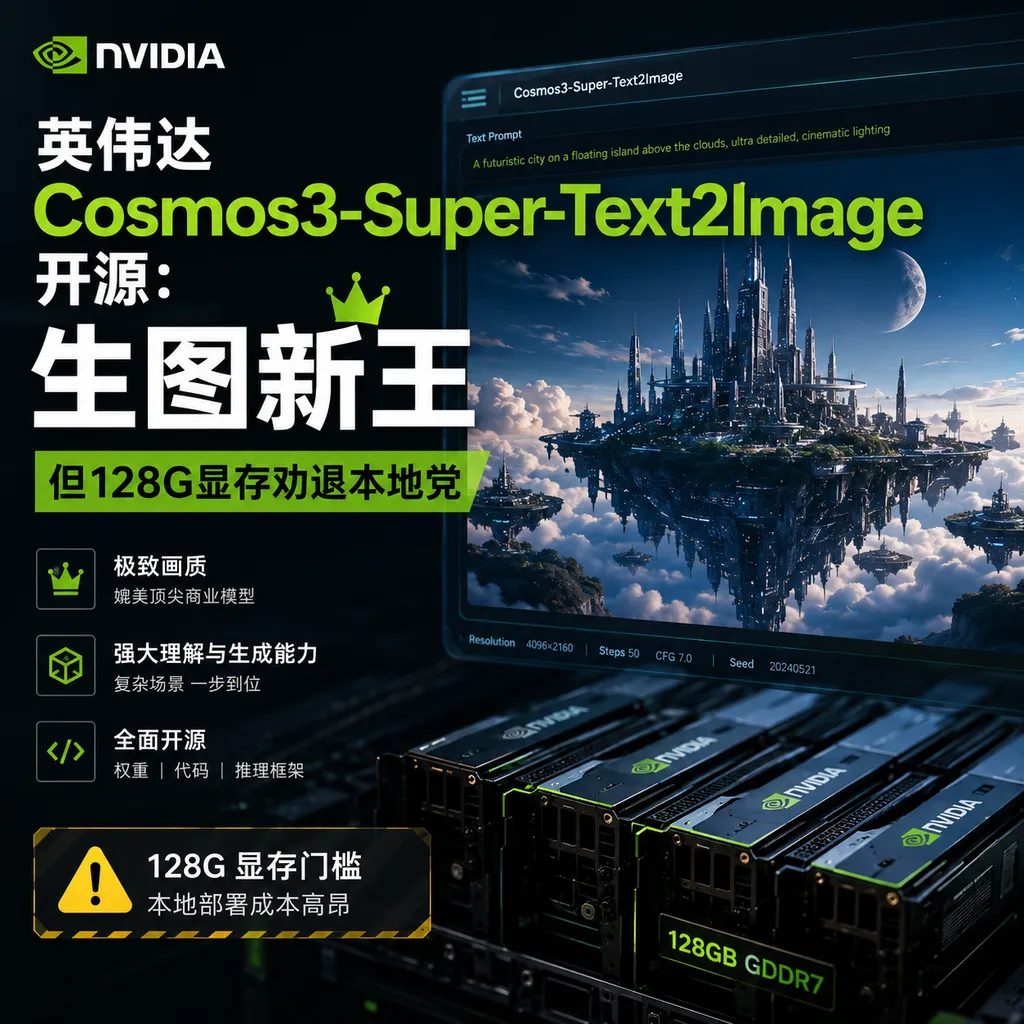
Late at night, NVIDIA released its new generation open-source text-to-image model, Cosmos3-Super-Text2Image. Technical evaluations show it comprehensively surpasses BigBanana Pro, but the 128G+ VRAM requirement makes local deployment completely unattainable.
Nvidia Cosmos3‑Super‑Text2Image Open Source Release: A New King of Image Generation Arrives, But 128 GB of VRAM Sends Local Enthusiasts Packing
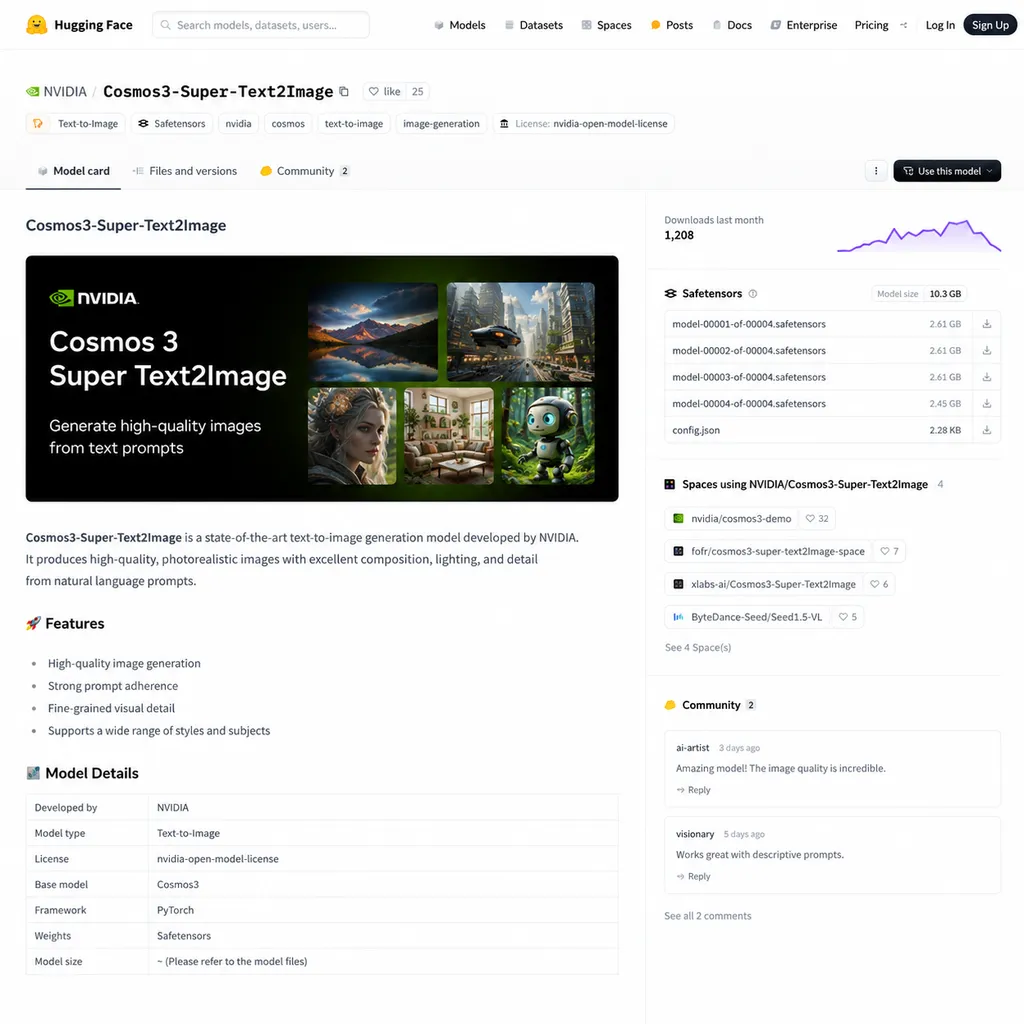
Just now, Nvidia quietly released a new model repo on Hugging Face: nvidia/Cosmos3-Super-Text2Image.
No product launch, no Jensen Huang leather‑jacket tease, not even an updated official blog—yet the global community has already exploded with discussion.
The reason is simple: based on leaked tech evaluations, this model beats the long‑reigning open‑source benchmark “Banana Pro” across multiple image‑generation tests.
In other words, the open‑source text‑to‑image SOTA crown has changed hands.
Summary in a Sentence: The Open‑Source Throne Has a New Holder—but Ordinary Users Can’t Touch It
Let’s start with the takeaway so you know whether to keep reading:
- What it is: The text‑to‑image branch of Nvidia’s Cosmos series—the flagship “Super” edition of the Cosmos 3 generation.
- How strong it is: Technical benchmarks show it surpasses Banana Pro—note, Pro, not the base Banana.
- Can it run locally: The Hugging Face weights are enormous, requiring over 128 GB of VRAM; a single H100 80 G isn’t enough—local deployment is basically out.
- API availability: Nvidia’s official API is underway; third‑party aggregation platforms are expected to follow soon.
- Can it beat GPT‑image‑2: Nvidia’s tech report contains zero GPT‑image‑2 comparisons—read between the lines: the closed‑source SOTA remains ahead.
This is classic “Nvidia‑style open source”: they lay out the weights, recipes, and datasets for transparency—while setting the run barrier right where you need to buy their cards.
From Cosmos to Cosmos 3: Nvidia’s Image‑Generation Ambitions Have Been Brewing
Before diving into the new model, let’s trace the lineage.
Nvidia’s Cosmos series started as a “world model” project emphasizing physical AI and embodied‑intelligence visual generation—essentially to synthesize simulation data for robotics and autonomous driving.
Originally focused on video generation and 3D consistency, text‑to‑image was actually a later spin‑off.
But things shifted this year. In March, Nvidia released Nemotron 3 Super—120 B parameters with a Mamba‑MoE hybrid architecture—pushing open‑source LLM transparency beyond even DeepSeek: full weights, datasets, and training recipes.
Jensen Huang said at the time:
“Open innovation is the foundation of AI progress.”
Combined with last month’s $26 billion five‑year investment in open‑source foundation models, Nvidia’s goal is clear: use open source as the base to lock developers into its hardware ecosystem.
Nemotron is the LLM bullet; Cosmos 3 now applies the same playbook to visual generation.
So Cosmos3‑Super‑Text2Image isn’t an isolated release—it’s the next piece in Nvidia’s “full‑stack open‑sourcing” strategy.
Technical Benchmarks: Where It Beats Banana Pro
Community leaks so far focus on several dimensions:
1. Long‑Prompt Following
Banana models have long been criticized for “hallucinating when the prompt gets long”—list five objects, three styles, and two lighting conditions, and it drops half at random.
Cosmos3‑Super clearly worked on this. In community comparison shots, when given 20–30 semantic elements, Cosmos3 maintains visibly higher element completeness than Banana Pro.
The likely reason: Nvidia revamped the text encoder, using a larger LM than T5‑XXL as conditioning input—partly explaining the insane VRAM demand, since the text tower itself is heavy.
2. Physical Consistency
Physical realism is the Cosmos family’s heritage. Cosmos3‑Super‑Text2Image inherits it: refraction in glass, liquid surface tension, shadow direction—all are more coherent.
For prompts like “a glass of water on a tilted table,” Banana Pro renders a horizontal water surface (physically impossible), while Cosmos3 gets it right.
3. Text Rendering
Bilingual (Chinese‑English) text and complex layout clarity have been hot points for six months. Cosmos3‑Super does well—but it still trails closed‑source GPT‑image‑2, especially on long Chinese text and cursive handwriting, where stroke errors persist.
4. The Omitted Comparison
Note that Nvidia’s materials completely skip any comparison with GPT‑image‑2.
That model—OpenAI’s March update—is currently the undisputed leader in closed‑source image generation.
By skipping it, Nvidia’s message is clear: they haven’t caught up there yet—but in open source, they’re on top.
It’s a smart positioning: dueling closed‑source giants yields little; owning “strongest open source” brings greater ecosystem leverage.
128 GB VRAM: Who Is This For?
When I saw the model size, my first reflex was to check the HF file list. The combined weight files are massive; even under FP16 inference, VRAM needs exceed 128 GB.
What that means:
- Single H100 80 G: won’t run
- Single H200 141 G: barely possible, leaving little for KV cache/activations
- Dual H100 via NVLink: the configuration Nvidia wants you to buy
- Consumer GPUs (4090/5090): dream on
See the pattern? This VRAM barrier isn’t a technical limitation—it’s strategic design. Nvidia could release a quantized or distilled variant, but hasn’t—yet. First, they’ll let you marvel at how powerful the open model is, then tell you to “buy DGX if you want to run it.”
Same playbook as Nemotron 3 Super: total 120 B params but only 12 B active per inference—yet you must load them all. Open source indeed—but the gates are high.
What It Means for Developers
Practically speaking, if you build generative‑image apps, note:
Short Term (1–2 weeks)
- Forget local deployment—unless you have a DGX box or can rent H200 clusters; wait for an API.
- Community quantized versions will appear soon—see Flux and SD3 history: AWQ/GGUF quant is likely within two weeks. But for image models, quality drops more than for LLMs.
- LoRA fine‑tuning is costly—even a tiny LoRA may need 80 GB VRAM+. Individual devs can’t afford it; wait for community‑trained LoRAs.
Medium Term (1–2 months)
- API services will roll out—Nvidia NIM and major aggregators (OpenAI Hub‑type “one Key for all models” services) will likely integrate it; for most devs, API calls are the practical route.
- A price war may start—since Cosmos3‑Super is open weights, anyone can host it; pricing power shifts away from Nvidia—good news for builders.
- Distilled variants may appear—Nvidia or the community may launch Cosmos3‑Mini/Nano versions, shrinking VRAM needs to 24 G or less—true mass adoption begins then.
Long Term
The real story isn’t the model itself but its implication: Nvidia intends to dominate the open‑source image‑gen ecosystem.
Previously, that space belonged to Stability AI, Black Forest Labs (Flux), and the Banana team. Now the hardware giant is entering with unlimited ammo.
The open‑source scene will grow more vibrant—but control will concentrate further in hardware vendors’ hands.
Whether that’s good or bad depends on where you stand.
Some Gripes
To be fair, this launch has issues:
- No formal technical report yet—HF repo has only README + weights; no full paper. Many details rely on community reverse‑engineering. Compared to Nemotron 3’s “weights + data + recipe” openness, this is a step back.
- License nuances—Nvidia’s open models often carry special commercial‑use terms; earlier Cosmos versions did. The new license needs close reading.
- Multilingual performance uncertain—Community samples show English prompts outperform Chinese noticeably—not ideal for Chinese developers.
Conclusion
In one line: The open‑source text‑to‑image crown has changed hands—but you probably can’t run it yourself.
Cosmos3‑Super‑Text2Image pours Nvidia’s hardware, data, and engineering muscle into the text‑to‑image race, clearly edging out Banana Pro technically.
But the 128 GB VRAM threshold blocks nearly everyone; near‑term adoption will center on API usage.
Developer advice is simple: skip local deployment, watch for API release.
Once aggregation platforms integrate it, compare GPT‑image‑2, Cosmos3, and Banana via a single Key and choose per scenario—that’s the cost‑effective path.
Platforms like OpenAI Hub will likely add Cosmos3 immediately after Nvidia’s API launch—then you just flip the model parameter instead of maintaining multiple integrations.
As for Nvidia’s ambition—it’s no longer content just selling GPUs.
From Nemotron to Cosmos 3, Jensen Huang aims to build the Wintel of the AI era: the models are open, but to actually run them, you’ll need Nvidia hardware.
This game of chess has only reached the middle stage.
References
- NV just released the latest open‑source image‑generation model, crushing Banana Pro – First‑hand community discussion on Cosmos3‑Super‑Text2Image at linux.do
- nvidia/Cosmos3‑Super‑Text2Image at main – Official HF repo for weights and documentation


