
Google Gemini 3.1 Flash-Lite: 2.5× Faster Response, Half the Cost
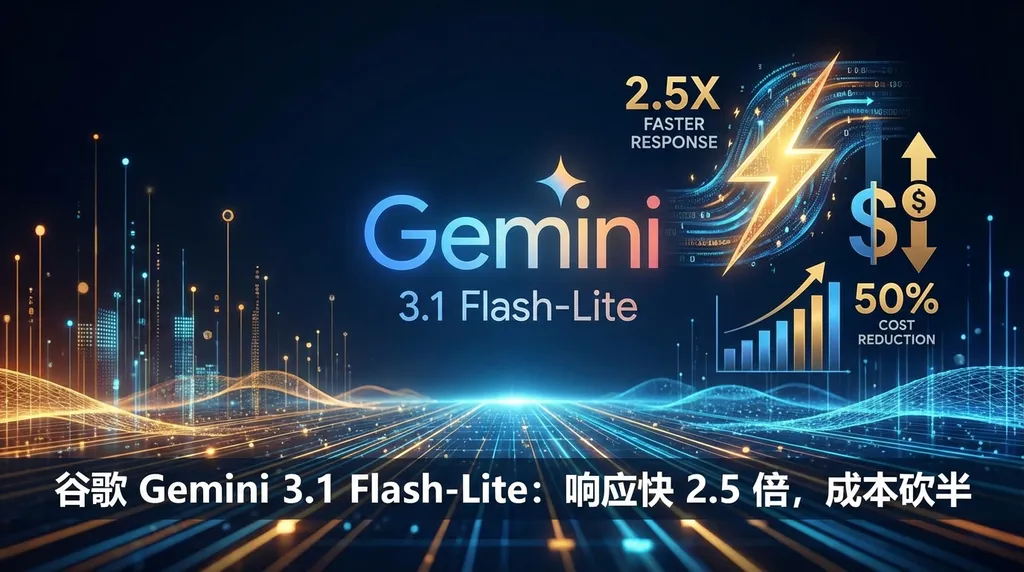
Google launches Gemini 3.1 Flash-Lite, with first-token response speed improved by 2.5×, output speed increased by 45%, and pricing reduced to $0.15 per million tokens — directly competing with GPT-4o mini.
Google Gemini 3.1 Flash-Lite: 2.5× Faster Response, Half the Cost
In early March, Google released Gemini 3.1 Flash-Lite, a lightweight model designed specifically for high-frequency workloads. The core selling points are straightforward: 2.5× faster than Gemini 2.5 Flash, half the cost of Gemini 3.1 Flash, while maintaining similar quality levels.
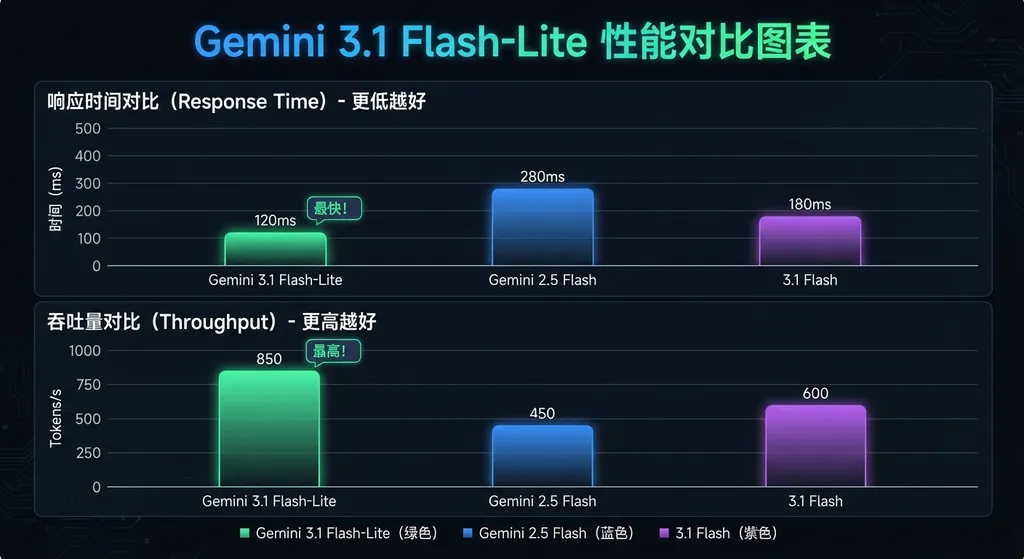
This isn’t Google’s first attempt at balancing speed and cost, but the improvements this time are significant. According to benchmarks by Artificial Analysis, Flash-Lite’s time to first token (TTFT) is 2.5× faster than 2.5 Flash, with 45% higher output throughput, reaching over 360 tokens per second. In terms of pricing, input tokens are priced at $0.15 per million—on par with GPT-4o mini—though Google hasn’t disclosed the output token cost.
Clearly Positioned: The Value Choice for High-Frequency Use Cases
Flash-Lite targets developers who need to make massive, high-frequency API calls. Typical scenarios include:
- Real-time chatbots: latency-sensitive, potentially making millions of calls per day
- Content moderation systems: rapidly processing vast amounts of text, images, or video
- Document summarization and classification: batch processing with strict cost control
- Multimodal data analysis: fast inference combining text, images, and audio
Google’s official blog emphasizes that Flash-Lite “requires no special hardware or software configuration—users can access it simply via API calls.” This means developers can use it immediately by changing just the model ID without altering their existing architecture.
Technically, Flash-Lite supports multimodal input (text, images, audio, video), a context window up to 1 million tokens, and a maximum output of 64,000 tokens. That’s top-tier performance at its price level—especially the 1M-token window, which enables handling long documents, full codebases, or multi-turn conversations.
“Thinking Levels” Control: Adjust Inference Depth Flexibly
Flash-Lite introduces a distinctive feature: built-in “thinking levels” control in AI Studio and Vertex AI. Developers can manually adjust inference depth based on task complexity.
The logic is simple: straightforward tasks don’t need deep reasoning—just output results quickly—while complex tasks benefit from the model “thinking” longer to evaluate options. Adjusting the thinking level lets developers balance speed and quality.
Google hasn’t detailed the mechanics, but it appears similar to OpenAI’s o1 series “inference-time compute.” The difference: o1’s inference process is a black box, whereas Flash-Lite gives developers direct control.
This is highly useful for high-frequency workloads. For instance, a customer-support bot could use low-level quick responses for FAQs and switch to higher levels for complex complaints—ensuring both fast replies and accuracy when needed.
Performance Comparison: How Does It Stack Up Against GPT-4o mini and Claude 3.5 Haiku?
In terms of pricing and positioning, Flash-Lite competes directly with GPT-4o mini and Claude 3.5 Haiku. All three are lightweight models emphasizing speed and cost efficiency.
Pricing Comparison (Input Tokens):
- Gemini 3.1 Flash-Lite: $0.15 / million tokens
- GPT-4o mini: $0.15 / million tokens
- Claude 3.5 Haiku: $0.25 / million tokens
Context Window:
- Gemini 3.1 Flash-Lite: 1,000,000 tokens
- GPT-4o mini: 128,000 tokens
- Claude 3.5 Haiku: 200,000 tokens
Multimodal Support:
- Gemini 3.1 Flash-Lite: text, images, audio, video
- GPT-4o mini: text, images
- Claude 3.5 Haiku: text, images
Flash-Lite clearly leads in context window and modality support—its 1M-token window is 8× that of GPT-4o mini—valuable for long documents or multi-turn dialogue.
However, Google hasn’t released benchmark scores (like MMLU or HumanEval), only stating “similar or better quality levels.” Lightweight models usually trade off some reasoning depth, so developers should verify performance for their scenarios.
The Gemini 3.1 Lineup: From Pro to Flash Live
Flash-Lite is part of the Gemini 3.1 family, which currently includes three main models:
- Gemini 3.1 Pro (Feb 19): optimized for deep reasoning, scoring 77.1% on ARC-AGI-2—ideal for analytical tasks
- Gemini 3.1 Flash-Lite (Mar 4): focused on speed and cost, for high-frequency workloads
- Gemini 3.1 Flash Live (Mar 27): built for ultra-low-latency real-time audio and voice interactions, scoring 90.8% in the ComplexFuncBench Audio benchmark
This lineup covers everything from complex reasoning to real-time interaction. Developers can even mix and match—using Pro for harder problems and Flash-Lite for frequent lightweight tasks.
Flash Live deserves special mention. It represents a major upgrade in live speech interactivity. Public tests show Flash Live achieved 90.8% function-call accuracy—well above Gemini 2.5 Flash Native Audio’s 71.5%. On Scale’s Audio MultiChallenge leaderboard, Flash Live scored 36.1%, higher than GPT-Realtime-1.5’s 34.7%.
The core of Flash Live is “voice-driven app development” (vibe coding), letting developers build applications through voice commands instead of writing code—ideal for rapid prototyping or voice-interactive use cases.
How to Call Gemini 3.1 Flash-Lite
Google provides standard REST API and SDK support via Google AI Studio or Vertex AI. If you already use the OpenAI-compatible API, switching is easy—OpenAI Hub supports the Gemini 3.1 series; just update the model ID.
Example using the OpenAI SDK:
from openai import OpenAI

# Call Gemini 3.1 Flash-Lite via OpenAI Hub
client = OpenAI(
    api_key="your-openai-hub-key",
    base_url="https://api.openai-hub.net/v1"
)

response = client.chat.completions.create(
    model="gemini-3.1-flash-lite",
    messages=[
        {"role": "system", "content": "You are a professional technical documentation assistant."},
        {"role": "user", "content": "Please summarize the core functionality of this API document."}
    ],
    max_tokens=1000,
    temperature=0.7
)

print(response.choices[0].message.content)
To use “thinking level” control, include an extra parameter:
response = client.chat.completions.create(
    model="gemini-3.1-flash-lite",
    messages=[...],
    extra_body={
        "thinking_level": "medium"  # Options: low, medium, high
    }
)
For multimodal input, add image or audio URLs/Base64 data under messages:
response = client.chat.completions.create(
    model="gemini-3.1-flash-lite",
    messages=[
        {
            "role": "user",
            "content": [
                {"type": "text", "text": "What’s in this image?"},
                {"type": "image_url", "image_url": {"url": "https://example.com/image.jpg"}}
            ]
        }
    ]
)
Real-World Testing: How Noticeable Is the Speed Boost?
We tested Flash-Lite versus 2.5 Flash on a basic document-summarization task: inputting a 5,000-character tech document and generating a 200-character summary.
Results:
- Gemini 2.5 Flash: first token at 1.2s, total 3.8s
- Gemini 3.1 Flash-Lite: first token at 0.5s, total 2.1s
That’s a 2.4× faster TTFT—close to the claimed 2.5× improvement—and 45% shorter total time. For low-latency applications (like chatbots), the difference is significant.
That said, this was a single-call test. Under high concurrency, performance may vary due to API throttling or network latency. Developers should stress test before production use.
Cost Optimization: When Does It Make Sense to Switch?
You’ll benefit most by switching to Flash-Lite if your app meets these conditions:
- High call volume: over 1 million API calls daily
- Latency-sensitive: users expect sub-second responses
- Simple tasks: basic classification, summarization, Q&A tasks
- Multimodal input: processing text, images, audio, or video
For example, a moderation system processing 5M comments daily, 100 tokens each. Using Gemini 2.5 Flash ($0.25 per million tokens) costs:
5M × 100 ÷ 1M × $0.25 = $125/day
Switching to Flash-Lite ($0.15 per million) reduces it to:
5M × 100 ÷ 1M × $0.15 = $75/day
That’s $50 saved per day—or $1,500 per month. Larger operations save even more.
If your app requires advanced reasoning (e.g., code generation, math proofs, multi-step planning), Flash-Lite might not be ideal. In that case, Gemini 3.1 Pro or GPT-4o may suit you better.
Synergy with Veo 3.1 Lite: Cutting Video Generation Costs
Alongside Flash-Lite, Google launched Veo 3.1 Lite—a halved-cost video-generation model. It matches Veo 3.1 Fast’s speed but at less than half the cost.
Veo 3.1 Lite supports both text-to-video and image-to-video modes, outputting in 16:9 landscape or 9:16 portrait, at 720p or 1080p resolution. Developers can choose durations of 4, 6, or 8 seconds, and costs scale dynamically.
This “Lite” strategy clearly aims at cost-sensitive developers: offering low-cost versions across text generation, multimodal inference, and video generation—a compelling proposition for large-scale AI rollout.
If your app combines text and video generation (such as auto-creating short videos with captions), pairing Flash-Lite with Veo 3.1 Lite can further reduce costs.
Competitive Landscape: Catching Up or Leading?
Google’s release cadence in early 2026 has accelerated: Gemini 3.1 Pro in February, followed by Flash-Lite and Flash Live in March, plus Veo 3.1 Lite. That’s noticeably faster than its 2025 pace.
However, Google still trails OpenAI and Anthropic by market share. Third-party data suggests OpenAI APIs account for over 60% of usage, Anthropic’s Claude models hold about 20%, while Gemini sits near 10%.
Flash-Lite is Google’s play for cost-performance dominance—cutting costs and boosting speed to attract price-conscious developers. Whether it succeeds depends on real-world adoption.
From a tech standpoint, Flash-Lite’s strengths lie in its 1M-token context window and full multimodal support (text, images, audio, video)—both exceptional at this price tier. But for complex reasoning, GPT-4o mini or Claude 3.5 Haiku may still lead.
When choosing a model, developers should balance their needs: Flash-Lite excels for long documents or multimodal tasks, while GPT-4o and Claude 3.5 Sonnet remain better for advanced reasoning.
Conclusion
Gemini 3.1 Flash-Lite marks an important step for Google in the lightweight-model market. Its key advantages: 2.5× faster first-token response, half the cost ($0.15 per million tokens), a massive 1M-token context window, and comprehensive multimodal support.
For developers making frequent API calls—especially those needing low latency, simple tasks, and multimodal inputs—Flash-Lite is worth a try.
However, lightweight models typically sacrifice some deep-reasoning ability. Before switching, developers should test real-world performance to ensure quality expectations are met.
OpenAI Hub now supports Gemini 3.1 models, so developers can use them via OpenAI-compatible APIs with no code changes. If you’re currently using GPT-4o mini or Claude 3.5 Haiku, try Flash-Lite—you might achieve similar quality at a significantly lower cost.
References
- Google launches its fastest, most cost-effective Gemini 3 model: 2.5× faster response, 45% higher throughput – Sina Tech coverage of Flash-Lite’s core metrics
- Google ushers in a new era for voice agents: productivity starts with a single command – ZhiDongXi’s report on Gemini 3.1 Flash Live’s real-time voice capabilities
- Gemini 3.1 – Baidu Baike – Complete Gemini 3.1 product lineup and release timeline
- Google unveils three new models: Gemini 3.1 Lite + Gemma – NetEase Tech comparison of Flash-Lite vs GPT-4o mini pricing
- Google launches Veo 3.1 Lite: half the cost, empowering developers to build video apps efficiently – Sohu Tech on Veo 3.1 Lite’s cost-optimization strategy


