
The Codex free quota reset period has quietly changed from 7 days to 30 days.
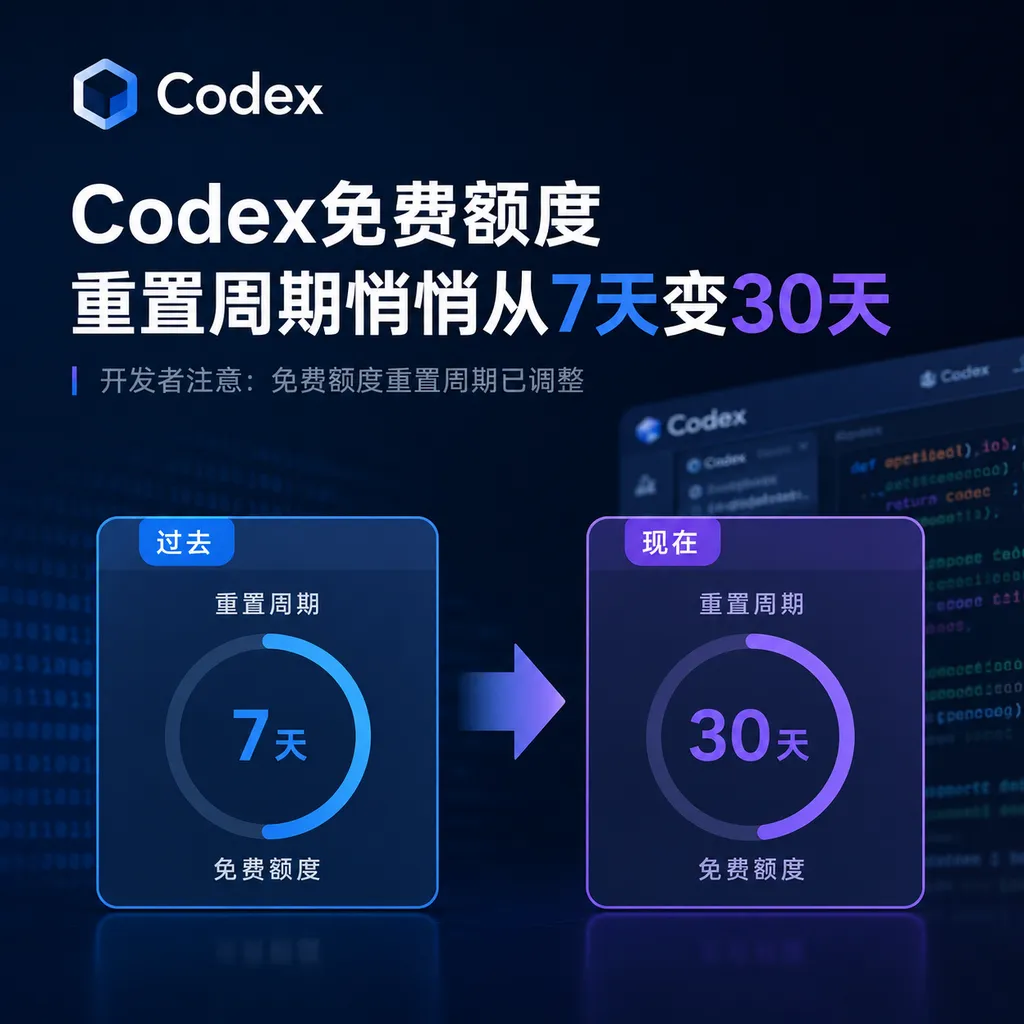
OpenAI recently changed the quota reset cycle for Codex free accounts from once per week to once per month, while the Team version still resets every 7 days. The developer community exploded — with the same quota pool, the recovery rate is now four times slower, making it basically impossible to keep enjoying the free usage loophole.
Woke Up to Find the Free Codex Faucet Tightened
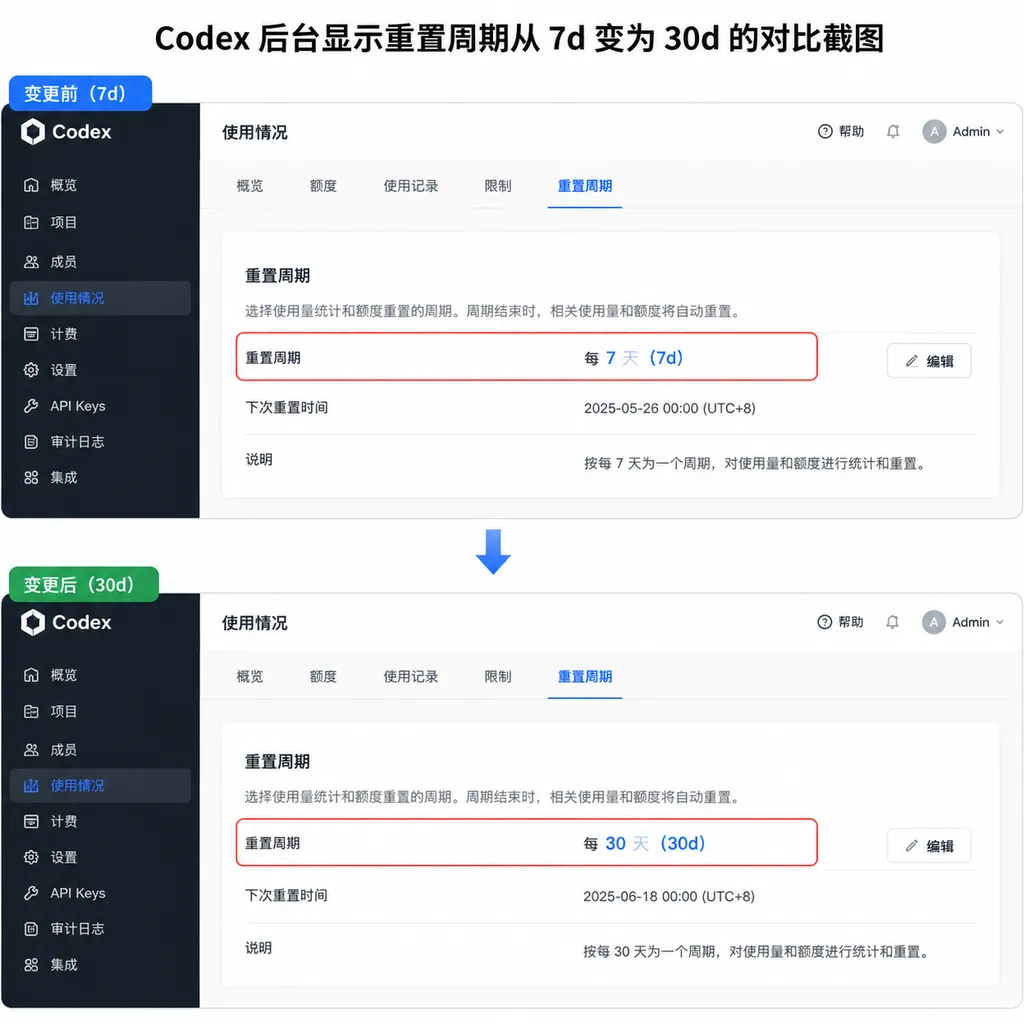
In the past couple of days, several posts popped up almost simultaneously on linux.do: when users checked the sub2api dashboard, they noticed that the credit reset period for free Codex accounts had changed from 7 days to 30 days. Team accounts remain unchanged and still refresh weekly.
OpenAI didn’t announce this change officially — users figured it out themselves. Someone noticed their quota hadn’t refreshed this week, checked the backend, and saw the next reset scheduled for the following month. A simple calculation: before, you could fully use up your quota once a week, four times a month; now it’s only once a month. The quota cap hasn’t changed, but the refill cycle is now four times longer. For those who rely on the free plan to run small scripts or daily coding agent tasks, this feels like the rug has been pulled out from under them.
When Did This Happen Exactly?
The timeline stretches back a bit. Looking through Reddit’s r/codex, discussions about “weekly limits” behaving strangely started early this year — sometimes resetting early, sometimes late. Some thought it was a compensatory reset after OpenAI outages; others guessed there was a metering bug.
But starting this week, the community’s feedback changed direction — from “why did my reset come early” to “why didn’t my reset come at all.” Multiple users in different time zones and on different accounts verified the same result: Free users’ next reset time had all been postponed to 30 days later.
A few key observations:
- Team accounts unaffected: Paid Team plans still reset every 7 days. This suggests OpenAI intentionally differentiated the tiers, not a global bug.
- Quota cap unchanged: The reported quota amount per reset is the same as before — only the recovery interval slowed down.
- No advance notice: There was no official update or tweet. This kind of “silent adjustment” is typical for OpenAI’s Codex product; based on multiple past changes this year, they seem to prefer acting first and watching the community reaction later.
Why Is OpenAI Doing This?
It’s not hard to guess. Since Codex was integrated with ChatGPT subscriptions last year, free-tier abuse has been rampant. A single ChatGPT account gives one free Codex quota, and with relay services and tools like sub2api, the free quota can be pooled and mass-used — an open secret among developers in China.
For OpenAI, running the free tier costs real GPU cycles. Codex runs agentic coding, not simple chat — single tasks can easily burn tens or hundreds of thousands of tokens. Weekly resets for free users basically meant giving away four times per month. Extending the reset period to 30 days cuts that cost down to one quarter with a single move, without touching the quota number or triggering negative publicity from an explicit “downgrade.”
It’s a typical “boil the frog slowly” approach: on paper, your quota is the same, but in practice, your usable access drops drastically.
What This Means for Developers
Depends on who you are.
Pure freebie users: Essentially done for. If you rely on free Codex for daily scripts, completions, or small refactors, now you only get one go per month — you’ll need alternatives for the other 29 days.
Light individual developers: If you could stretch things weekly before, now you’ll need to do the math. Either strictly manage token usage — don’t have Codex refactor an entire repo when a patch will do — or prepare to pay for Plus or Team.
Old rhythm: Monday full → Friday depleted → Sunday reset → repeat
New rhythm: 1st full → 5th depleted → wait until next 1st → 25-day gap
Heavy users and teams: You’re already on Team/Enterprise; this change doesn’t affect you.
Those using aggregator platforms: If you’re accessing Codex through aggregator services like OpenAI Hub (behind models such as gpt-5-codex or o-series), that usage is billed by API tokens and unaffected by the free-tier reset cycle. Pay-per-token rules haven’t changed. That’s why many teams prefer the API route anyway — the billing is consistent and predictable.
Community Reaction: From “Last Supper” to “Time to Pay Up”
One linux.do user put it vividly: “Feels like we’re eating our last meal.” The analogy hits — it’s not a full cutoff, but you’re left with scraps and have to starve for a month.
Some rational voices in the discussion noted that OpenAI would eventually tighten the free tier. After all, Codex isn’t a chat product like ChatGPT, which can offset costs through engagement or growth; it’s a compute-heavy developer tool. Anthropic’s Claude Code has long dropped any real free tier, Cursor’s free quota got cut multiple times — OpenAI’s follow-up was only a matter of time.
But the community’s core frustration isn’t with the tightening, it’s with the lack of transparency:
- No announcement — users had to find out themselves
- No grace period — the change took effect immediately
- Official docs remain unupdated
This approach hurts developer relations. Codex’s reputation this past year has been positive, driven by the “OpenAI finally made a proper coding agent” narrative. If quota rules keep shifting without communication, migration to Claude Code or local solutions (like Aider + DeepSeek or Qwen Coder) isn’t that costly anymore.
Coping Strategies
If you still want to use Codex but aren’t ready to pay right away, consider the following:
- Refine task granularity: Break “refactor this module” into multiple smaller, specific tasks to avoid uncontrolled token spending.
- Disable unnecessary reasoning: Codex’s default reasoning budget is high — wasteful for simple tasks. Check
~/.codex/config.tomlformodel_reasoning_effort; lower it if possible. - Use local models as fallback: For small completions or comment generation, a local Qwen2.5-Coder 32B is plenty. Save Codex quota for truly complex agentic tasks.
- Switch to API billing: If your workflow depends on Codex, it’s better to use the paid API instead of struggling on the free tier. Aggregators like OpenAI Hub let you use GPT, Claude, and Gemini under one API key and auto-switch if Codex is rate-limited — saving the trouble of using proxies.
Final Thoughts
The real impact of this change is limited — most frequent Codex users already pay. The free tier was never OpenAI’s core business focus. But the message is clear: the free lunch for AI coding agents is ending.
In 2025, everyone’s still competing with subsidies to win developer mindshare and market share through free quotas. By 2026, the financial pressure on model companies will ramp up. OpenAI is extending Codex reset cycles; Anthropic is quietly tightening Claude Code’s Max plan limits; Cursor is pushing free users onto cheaper models via Auto mode. Free users’ good days are indeed numbered.
For developers, the reality is simple: either subscribe, pay per use via API, or go local. The window for “milking free credits for productivity” is closing — fast.
References
- linux.do - Codex Free Account Now Resets Every 30 Days? – Original sub2api backend observation
- linux.do - Codex Free Users’ Reset Cycle Extended – Cross-user verification of cycle change
- linux.do - Questions About Codex Free Account Quota – “Last meal” discussion thread
- Reddit r/codex - Weekly Limit Reset Early Again – Early community observations of reset anomalies
- Reddit r/codex - Understanding Codex Weekly Limit Reset – Community analysis of quota mechanics


