
Google Gemini Spark Launch: The First Truly 24/7 Online AI Agent
At I/O 2026, Google launched its first consumer-grade persistent AI agent—**Gemini Spark**. Even if you turn off your device, it can keep working in the cloud. Its real-world performance is impressive, but the subscription cost and privacy trade-offs are equally significant.
Google Turns Its AI Agent into an “Always-On Employee”
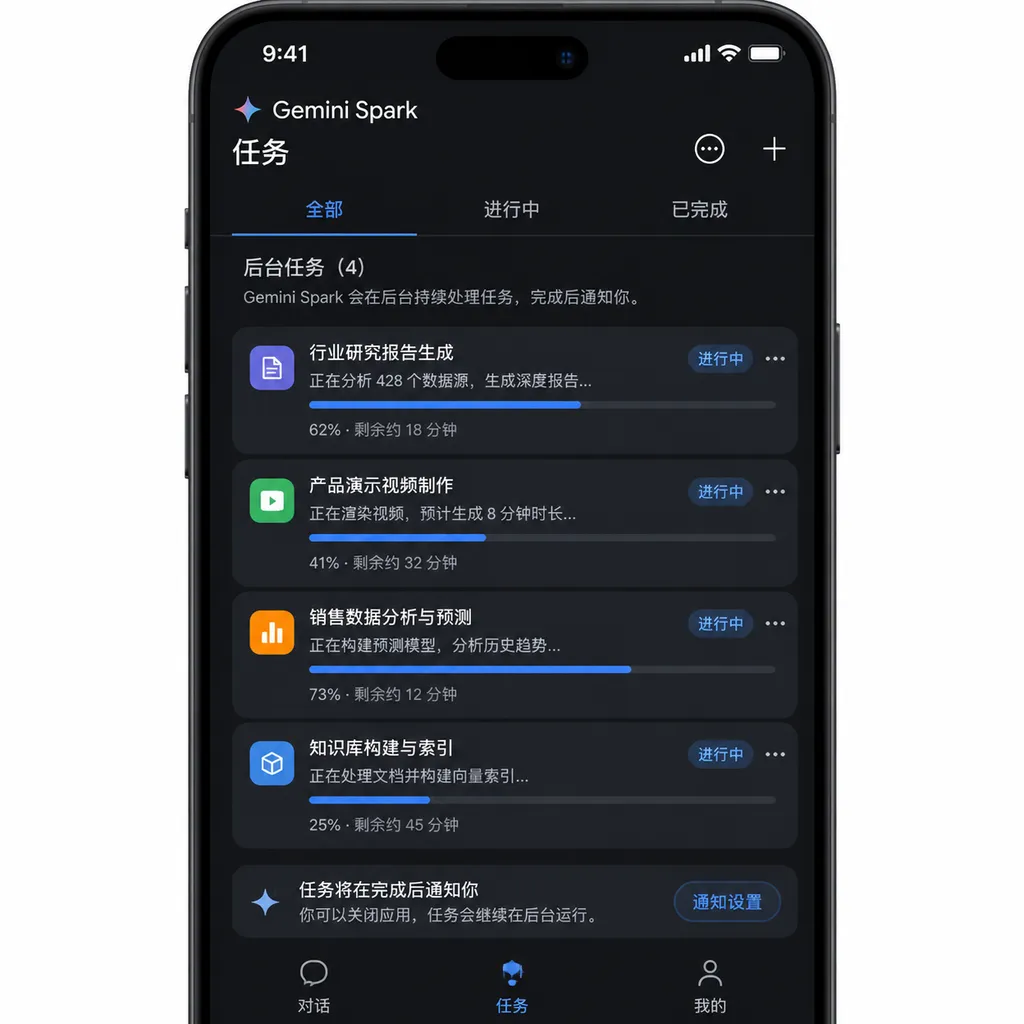
At the Google I/O 2026 keynote on May 19, Google officially released Gemini Spark — its first consumer-facing “always-on” AI Agent. Simply put, when you shut down and leave, it continues working for you in the cloud.
This is more important than it sounds. For the past two years, most so-called AI Agents have been “session-level”: you open a chat window, assign a task, wait for it to finish, and then close the window. OpenAI’s Operator, Anthropic’s Computer Use, and Google’s early Project Mariner all follow this paradigm — they are “invoked” tools, not “on-duty” assistants. Gemini Spark is the first product to cross that boundary.
According to The Verge, which got hands-on access last week, Spark can handle multi-step tasks: sorting your inbox, booking restaurants, comparing prices, organizing schedules — all running like a real personal assistant in the background. The key difference: you don’t need to watch it.
From Codename Remy to Gemini Spark
This product has actually been in development for at least a year. Internally, it was codenamed Remy, inspired by the mouse from Ratatouille who hides under the chef’s hat and orchestrates the kitchen — a neat metaphor: it works behind the scenes, and you barely notice it.
Sometime overnight between May 13 and 14, the name “Remy” quietly disappeared from the Google app beta, replaced with “Gemini Spark.” 9to5Google’s APK Insight first spotted the change, and a leaked onboarding screenshot from an X user confirmed it — just five days before the I/O keynote.
Naming-wise, Spark feels lighter than the previously rumored Gemini Agent. The word “Agent” had become ubiquitous by 2026 — almost every tech giant was building one, dulling its meaning. “Spark” implies ignition and initiative, aligning with the product’s “proactive” positioning — a clever marketing move.
Tech Stack: Gemini 3.x Custom Variant + Enhanced Vision
The beta model selector reveals some underlying details:
- Base model: A custom variant of Gemini 3.x, optimized for long-duration tool use and multi-step “thinking.” This means it isn’t just calling the universal Gemini API, but rather using a specially trained checkpoint for agent-specific tasks.
- Vision model: Internally called Spark Robin, dedicated to interpreting screenshots, PDFs, and complex web forms during browsing sessions. This is crucial—“understanding the page” is the hardest part in long tasks. Past agents often got stuck there—like when booking flights with strange pop-ups or verifying captchas.
- Runtime location: It’s still unclear whether Spark runs entirely in the cloud. Given the core selling point of “24/7 operation,” cloud deployment is inevitable; but Google may reserve a local component for the next-gen Googlebook (pitched as the Chromebook successor with built-in Gemini Intelligence).
Another noteworthy detail: Spark will likely be integrated with DeepMind’s Magic Pointer — the project that redefines the mouse cursor through Gemini. Both target an “AI-first interaction paradigm” and share technical roots.
# Example of calling Gemini Spark via OpenAI Hub (compatible with OpenAI format)
from openai import OpenAI

client = OpenAI(
    api_key="your-openai-hub-key",
    base_url="https://api.openai-hub.net/v1"
)

# Start a background long-running task
response = client.chat.completions.create(
    model="gemini-spark",
    messages=[
        {"role": "system", "content": "You are a persistent agent. Continue tasks across sessions."},
        {"role": "user", "content": "Monitor my inbox, archive invoice emails automatically, and extract amounts into a spreadsheet"}
    ],
    extra_body={
        "agent_mode": "persistent",
        "max_steps": 50,
        "require_confirmation": ["purchase", "send_email"]
    }
)

print(response.choices[0].message.content)
Field Test: Impressive, but Not Cheap
The Verge’s reporter got access to Spark last week and described it as “shockingly good at doing things on your behalf.” Multi-step tasks, app switching, waiting flows (like pausing until a reply email arrives) all ran smoother than expected.
But the journalist also cooled the hype: It’s unclear whether the financial cost and privacy trade-off are worth it.
Both concerns are valid:
1. The price is unannounced—but it won’t be cheap. A 24/7 agent running in Google Cloud, connected to 30+ apps, is a constant compute drain. Whether billed monthly or by token, pricing will likely exceed Gemini Advanced’s current $19.99 tier. Industry estimates suggest $40–$60 per month would be reasonable.
2. Privacy permissions are the core conflict. For Spark to be truly useful, it must access your email, calendar, payment, and shopping accounts—its “initiative” depends on that. But Google’s track record on data use has always been murky. Spark’s website prominently claims, “Always under your command,” “Only activated by you,” and “Major actions confirmed with you”—language that, ironically, reveals just how concerned users are.
Regulatory Red Zone: What About the EU AI Act?
Google’s Spark terms of service include a critical statement: “Spark is not intended for use in medical, legal, financial, or other professional advisory contexts.”
That’s not just a disclaimer. The EU AI Act will fully take effect on August 2, 2026, classifying AI systems making autonomous decisions in finance or healthcare as “high-risk.” An agent that completes purchases without explicit confirmation sits right on that line.
Expect the EU version of Spark to be more restricted than the US version — likely removing auto-shopping and auto-pay features, requiring manual confirmation for more actions. Regional differentiation has already happened before — in GPT-4o’s voice features and Meta AI’s training data usage — and Spark extends it to the agent level.
How It Differs from Competitors
A quick comparison of today’s agent products:
| Product | Type | Persistent Operation | Connected Apps | |----------|------|----------------------|----------------| | OpenAI Operator | Browser agent | No, session-level | Generic web | | Anthropic Computer Use | Desktop agent | No, session-level | Generic desktop | | Microsoft Copilot Agents | Embedded | Partially persistent | M365 ecosystem | | Gemini Spark | Cloud persistent | Yes, 24/7 | 30+ apps |
Spark’s differentiation is clear: “On duty,” not “on call.” This marks a leap in product positioning, not just functionality.
But that distinction also has a fragile side. The hardest part of a persistent agent isn’t technology—it’s trust. You must hand over your email, calendar, and credit cards, assuming it won’t misuse them. OpenAI was deliberately cautious with Operator, requiring confirmation for each step; Anthropic framed Computer Use as a “developer preview,” emphasizing experimentation. Google’s move to launch a consumer-grade persistent agent is bolder—but the cost of failure is higher.
What It Means for Developers
Several trends to watch:
- Agent orchestration frameworks will heat up. With Spark, engineering topics like multi-step task scheduling, long-term memory, and cross-session context management will move from research into production. Frameworks like LangGraph and CrewAI are poised for a demand boost.
- “Tool calling” standards will be revisited. Spark connects to 30+ apps; Google likely has its own tool-calling spec. That will enter a triangle with Anthropic’s MCP and OpenAI’s Function Calling — potentially shaping a new de facto standard.
- Local agent opportunities are shrinking. If Spark’s cloud model works, it’ll be harder for on-device agent products to justify their value—unless they play the “data never leaves device” privacy card.
OpenAI Hub already supports unified access to Gemini-series models: one key switches between GPT, Claude, Gemini, DeepSeek, etc., all OpenAI-format compatible and accessible from China. Once Spark’s API opens, it will likely be supported right away.
Final Thoughts
Gemini Spark is 2026’s most ambitious product so far. It’s not about bigger parameters or higher benchmarks—it’s about a shift in form: turning AI from a “tool” into an “on-duty employee.”
But it also concentrates every contradiction:
- More capability means more power, hence more risk
- The more “persistent” it is, the harder it is to avoid regulation
- The more “autonomous” it becomes, the greater the demand for transparency
The Verge’s observation—“not sure it’s worth it”—might sum up how most ordinary users felt after the keynote. Whether Spark can move from “demo wow” to “daily reliance” will depend on how Google lands pricing, EU versions, and privacy safeguards in the next three months.
The AI Agent war officially starts today.
References
- Reddit Discussion: Google I/O 2026 Gemini Spark Launch — Real-time community reactions and hands-on tests of Spark
- Hugging Face Model Hub — Google’s official model repositories on Hugging Face; track Gemini’s future open-source developments


