
Microsoft’s self-developed reasoning model MAI-Thinking-1 to debut tomorrow at Build 2026

At the Build 2026 event in the early hours of June 3, Microsoft will release its first self-developed reasoning model, **MAI-Thinking-1**, along with the **MAI-Image-2.5** series of image generation models. The **Copilot super app** is also coming to light.
Microsoft’s Self-Developed Reasoning Model MAI-Thinking-1 to Debut at Build 2026 Tomorrow, Alongside Copilot Super App
Microsoft is finally putting its own reasoning model on stage.
According to a report from The Verge on June 1, at the Build 2026 conference scheduled for 12:30 a.m. Beijing time on June 3, Microsoft’s AI division (MAI) will officially launch MAI-Thinking-1—the company’s first self-developed reasoning model. The leak also highlighted an important detail: it was not trained via distillation from other models’ outputs. That line carries a lot of weight, which we’ll unpack below.
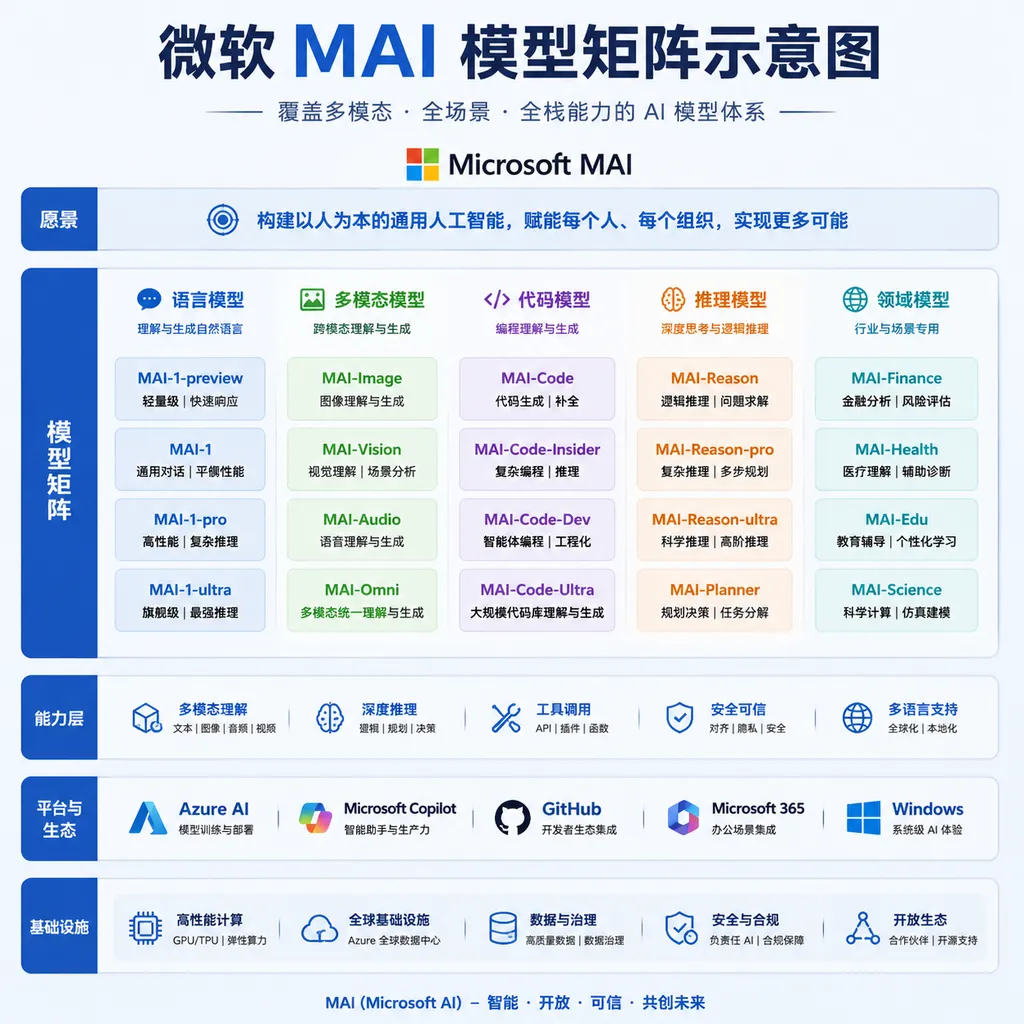
Also debuting are two image-generation models: MAI-Image-2.5 and MAI-Image-2.5-Flash. Combined with last August’s MAI-Voice-1 speech model and the MAI-1-preview foundation model, Microsoft’s four-piece self-developed model puzzle—foundation, speech, image, and reasoning—is now complete.
Why This Launch Is Worth Close Attention
Over the past few years, Microsoft’s position in AI has been somewhat conflicted. On one hand, it’s OpenAI’s biggest investor and client, running GPT‑4 and GPT‑5 inside Copilot. On the other, since Mustafa Suleyman joined from Inflection in 2024 to lead MAI, the team has been quietly building its own models.
When MAI-Voice-1 and MAI-1-preview launched last August, Suleyman wrote a telling line on the blog: “We will continue to use the best models from our team, from our partners, and from the open-source community to power our products.” In plain terms: OpenAI will still be used, but we’re not betting everything on that one tree.
MAI-Thinking-1 marks the most critical step in this strategy. Reasoning models are the main battleground of the current large-model race. OpenAI’s o-series, Anthropic’s Claude “think” mode, DeepSeek-R1, Gemini’s Deep Think—all major players have a reasoning model capable of tackling math, code, and long-chain tasks. Any company without one can’t compete in enterprise Agent scenarios. If Microsoft wants Copilot to function as an end-to-end Agent, it needs its own reasoning backbone—otherwise, it remains tethered to OpenAI.
The Significance of “No Distillation”
The phrase “no distillation from other model outputs” is immediately meaningful to industry insiders.
Training reasoning models is extremely expensive. The cheapest shortcut is to take the chain-of-thought outputs from models like OpenAI’s o1/o3 or DeepSeek-R1 and use them as data for supervised fine-tuning or rejection sampling. After DeepSeek-R1’s release, dozens of “reasoning models” appeared overnight—most trained exactly this way. It’s a fast route to a usable product, but with one major limitation: the model’s ceiling is fixed by the capabilities of the distilled source. There are also legal gray areas—OpenAI’s terms of service explicitly prohibit using its outputs to train competing models.
Microsoft’s emphasis that MAI-Thinking-1 is not distilled suggests two things:
- Its capability ceiling isn’t capped. A reasoning model trained from scratch could theoretically surpass the model it would have been distilled from, or at least won’t be inherently constrained by it.
- It reflects Microsoft’s relationship with OpenAI. Microsoft still uses OpenAI models, so distilling from its own investee’s outputs would be problematic both contractually and publicly. Training from scratch keeps this new product line legally clean, leaving no baggage if Copilot eventually reduces OpenAI’s share inside the system.
Of course, whether the “no distillation” claim holds true will only be verified once the model is released—through benchmarks and fingerprint analyses. The earlier OpenAI–DeepSeek distillation accusations are still fresh in everyone’s memory.
MAI Completes Four Modalities in a Year
Looking at the timeline, MAI has moved remarkably fast over the past year:
| Date | Model | Type | Notes | |------|--------|------|-------| | 2025.8 | MAI-Voice-1 | Speech generation | Generates 1 min of audio in 1 second on a single GPU; already in Copilot Daily | | 2025.8 | MAI-1-preview | Base text model | 500 B‑parameter class, comparable to GPT‑4‑level models | | 2026.6 | MAI-Image-2.5 / 2.5-Flash | Image generation | Standard + fast dual SKUs | | 2026.6 | MAI-Thinking-1 | Reasoning | First self-developed reasoning model, non-distilled |
Jumping straight to Image 2.5 suggests at least one or two internal iterations happened beforehand. The “Flash” naming clearly borrows from Gemini—same core model, different performance tiers: one optimized for quality, one for speed and cost—aligning with Copilot’s dynamic model routing strategy across scenarios.
Together, these releases give Microsoft its first complete, independent model stack. This doesn’t mean OpenAI gets dropped immediately, but internally, Copilot can route tasks more flexibly: routine queries to MAI‑1, text‑to‑image to MAI‑Image‑2.5‑Flash, complex reasoning to MAI‑Thinking‑1, and only the toughest problems to GPT‑5. From a cost and latency standpoint, that’s great news for Microsoft’s financials.
The Emergence of the Copilot “Super App”
Another noteworthy change is Copilot’s format. Screenshots leaked by Fortune last week show Microsoft merging its scattered AI assistants—Microsoft 365 Copilot, Copilot Chat, and various agents in Copilot Studio—into a unified entry point. The images also reference a new Scout AI agent.
Sources clarified that the screenshots are just prototypes for Build 2026 demos, with the beta expected later in the summer. Still, the direction is clear: Microsoft doesn’t want to maintain a bunch of isolated “Copilot”-branded products. It aims to build a unified shell incorporating Agents, Chat, document collaboration, and voice interaction.
This mirrors OpenAI’s consolidation of GPTs, Operator, Canvas, and Sora into ChatGPT, as well as the “super app” trend seen at ByteDance and Alibaba. A “super app” in this context is essentially an intelligent-agent orchestration hub, and its foundation layer is the self-developed MAI model matrix. Within that architecture, MAI‑Thinking‑1 will likely act as the “what-to-do-next” decision-maker—the brain of the Agents.
The “Scout” name itself is interesting: it has appeared in past Microsoft internal codenames related to browsing and search enhancement, so pairing it with Bing’s data base for real-time information retrieval would make sense.
Outstanding Questions
Before Build 2026 kicks off in the early hours, several key questions remain:
- Model size and context length: MAI‑1‑preview reportedly has 500 B parameters with an MoE structure. If the reasoning model uses similar architecture, its active parameters are likely in the tens of billions. For context length, Microsoft Research this year published LongRoPE2, extending LLaMA3‑8B to 128 K tokens while retaining 98.5 % short‑context performance—technology likely reused here.
- Public API or Copilot‑only? MAI‑1‑preview was only tested publicly via LMArena, not a full API release. If MAI‑Thinking‑1 remains Copilot‑exclusive, outside impact will be limited; if it’s offered through Azure AI Foundry, that would mark its real entry into the reasoning‑model market.
- Relationship with OpenAI: Microsoft already has access to GPT model weights, but commercial competition between the two is intensifying. Suleyman’s messaging at Build 2026 may matter more than the model itself.
- Benchmark selection: Reasoning models are now judged by AIME, GPQA Diamond, SWE‑bench Verified, and Codeforces scores. If Microsoft only shares proprietary benchmarks and omits these mainstream ones, skepticism will follow.
What It Means for Developers
For developers, MAI‑Thinking‑1 will only become practically usable once a few conditions are met:
- It’s released on Azure AI Foundry with a reasoning API
- It appears in Copilot Studio’s model‑selection list (which currently includes GPT‑5.5 Reasoning, Claude Sonnet 4.6, Claude Opus, and others)
- It’s integrated into GitHub Copilot’s model‑switching menu
Microsoft Copilot Studio’s pace has clearly picked up in recent months—from GPT‑5’s full rollout, to officially adding the Claude series, and now to internal models. For enterprise users, more choice means more complexity: deciding which model to use for which task becomes an ongoing optimization challenge. That’s also why model‑orchestration tools are suddenly in demand.
Incidentally, OpenAI Hub’s single‑key access to major closed‑source models has proven convenient in a multi‑model world. If MAI models open APIs in the future, we can expect them to be integrated there quickly.
Conclusion
MAI‑Thinking‑1 isn’t Microsoft’s first self‑developed model, but it’s the most crucial piece of its in‑house strategy. Speech and image can rely on partners or open source, but owning the reasoning model means Copilot finally gets a true “proprietary brain.”
Tomorrow’s Build 2026 isn’t just about a new model—it’s about how Microsoft explains its rationale: as OpenAI’s biggest backer, why build its own from scratch? The answer is likely already written in Suleyman’s notebook: in the AI race, no one wants to leave their fate in someone else’s hands.
References
- Microsoft’s first self-developed reasoning AI model MAI-Thinking-1 and new Copilot Super App exposed - IT Home — IT Home leak covering MAI‑Thinking‑1 and Copilot Super App screenshots


