
OpenAI Models Land on AWS Bedrock: GPT-5.5, 5.4, and Codex Now Available
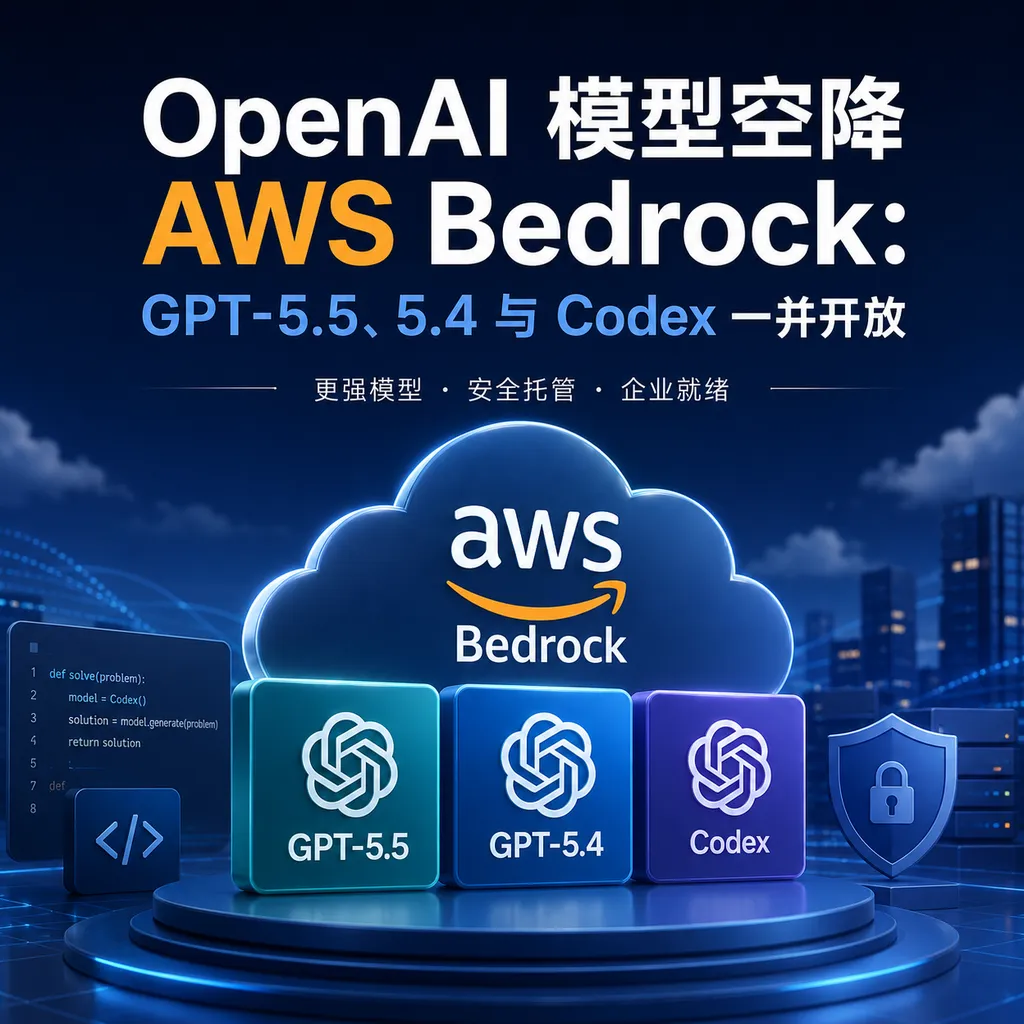
On June 1, AWS officially announced that OpenAI’s GPT-5.5, GPT-5.4, and Codex have launched on Amazon Bedrock, with pricing aligned to OpenAI’s own rates and no additional markup. This marks the first time OpenAI’s closed-source flagship models have been natively integrated into the AWS ecosystem.
On June 1, two new lines quietly appeared in the AWS Bedrock model catalog: openai.gpt-5.5 and openai.gpt-5.4. Along with the simultaneously launched Codex (limited preview) and Bedrock Managed Agents powered by OpenAI models, this marks the first time OpenAI’s closed-source flagship models have natively entered the AWS ecosystem—not through a third-party proxy or Azure detour, but directly behind Bedrock’s API.
For enterprise customers, the symbolic significance of this move outweighs its technical meaning. For the past two years, “OpenAI models can only be reliably used on the cloud through Azure OpenAI Service” was an almost universal rule. AWS customers wanting to use GPT either had to connect directly to the OpenAI public API (which raised compliance and VPC peering issues) or go through a third-party aggregator. Now AWS has opened up a direct route—and the most notable detail is that the OpenAI models on Bedrock are priced exactly the same as OpenAI’s own API, with no markup from AWS.
What’s Actually Included This Time
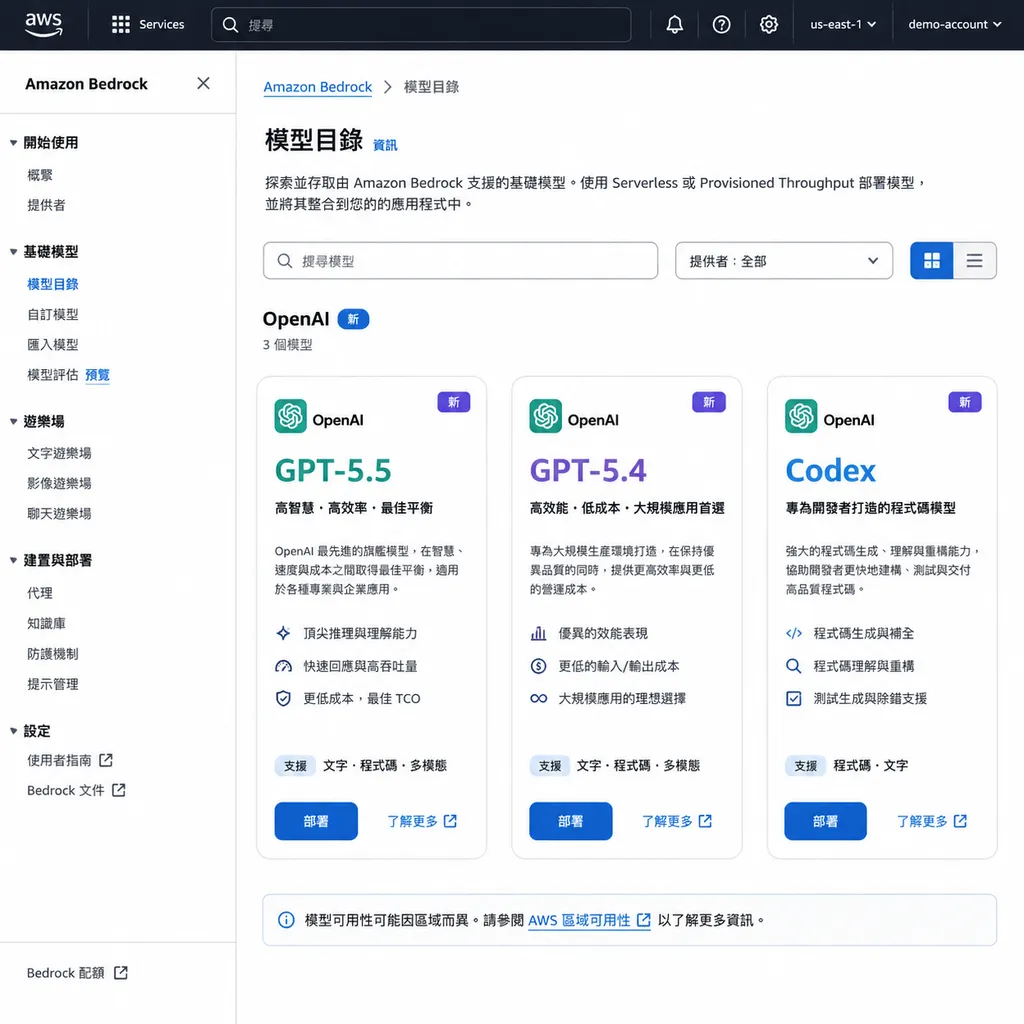
This release bundles together three components:
1. OpenAI models on Bedrock: Currently includes OpenAI’s most advanced frontier models, GPT-5.5 and the more cost-effective GPT-5.4. Both are accessible through standard Bedrock InvokeModel / Converse APIs and leverage AWS’s full stack of existing security and audit systems (IAM, KMS, CloudTrail, etc.). AWS also provides two paths—Mantle and Runtime. Mantle is AWS’s new low-latency endpoint, optimized for tool use and long-context scenarios.
2. Codex on AWS: Codex is OpenAI’s advanced programming platform and product suite. This integration allows Codex to use OpenAI models hosted on Bedrock as its backend—configuration-wise, it simply points Codex’s provider to Bedrock. The launch supports Codex CLI, the Codex desktop app, and the VS Code extension. Customer data is entirely handled by Bedrock. Qualified customers can even count Codex usage toward their AWS committed spending agreement (EDP), which is crucial for enterprises with large AWS contracts—effectively granting them a discount.
3. Bedrock Managed Agents powered by OpenAI: AWS is turning Agent orchestration into a managed platform, powered by OpenAI models for reasoning. Developers no longer need to handle orchestration, tool-calling, memory, or guardrails—Bedrock does it. The goal is to shorten the gap between “can run a demo” and “can run in production.”
Price Alignment—What It Means
The simple statement “priced the same as OpenAI” sounds trivial, but for those familiar with cloud business models, it’s a remarkable concession.
Cloud vendors that resell upstream APIs typically add a markup—Azure OpenAI Service did so early on, justifying it with “enterprise-grade SLA + data residency.” AWS’s decision not to markup means it’s treating Bedrock as a zero-margin distribution channel. The motivation is clear: AWS has been outplayed by Azure for two years in the generative AI race thanks to OpenAI exclusivity. Its own Titan models haven’t taken off, and while Anthropic is an AWS partner, that only covers half the table. By onboarding OpenAI, AWS aims to retain enterprise customers who had to run a “second cloud” just to get GPT access. Giving up the markup is worth it for that.
OpenAI’s reasoning is equally clear: AWS holds roughly one-third of the global public cloud market, hosting massive enterprise workloads. These customers already have compliance, billing, and audit pipelines built into AWS. Forcing them to “hook up a separate cloud just for one model” is friction. Entering Bedrock directly pipes OpenAI models into those existing workflows.
What It Means for Developers
From an engineering perspective, these changes are concrete:
- Data residency and compliance: When calling GPT-5.5, requests and responses stay within your selected AWS region—in-region traffic only. For sectors like finance, healthcare, and government where data sovereignty matters, this is a truly viable setup.
- IAM instead of API keys: Authentication is handled through AWS IAM roles and policies—no need to manage separate OpenAI API keys, rotations, or revocations. This is a relief for large security teams.
- Unified billing: Usage appears directly on your AWS bill and counts toward EDP commitments. Finance teams no longer have to handle separate OpenAI credit card billing.
- Codex via Bedrock: For engineering teams already using AWS for CI/CD, integrating Codex through Bedrock is much simpler than OpenAI’s public API. The VS Code extension and CLI are already supported.
Some caveats: Codex on Bedrock and Managed Agents are both limited preview for now, requiring an application process. Regional coverage is limited; according to AWS docs, it’s currently only available in us-east-1, us-east-2, and us-west-2. Asia-Pacific support is coming later. AWS China regions (Beijing, Ningxia) have no related information, and historically, there’s virtually no chance that OpenAI models will arrive in China regions soon.
Choosing Between GPT-5.5 and 5.4
GPT-5.5 is OpenAI’s flagship frontier model—best for long-context reasoning and complex Agent tasks. GPT-5.4 is essentially the previous-generation flagship repurposed for everyday workloads—lower latency and cheaper per-token pricing, making it more economical for high-concurrency or latency-sensitive use cases (customer support, RAG, batch content processing).
A practical selection strategy: start with 5.5 to get optimal task performance, then downgrade to 5.4 if possible. Don’t start the other way around, because when 5.4 fails, you may not be able to tell if it’s due to prompt design or model capability.
Example Invocation
If you already have Bedrock access, calling GPT-5.5 is straightforward using the standard Bedrock Converse API:
import boto3

client = boto3.client("bedrock-runtime", region_name="us-west-2")

response = client.converse(
    modelId="openai.gpt-5.5",
    messages=[
        {
            "role": "user",
            "content": [{"text": "Explain the core idea of MoE architecture in one paragraph"}],
        }
    ],
    inferenceConfig={
        "maxTokens": 1024,
        "temperature": 0.7,
    },
)

print(response["output"]["message"]["content"][0]["text"])
For developers who don’t want to be locked into the Bedrock SDK or who want cross-model compatibility (Claude, Gemini, DeepSeek, etc.), there’s the OpenAI Hub—a unifying layer offering a single API key for all mainstream models, fully OpenAI-compatible, and directly accessible from China:
from openai import OpenAI

client = OpenAI(
    api_key="your-openai-hub-key",
    base_url="https://api.openai-hub.net/v1",
)

resp = client.chat.completions.create(
    model="gpt-5.5",
    messages=[
        {"role": "user", "content": "Explain the core idea of MoE architecture in one paragraph"}
    ],
)
print(resp.choices[0].message.content)
The two approaches differ mainly by target audience:
Bedrock suits enterprise teams fully invested in AWS wanting end-to-end IAM/VPC/CloudTrail integration;
aggregation layers suit developers and small teams aiming for multi-model comparison, fast prototyping, and vendor independence.
A Hidden Detail: Codex Counts Toward AWS Commitments
One detail buried in the announcement may actually be more valuable than the headline.
Large enterprises sign EDP (Enterprise Discount Program) contracts with AWS, promising to spend a certain multi-million-dollar amount over several years in exchange for discounts. Unused commitments are wasted spend. Allowing Codex usage to count toward that commitment means for EDP customers, using Codex effectively costs “no new money.”
That’s a powerful lever for OpenAI to compete with GitHub Copilot in the enterprise coding space.
Copilot, backed by Azure and GitHub, has long dominated enterprise channels. Codex entering AWS’s committed-spend pipeline punches directly into Copilot’s stronghold.
The Bedrock Agent Game
The Managed Agents play deserves long-term attention. AWS aims to sell not just model tokens but a full Agent runtime—covering orchestration, tool use, state management, and security guardrails—as a managed service. OpenAI provides the reasoning brain, AWS provides the enterprise-grade operational body.
This approach directly aligns with Anthropic’s Claude Agent SDK strategy, though with a key difference: Anthropic focuses on the SDK + developer flexibility route, while AWS emphasizes “fully managed, deploy from console in a few clicks.” Different customer profiles: enterprises building backend, support, or internal tools may prefer the managed route; product teams seeking flexibility will prefer the SDK route.
Unanswered Questions
This release still leaves a few open points:
- Rate limiting: It’s unclear how RPM/TPM quotas for OpenAI models on Bedrock are calculated, and whether they share pools with OpenAI’s own APIs.
- Model update cadence: No timeline yet on whether the upcoming GPT-5.6 will appear on Bedrock simultaneously or remain exclusive to OpenAI first.
- Fine-tuning: The announcement doesn’t mention whether fine-tuning will be supported. Bedrock’s existing Anthropic models only support it partially, so this may take time.
- Codex on Bedrock real-world performance: Developer community data exists for Codex connecting directly to OpenAI; we’ll need limited preview scaling to assess latency and stability via Bedrock.
Final Thoughts
OpenAI’s entry into Bedrock seems like mere channel expansion on the surface, but underneath, it represents a rebalancing of relationships between cloud providers and model vendors. Azure’s exclusivity with OpenAI gave it a two-year lead. Now OpenAI has handed the same card to AWS—signaling that model vendors no longer want to be locked into one cloud, and cloud providers have accepted that “if your own model can’t win, resell someone else’s.”
For developers, this is good news: more choice, transparent pricing, and shorter compliance paths. Whether you’re an enterprise team fully built on AWS or an independent developer needing a unified interface across multiple models, today’s tool landscape is already orders of magnitude richer than a year ago.
This battle is far from over—but at least on Bedrock’s table, all the key pieces are finally there.
References
- linux.do - GPT-5.5 now available on AWS Bedrock: Community summary and discussion of AWS’s official announcement
- linux.do - OpenAI announces its flagship large models and Codex now officially live on AWS: Chinese summary of OpenAI’s side of the announcement


