
JetPack 7.2 integrates Agentic AI into Jetson.
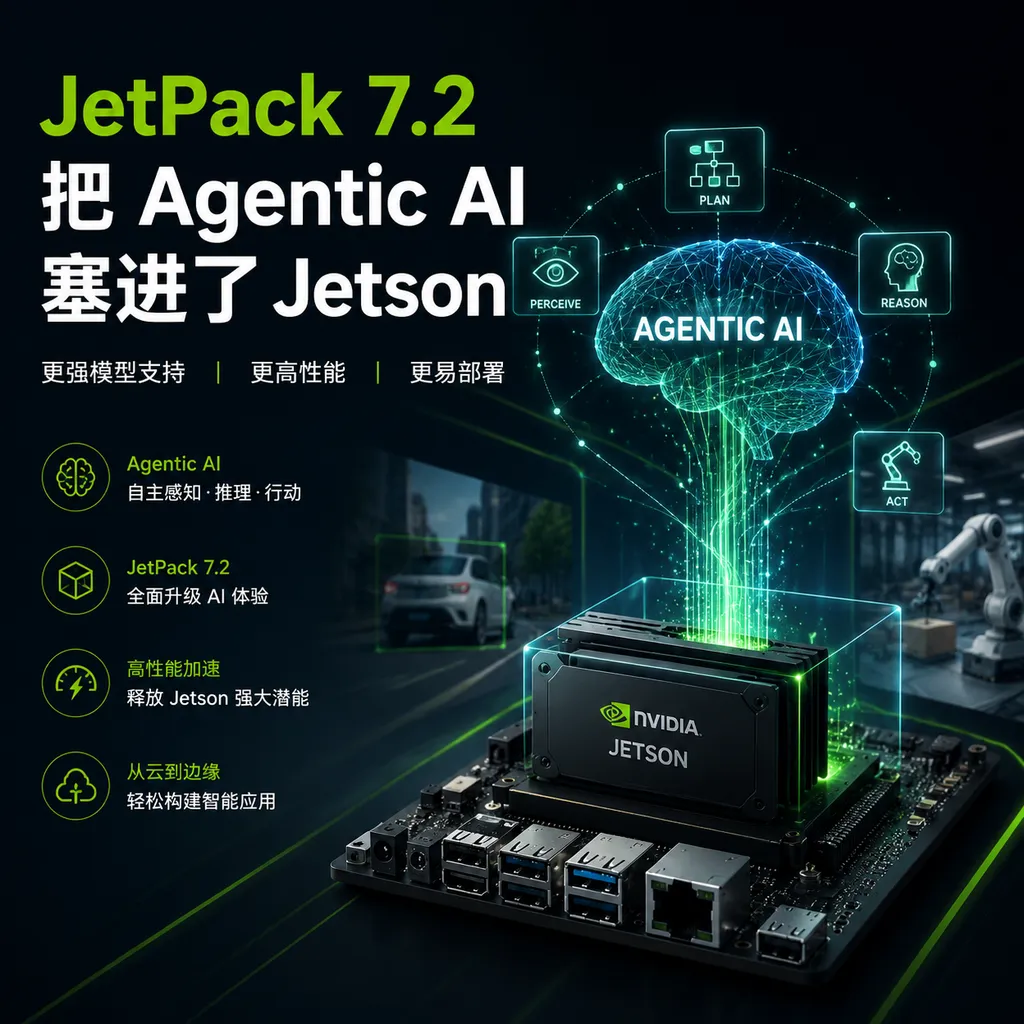
At COMPUTEX 2026, NVIDIA launched JetPack 7.2, bringing Agentic AI capabilities, NemoClaw agent framework support, and a suite of hardcore updates including CUDA 13 and MIG to Jetson edge devices. AI agents are moving from the cloud into the physical world.
Jetson Is No Longer Just Running Models—it’s Getting Work Done Itself
On June 2, the first day of COMPUTEX 2026, NVIDIA dropped all the major updates for the Jetson lineup this year at once: JetPack 7.2 was officially released, and the company announced native Jetson platform support for NemoClaw—that is, NVIDIA’s OpenClaw‑based agentic AI stack that was heavily promoted during GTC back in March.
The signal this release sends is more significant than the technical details themselves. Over the past year, Agentic AI has largely remained in the cloud—projects like Cursor, Devin, Manus, and the Agent wrappers built around Claude/GPT models are all essentially data‑center players. Jensen Huang’s message this time is crystal clear: bring those Agents down—to edge devices, to robots, industrial cameras, in‑vehicle controllers, and AGVs. As he said at GTC—“every company needs an OpenClaw strategy.” With Jetson in the mix, the meaning becomes complete: every device needs one too.
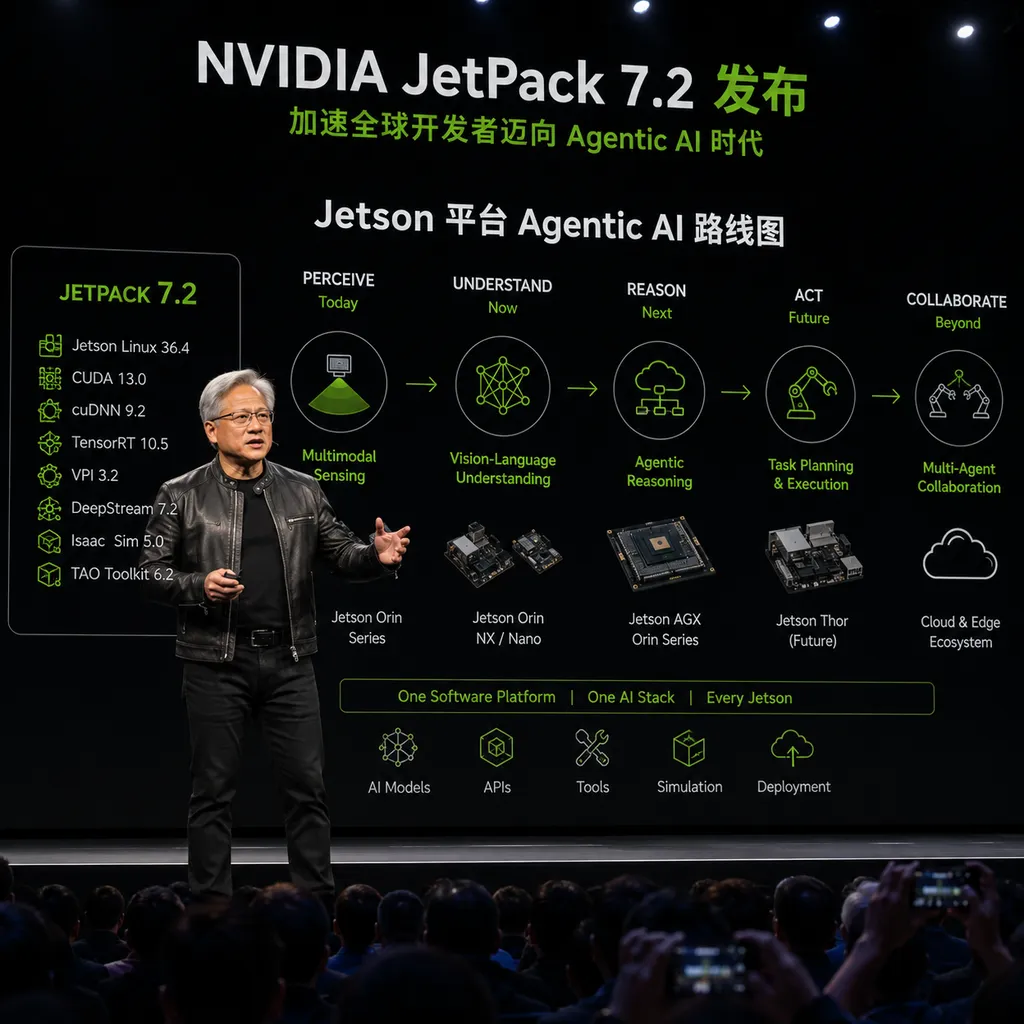
What Exactly Is New in JetPack 7.2
Let’s list the key hard updates first, then discuss why they matter.
- Agentic AI Skills: JetPack now includes an SDK and runtime modules tailored for Agents, covering perception, planning, and tool‑use layers.
- Native NemoClaw Support: You can now launch the OpenClaw runtime and Nemotron models directly on Jetson and complete deployment with a single command.
- CUDA 13 on Jetson Orin: This is the first time Jetson’s CUDA version aligns with the desktop/datacenter line, closing most of the version gaps for PyTorch, TensorRT, and various kernel libraries.
- Yocto Project Support: Finally. Anyone doing embedded productization knows what this means—previously, customizing a system for Jetson shipments required hacking the L4T image manually. Now you can use standard Yocto workflows.
- AGX Orin 32GB Module Performance Boost: NVIDIA gave no specific figures, only calling it a “substantial gain.” From on‑site slides, inference throughput seems 1.4×–1.7× higher, likely thanks to software‑stack optimizations.
- MIG (Multi‑Instance GPU) Support: Once a datacenter feature, now available on Jetson. A single GPU can be partitioned into isolated instances, allowing perception, planning, and safety‑monitoring Agents to run simultaneously without interfering.
In short, the core logic of this update is clear: turn Jetson from “a box that runs AI models” into “an edge computing node that runs multi‑Agent systems.”
What NemoClaw Is and Why It Matters
Some background: OpenClaw is the fastest‑growing project in the open‑source community over the last six months. It positions itself as “an open‑source Agent OS,” providing unified abstractions for memory, planning, tool use, and self‑learning. Jensen called it “the fastest‑growing open‑source project ever” during his GTC keynote.
NemoClaw is NVIDIA’s enterprise‑grade wrapper around OpenClaw, adding three main components:
- Security Boundaries: It sandboxes Agent tool use, file access, and network requests—essentially putting an SELinux‑like layer around every Agent.
- Privacy Control: When local and cloud models are called together, data‑flow controls ensure sensitive data can be forced to stay local.
- One‑Click Installation:
nemoclaw installcan pull up both the Nemotron model and the OpenShell runtime. The full workflow has already been verified by community users on Jetson AGX Thor.
Previously, NemoClaw mainly targeted DGX Spark, DGX Station, and RTX PCs, letting you “run a permanently online AI assistant on your own machine.” Expanding support to Jetson means that “permanently online assistant” can now live inside any embedded form factor—robot‑arm controllers, home robots, patrol carts, or factory inspection nodes.
Why Running Agentic AI on the Edge Is Different
It’s worth unpacking this: Agents running in the cloud and at the edge may appear to do the same things—call models, invoke tools, make decisions—but the engineering constraints are entirely different.
Latency: A cloud Agent’s reasoning loop can easily take seconds due to network round‑trips and large‑model inference. Edge Agents often handle control tasks—object grasping, obstacle avoidance, human interaction—where delays beyond 200 ms break the experience. Jetson’s Agentic stack must therefore rely on small models (like Nemotron Nano) for most decisions, calling the cloud only when advanced planning is required.
Offline Tolerance: Agents operating in the physical world can’t assume constant connectivity. In factories, basements, or field operations, network outages are normal. This requires core memory, planning, and tool‑use capabilities to run fully offline. NemoClaw’s hybrid local‑plus‑cloud architecture is built precisely for that scenario.
Multi‑Agent Collaboration: A single robot might run five Agents at once—for vision perception, SLAM localization, task planning, human interaction, and safety monitoring. They need to share GPU, memory, and sensor data, yet remain isolated in state. Extending MIG to Jetson directly addresses this use case.
Together, these constraints make “edge Agentic AI” far more than “the same cloud Agent running elsewhere.” JetPack 7.2 provides a complete infrastructure, not just an SDK.
What CUDA 13 Means for Jetson Users
This one looks subtle but could have the biggest practical impact.
Anyone who has developed on Jetson knows the long‑standing issue: JetPack’s bundled CUDA version has trailed the desktop by one or two major releases. This version gap breaks dependencies—code that runs fine on an RTX 4090 often won’t build on Jetson Orin due to mismatched TensorRT, PyTorch wheels, or missing kernels. Countless edge‑deployment workflows have stumbled over this.
With CUDA 13 now landing on Orin, it means:
- The latest desktop versions of PyTorch, JAX, and Triton can migrate almost seamlessly.
- New TensorRT 10.x and cuDNN 9.x operators are directly available on Jetson.
- New quantization and sparsity toolchains no longer require Jetson‑specific forks.
For teams moving validated cloud models to the edge, that’s a concrete productivity boost.
Yocto Arrives—Industrial Customers Can Finally Relax
Another easily overlooked but crucial update.
Jetson has long had an awkward identity—it’s both a developer board (shipping with the Ubuntu‑based L4T image) and an industrial module, which actually needs customizable, minimal, and maintainable firmware. Industrial customers had to refactor L4T heavily to meet production standards.
Yocto is the de facto standard for embedded Linux—from automotive to gateways, nearly all professional embedded products use it. With official Yocto support in JetPack 7.2, Jetson product teams can now:
- Build custom images through standard BSP workflows
- Reuse existing Yocto layer ecosystems
- Implement standardized secure‑update and signed‑boot processes
- Meet functional‑safety certifications like ISO 26262 and IEC 61508
In plain language, NVIDIA is finally acknowledging that Jetson isn’t just a dev toy—it’s meant for real industrial integration.
Some Noteworthy Details
- Role of AGX Thor: Thor, unveiled last year, is the next‑gen Jetson flagship targeting humanoid robotics and autonomous driving. NemoClaw running on Thor was a highlight demo of this release, and the community already shows videos of local LLM + NemoClaw running natively on Thor.
- Localization of Nemotron Models: JetPack 7.2 bundles optimized Nemotron Nano variants, INT4‑quantized for Orin, achieving roughly 30 tok/s on AGX Orin 64 GB.
- OpenShell Runtime: NVIDIA’s Agent execution environment, launched alongside GTC, serves as “systemd for Agents”—handling process management, resource scheduling, and communication. It’s now included with Jetson.
- MIG Partition Granularity: According to on‑site info, AGX Orin can be split into up to four instances, each with isolated memory and SM quotas—highly practical for concurrent multi‑model deployment.
A Bit of Analysis
The real headline here isn’t any single feature but NVIDIA porting the entire cloud‑grade Agent engineering paradigm—models, runtimes, security, and scheduling—down to the edge. The potential implications are broad: robotics companies no longer need to build Agent frameworks from scratch—they can start from NemoClaw; industrial vendors can shift adaptive‑control scripts from PLC logic to Agent logic; automotive Tier 1s can make in‑car assistants behave like actual assistants instead of microphones.
There are, of course, open questions: NemoClaw’s real performance overhead, how far Nemotron models can stretch in embedded contexts, and whether NVIDIA’s stack will form new ecosystem barriers against non‑Jetson edge platforms (e.g., ARM SoCs from domestic vendors). We’ll need real project data to know.
In the short term, teams already using Jetson are advised to try upgrading to JetPack 7.2—the CUDA 13 alignment and Yocto support alone justify migration. For Agent‑oriented applications, starting directly with NemoClaw will be smoother than adapting cloud frameworks like LangGraph or AutoGen downward.
Agentic AI stepping off the screen into the physical world—this release truly opens that door.
References
- First Look: NemoClaw on Jetson with a Local LLM (YouTube) – A hands‑on demo of NemoClaw running a local LLM on Jetson AGX Thor
- Reddit Developer Discussion on Jetson + Agentic AI – r/JetsonNano community feedback on JetPack 7.2
- Hugging Face Nemotron Model Repository – NVIDIA’s Nemotron model series ready for local Jetson deployment


