
AI Agent Embedded in WeChat Enters Countdown to Beta Testing — The Gateway for 1.4 Billion Users Is About to Change

Tencent is testing a prototype of an AI agent embedded in WeChat, with regulatory approval possibly starting as early as this month. Swiping right brings up a chat window, which can coordinate millions of mini programs to complete tasks such as booking rides or placing orders. The project has been designated a top strategic priority, but a shortage of computing power remains the biggest obstacle to full-scale rollout.
Countdown to WeChat’s Embedded AI Agent Beta Test: A Paradigm Shift for 1.4 Billion Users
Tencent’s long‑held secret weapon, over a year in the making, is finally about to be unveiled.
According to a Financial Times report on June 2, Tencent is testing a prototype of an embedded AI agent within WeChat, with regulatory approval processes expected to start as early as this month. After approval, it will begin with a small‑scale beta (“gray”) test before gradually expanding. The project actually started in the first half of last year and was internally classified as “top secret.” The Information first leaked it in March this year, and now it has reached the eve of its gray‑test rollout.
As soon as the news broke, Tencent Holdings’ Hong Kong shares rose over 3% intraday. The market knows what this means — integrating a fully functioning AI agent into a super‑app with 1.4 billion monthly active users is, globally, the largest experiment yet for application‑level agent deployment.
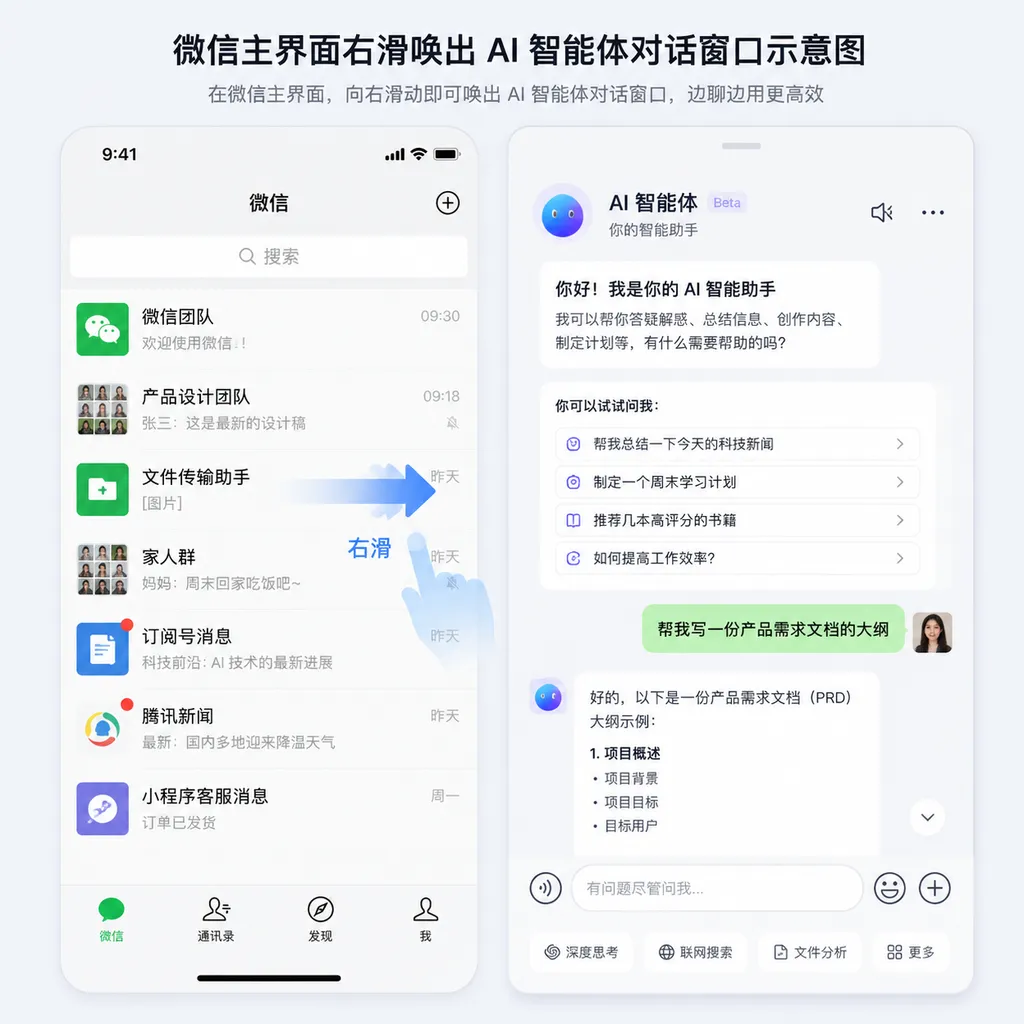
Where’s the Entry: Slide Right from the Main Interface
People who have seen early demos revealed a key detail: on WeChat’s main screen, swiping right brings up the AI agent’s chat window.
This interaction design choice is deliberate. Swiping left on the main screen brings up “Top Stories/Subscriptions” (depending on version), while right swipe has long been reserved for limited, highly controlled functions. Placing the Agent here means Tencent treats it as a primary entry point, parallel to the “chat list,” rather than burying it under “Discover” or “Services.”
Compare this with Yuanbao’s current approach — Yuanbao exists as a chat contact in WeChat, essentially just a conversational bot. The new Agent is different: it is meant to execute tasks on behalf of the user — find a café based on preferences and price, place an order, book train tickets and hotels in one flow, compare prices across services and pay — all without manual switching or navigation.
The Real Trump Card: Millions of Mini Programs
Simply adding an LLM for conversation doesn’t qualify as a breakthrough. The core of Tencent’s plan is its mini‑program ecosystem.
China’s leading online services — Meituan for food delivery, Didi for rides, Ctrip for bookings, JD for shopping, 12306 for train tickets, and countless government services — all have WeChat mini‑programs. This moat has taken Tencent nearly eight years to build. Once the AI Agent is authorized by the user, it can theoretically call the full ability chain of these mini programs, linking multiple services into a seamless task flow.
This capability boundary is something Alibaba’s Qianwen can’t match. Even if Qianwen’s Agents run smoothly, they still operate within Alibaba’s own ecosystem — Taobao, Fliggy, Amap, Alipay. When user needs go beyond that, Qianwen can provide information but not direct results. ByteDance tried a more radical approach via smartphone OS integration, partnering with device makers on an “AI‑native OS,” but quickly hit walls — Meituan, Didi, and Alipay tightened permissions and added anti‑bot controls, blocking external agents.
WeChat doesn’t have that problem. It sets the rules itself, invoking APIs of its own mini‑program ecosystem with clear compliance pathways and no countermeasures.
That gives WeChat’s Agent its greatest asymmetric advantage: others need to break in through the door; WeChat already holds the key.
Why Tencent Is the One to Reach This Point
To be honest, Tencent has long been considered the slow player in the current AI race.
Alibaba connected Qianwen to e‑commerce, maps, and travel; ByteDance turned Doubao into an Agent handling daily tasks; even Baidu embedded Ernie Bot into search and maps. As for Tencent, its Hunyuan model hasn’t stood out, and Yuanbao’s WeChat integration only covers search and conversation — not the core ecosystem.
But slowness has its reasons.
WeChat holds not just 1.4 billion monthly active users but also China’s most complete and private user data graph — social connections, consumption records, travel footprints, payment behaviors. Allowing third‑party Agents direct access to that would create uncontrollable data‑flow risks and liability chains. That’s why WeChat’s open platform has APIs for public accounts, mini programs, and enterprise accounts — but has never opened an official API for personal WeChat use.
So Tencent chose the safest — albeit slowest — path: build its own model, its own Agent framework, and handle data authorization itself. Every link stays under its control.
According to disclosures from TMT insiders, this project doesn’t rely solely on the Hunyuan model but has tested models from Zhipu, Alibaba, DeepSeek, and WeChat’s in‑house small models. Hunyuan’s current capacity can’t yet handle such scale, while integrating external models introduces complex data‑authorization chains — tasks involving payments and personal data must remain isolated when passing through third‑party nodes. At WeChat’s scale, there’s no easy solution, which fundamentally limits project speed.
Computing Power: The Real Bottleneck
A notable detail from the report is that the prototype performs tasks smoothly, but mass deployment faces shortages in computing power.
An insider said: “Before the U.S. chip export ban, Tencent’s preparations were conservative, and it didn’t stockpile enough NVIDIA chips. Domestic chip supply remains tight.”
This says a lot. First, Tencent didn’t hoard H100/H800 chips like Alibaba or ByteDance, losing out due to caution. Second, domestic alternatives (Huawei Ascend, Cambricon, etc.) still fall far short of what WeChat’s billion‑user inference scale requires. Third, internal estimates suggest that full rollout costs would be sky‑high, and short‑term cost recovery remains uncertain.
That explains why Tencent isn’t rushing — not because it doesn’t want to, but because it physically can’t.
An Agent is very different from a chatbot. A conversation may consume a few hundred tokens, while a full task run requires planning, tool calls, reading mini‑program returns, and deciding next steps — multiplying token usage dozens of times. Rolling this out to 1.4 billion users would mean astronomical compute bills.
Will Ecosystem Partners Cooperate?
A deeper question: will major apps with their own ecosystems — Alibaba, ByteDance, Pinduoduo, JD — open their service interfaces for WeChat’s Agent?
That’s a pure matter of interest negotiation.
For merchants, hosting a mini program inside WeChat has always been a subtle compromise — traffic resides in WeChat while orders stay with them. But once the AI conversation layer becomes the only entry point, brand exposure, recommendations, and marketing placements all shrink, reducing merchants to invisible “backend service providers.” Power over traffic distribution moves even further toward Tencent.
If top platforms tighten interfaces citing “data security,” or even withdraw key services from WeChat mini programs, the Agent’s coverage radius will shrink considerably. This tug‑of‑war is likely to persist long after launch.
Timeline and Uncertainties
Based on multiple sources, the current confirmed schedule is:
- First half of 2025: Project launch; designated top internal secret
- March 2026: The Information disclosure; original plan for mid‑year beta and Q3 full rollout
- June 2026: Financial Times confirmed regulatory approval process to start this month; small‑scale beta to follow
- Official launch: Undetermined, depending on approval duration
Tencent’s management reportedly wants to “refine every detail,” implying prolonged testing and several iterations before public release. Considering compute constraints and ecosystem negotiations, full rollout likely won’t happen this year.
The Real Significance
Let’s step back: why is everyone watching WeChat?
Because if this works, it will be the world’s first 1‑billion‑user-scale deployment of Agent capabilities. OpenAI’s Operator, Anthropic’s Computer‑Use, and Google’s Project Mariner are still small-scale previews — reaching even a few million monthly users is a big deal. A WeChat rollout would instantly jump two orders of magnitude in scale.
More importantly, it shifts paradigms. For the past decade, mobile‑internet strategy has meant “App‑first” — every service competing for space on the home screen. In the Agent era, if “conversation becomes the entry point,” the concept of an App will fade. Users won’t choose which App to open; they’ll voice a need and let the Agent decide. If WeChat centralizes that orchestration power, China’s mobile‑internet hierarchy could be quietly reshuffled.
That’s why Tencent has defined this as a “top strategic priority” — not to sell more memberships, but to secure the next decade’s entry point.
For developers, some early thoughts: how to optimize mini programs for Agent invocation (API descriptions, parameter semantics, error handling), how to maintain brand visibility in Agent‑controlled traffic distribution, and how to incorporate Agent capabilities into your own products. Multi‑model aggregation API services (like OpenAI Hub, which connects GPT, Claude, Gemini, DeepSeek, etc. with one key) can save model‑switching costs during early prototype validation.
Whatever the outcome, WeChat’s move will be the most noteworthy event in China’s AI industry in 2026.
References
- Report: Tencent Testing WeChat AI Agent Prototype, Classified as Top Strategic Priority – IT Home — Financial Times update on regulatory‑approval progress before gray testing
- Tencent Developing “Top‑Secret” WeChat AI Agent: Beta Test Scheduled for Mid‑Year – IT Home — The Information’s first disclosure in March
- Tencent Bets on WeChat AI Agent: The Next Battle for 1.4 Billion‑User Entry Point – Zhihu — In‑depth analysis of WeChat Agent’s strategic implications


