
OpenAI Live Tomorrow Night: Major Codex Update and New Reasoning Model on the Way
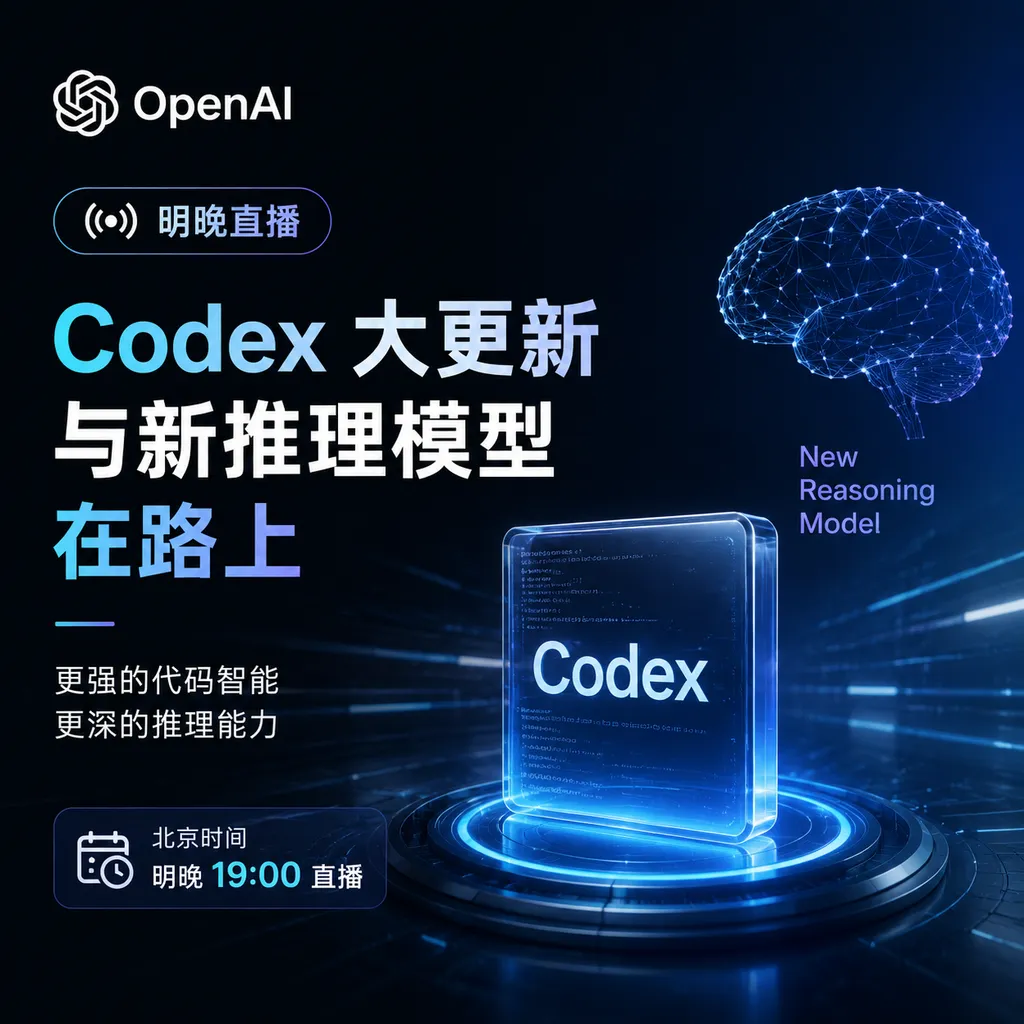
OpenAI officially announced a live event, *Intelligence at Work*, on June 3. The community widely anticipates a major Codex update and a new generation of reasoning models. Judging from the release pace since the beginning of the year, this livestream is very likely aimed at developers.
OpenAI Live Tomorrow Night: Major Codex Update and New Reasoning Model on the Way
OpenAI has scheduled a livestream for June 3rd, titled Intelligence at Work. The teaser page doesn’t specify what will be announced, but developer circles are already betting: Codex is about to get a major version leap, possibly accompanied by a new reasoning model.
This will be OpenAI’s third livestream this year under the Intelligence at Work series. The previous two introduced members of the GPT-5.3-Codex and GPT-5.4 Thinking families — the release tempo feels like flipping calendar pages monthly. Following that rhythm, tomorrow night will likely either push the Codex line forward or unveil something new on the reasoning side.

Over the past year, OpenAI’s model lineup has already rotated three times
Looking back at the release pace of early 2026, it’s clear OpenAI has been relentlessly refreshing its models. A quick timeline recap:
- February 5: GPT-5.3-Codex released — around 25% faster coding than the previous generation, began self-debugging and deploying into its own codebase
- February 13: GPT-4o, GPT-4.1, GPT-4.1 mini, and o4-mini all removed from ChatGPT
- March 11: GPT-5.1 series (Instant/Thinking/Pro) retired from ChatGPT; chats automatically migrated to 5.3 Instant, 5.4 Thinking, and 5.4 Pro
- March 16: GPT-5.3 Instant received a response style update
- March 18: GPT-5.4 mini added to ChatGPT as fallback when 5.4 Thinking hit rate limits
In half a year, the mainstream tier has moved up to GPT-5.4 Thinking, while the Codex line sits at 5.3. Following OpenAI’s pattern, Codex is due for movement. This is why some in the community are predicting ChatGPT 5.6 — the logic being that since 5.4 has been out for three months, the next release should be either 5.5 or a direct jump.
Why everyone’s paying attention to Codex
Codex isn’t new, but this year it’s fundamentally different.
The GPT-5.3-Codex update in February transformed Codex from a mere code completion engine into an intelligent agent capable of functioning in real-world engineering environments. Over the past few months, Codex has gained new integrations: a local proxy on Mac, remote control on iOS/Android, and Computer Use support on Windows, enabling direct interaction with desktop applications.
The intent is clear — to make Codex a cross-device development collaboration terminal, not a code assistant limited to a chat box. You could run tests on your Windows machine, continue issuing commands from your phone on the subway, then resume progress on your Mac at home. Files, shells, and local services stay on the host machine; your mobile device is simply a remote controller.
This differs from Anthropic’s Claude Code or Cursor’s Background Agents. Cursor thickens the IDE; Claude Code makes the terminal smarter. Codex, however, treats the developer as the orchestrator — decoupling where the model runs, where files live, and where the user is.
That’s why tomorrow’s livestream carries such anticipation. If Codex moves another step forward, it’ll either mean a leap in code intelligence (longer context, better multi-file refactoring, monorepo understanding) or a protocol-layer opening — e.g., exposing Computer Use capabilities to third-party IDEs and CI systems.

The reasoning models are also due for change
GPT-5.4 Thinking is currently ChatGPT’s default high-intensity reasoning model, but it remains largely an iteration of 5.3 Thinking without architectural innovations. Pro users have noted several long-standing issues:
- Uncontrollable thinking duration — even with the configurable reasoning time added in February, complex problems often cause long idle delays, yielding results not much better than quick responses.
- Split between tool use and reasoning — when the Thinking mode invokes search or the code interpreter, the reasoning chain often restarts, unlike Anthropic’s seamless embedding of tool use within extended thinking.
- Weak multimodal reasoning — when solving math or circuit problems with images, 5.4 Thinking still describes the picture first and reasons afterward, rather than reasoning directly in visual space.
If a new generation of Thinking arrives tomorrow, at least one of these issues must be addressed — otherwise it’s just a minor upgrade. The community’s rumor of ChatGPT 5.6 might sound like a jump, but considering OpenAI’s tradition of using odd version numbers for reasoning-line models, a 5.5 Codex + 5.6 Thinking pairing is plausible.
Of course, OpenAI could surprise everyone — by reviving the “o” series, releasing something like o5 as a pure reasoning model alongside the GPT-5 line. This theory stems from Sam Altman’s podcast comment: “We haven’t abandoned the o-series; we’re waiting for something worthy of the o5 name.”
What this means for developers
Setting aside the naming suspense, there are several practical implications:
API pricing is likely to change. Each major version reshuffle comes with repricing — 5.3-Codex’s input cost dropped ~20% versus 5.1-Codex, with output prices roughly unchanged. If the new Codex expands context from 400K to 1M tokens, pricing will be key. Whether it scales proportionally or gets offset via prompt caching discounts will determine whether it beats Claude’s cost advantage in large codebase scenarios.
SDK behavior might introduce breaking changes. Starting with 5.2, Codex quietly tweaked its streaming protocol — adding fields like reasoning_effort and tool_choice_strict. If the new version standardizes Computer Use as an API suite or introduces persistent sessions, code migration work will be needed.
Model selection in ChatGPT will shift again. Typically, new versions trigger old-model deprecation notices. We’ll see after tomorrow whether 5.3 Instant and 5.4 mini remain available. Plus and Pro quota adjustments also await official clarification.
Sync timing with OpenAI Hub
Historically, OpenAI Hub synchronizes within hours after new APIs go live. When GPT-5.3-Codex launched in February, Hub added the new model name to the chat completions endpoint immediately — developers didn’t need to change code or SDKs, just update the model field.
If the livestream indeed releases a new Codex, calls will likely look like this:
from openai import OpenAI

client = OpenAI(
    api_key="your-openai-hub-key",
    base_url="https://api.openai-hub.net/v1"
)

response = client.chat.completions.create(
    model="gpt-5.5-codex",  # to be confirmed officially
    messages=[
        {"role": "system", "content": "You are a senior backend engineer."},
        {"role": "user", "content": "Refactor this Python service to use asyncio instead of sync IO."}
    ],
    reasoning_effort="medium",
    stream=True
)

for chunk in response:
    if chunk.choices[0].delta.content:
        print(chunk.choices[0].delta.content, end="")
For developers in mainland China, Hub uses a direct connection route, achieving sub-800ms first-token latency, typically more stable than proxying to OpenAI’s official endpoint. One key can invoke GPT, Claude, Gemini, and DeepSeek — convenient for teams conducting model benchmarking.
What else to watch for
The livestream starts at 10 a.m. Pacific Time on June 3, which is 1 a.m. Beijing Time on June 4. Based on recent OpenAI events, the broadcast will likely run under 30 minutes, with the key reveal usually hidden in the last five minutes — the classic “one more thing.”
Signals to look out for:
- Mentions of an Agents SDK update — if a new Codex ships alongside an updated SDK, that means OpenAI is paving a unified agent deployment path for enterprise clients.
- Pricing slides — though rare, if cost comparison charts appear, it’s a sign this update targets cost-performance optimization.
- Sam Altman’s appearance — routine updates are usually led by product heads; Altman showing up often signals a longer-term strategic announcement.
If tomorrow indeed brings both the Codex 5.5 and a new reasoning model, OpenAI will once again pull ahead on both programming and reasoning tracks. If it’s just a mini upgrade, then think of it as a warm-up for the second half of the year — by the pace so far, something bigger is due before the end of July.
Once the livestream begins, we’ll immediately follow up with detailed specs, pricing, and API field changes.
References
- OpenAI livestream tomorrow — new Codex incoming! ChatGPT 5.6? — community discussion and speculation on linux.do
- Global AI Model Release Timeline — Zhihu column summarizing model release history across major AI labs


