
Tencent Cloud follows DeepSeek’s price cuts: V4 series API cache hit price slashed to 0.025 yuan
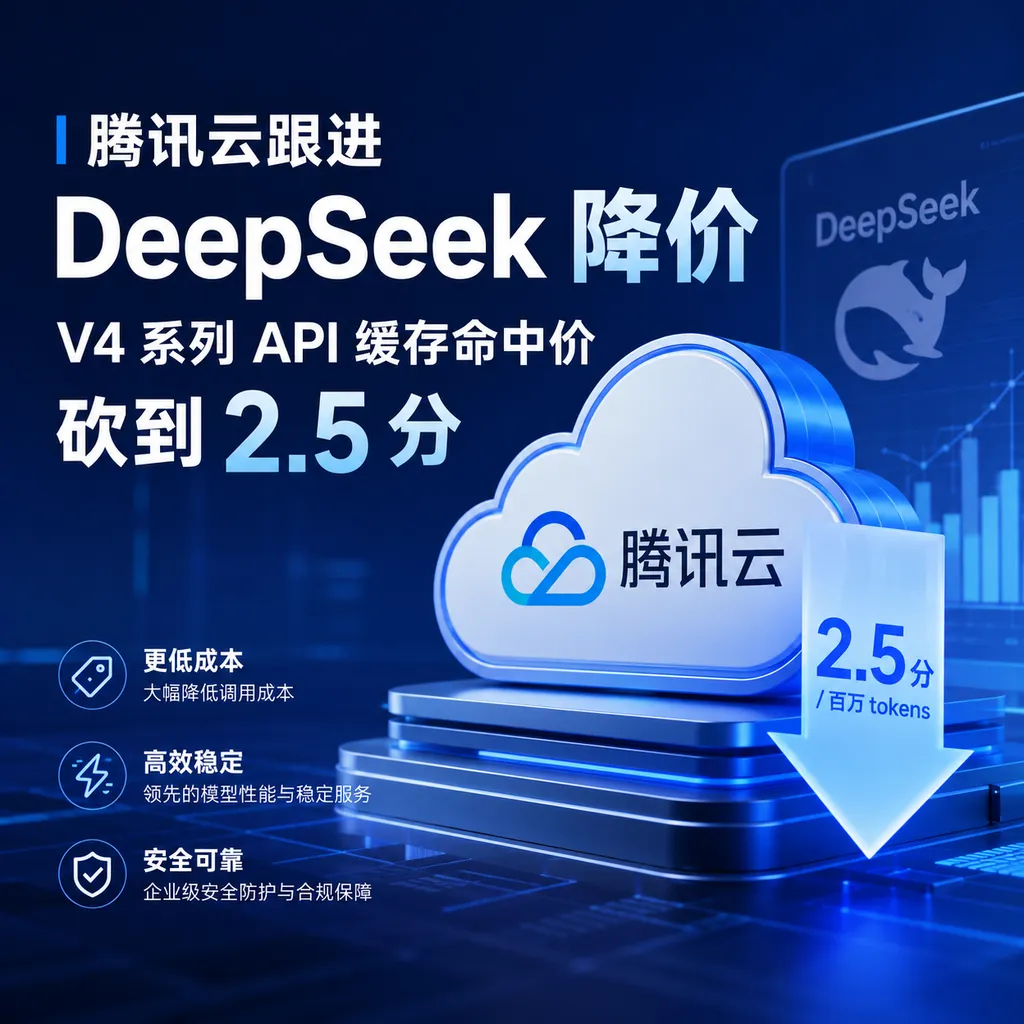
Starting from midnight on June 3, Tencent Cloud’s Intelligent Agent Development Platform will reduce the price of the DeepSeek-V4 series. The V4-Pro inference input/output cost will drop by 75%, and the cache hit price will be reduced by 97.5% to ¥0.000025 per thousand tokens, matching the official website. This marks the continuation of DeepSeek’s permanent price reduction wave through cloud service provider channels.
Following DeepSeek’s Permanent Price Cut, Tencent Cloud Reacts Passively
Tencent Cloud released an announcement today: starting from midnight on June 3, the API prices for the DeepSeek-V4 model series on its Intelligent Agent Development Platform will be significantly reduced, with a maximum reduction of 97.5%. Only the prices are being adjusted; service capabilities remain unchanged.
The timing is interesting. On May 22, DeepSeek officially announced that the V4-Pro’s limited-time 75% discount would become permanent, setting its price at one-quarter of the original, effective May 31. Less than three days later, Tencent Cloud matched the move, aligning its API access pricing with the official site. To put it simply, it had no choice but to follow suit—developers can always directly call DeepSeek’s official API, so cloud vendors acting as intermediaries can’t charge more than the source.
How Much Has It Dropped: Breaking Down the Numbers
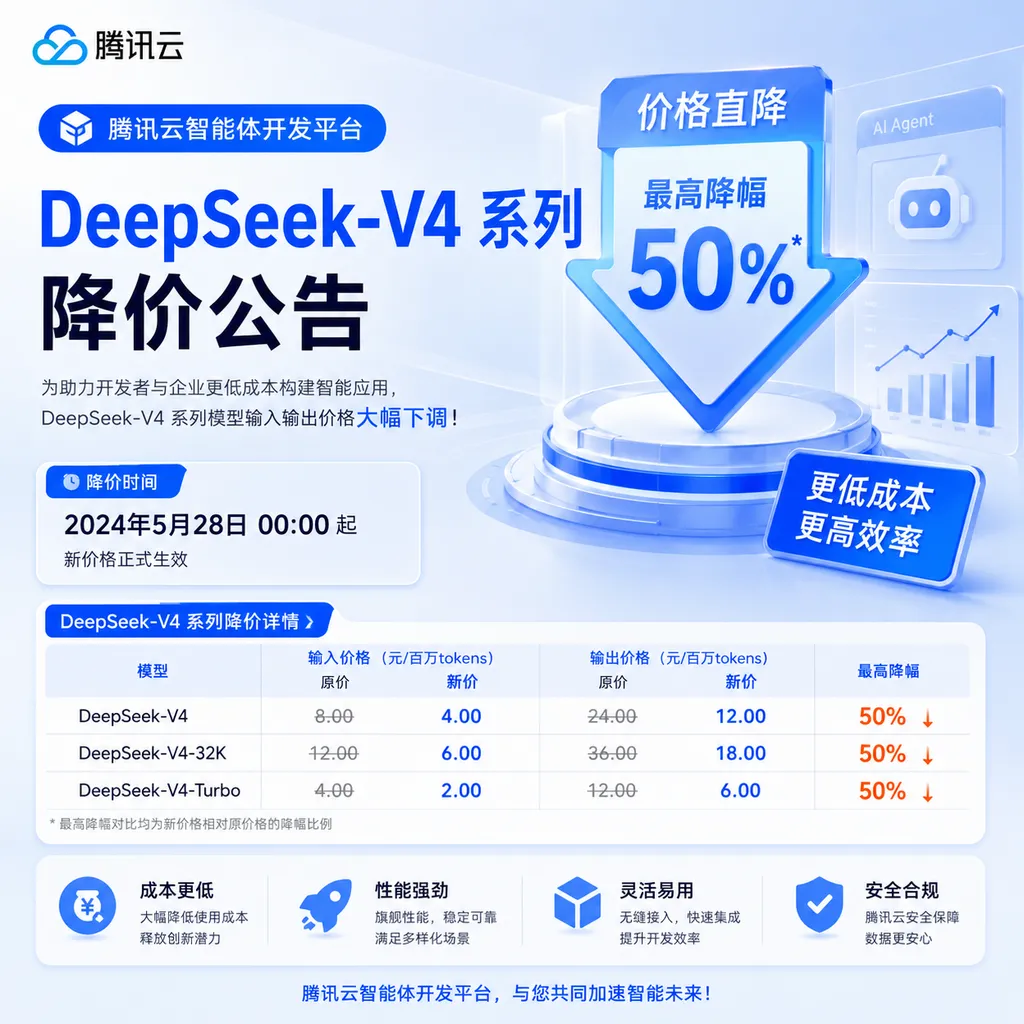
The main price adjustment this time targets V4-Pro, with only the cache-hit pricing tier modified for V4-Flash. The full comparison is as follows:
DeepSeek-V4-Pro (unit: RMB / 1,000 tokens)
| Category | Before Adjustment | After Adjustment | Reduction | |-----------|-------------------|-----------------|------------| | Inference Input | 0.012 | 0.003 | 75% | | Inference Output | 0.024 | 0.006 | 75% | | Cache Hit | 0.001 | 0.000025 | 97.5% |
DeepSeek-V4-Flash (unit: RMB / 1,000 tokens)
| Category | Before Adjustment | After Adjustment | Reduction | |-----------|-------------------|-----------------|------------| | Cache Hit | 0.0002 | 0.00002 | 90% |
Converted into the industry’s more common “per million tokens” metric, V4-Pro’s cache-hit price drops to 0.025 RMB / million tokens, input 3 RMB, output 6 RMB; V4-Flash cache-hit 0.02 RMB / million tokens.
What does this mean? According to Hong Kong media, OpenAI’s GPT-5.5 model’s cache input price works out to roughly 3.4 RMB / million tokens—136 times higher than V4-Pro’s cache cost. For Anthropic’s Claude Opus 4.7, the cost to complete a benchmark test set is about 40 times that of V4-Pro, using DeepSeek’s own disclosed figures.
Cache Hits: The Key Variable in Understanding This Price Drop
Seeing “97.5%” makes many think “it’s basically free.” But to truly benefit from that price, the prerequisite is cache hit.
In simple terms, cache-hit mechanisms allow large models to reuse previously computed KV caches when handling repeated or similar prefixes, avoiding recomputation. In real development scenarios—for example, agents repeatedly invoking the same system prompt, RAG stuffing the same document group into context, or code assistants reading the same project—the overlap rate of prefixes is often high, meaning cache hit rates tend to be excellent. This is precisely why DeepSeek’s recent rounds of price cuts have focused on cache-hit tiers: it knows that, in practice, most tokens fall into that category.
On the other hand, cache-miss pricing isn’t particularly aggressive. V4-Pro’s inference input, at 3 RMB / million tokens, compared with Kimi-K2.6’s 1.1 RMB and Zhipu’s GLM-5.1 at 1.3–2 RMB, isn’t extraordinarily cheap. The real value lies in the two orders of magnitude difference once caching hits.
When Xiaomi announced a 99% price cut for its MiMo large model API last week, the logic was identical: 0.025 RMB / million tokens for cache hits, 3 RMB / million tokens for misses. This pricing strategy has proven effective—and is now being replicated.
Why Tencent Cloud Followed, and Followed So Quickly
To understand this move, we need to look at the broader context of early 2026.
Since the beginning of the year, AI service prices have generally been rising. HBM prices have quintupled, high-end GPUs are hard to find, and inference demand continues to surge. AWS and Azure have raised prices, and China’s major cloud vendors have done the same—Tencent’s Hunyuan saw input price increases as high as 463%, and Zhipu adjusted three times over several months. The overall industry consensus: compute is getting more expensive, so API services should get pricier.
DeepSeek took the opposite approach, locking V4-Pro’s price permanently at one-quarter of the original. This effectively cornered all vendors who had followed the price-hike trend. For Tencent Cloud, raising prices on its own Hunyuan model is fine—but for DeepSeek-V4 being offered on its platform, pricing can’t exceed DeepSeek’s official rates, or developers will just bypass them. This is the awkward side of being an aggregation platform: it doesn’t control the pricing.
So this “adjustment” is, for Tencent Cloud, more a case of passive alignment than proactive discounting. The new prices on Tencent Cloud’s Intelligent Agent Development Platform now essentially match the official DeepSeek site.
A Quick Recap: What Is the V4 Model Series
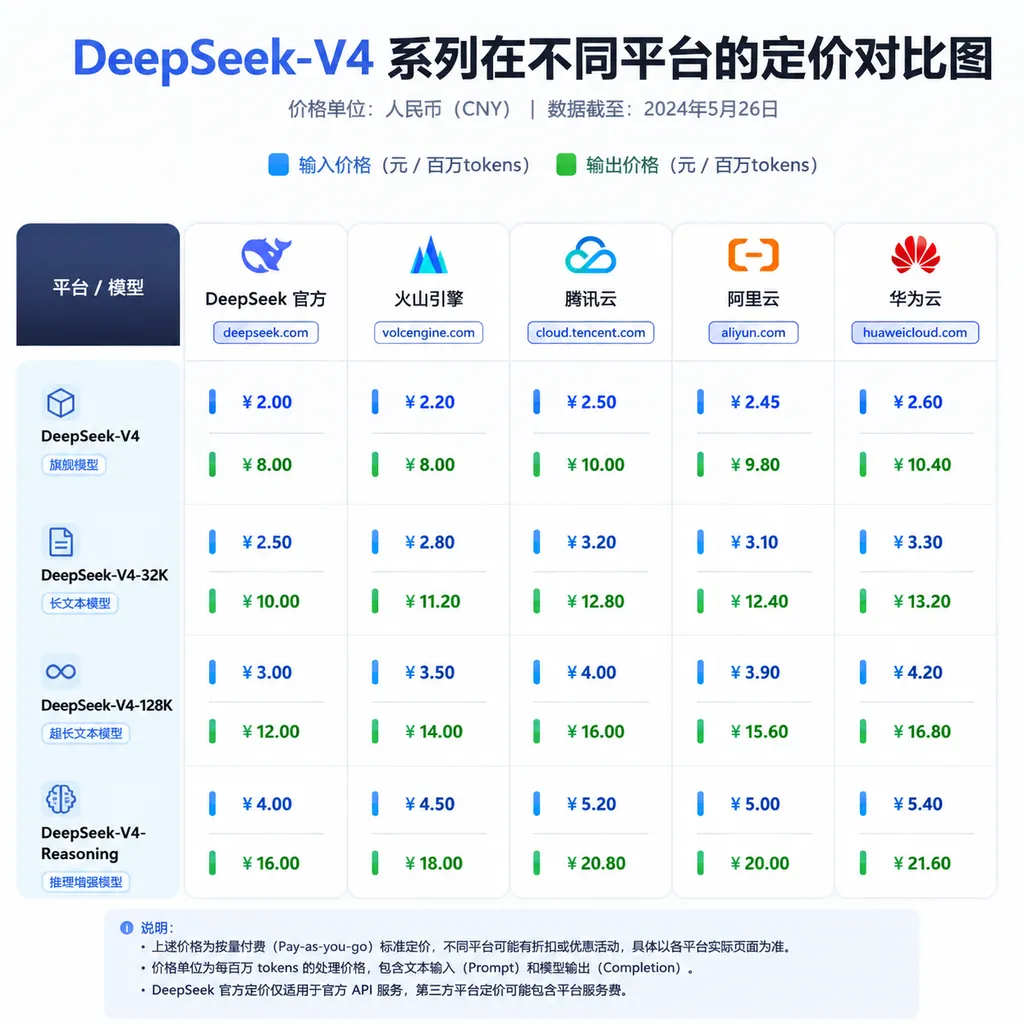
The DeepSeek-V4 series was released on April 24, 2026, comprising two versions:
- V4-Pro: 1.6 trillion total parameters, 49 billion active, positioned for high-performance tasks
- V4-Flash: 284 billion total parameters, 13 billion active, optimized for low-cost, high-throughput scenarios
Both use MoE architecture and natively support 1 million-token contexts. According to the technical report, V4-Pro’s Agentic Coding experience surpasses that of Claude Sonnet 4.5; it outperforms all open-source models in mathematics, STEM, and competition-level coding, and trails only Gemini-3.1-Pro in world knowledge. Its overall intelligence level still falls short of top-tier closed models, but its cost-performance difference is enormous.
By late May, OpenRouter data showed V4-Flash ranking first globally in invocation volume—the first time a DeepSeek model topped the global chart. V4-Pro also held strong position for multiple consecutive days.
The Compute Side Foreshadowing: Ascend 950 Has Yet to Ship in Volume
What’s even more noteworthy is the hint DeepSeek dropped when releasing V4.
In its pricing notes, DeepSeek explicitly stated: “Due to limited high-end compute, the current Pro version’s service throughput is quite constrained. Once the Ascend 950 supernodes enter mass production later this year, Pro pricing will undergo a substantial reduction.”
That’s an unusual statement—tying future pricing directly to the rollout schedule of a domestic chip cluster. It shows DeepSeek now treats “model + domestic compute” as part of its pricing infrastructure. V4’s EP (Expert Parallelism) scheme has already been verified on both NVIDIA GPUs and Huawei Ascend NPUs, achieving 1.5–1.73× speedups for general inference and up to 1.96× for latency-sensitive scenarios.
If Ascend 950 supernodes are indeed shipped in volume later this year, DeepSeek-V4-Pro’s cost structure will drop another tier. When that happens, aggregators like Tencent Cloud and Alibaba Cloud will almost certainly adjust again.
Practical Recommendations for Developers
For integrators and app developers, this price-cut window is worth leveraging:
-
If your application has high cache-hit rates (agents, long system prompts, document QA), V4-Pro’s cost is now nearly negligible.
In a typical RAG setup with a 70%+ prefix overlap, at 0.025 RMB/million tokens for cache hits, input costs for a thousand calls might only amount to a few cents. -
Since Tencent Cloud and DeepSeek now have matching prices, choose based on the surrounding ecosystem.
If you already use Tencent Cloud’s services (COS, vector databases, agent-development platform), integration there is more convenient; otherwise, direct API calls to DeepSeek’s official endpoint also work. -
Cache-miss pricing isn’t particularly cheap—solid prompt engineering matters.
Keeping your system prompts and long documents stable at the top of each request is key to minimizing cost. If your app frequently changes its prompt head, you’ll miss out on the benefits of these price cuts. -
Several domestic aggregator platforms (including OpenAI Hub, which supports multi-model calls via one key) already support DeepSeek-V4.
This makes parallel testing against GPT, Claude, and Gemini easier—run comparisons first, then decide on your integration path.
A Final Assessment
Though nominally Tencent Cloud’s announcement, this price adjustment is essentially DeepSeek’s permanent reduction flowing through its distribution channels. The critical story isn’t the “97.5%” figure—cache-hit pricing is already near rock bottom—it’s that the mid-year picture is now clearer: the industry raised prices in the first half, but DeepSeek’s aggressive pricing is anchoring the second half firmly.
China’s large-model market is stratifying: at the top sit OpenAI and Anthropic with ultra-premium closed models like GPT-5.5 and Claude Opus 4.7; at the bottom, DeepSeek occupies the mass-access tier with 1.6 trillion parameters, 1 million-token context, and 0.025 RMB/million tokens for cache hits. The middle players must choose—either move upmarket or compete downward. Zhipu went upscale, benchmarking GPT and Claude with higher pricing, while Xiaomi went downmarket, mirroring DeepSeek. For integrated cloud vendors like Tencent, their own models can raise prices, but their DeepSeek-based offerings must remain price-aligned—otherwise-users will vote with their feet.
The next key point will be the mass shipment of Ascend 950. If domestic compute capacity ramps up later this year, the next DeepSeek-V4-Pro price drop won’t just be a channel adjustment—it’ll be a structural shift in production cost. At that point, cloud API aggregation business models may need a full rethinking.
References
- Up to 97.5% Reduction: Tencent Cloud Intelligent Agent Development Platform DeepSeek-V4 Series Model Prices Drop Tomorrow, Matching Official Site – IT Home: complete price list and official announcement


