
Microsoft 365 Premium Unexpectedly Opens Claude Opus 4.8
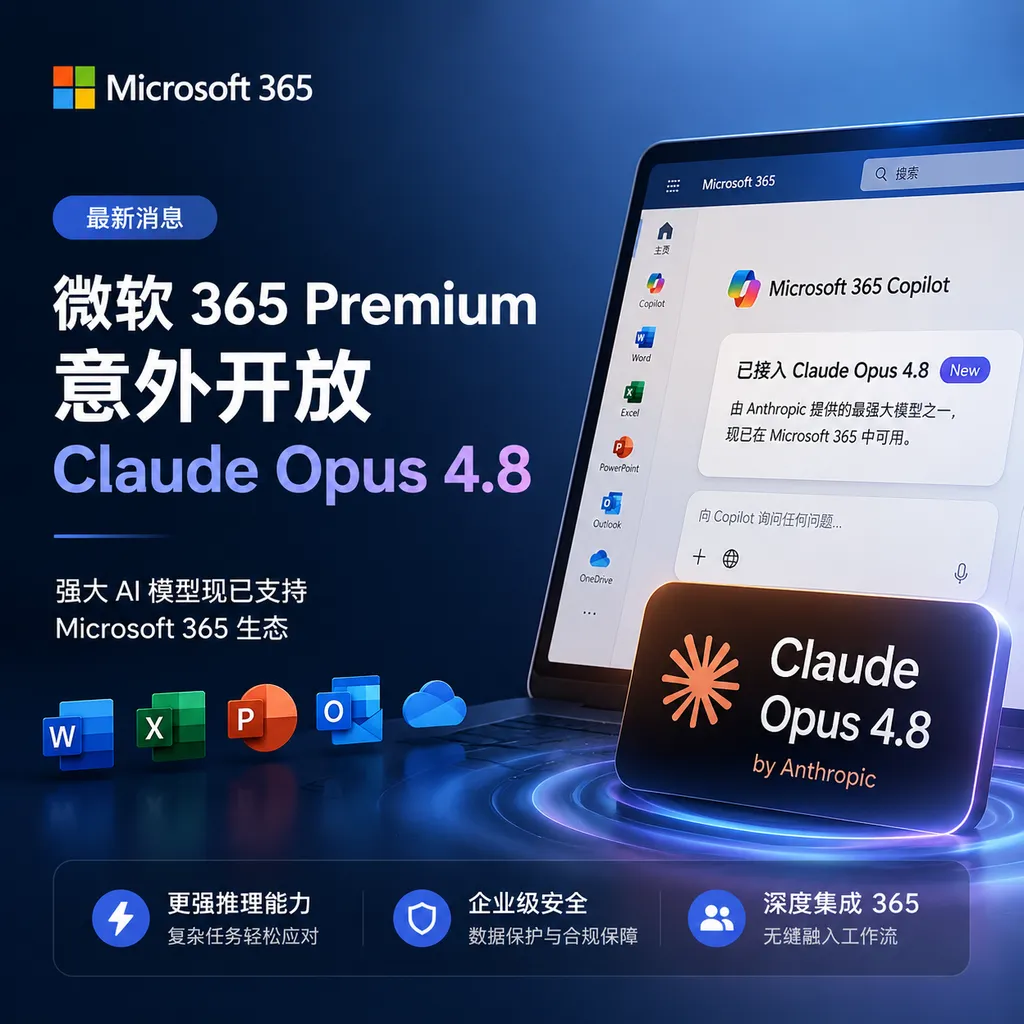
Microsoft 365 Premium users have found that they can freely call Claude Opus 4.8, the GPT series, and several image generation models within Office editing scenarios, sparking discussions around reverse API access. Earlier, Microsoft had just integrated Claude into Copilot Cowork, but this recent open access is suspected to be a configuration mistake.
Microsoft 365 Premium Unexpectedly Opens Up Claude Opus 4.8
Microsoft’s AI strategy has been a bit chaotic lately. In early June, some Microsoft 365 Premium subscribers posted in the community, saying they found they could directly call Anthropic’s Claude Opus 4.8, the latest of OpenAI’s GPT models, as well as image-generation models like GPT-Image-2 and Flux.2 Flex — all completely free and with no usage limits — within Office app editing scenarios.
The timing of this discovery is rather delicate. Back in March, Microsoft had just announced Copilot Cowork, officially integrating Anthropic’s Claude family models into Microsoft 365 Copilot, describing it as a “multi-model strategy.” But the permissions users uncovered this time clearly fall outside the scope of official promotion.
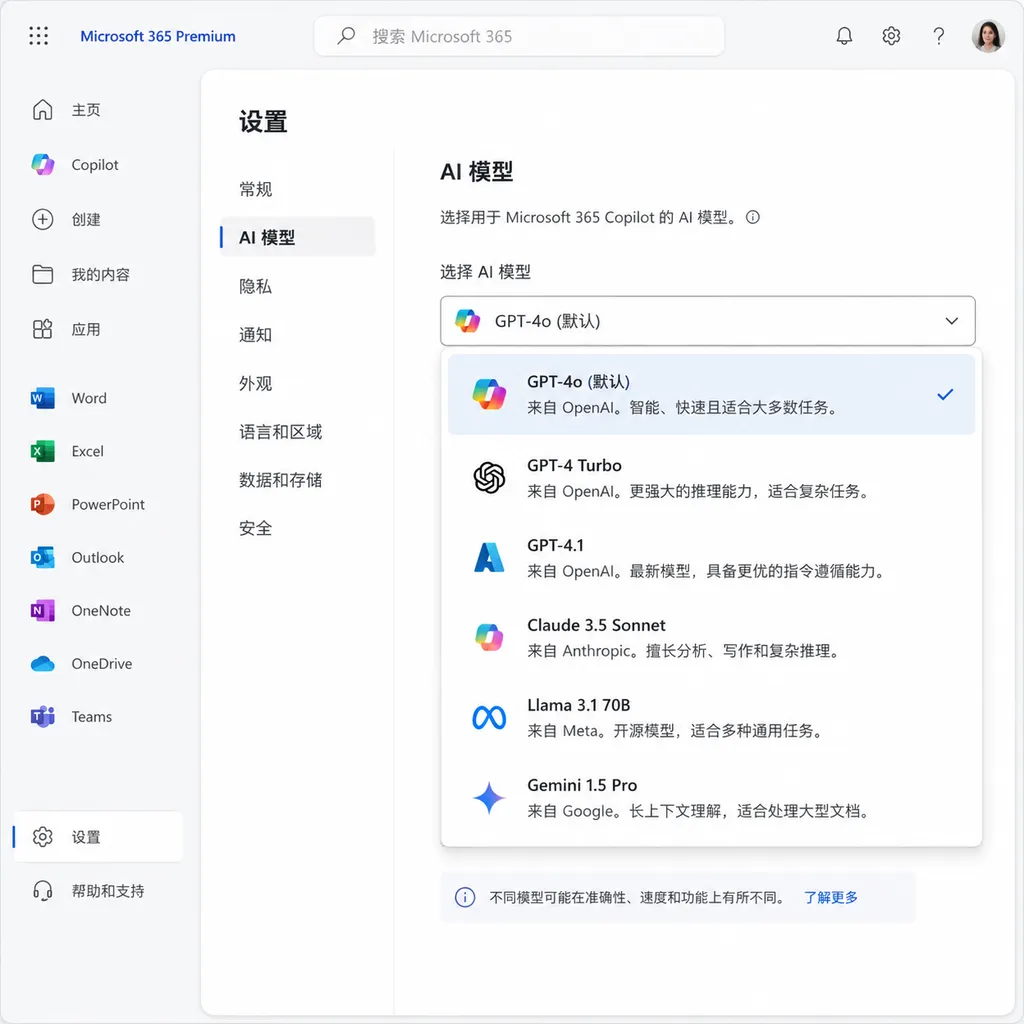
Available Only in “Allow Editing” Mode
According to the users who first posted about it, the feature comes with several restrictions:
- You must be a Microsoft 365 Premium or Microsoft 365 Advanced subscriber
- It only works for the main account; shared sub-accounts don’t have this capability
- It only appears in “Allow Editing” scenarios — you won’t see these models in chat-only mode
The “Allow Editing” mode refers to when you’re actually working inside Office apps such as Word, PowerPoint, or Excel — using AI to rewrite text, generate tables, or optimize layouts. Only then does the model selector show the full list, including external models like Claude Opus 4.8.
This design logic reflects Microsoft’s intentions. In pure chat scenarios, Microsoft wants users to rely on its own Copilot. But in productivity tasks requiring deep understanding of document context, the company knows Claude’s advantages in reasoning and long-text processing — hence the open integration point. The issue is that the range of this access may have exceeded Microsoft’s original expectations.
The Possibility of Reverse-Engineering the API
After the post went viral, the top discussion wasn’t “Wow, free access!” but “Can someone reverse-engineer the API?”
This request has a practical basis. In January, Anthropic cut off OpenAI’s access to the Claude API, claiming OpenAI violated its Terms of Service — OpenAI engineers had used the Claude API for benchmark testing, comparing model performance in coding and creative-writing tasks. Anthropic argued that this constituted “using our service to develop competing products.”
OpenAI’s response was that “cross-benchmarking between AI companies is industry standard,” and they too had opened APIs for Anthropic to use. But Anthropic’s position was firm: its Terms of Service explicitly prohibit using Claude to train competitive models or conduct reverse-engineering or replication.
A similar situation happened with Windsurf. In June, Anthropic restricted Windsurf’s access to Claude because of acquisition rumors involving OpenAI. After Windsurf’s founders joined Google DeepMind and the company merged with Cognition, Anthropic lifted the restriction.
So now, if someone managed to reverse-engineer Claude’s invocation method from Microsoft’s endpoint — bypassing Anthropic’s API fees and usage restrictions — it would be technically feasible but a blatant TOS violation. Anthropic would almost certainly suspend accounts or pursue legal action if discovered.
Still, developers argue that since Microsoft opened the door, why not study it? Moreover, if this was Microsoft’s configuration error, then shouldn’t the responsibility lie with Microsoft rather than users?
Microsoft’s Multi-Model Dilemma
Viewed in a broader context, this incident reflects Microsoft’s internal conflicts in its AI strategy.
Microsoft has invested over $13 billion in OpenAI. Azure is OpenAI’s exclusive cloud provider, and GPT models power nearly all Microsoft products. By that logic, Copilot’s core engine should be GPT. Yet, when releasing Copilot Cowork in March, Microsoft chose to integrate Claude.
Why?
According to Forrester VP J.P. Gownder, Copilot Cowork’s advantage lies not in model capability but in data. When the AI reschedules meetings or generates reports, it needs to extract contextual information from Outlook, Teams, SharePoint, and Excel. This data integration layer is Microsoft’s moat—less dependent on which model it uses.
But users think differently. Ryan Goodman, founder of DataTools Pro, put it bluntly: “Claude feels like magic. Copilot feels like my ChatGPT experience from 18 months ago.”
In early March, daily downloads of Claude reached 149,000, surpassing ChatGPT’s 124,000. Anthropic reported record-breaking registrations in every available country that month — even causing temporary server outages due to overload.
This shift in user preference puts pressure on Microsoft: after investing so heavily in OpenAI, users seem to prefer Claude. Microsoft’s compromise has been to connect both model families, letting users decide — but that brings new challenges. How can it maintain its strategic alliance with OpenAI without making Anthropic feel like a secondary partner?
The Impact of Claude Cowork
A bigger challenge comes from Anthropic’s own release of Claude Cowork.
This product can autonomously run background tasks, work across applications, and generate documents — a true AI Agent rather than a simple chatbot. On launch day, traditional SaaS companies like Salesforce and ServiceNow saw stock drops, as Claude Cowork directly threatens their core business logic: if AI can handle CRM input, ticket routing, and report generation by itself, what’s the purpose of those platforms?
Microsoft’s own stock fell more than 14% over the following two months. While not fully attributable to Claude Cowork, the market’s concern was clear: what is Microsoft’s moat in the AI era? Model capability (outsourced to OpenAI or Anthropic)? Or its data and ecosystem integration (now being challenged by AI agents that can bypass traditional software)?
Microsoft’s integration of Claude into Office via Copilot Cowork was, to some extent, a defensive move. Yet the implementation remains incomplete.
Forrester pointed out that Copilot Cowork doesn’t support local machine operations, can’t directly interact with local files or apps, and lacks native third-party tool integration. In other words, it’s a Claude confined within Microsoft’s ecosystem — not a truly open AI Agent.
By contrast, Anthropic’s own Claude Cowork, built within weeks using Claude Code, has been iterating at a much faster pace. Wharton professor Ethan Mollick commented sharply: “Microsoft tends to launch breakthrough products and then pause for a while.”
A Configuration Error or a Trial Balloon?
Returning to the starting question: Was the Claude Opus 4.8 access in Microsoft 365 Premium intentional, or simply a misconfiguration?
From a technical perspective, it likely leans toward the latter. If Microsoft truly meant Claude Opus 4.8 to be a Premium selling point, there would have been an official announcement — not a quiet community discovery. Also, the “only available in editing scenarios” restriction feels like a permissions boundary that wasn’t clearly defined.
Strategically, though, Microsoft is indeed experimenting with multi-model coexistence. The Copilot Cowork release in March already demonstrated Microsoft’s willingness to embed Claude into its products. The remaining question is how broad and in what form this integration should be implemented.
If Microsoft were to open Claude universally — letting Premium users freely switch among models anywhere — it would be implicitly admitting “our Copilot isn’t as good as Claude.” That would hurt both the OpenAI partnership and Microsoft’s own brand positioning.
Conversely, if Microsoft tightens access and limits Claude to certain scenarios, users will be frustrated: “You’ve already integrated it — why can’t I use it freely? I’m paying for Premium; shouldn’t I get the best available model?”
It’s a tough balance — and this “accidental access” may accelerate Microsoft’s decision-making process.
Risks of Reverse Engineering and Compliance Boundaries
For developers, the temptation to reverse-engineer this interface is strong — but the risks are obvious.
Anthropic’s Terms of Service forbid “using the service to develop competing products or services, including training competitive models, reverse-engineering, or replication.” Anyone discovering how to invoke Claude through Microsoft’s interface and wrapping it into a third-party API service would clearly risk enforcement.
But what if it’s just for personal research, not public use — does that still violate the ToS? The boundary is murky. Technically, Microsoft must have a licensed agreement with Anthropic, paying for Claude API usage and allocating it to Premium users. However, it’s unclear whether extracting call logic through technical means would be considered misuse under these terms.
The situation complicates further with OpenAI in the mix. If a developer reverse-engineered Claude’s calls to benchmark GPT models, would that count as “using Claude to develop a competing product”? By Anthropic’s established precedent with OpenAI, yes. But if the reverse-engineering is done via Microsoft’s legitimately licensed access, can Anthropic simply ban the user — or must it negotiate directly with Microsoft?
No clear answers yet — except that Anthropic tends to act quickly against misuse. January’s OpenAI lockout and June’s Windsurf restriction both make that point obvious.
The Fragmenting Enterprise AI Market
Behind this incident is a deeper shift in the enterprise AI landscape.
A year ago, the central question was: “Which model is smarter?” GPT‑4, Claude 3, Gemini 1.5 — everyone competed on parameters, benchmarks, and reasoning power. But that’s becoming less important.
Forrester highlights the new reality: model performance gaps are narrowing while the value of data and distribution channels is rising. As Claude Opus 4.8 and GPT‑5 perform similarly on most tasks, users’ choices depend increasingly on which integrates better into existing workflows, can access enterprise data, and cooperates with existing tools.
That’s Microsoft’s strength. Office 365 serves hundreds of millions of enterprise users; Outlook, Teams, and SharePoint contain invaluable work data. As long as AI capabilities are deeply embedded in those apps, Microsoft maintains a competitive edge regardless of whether the underlying model is GPT or Claude.
But Anthropic’s Claude Cowork challenges that logic. It demonstrates that AI agents can operate directly on underlying data and APIs without traditional SaaS intermediaries. If this approach proves viable, Microsoft’s moat becomes shallower.
Thus, Microsoft’s current strategy is twofold:
- Continue integrating Claude into Office to preserve multi-model optionality
- Accelerate its own AI agent initiatives (such as “Work IQ”) so that AI actions are grounded in real enterprise data rather than isolated model calls
The “accidental” opening in Microsoft 365 Premium might only be a small incident within this grand chess game — but it reveals a critical tension: when model capability is no longer the sole differentiator, how should companies balance control over channels, data integration strength, and seamless user experience?
Microsoft is still searching for that answer. Meanwhile, developers are already eyeing ways to pry open that narrow seam.
References
- Microsoft 365 Premium users can use Claude Opus 4.8, latest GPT models, and image‑generation models for free – Linux.do — The original community post revealing this feature
- Anthropic bans OpenAI’s access to Claude API over ToS violation – iThome (Chinese) — Background on Anthropic cutting OpenAI’s API access


