
OpenAI equips Codex with a white-collar toolbox: expanding from writing code to knowledge work

On June 2, OpenAI launched a full set of enterprise-oriented new capabilities for Codex, aiming to expand this intelligent agent tool from the developer community to broader white-collar work scenarios. At the same time, it has partnered with companies such as Accenture, PwC, and Dell for enterprise implementation, and its weekly active developer count has surpassed 4 million.
On Tuesday (June 2), OpenAI rolled out a full suite of new capabilities for Codex in one go, with a clear intention: not just to let it keep running in engineers’ terminals, but to push this intelligent agent onto the desks of more white-collar workers. Alongside the release was an internal report dedicated to Codex’s use in knowledge-work scenarios—in other words, the company is now officially taking the enterprise market seriously.
From last year’s release of GPT‑5.2‑Codex, to the launch of the macOS app in March, native browser integration in April, and Windows version follow‑up in May, the Codex product line has been iterating almost monthly over the past half‑year. This latest update feels more like a milestone summary: in terms of capability, evolving from a “code‑writing agent” to a “task‑completing agent through code”; in terms of business, bridging the last mile of enterprise deployment.
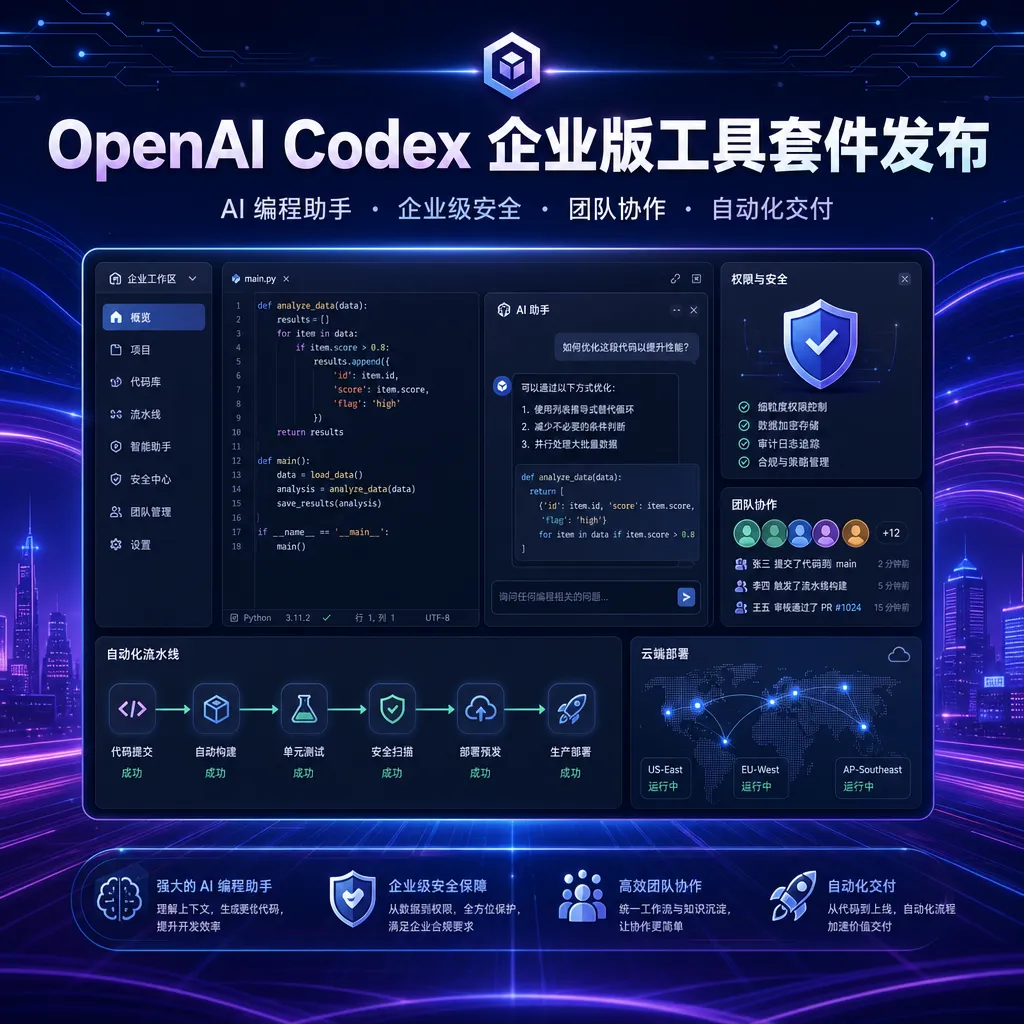
What exactly was updated this time?
The core action can be divided into three parts.
The first is Codex Labs, which OpenAI positions as “the vehicle for extending Codex to global enterprises.” The partner list includes Accenture, PwC, and Infosys—three typical global consulting and systems‑integration giants. This lineup makes sense: OpenAI isn’t good at enterprise‑level delivery, while those consulting firms write countless lines of code and perform endless systems integrations for Fortune 500 companies every year. Embedding Codex into their delivery pipelines means direct access to those companies’ software lifecycles.
The second is its partnership with Dell, bringing Codex to hybrid‑cloud and on‑premise deployment environments. This move targets clients in finance, healthcare, and government—fields where “data must not leave the premises.” Codex will integrate with the Dell AI Data Platform and explore future integration with Dell AI Factory. Simply put: before, using Codex meant sending code and context to the cloud; now it can run in your data center, alongside your codebase, documents, and business systems. For compliance teams who balk at “data leaving the domain,” this door is finally open.
The third is the expansion of the product’s capabilities, and this is the part developers will want to examine closely:
- Backend agent visibility: Admins can review Codex interaction logs within common applications even without the user present—a necessary patch for enterprise governance. You can’t have an agent running around the company unchecked.
- Mac app supports general application control: Codex can now drive desktop applications that have no API interfaces. Many agent tools have been competing in this area recently, but OpenAI implemented this inside a native application rather than a browser extension, offering better control and stability.
- Long‑duration task automation: Codex can execute background tasks up to 8 hours long and auto‑launch at scheduled times. This builds on the Automation feature released in March but extends the execution window from minutes to hours.
- New preview pages: Users can directly view Codex‑generated web pages, with pinpoint annotations anchored to specific elements—an extension of April’s browser integration.
- Image model upgrade to gpt‑image‑1.5: Faster generation, higher fidelity. The
$imagegencommand in Codex should now produce visibly improved output quality.
Knowledge work: no longer a programmer’s toy
A key insight from the internal report released alongside this update: Codex’s users have already expanded beyond the developer community.
OpenAI’s sample use cases show where things are heading:
- Gathering background information and preparing reports across multiple tools
- Sorting and routing product feedback
- Assessing sales leads and drafting follow‑up emails
- Coordinating workflows across business systems
These scenarios have little to do with writing code—rather, they outsource repetitive tasks from sales, marketing, operations, and PM roles. Codex product lead Thibault Sottiaux put it plainly in an interview: “Inside our own company, Codex is now serving everyone and gradually plugging into all applications.”
This logic aligns with OpenAI’s May establishment of the Deployment Company (OpenAI Deployment Company)—a consulting/delivery entity dedicated to helping enterprises integrate AI into existing workflows. Combined with the Atlas browser project and Codex desktop app, three puzzle pieces now fit together: Atlas for the web, Codex at the OS level, and Deployment Company for vertical business delivery. OpenAI clearly aims to own the entire enterprise AI stack—end‑to‑end, from entry to execution.
The numbers: over 4 million weekly active users
Highlights worth noting:
- Codex’s weekly active user count (WAU) has surpassed 4 million developers
- Since GPT‑5.2‑Codex launched in mid‑December, overall usage has doubled
- Over 1 million developers used Codex in the past month
What does 4 million WAU mean? For comparison, GitHub Copilot disclosed 15 million paying subscribers by mid‑2025. But Copilot has been around for nearly five years; Codex’s reboot has only taken about one. OpenAI admits Codex is now “one of its fastest‑growing enterprise products.”
That growth rate explains why Anthropic and Google are scrambling to catch up. Claude Code pushes harder on enterprise control and its Agent SDK, Cursor focuses on a pure editor‑based route, and Cognition’s Devin markets itself as a fully autonomous engineer. Yet in ecosystem depth, Codex benefits from ChatGPT’s 800 million monthly active users—with ready subscription channels, brand recognition, and model iteration.
How Codex compares with competitors
A few key differentiators:
| Dimension | Codex | Claude Code | Cursor | |------------|--------|--------------|---------| | Form | Native app + CLI + IDE extension + Web | CLI + Agent SDK | Editor | | Long tasks | Up to 8 hr background | Skills + long context | Interactive | | Enterprise deployment | Codex Labs + Dell localization | Enterprise console | Weak | | Knowledge‑work extension | Strong (white‑collar scenarios) | Strong (Skills) | Weak | | Browser | Native integration | Computer Use | None |
Codex’s strategy is clearly “go broad”, extending from developers to non‑technical roles. Claude Code is “deep within developer + enterprise control”, while Cursor continues to dominate “best AI editor” territory. For independent developers, the question isn’t which model is stronger, but which workspace fits your daily rhythm better.
A notable security design
One easily overlooked detail this time: Codex’s “general application control” is built atop a native sandbox. The Codex app and CLI share the same open‑source, configurable system‑level sandbox—by default, the agent can only modify files within its own working directory or branch, use cached web searches, and must request permission for network access or elevated privileges.
Enterprise admins can set rules allowing specific commands to auto‑run at higher privileges when needed. Combined with the new backend‑agent visibility, a full governance loop is forming: sandbox isolation + permission rules + audit visibility. This is particularly crucial for Dell’s on‑premise deployments, where “extremely sensitive data, granular permissions” is the rule.
It’s also worth noting that OpenAI recently handled the TanStack npm supply‑chain attack (response published May 13). Since then, emphasis on supply‑chain and sandbox security has clearly increased. In enterprise sales, “can you control the agent?” often matters more to buyers than how strong the model is.
What to watch next
A few directions worth keeping an eye on:
- Can Codex Labs integrate effectively into consulting firms’ delivery pipelines? Giants like Accenture and PwC have long decision cycles—whether they adopt Codex as a standard delivery tool or keep it at “pilot project” stage will decide how far this enterprise story goes.
- Actual performance loss in Dell’s localized deployments. Shifting models from cloud to on‑prem means tackling inference latency, version synchronization, and compliance auditing—hard problems all.
- Retention rates in white‑collar scenarios. Developers use Codex out of necessity, but agents for sales or operations tend to have poor retention—great in demos, unused in daily work. The internal report listed use cases but gave no retention data; that’s a question mark.
- Synergy among Atlas, Codex, and Deployment Company. If integration runs smoothly, OpenAI will form an end‑to‑end enterprise AI pipeline; if not, it’s three separate products fighting their own battles.
Codex’s evolution over the past year reflects the direction of the entire AI‑agent industry—from “can write code” to “can get work done” to “can work inside enterprises.” The leap from developer tool to enterprise productivity tool has never been driven by model capability alone, but by the unglamorous engineering work of governance, compliance, integration, and delivery. This update pulls those missing pieces together, and OpenAI’s intent is now crystal clear.
References
- TechCrunch original report – Initial coverage of Codex’s new white‑collar tools
- OpenAI official: Codex Labs expands to global enterprises – Partnership plan with Accenture, PwC, Infosys
- OpenAI official: Codex App release notes – Full capability introduction for macOS/Windows
- OpenAI × Dell collaboration announcement – Codex entering hybrid‑cloud and on‑premise environments


